


It’s been a wild ride for billions of passionate football fans around the world. The first 48-team FIFA World Cup, hosted by three North American nations: Mexico, Canada, and the United States, officially concluded at MetLife Stadium Sunday, July 19th.
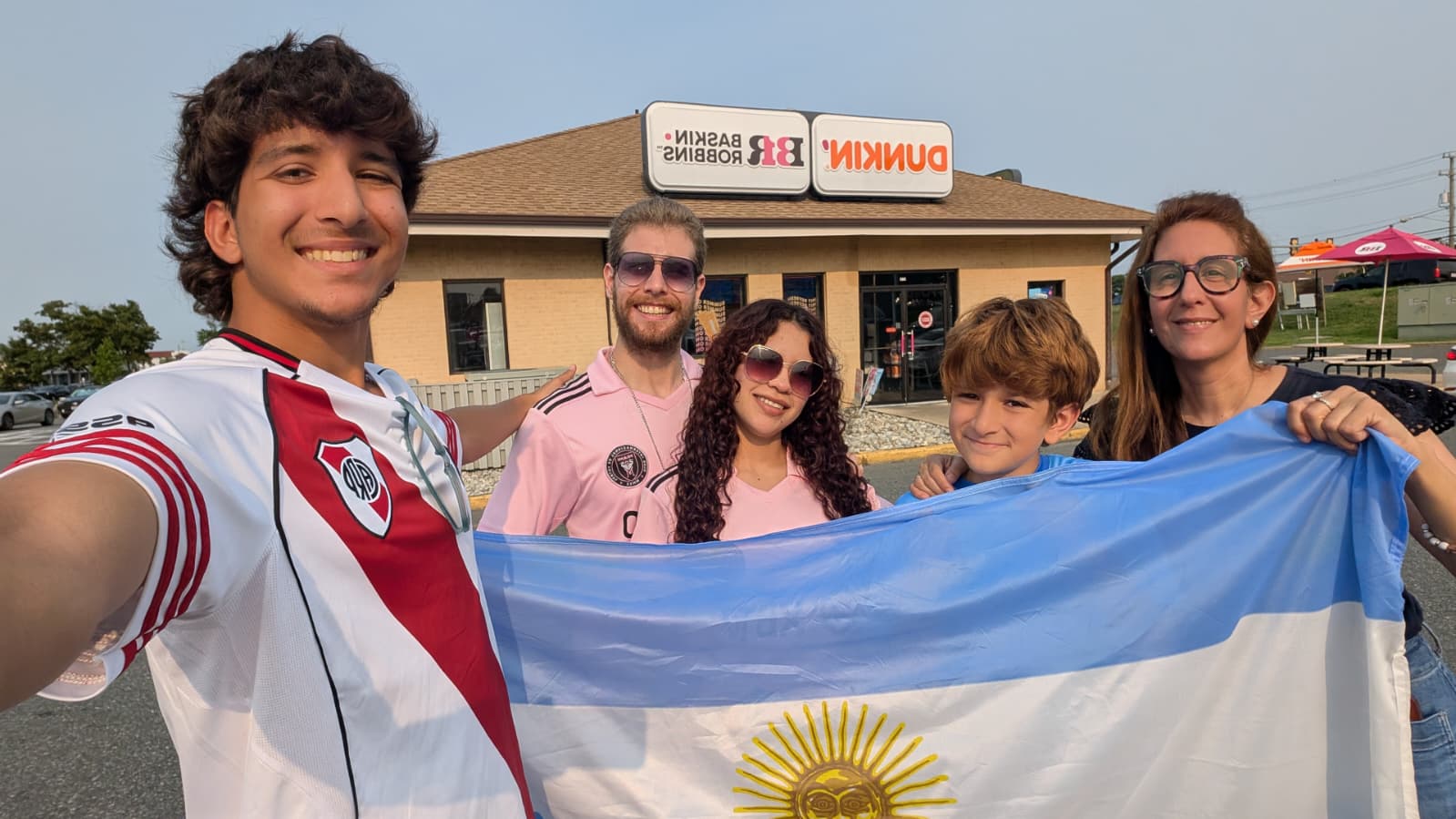
I had the privilege of travelling with an Argentinian family from Allentown to Atlanta on Wednesday, July 15th to be in the city for the semifinal game between England and Argentina. The city of Atlanta organized an area to watch the games in the Underground, a spacious multi-level public space surrounded by shops in the middle of downtown Atlanta. As an Argentinian, this reporter understands the history that transcends what many consider to be “just a game,” in the words of Argentina’s Coach Lionel Scaloni.
Argentina and England fought a war in 1982 over the illegal Argentinian occupation of the Islas Malvinas (Falkland Islands), as they are known in Argentina. Many Argentinians remember this as a time of great struggle, ruled by a military junta with no regard to human life, known for forcibly disappearing dissidents and kidnapping the babies of those who were forced in captivity in clandestine prisons on military bases. Thousands of young conscripts, many of them boys who had barely graduated high school, were shipped to these rocky outposts caught between Argentina’s continental shelf and the Southern Ocean. The war was lost after Prime Minister Margaret Thatcher sent a carrier group to liberate the islands, ushering in Argentina’s democratic government.
Following this failure by the junta government, the Mexico World Cup in 1986 was Argentina’s moment to debut on the international stage and reclaim their failed reputation. Led by Argentina’s number 10, Diego Maradona, Argentina fought their way to a Quarter Final against England, resulting in the infamous “Right-Hand of God” goal by Diego Maradona, and then a solo play by Diego Maradona starting on Argentina’s side of the pitch, which many experts consider to be the greatest play by a single player in football history. The game ended in a 2-1 victory by Argentina (also the final score for Wednesday’s game) who would go on to win the 1986 World Cup, and the second of their three stars above the AFA logo on Argentina’s jerseys.
It is difficult to truly capture the emotion of the moment that Argentina beat England on July 15th, the sentiments, the history, the grieving of loved ones lost, and the glory of a team that had so much to prove to the world as the then reigning World Champions. Argentina would go on to lose to Spain in the final on Sunday, July 19th after a one-sided match that resulted in a late 106’ goal by Spain to win the game 1-0 with Argentina down a player.
It is also impossible to ignore what many saw as an organized campaign to paint Argentina as a team that was tainted by corruption, favorability, and outright false accusations of racism. The claim that a nation constantly teetering on the brink of bankruptcy can afford to rig the world’s most popular sporting event could be seen as a stretch by many. Current FIFA president Gianni Infantino hails from the UEFA, the European football conference which many consider the only competitive rival to South America’s CONMEBOL. Then comes the accusation of “VARgentina,” that Argentina is constantly favored by officiating decisions.
I urge every critic to go back and watch all of Argentina’s games and carefully examine all of the fouls and infractions committed against Argentina’s players, particularly Lionel Messi, that were never called. The Argentina versus Austria game had plenty of infractions called against Argentina, resulting in a lackluster performance for Argentina’s second game of the group stages. A comment that keeps circling online is that, if Argentina truly influenced officiating in their favor, then this tournament was the equivalent of paying for dinner at a 5-star Michelin restaurant and having the servers slap and insult you while you tried to enjoy your expensive dinner.
Then comes the accusation that Argentinians are racist. Many Latin Americans seem to forget their own histories, their treatment of formerly enslaved Africans, the genocide of indigenous populations, seizing of lands from poor and marginalized communities, and what many see as an entrenched politically wealthy elite of predominantly European background that pull the levers of power in many Latin American countries; seemingly, at the expense of the majority of their populations.
Afro-Argentinians are recognized in the country’s war of independence against Spain, then an oppressive empire built by a hybrid system of class and race that permeated into everyday society in Latin America. Afro-Argentinians were granted rights long before African Americans gained any semblance of rights and power in the United States. Many aspects of Argentina’s culture, from the music, food, and linguistic variety, derives from the influence of Afro-Argentinians. Argentina’s founders recognized the value that Afro-Argentinians contributed to the idea of the nation of Argentina and ensured they would be eternally recognized for it.
Many Argentines find these comments to be misplaced, false, and outright envious. As Latin Americans, Argentinians happily cheer on teams from our hemisphere, whether its powerhouse rival Brazil, or Colombia, Mexico, and any team that represents our shared continent and bonds. Argentina is a proud country with a mixed history, once seen as the richest country on the continent a century ago, decades of misgovernment, corruption, emigration, and stagnation have had a damaging effect on Argentina’s reputation. A country that produced Jorge Luis Borges, Rene Favaloro, Diego Maradona, Leo Messi, Pope Francis, likely candidate for UN Secretary General Rafael Grossi, Carlos Gardel, Astor Piazzola, Maria Becerra, Lali Esposito, Mirtha Legrand, and so many prominent figures always finds itself at the crossroads between Europe and America. Argentina’s culture, history, and outsized influence on the global stage continues to produce moments of glory for its people and supporters, as well as a misplaced sense of envy among those whom Argentinians consider to be brothers and compatriots through our shared history and bonds. Don’t Cry for Me, Argentina!