


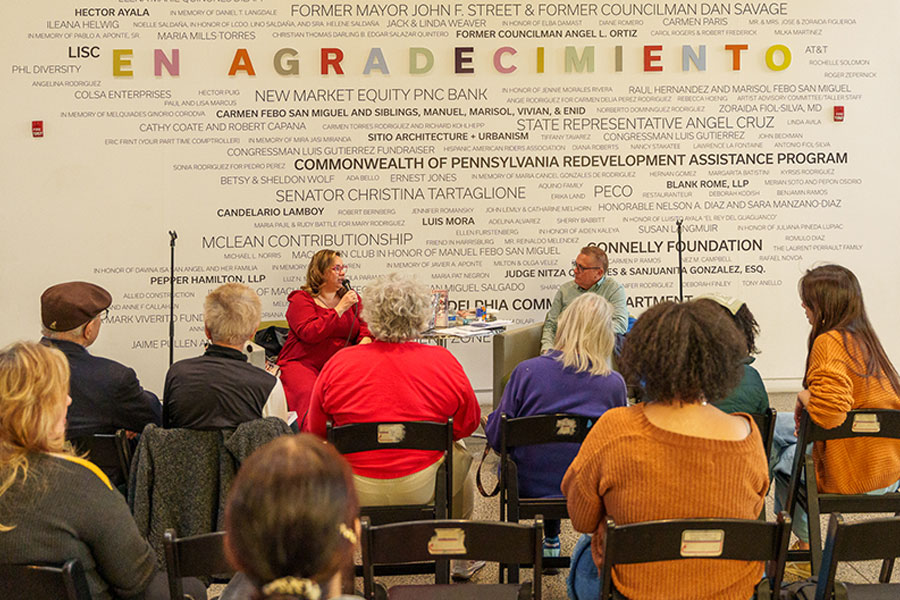
Philadelphia, PA — On Wednesday, May 13th, Taller Puertorriqueño hosted author Steve Howell in conversation with journalist and community organizer Vanessa Maria Graber for a discussion on Steve’s new book, Cold War Puerto Rico: Anti-Communism in Washington’s Caribbean Colony.

The book explores the history of FBI surveillance, political repression, anti-communism, and the Puerto Rican independence movement during the Cold War.
Inside Taller, the discussion became a community reflection on how Puerto Rico’s colonial status has been enforced, how parts of its political history have been left out of mainstream archives, and how that history continues to echo in the present.
Vanessa opened the discussion by situating the book within a broader resurgence of interest in Puerto Rican history. She spoke about the difficulty of recovering stories from Puerto Rican communities, including Philly Rican history.
“Most of the mainstream media didn’t have Latino journalists; they weren’t covering Latino communities,” Graber said. “They were invisibleized in the archives.”
That question of what gets documented and what gets erased shaped much of the evening.
Steve’s book begins with a personal connection. His father, Brandon Howell, lived and worked in Puerto Rico in the 1940s, where he produced political cartoons and became involved with leftist and labor circles. Steve said he grew up knowing that his father had lived in Puerto Rico, but it was not until later in life that he began to understand the depth of that history.
After his father became ill in 1987 and lost his speech, Steve found boxes of material in the family home. Inside were pamphlets, reports, political publications, and other documents connected to Puerto Rico’s labor and independence movements.
“It was a treasure trove of stuff from Puerto Rico,” Steve said.
Those family materials eventually led him to Freedom of Information Act requests and a deeper investigation into the way U.S. authorities monitored his father and others connected to Puerto Rican political movements. Steve said his father’s FBI file began with his political activities in Puerto Rico in 1941 and continued long after he had left the island.
The book also follows figures such as Puerto Rican author César Andreu Iglesias and Jane Speed de Andreu, who were arrested and imprisoned during the 1950s. Steve described them as part of a broader movement that faced surveillance, indictments, high bail, imprisonment, and political intimidation.
At the center of the discussion was Puerto Rico’s unresolved colonial status. In the 1940s, Puerto Rico became a major U.S. military outpost with the construction of naval facilities and bombing ranges. In 1952, the island adopted a new political arrangement that gave it a degree of self-government while leaving it as an unincorporated territory of the United States.
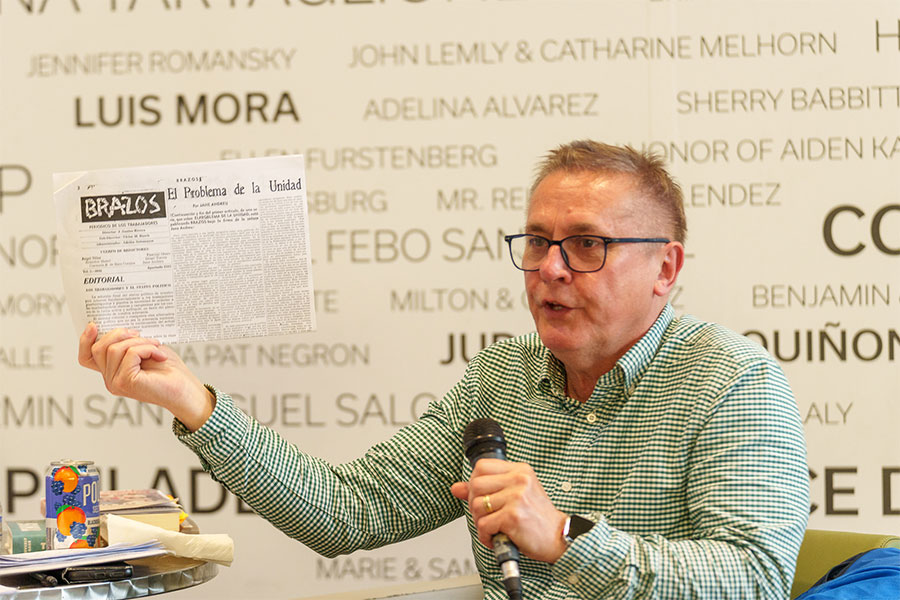
Steve argued that the limits of that autonomy became clear soon after. In 1954, the U.S. Department of Justice and the FBI began prosecuting leaders of the Puerto Rican Communist Party under the federal Smith Act. The law had not been adopted by Puerto Rico’s legislature, but it was still used against a Puerto Rican political party.
“You had the federal government, a federal agency, the FBI using a federal law in Puerto Rico to prosecute a Puerto Rican political party,” Steve said. “So, it made a nonsense of the idea of autonomy.”
The conversation also explored the Gag Law, known in Spanish as La Ley de la Mordaza, which was used in Puerto Rico to criminalize speech, symbols, and political activity associated with nationalism and independence. Older audience members in attendance connected the discussion to the history of carpetas, the government surveillance files kept on Puerto Ricans for their political beliefs, organizing, meetings, marches, and associations.
One speaker explained the concept plainly for younger people in the room: “It’s basically a file that the government has on you.”
That part of the discussion brought the history out of the book and into lived memory. Audience members shared stories about surveillance, intimidation, and the ongoing presence of government monitoring in Puerto Rican life. The conversation moved from Cold War history to more recent movements, including organizing against austerity, environmental destruction, university cuts, and support for Palestine.
Vanessa noted that these histories remain relevant because political repression did not belong only to the past. She connected the discussion to current struggles in Puerto Rico and to the importance of knowing history when public narratives try to portray independence as something foreign or outside Puerto Rican political life.
“The idea that nobody in Puerto Rico thought about independence, that you had to rely on activists from Cuba and Venezuela to come in and convince people that they should advocate for independence, is quite ridiculous,” Vanessa said.
Steve also spoke about the resilience of Puerto Rican movements. Despite surveillance and repression, many of the people targeted by the FBI were acquitted and helped revive the independence movement in later decades. He described a “great history of defiance” shaped by mass movements that have risen, declined, and returned again.
For Taller Puertorriqueño, the event placed that history in a community setting where the past could be discussed not as a distant academic subject, but as something connected to family memory, political identity, and the present-day struggle over Puerto Rico’s future.
By the end of the evening, the conversation made clear that Cold War Puerto Rico is not only about surveillance files or Cold War politics. It is about the stories those files tried to contain, the people who refused to be silenced, and the communities still working to remember them.