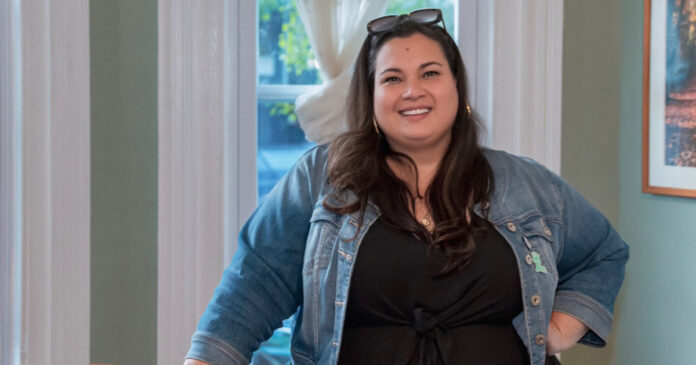
During onboarding on my first week in my new role, I met with EVP Rev. Danny Cortes. We had the opportunity to discuss the missional values of Esperanza and how it can be translated into a community newspaper like Impacto. Esperanza’s missional values of faith, integrity, and excellence are three values that are at the core of building opportunity community. These values guide us towards making the right choices and achieving our goals. In particular, excellence is a value that is often seen as the key to success. However, it is important to note that excellence is not a destination, but a never-ending journey.
Faith is the belief in something greater than oneself, whether that be a higher power or a shared vision for the community. When we have faith in something greater than ourselves, we are able to see beyond our own personal interests and work towards a common goal. This creates a sense of unity and purpose that can help to drive a community forward.
Then there is integrity, also a value that is essential in building an opportunity community. Integrity is the adherence to a set of moral principles and values, such as honesty, respect, and responsibility. When individuals act with integrity, they build trust and respect among their peers, creating a community where everyone feels safe and valued. This creates a sense of accountability and responsibility, where individuals are held to a high standard of behavior and are encouraged to act in the best interests of the community as a whole.
If you work hard and you are humble enough to understand that a higher power guides us, we have a chance to achieve higher levels of faith and integrity. Oh, but then there is excellence.
Excellence is the pursuit of greatness and the constant striving to do better. It is the desire to be the best that we can be, in whatever field you are in. It is the willingness to put in the hard work and dedication necessary to achieve your goals. Excellence, however is not just about achieving success; it is also about learning from failure and using it as a stepping stone towards greater achievements.
In the pursuit of excellence, we learn that there is always room for improvement. No matter how successful we become, there is always something that we can do better. There are always new skills to learn, new challenges to overcome, and new opportunities to explore. The pursuit of excellence requires a commitment to continuous learning and growth. It also means being willing to step outside of our comfort zone and take on new challenges that pushes us to grow and develop. We constantly seek out feedback and guidance from others. This means being open to constructive criticism and using it as an opportunity to improve.
So as I start this journey of community service with our collective commitment to integrity and faith, I realize that excellence is something I will must certainly strive for. Excellence is often seen as the key to success, but I understand that excellence is not a destination, instead it is a wonderful never ending journey. The pursuit of excellence requires a commitment to continuous learning and growth, a willingness to set high standards for us, and a dedication to seeking feedback and guidance from others. By embracing these values and committing to the pursuit of excellence, we can achieve our goals and create a life that is fulfilling and meaningful…and in turn a chance to build an opportunity community.
Creativa Event Planner, ofrece sus servicios profesionales y adecuados a su presupuesto en toda el área metropolitana de Filadelfia. Norma Romero. (Foto: Staff de Impacto)
Norma Romero representa la fuerza y tenacidad de las mujeres migrantes, que lejos de conformarse, decidieron cruzar fronteras para ir en busca de realizar los sueños de una vida mejor para ellas y para sus familias.
El número de las mujeres que migran específicamente del vecino del sur, según datos del consulado mexicano, ha venido en aumento. Después de muchas décadas donde los inmigrantes eran en su mayoría varones que venían a trabajar.
Otro dato interesante es que las mujeres latinas se destacan en Pensilvania, por la gran cantidad de negocios que abren, y en especial durante la pandemia, proliferaron.
Norma es una joven madre independiente, de dos pequeños, Santiago y Julieta. Además de ser una embajadora de la cultura mexicana ya que es una talentosa bailarina folclórica, se ha dedicado por muchos años a embellecer principalmente a otras mujeres durante momentos especiales, ya que, al mismo tiempo de trabajar como estilista en una estética, también ofrece sus servicios de peinado y maquillaje para eventos especiales.
Norma es bien conocida en el condado de Montgomery, por el profesionalismo en su trabajo, pero también porque está dispuesta a ayudar en lo que puede; ella siempre da la milla extra.
De hecho, es una de las voluntarias de CCATE, donde es muy querida por ser una gran amiga de la comunidad en general.
Esta talentosa madre mexicana, quien emigró del Estado de México cuando era una adolescente, también se ha venido dedicando a decorar eventos, desde las fiestas más modestas, hasta grandes y elegantes celebraciones de matrimonios, y quinceañeras.
Poco a poco su clientela se ha ido ampliando, y su éxito ha sido tal, a pesar de los múltiples trabajos que sortea cotidianamente, recientemente abrió con mucha ilusión su propio local, donde por fin puede almacenar todo el material necesario para cumplir con los deseos temáticos de sus clientes.
Creativa Event Planner, en el corazón de Montgomery, solía solo promocionarse en redes sociales, pero ahora está disponible y con más servicios que ofrecer. Planeación y operación de eventos sociales, show de entretenimiento, payasos, y otros servicios para fiestas infantiles, artículos para fiestas en general, fotografía y video, servicio de catering, y deliciosos y artísticos pasteles. Además, por supuesto, de sus reconocidos servicios de maquillaje, peinado.
La polifacética y “luchona” Norma, es un ejemplo de las madres migrantes que vienen a este país a aportar. Felicidades a todas las normas del mundo.
Si quieres compartir una historia como la de Norma Romero, escríbenos a redaccion@44.218.246.32
Creativa Event Planner abierto de lunes a sábado de 10 am a 8 pm. Y los domingos de 10 a 5:00 pm. Se encuentra en el 108 E. Main St. Norristown PA. 19401. Para contactar a Norma puedes escribirle a creativaeventplanners
Quetcy Lozada, tiene una larga trayectoria en el servicio a la comunidad, ha estado dedicada al servicio público, con un genuino amor a la comunidad.
I was born in the Fourth and Berks Streets area, where my grandmother lived. When I was around six, my family moved to the Hunting Park Community. I understand the joys and challenges of living in the 7th District because that is where I was born and raised. QL
Quetcy nació y creció en el barrio que actualmente ya representa. El Consejo de Organizaciones de Habla Hispana (Concilio) fue uno de los primeros lugares donde trabajó y aprendió sobre el servicio a la comunidad. “Mi pasión creció al ayudar a otros cuando comencé a comprender las necesidades de nuestros vecindarios… Estamos dispuestos a trabajar unos con otros si se nos dan las herramientas adecuadas… comprometiéndonos con los demás. Somos resilientes y siempre dispuestos a echar una mano. Esta es una comunidad de la que estoy orgullosa y me apasiona servir”. Expresa Quetcy.
Well, service to the community is who I am. My family believes in uplifting our community, and my father was a Deacon for 41 years. Growing up, my house was always open to others for conversation, counseling, or a warm plate of food.
As a child, sometimes, the lack of privacy bothered me, but as I matured, I realized the need to have people around for even a few kind words, and thus I became attracted to the idea of service to others.
Graduada de la Universidad La Salle, obtuvo una licenciatura en Administración de Empresas; y se graduó “Cum Laude” en la Universidad Lincoln, en el programa de maestría en Administración de Recursos Humanos, en 2019.
La boricua es uno de los rostros detrás del aumento del voto latino en la ciudad, pues dentro de sus múltiples empeños por mejorar a la comunidad latina, está su trabajo para promover el voto y la participación cívica.
Our community is a community of compassion. We are willing to work with one another if given the appropriate tools. We accept many things and compromise with others. We are resilient and always willing to lend a hand. This is a community that I am proud of and passionate about serving.
“La comunidad latina no vota porque no invierten en ella. Primero hay que invertir, para ganar la confianza del electorado y voten, y después, hay que mostrarles respeto como pueblo”. QL
Cobijada por muchas alianzas, Quetcy representa al distrito 7, que incluye partes de la ciudad que han sido el epicentro de la epidemia de opiáceos. Con 54% de latinos, y un 35% de otras minorías.
Latino elected leaders at all levels of government are collaborating to secure more funds for the Kensington community. I am involved with these bipartisan efforts to bring more funds to Kensington and provide the needed services and beds. The municipality has unsuccessfully tried to bring solutions to the Kensington community, but the concerns remain the same.
El Distrito 7 del Concejo del Norte de Filadelfia enfrenta desafíos únicos, con una alta tasa de pobreza, y violencia, y más recientemente, de gentrificación, que Quetcy Lozada conoce bien.
Gun violence is a serious and painful issue in our District. There are too many guns. Hunting Park has some of the highest numbers of illegal weapons, and what will we do about that? I believe that enforcement is necessary. Although in recent times, we have experienced community sensitivities around enforcement, it remains crucial in solving the issue of gun violence.
Tiene un amplio conocimiento de la comunidad a la que sirve, y ha crecido en el barrio, cuenta también con el apoyo de otros agentes sociales, funcionarios y servidores públicos. Quetcy sabe la importancia de reunir esfuerzos a la mesa. “Estoy muy emocionada de haber recibido el respaldo del Comité Municipal del Partido Demócrata para las elecciones primarias de mayo, y especialmente agradecida de que haya sido unánime”.
We need innovative programs to teach children and youth how to redistribute their energy, communication skills, and conflict resolution. Respect for ourselves, our parents, and our communities.
La crisis de los opiáceos ha sido una de sus principales prioridades, por lo que presentó una resolución para pedir a la Asamblea General de Pensilvania agregara la xilazina, también conocida como «tranq», a la lista de sustancias controladas en Pensilvania.
If elected, I will provide more funds for programs that can engage children at young ages, so we can have a much better chance to help our youth find other ways for children and youth.
La servidora pública es enfática en que se debe monitorear e investigar con urgencia para que se pueda cumplir con el deber de proteger a la población de los muchos daños asociados con las peligrosas drogas callejeras. “Entendiendo cuán serio es esto, también aprobé por unanimidad una resolución que pide que el Comité de Seguridad Pública celebre audiencias públicas para examinar el mercado de drogas al aire libre y otras barreras a las calles limpias, seguras y libres de delitos en Kensington”.
I listen to community members and have been their voice for many years. I have proven that I am not afraid to speak up or work hard, even when things get tough, I continue to show up. I understand the challenges of the residents of the 7th District because I live here, and I am raising a family here.
Quetcy trabaja para ganarse la confianza de la gente todos los días, mostrándoles lo que pueden hacer. “Entiendo la importancia de las relaciones y el respeto incluso cuando como líderes no estamos de acuerdo. He trabajado durante años para ganarme la confianza de mi comunidad permaneciendo «presente» no solo de manera constante, sino especialmente cuando las cosas se ponen difíciles”.
In this election, I lead with my dedication to my community, the compassion to serve, and the hands-on experience, I will employ as the Councilperson for the 7th District in Philadelphia, Pennsylvania.
Ceiba fue uno de los organizadores del Foro Latino “Filadelfia Decide” en Esperanza, el pasado 10 de abril.
Este próximo martes 16 de mayo son las elecciones primarias. Esta es ya considerada la carrera hacia la alcaldía, más cara en la historia de Filadelfia.
En 2015, las primarias demócratas ganadas por Jim Kenney costaron $29 millones. En ese momento, según los cálculos publicados por WHYY, fue la elección más cara en la historia de la ciudad grande más pobre de los EE. UU.
Con $31 millones ya gastados a finales de abril, la carrera por la alcaldía de este año supera ese récord.
Según un análisis de Inquirer, Domb ha gastado más (10,8 millones de dólares), seguido de Brown (5,6 millones de dólares + 2,8 millones de dólares de los PAC). El gasto de Rhynhart fue de $ 2,6 millones, mientras que el de Gym fue de $ 2,1 millones más otro millón de PAC. Parker ha gastado menos: 1,4 millones de dólares directamente y 1,1 millones de apoyo a los PAC.
Los candidatos hacen sus últimas concentraciones, los generadores de opinión hacen públicas sus preferencias y los grupos políticos se reúnen, se alinean, y salen resueltos a ofrecer su apoyo a un único candidato, pero a veces, los votantes se dispersan votando por múltiples opciones, diluyendo así la posibilidad de ganar el músculo político que surge del votar en grupo y unidos.
A ese escenario se suma uno menos deseable, los potenciales votantes no salen a cumplir su responsabilidad cívica de escoger al candidato de su preferencia. Algo que todavía afecta a las comunidades latinas, ya que los pocos candidatos que se esfuerzan por conseguir su voto, y que se comprometen a sus demandas, a menudo no tienen la certeza de si saldrán o no a votar.
En la medida en que los latinos vengan persuadidos y todas las partes reconozcan su importancia reflejada en el censo, el voto de los diversos grupos latinos conquistará su valor potencial.
Muchos vecindarios de Filadelfia se han latinizado a ritmo rápido, sin embargo, sus cuadros políticos todavía no reflejan a los constituyentes del territorio, ya sea porque no se inscriben en el registro de votantes, o porque no participan en los comités de sus partidos.
Las múltiples organizaciones hispanas de la ciudad han venido trabajando en orientar sobre el proceso de inscripción; de dónde corresponde votar y, sobre todo, en el caso de Impacto, también de informar cuáles son las ideas detrás de los candidatos, para incentivar una elección informada. Sin embargo, aún falta información electoral dirigida a los problemas que enfrentan nuestras comunidades y en su propio idioma.
A pesar de que muchos activistas se han movilizado para sumar votantes al registro y de que se sigue galvanizando al electorado latino, un reporte del PEW Hispanic Center aún estima que en ciertos vecindarios hispanos el promedio de los que salen a votar a veces no supera ni el 4%, lo cual es un pésimo augurio para las esperanzas de los líderes latinos.
Por eso, es un deber moral y no solo cívico, salir el día de las elecciones, con el orgullo de no haber dejado que otros decidan por ti.
En su libro de reciente publicación “Generación idiota”, el politólogo argentino Agustín Laje critica fuertemente esta deriva social posmoderna que lleva al hombre a querer pasarse la vida “mirando su propio ombligo”. Para los griegos, el término “idiota” significa el hombre que no participa en las decisiones de la poli, en los destinos y el futuro de su ciudad o su país; o porque es perezoso intelectual, o porque es pobre de medios y de espíritu, o simplemente porque a su pasmada inteligencia no le importa que otros decidan por él. Salgamos, pues, de la indiferencia y la contemplación, y que no entremos en esta clasificación. Si podemos hacer la diferencia en estas elecciones, y hacer que valga la pena su enorme costo, vayamos a ejercer el privilegio y el deber de votar.
The home of Neftali Ramos in Norris Square hosted a diverse, standing-room-only crowd buzzing with enthusiasm waiting for the arrival of Cherelle Parker, leading Democratic Mayoral candidate. Cherelle Parker, who is looking to succeed Mayor Jim Kenney, who is term-limited after serving eight years. The Sunday afternoon «meet and greet» was an intimate, relaxed affair, where the hard-working candidate, who is fighting for every vote, took off her high heel shoes and slipped into her more comfortable flat shoes. The relaxed atmosphere was a great opportunity to get to know the candidate without a filter. The Sunday afternoon meet and greet was about Parker, who can become the first woman and woman of color elected mayor of Philadelphia. When one asked her about the Black and Latino political alliances that had Latinos as the swing vote, she stated that Latinos were not a swing vote, but part of the overall vote that will get her elected.
But the afternoon also belonged to other new political partners: City Councilperson Quetcy Lozada, who is fending off a challenge from a neophyte candidate, Andres Celin, a modern-day radical who lacks the experience and has not endured the life of generations of Latinos that came before him. In attendance was City Council’s 7th District, longtime 19th Democratic Ward Leader, Carlos Matos, John Scott, former 18th Ward Democratic Ward Leader John Scott, and Nayda R. Cintron, founder/former Executive Director of the storied Norris Square Civic Association.
Ramos, of Puerto Rican descent, is the first political director of a significant Philadelphia mayoral campaign, said, «My family was overwhelmed by the support of so many young and older political activists; the attendees looked like Philadelphia –Latino, Black, White, Asian, and LGBTQ.»
«While the media are consistently telling Latinos that their participation in the political process is significantly lower than that of other ethnic groups in Philadelphia and the nation. “This behavior can be attributed to elected officials’ lack of involvement with this growing community”, said Matos. For her part, Cintron added, «Cherelle Parker’s campaign strategy of frequent visits to Latino and other neighborhoods, could create a rainbow alliance of African Americans, Latinos, Asians, Labor, LBGTQ, and others of diverse political ideologies”.
This story is a part of Every Voice, Every Vote, a collaborative project managed by The Lenfest Institute for Journalism. Lead support is provided by the William Penn Foundation with additional funding from The Lenfest Institute, Peter and Judy Leone, the John S. and James L. Knight Foundation, Harriet and Larry Weiss, and the Wyncote Foundation, among others. Learn more about the project and view a full list of supporters here.
Erika Almirón, running for election for an At-Large seat of the Philadelphia City Council in Pennsylvania.
Erika Almirón (Democratic Party) is running for election for an at-large seat of the Philadelphia City Council in Pennsylvania. Almirón is on the ballot in the Democratic primary on May 16, 2023. Here is her story and her agenda in her own words.
I am the daughter of Latino immigrants from Paraguay and was born and raised in Philly. I have spent over 20 years defending the rights of workers, students, women, immigrants and the poor and leading them to fight for our rights.
I am the oldest of four in my family and know intimately well what it means to be the student and the translator in a family when a school district is not prepared to support the parents of their students. I know what it means to have to be the first in your family to go to college and how there are very little opportunities and support for first generation young people to get to higher education.
In college, I worked as a waitress. One day the manager handed out paychecks without our hourly pay. Guided by the values of my family, I organized everyone. We walked off the job and the next day, we all got paid. I found my voice as a community organizer for social and economic justice.
After college I worked at Planned Parenthood as a counselor and translator, helping women access healthcare and services and then worked with the American Friends Service Committee supporting women organizing in the factories at the US/Mexico border.
When I was the assistant director at the Philadelphia Student Union, I supported and mentored dozens of brilliant young people who were organizing to make their schools safer without relying on suspensions and arrests. I saw the difference a teacher or a principal can make, someone in power who understands you and is willing to work with you and support you.
For almost nine years, as the Executive Director of Juntos, I worked alongside some of the most courageous Latino families in Philly, many of whom remind me of my very own family. Together these families and I worked to build a movement of leaders poised to fight back against the criminalization of Latinos and migrants and one that fights to keep our families together. It was through that work that I saw how a mayor, a governor, a president, or a city council can keep a family together or rip them apart, can help free women and their children from detention centers or leave them to suffer, can force people into the shadows or welcome them into the light.
All this experience has prepared me in my leadership to fight as a city councilperson. I have learned how to build strong coalitions, write policies, and pass policies. Under my leadership at Juntos we pushed to pass the most progressive sanctuary city policies in the country in 2014 and in 2018 pushed to pass those policies to stop criminalizing our community.
If I were to win, I would be the first Latina to ever win a seat as an at-large council person in the history of Philadelphia. Our city now is almost 20% Latino and we have only historically had one seat at the table for city council ever. That seems like an injustice to me in fair representation. We need leaders in our city who understand what our families are going through, who understand the need for things like language access and addressing issues like poverty and public safety.
If elected to office I would prioritize public safety given the rise in gun violence since the pandemic, this would include focusing on policing reforms that work and investing in violence prevention programs that have shown success and are tailored to each community’s needs. I would also work under the umbrella of public safety and services in improving our crisis response in the city.
Our emergency response department needs support to expand their staff, improve their salary and expand our crisis response to be diverse to the needs of the people. I would like to improve response times and work to expand crisis response for mental health issues.
I will fight for policies that bring more funding to our schools and will hold the school board and superintendent accountable during the budget approval process and throughout the year and to push for more support for our children and youth, like counselors, nurses, bilingual education, culturally competent curriculum, and social workers instead of school police.
Me winning a city council seat will, one, allow people to see themselves reflected inside the halls of power and two, will allow us to fight for our families harder for what we need when they know their opinions and visions are valued inside. These policy changes they help me to push will create the opportunities we all desperately need. And when I win, I will be the first Latina to ever win city council at-large in the history of this city.
My parents worked non-stop since their arrival in the U.S. until they recently retired. Many times, they worked for little pay in exploitative conditions until they started their own business, first they opened a shoe repair and then they started their own cleaning business. They taught me the value of putting in hard work and dedication to achieve your goals.
My father started out as a dishwasher in a NY restaurant and my mother has been a domestic worker most of her life. They have taught me that all work and labor is valuable and to survive, you must be willing to do the hard work and do it with integrity. I bring that energy and love to work with me every day. I bring that passion and dedication to my fights for the people every day. And when I fight for our communities, they, my parents, are always at the forefront of my mind. I fight for families just like mine because when I was younger, we deserved people to be fighting for us too.
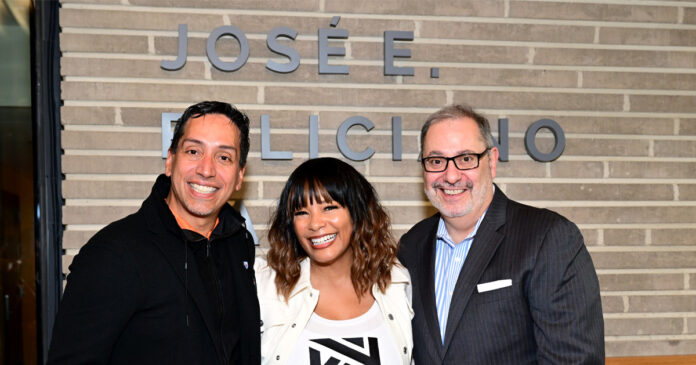
Kwanza Jones, José E. Feliciano and Rev. Luis Cortés at the dedication of Kwanza Jones Hall & José E. Feliciano Hall at Princeton University on May 05, 2023, in Princeton, New Jersey. (Photo: By Lisa Lake/Getty Images for the Kwanza Jones & José E. Feliciano Initiative)
Kwanza Jones and José E. Feliciano have made a major gift to Princeton University, a $20 million contribution that is the largest gift to date by Black and Latino donors, and one of a few extraordinary alumni commitments to the University’s strategic goal of undergraduate expansion.
“Kwanza and José bring strong values and deep dedication to their philanthropy as well as their work as volunteer leaders on behalf of the University, and I am deeply grateful for their extraordinary commitment to Princeton,” at the announcement said President Christopher L. Eisgruber ’83.
The dedication took place on May 5, with these new undergraduate dormitories, the capacity is increased by approximately 10%. The addition of approximately 500 undergraduate students will allow the University to admit more students from racialized communities.
Kwanza and I are committed not only to continuing Princeton’s tradition of excellence in academia but also in making sure that we can make that available to more deserving students who represent a cross section of our society,” Feliciano said. “We both have the privilege of being Princeton graduates, thanks to the many sacrifices of our parents who recognized the value of education. We recognize that our Princeton education and network have had a fundamental impact on our career path and success. As such, we hope that our gift can be used to continue providing access to education and opportunity to many others, and we hope to inspire other alumni, including alumni of color, to give and be even more active stakeholders of the Princeton community.”
“Through KJSI, we are committed to powering possibilities and boosting humanity and its future,” Feliciano said. “As Cesar Chavez said, ‘We cannot seek achievement for ourselves and forget about progress and prosperity for our community … Our ambitions must be broad enough to include the aspirations and needs of others, for their sake and for our own.’ This is particularly important now when minority communities are threatened by the combination of a health crisis as well as persistent economic and social inequities. Kwanza and I are determined to do our part.
“We are especially encouraged by the recent announcement by President Eisgruber and the University to continue making Princeton a more inclusive destination to all deserving students, including the commitment to collect data and report on the University’s progress in an annual Diversity, Equity, and Inclusion report,” he added. “We look forward to even more progress in the years ahead.”
The Kwanza Jones & José E. Feliciano Initiative (Jones Feliciano) is a high-impact philanthropic grantmaking and investment organization and family office founded by Kwanza Jones and José E. Feliciano. They have one bold goal “to Power Possibilities for Humanity and its Future”, by investing in both nonprofits and for-profit ventures that are compatible with their goal and make a lasting impact across four key priorities: Education, Entrepreneurship, Equity and Empowerment.
*Jose E. Feliciano cofounded Clearlake Capital in 2006 with Behdad Eghbali; both men are managing partners. The private equity firm is based in Santa Monica, California.
Clearlake Capital says it oversees more than $70 billion in assets under management; it has scored some of the industry’s best returns.
In May 2022, Clearlake Capital joined billionaire investor Todd Boehly to buy English soccer team Chelsea FC; the firm is known for buying software, industrial and consumer products companies.
Feliciano worked in investment banking at Goldman Sachs and was the chief financial officer of govWorks before it declared bankruptcy in 2000.
Feliciano, who was born in Puerto Rico, is on the board of trustees of Stanford University and the Smithsonian National Museum of the American Latino.
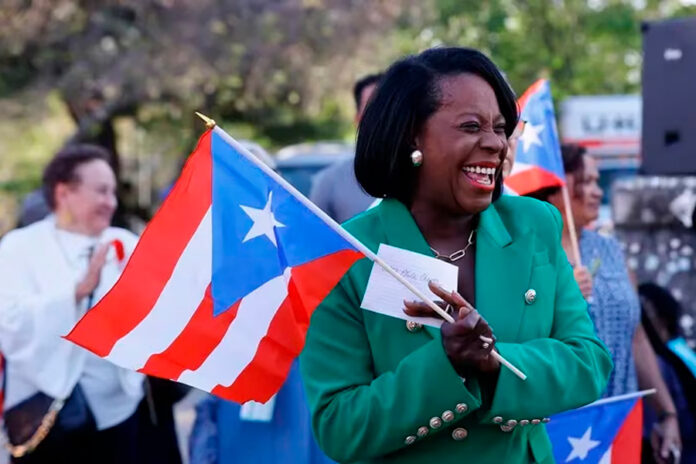
Democratic mayoral candidate Cherelle Parker claps during the Latinos for Cherelle rally at Norris Square Park on April 13. (Photo: Yong Kim/Inquirer staff)
Cherelle Parker, la exconcejala de la ciudad de Filadelfia por dos mandatos, representando al noroeste de Filadelfia, se postuló para alcalde de Filadelfia, y obtuvo los respaldos de dos de sus excolegas, y excompetidores, Derek Green y Maria Quiñones Sánchez. Y también el sostén de varios grupos de latinos prominentes.
El 7 de septiembre, Cherelle Parker se convirtió en la tercera candidata en anunciar su campaña para convertirse en la alcaldesa número 100 de Filadelfia, luego del mandato de ocho años de Jim Kenney, quien esta semana reveló que voto por ella.
La concejal de la ciudad representó al noveno distrito de la ciudad, que consta de los vecindarios noroeste y noreste de Mount Airy (donde residen Parker y su familia), West Oak Lane, East Oak Lane, Olney, Lawncrest, Lawndale, Burholme y Oxford Circle. Fue líder de la mayoría del Concejo Municipal.
A los 17 años, Parker comenzó un período de 15 años trabajando para la concejal de la ciudad de Filadelfia, Marian B. Tasco. Más tarde se convirtió en la mujer afroamericana más joven elegida para la Cámara de Representantes de Pensilvania, donde sirvió 10 años.
Como miembro del Consejo, Parker se desempeñó como presidente del Comité de Trabajo y Servicio Civil y vicepresidente del Comité de Comercio y Desarrollo Económico. Convirtiéndose en la primera mujer en presidir la junta directiva de la Autoridad Portuaria del Río Delaware.
Parker ha dicho que su misión como funcionaria pública, es “cerrar la brecha entre los que tienen y los que no tienen”. Dice que sus prioridades como alcaldesa serían la seguridad, el empleo y los servicios de la ciudad.
Cherelle Parker se asoció con el Community College of Philadelphia, para establecer el programa de capacitación para pequeñas empresas, Power Up Your Business.
Ella y el presidente del consejo, Darrell Clarke, quien también le dio su respaldo, desarrollaron Restore, Repair, Renew para ayudar a los propietarios a acceder a préstamos para mejoras del hogar a bajo interés.
Mediante la creación de un proyecto de ley que les exige completar un Formulario de información del proyecto para informar a los vecinos sobre los impactos ambientales, quiere salvaguardar los derechos de los vecinos de los frecuentes intereses de particulares que suelen aplazar a los del interés común.
Parker ha estado en contra del impuesto a los refrescos/sodas, por el gravamen para los pequeños negocios de las comunidades racializadas.
In March of 2016, Luz Colón was named by Governor Tom Wolf as the Executive Director of the Governor’s Advisory Commission for Latino Affairs (GACLA). (Photo: Credit/Impacto Staff
Her campaign priorities include improving public safety, promoting economic opportunity, and investing in quality public education.
Luz B. Colón has epitomized integrity, hard work, and passion for community service during her 25-year career working in various roles for the City of Philadelphia and the Commonwealth of Pennsylvania.
Luz grew up in the Kensington section of North Philadelphia, the very same community where she continues to live and serve today. She is the single mother of two boys, Joseph, and Sebastian, who are her biggest supporters and motivators to help make the city a safer place for all Philadelphians.
Luz started her career working in City Hall in the offices of former At-Large Councilman Angel Ortiz, Councilman Blondell Reynolds-Brown, and Councilman Bill Greenlee. She continued her career in public service under Governor Tom Wolf as the Executive Director of Pennsylvania’s Latino commission, GACLA, where she was responsible for serving Latino communities in all 67 counties across the Commonwealth of Pennsylvania.
Her experience working inside the walls of city and state government, while remaining deeply rooted in Philadelphia’s multicultural community uniquely sets Luz apart from other candidates. Luz embodies and actively demonstrates her belief that the role of government, and all its public servants, is to listen to the community and work with integrity for the good of the people.
PUBLIC SAFETY
Polls show that Philadelphians no longer feel safe. We love our city and know our potential, but public safety continues to cripple our neighborhoods.
As City Councilwoman, Luz has placed public safety as a top priority. She is prepared and equipped to work with communities and city agencies to have honest conversations and create actionable goals to prioritize the safety of all Philadelphians.
ECONOMIC OPPORTUNITY
Philadelphia is a world-class city that continues to grow in opportunity. As City Councilwoman, Luz will be committed to partnering with businesses, banks/FIDCs and federal agencies to ensure resources are accessible and equitable for all.
Investing in our city through smart policies, such as the infrastructure bill, will enable Philadelphia to flourish as one of the country’s top destinations to live, work, and raise a family.
SCHOOLS THAT TEACH
Investing in education is the best way to ensure children are given a bright hope for a future. As we raise these future generations, it is our responsibility to provide them with the essential tools to become educated, passionate leaders who will support our communities in countless ways. But our schools are hurting. Since COVID, students, teachers and parents have dealt with tremendous trials and tribulations, which need the attention of City Council leaders.
Among Luz’s top campaign priorities is investing in programs and policies that support the infrastructure of sustainable, world-class education in Philadelphia.
POLITICAL EXPERIENCE
Luz Colón has extensive experience working in city and state government where her priorities have always been focused on integrity, leadership, and a passion for public service. Colon previously served as a staff member in the offices of former At-Large Councilman Angel Ortiz, Councilwoman Blondell Reynolds-Brown and Councilman Bill Greenlee, where she experienced first-hand the commitment and dedication it takes to serve the city of Philadelphia.
CIVIC SERVICE
Luz Colón dedicated 15 years as a committee person for the 20th Ward and 10th Division in the City of Philadelphia where she helped facilitate elections, and voter registration and education errors. She sits on the Philadelphia Fight Advisory Board, the largest HIV AIDS comprehensive medical care organization in the Philadelphia area, the Asociacion Puertorriqueños en Marcha, Inc. (APM) Board and co-founded La Liga del Barrio, Philly’s 1st Latino Youth Basketball League.
This is a part of Every Voice, Every Vote, a collaborative project managed by The Lenfest Institute for Journalism. Lead support is provided by the William Penn Foundation with additional funding from The Lenfest Institute, Peter and Judy Leone, the John S. and James L. Knight Foundation, Harriet and Larry Weiss, and the Wyncote Foundation, among others. To learn more about the project and view a full list of supporters, visit www.everyvoice-everyvote.org. Editorial content is created independently of the project’s donors.
El Recinto de Río Piedras de la UPR es el más grande y antiguo de Puerto Rico y el Caribe. (Foto: VOA)
Jóvenes caribeños y suramericanos viajan hasta la isla para conseguir diplomas válidos en EE. UU., pero en el contexto latino que ofrece Puerto Rico.
En la búsqueda de “un mejor futuro” llegó a Puerto Rico el joven dominicano Eudy Ledesma. El calor caribeño y latino y la cercanía con su tierra natal fueron la fórmula perfecta para que este estudiante latinoamericano se viera atraído por el vínculo de la universidad con EE. UU. Como él, cientos de jóvenes llegan cada año con esta meta.
“Se me presentó la oportunidad de estar cerca de mi familia para cualquier momento que quiera visitar, y si el programa que tiene la universidad es validado igual que uno de EE. UU., ¿por qué no hacerlo?”, dijo a la Voz de América Ledesma, quien cursa estudios en ciencias del ejercicio en la Universidad del Sagrado Corazón, en San Juan. “Como República Dominicana y Puerto Rico se parecen, no tuve un choque cultural”, agregó.
Ledesma comenzó clases y se unió al equipo de tenis de campo de la universidad, un deporte que practicaba profesionalmente en RD.
“Pienso que lamentablemente en mi país no voy a poder evolucionar tanto como podría aquí”, apuntó Ledesma, al asegurar que su intención es quedarse en PR una vez termine sus estudios y abrir su propia academia de tenis.
Estudiantes extranjeros llegan a la isla en búsqueda de educación con raíces latinas. (Foto: VOA)
Anuchka Ramos Ruiz, vicepresidenta de asuntos académicos de Sagrado, dijo a la VOA que además de RD, la universidad recibe estudiantes de Cuba, México, Colombia y España, entre otros. Por otro lado, apuntó que la facultad está preparada para recibir a estudiantes internacionales “desde la empatía, la emoción y el manejo de la interculturalidad».
Los estudiantes internacionales desde que llegan son acompañados a través de “experiencias extracurriculares, giras a través de la isla, acompañamiento a hacer las tareas básicas del día a día en la isla, charlas que les permiten conocer nuestros contextos socioeconómicos, culturales y diversidad”, agregó Ramos Ruiz.
Al oeste encuentra el Recinto de Mayagüez, de la Universidad de Puerto Rico (UPR), el centro con la mayor cantidad de estudiantes internacionales entre las 11 sedes del sistema universitario. Hasta allí llegó para estudiar su maestría Kevin Silva, un colombiano de 21 años graduado de matemáticas en Cartagena.
Silva contó a VOA que llegó a la UPR —la única universidad pública de la isla— por recomendación de un profesor en Colombia, quien lo impulsó a solicitar una beca para el programa de matemáticas aplicadas.
El clima, comida e idioma son algunos de los elementos más atractivos en Puerto Rico. (Foto: VOA)
“La conexión que tiene la universidad con instituciones estadounidenses, teniendo en cuenta que PR es un territorio de EE. UU., me pareció positivo”, dijo.
En la administración central de la UPR ven este intercambio cultural como uno importante para que “reconozcan que es una universidad de calidad mundial, que puede ser una institución accesible a ellos”, dijo Edwin Vega, vicepresidente asociado de asuntos estudiantiles.
Influenciado por la experiencia de Silva, a quien conoció en Cartagena, el joven Emigdio Ramos, también decidió viajar desde Colombia hasta Puerto Rico para estudiar en el recinto de Mayagüez.
“La motivación fue netamente educativa”, dijo a la VOA a un día de su llegada a la isla, donde espera aprobar sus clases de maestría y experimentar un intercambio cultural que le permita “establecer alianzas” en diferentes países.
“A los estudiantes latinoamericanos, sobre todo los colombianos, venezolanos, peruanos, ecuatorianos, les encanta. Ellos se sienten como en su casa, se sienten muy acogidos por el puertorriqueño, tanto en el contexto académico de la universidad como a nivel personal”, agregó Luis Irizarry, decano auxiliar de asuntos internacionales del Recinto de Río Piedras, ubicado en San Juan.
La mayoría de los estudiantes internacionales en la institución pertenecen a programas graduados de maestría o doctorado, enfocados en áreas de ciencia, tecnología, ingeniería y matemática.
La UPR Mayagüez, en el primer semestre del año académico del 2022-2023, alcanzó 274 estudiantes internacionales provenientes Colombia, Costa Rica, RD, Ecuador, Haití, Honduras, México, Perú y Venezuela, entre otros, según informó la administración de la universidad.
Universidad de Puerto Rico Recinto de Mayaguez (Foto: VOA)
Mientras que la UPR en Río Piedras, en el mismo semestre, tuvo 148 estudiantes internacionales, entre ellos, 48 colombianos, ocho haitianos, tres hondureños y dos venezolanos.
En la medida en que nuestros cursos son en español, pero también en inglés, el estudiante tiene la posibilidad de navegar ambos idiomas y es muy propio de la cultura y de la idiosincrasia puertorriqueña. Así que hay un valor, hay una particularidad en estudiar en PR”, dijo la vicepresidenta de asuntos académicos de Sagrado.
A Sagrado llegan cada semestre entre 15 y 20 estudiantes de intercambio, y mantiene una matrícula regular de unos 50 estudiantes internacionales. En casos como el programa de enfermería, el número de estudiantes extranjeros podría alcanzar los 200.
Las instituciones están acreditadas por la Middle States Commission on Higher Education (MSCHE), una institución acreditadora reconocida por el Departamento de Educación de EE. UU.
Katelyn Carmody es una joven estadounidense de 19 años que hace tres años llegó luego de recorrer diferentes países junto a sus padres, quienes son misioneros católicos. Nacida en Detroit, Michigan, ha vivido la mitad de su vida en países latinoamericanos, entre ellos Perú y México, donde aprendió español.
Carmody busca graduarse de estudios internacionales y comunicación global con una concentración en trabajo social y lenguas extranjeras. Su sueño es ser intérprete de idiomas, lo que asegura la aleja de PR una vez consiga su diploma, pues “la mayoría de las personas son bilingües y la industria está saturada”.
Motivada por la premisa de que “no podemos negar la educación a ningún estudiante por razones de origen”, Frances Santiago Torres, coordinadora de estudiantes internacionales y servicios académicos de la UPR Mayagüez, presentó el año pasado una propuesta para una política
Sagrado tiene más de 140 años de historia en el Santurce, Puerto Rico. (Foto: VOA)
institucional que les permita aceptar estudiantes indocumentados y beneficiarios del programa de Acción Diferida para los Llegados en la Infancia, conocido como DACA.
Puerto Rico, es una de las jurisdicciones de EE. UU. que no tiene política estatal sobre el acceso a la educación superior de estudiantes indocumentados, según el Portal de Inmigración de Educación Superior.
“Eso es ventajoso para las instituciones de educación superior porque nosotros podemos crear nuestras políticas institucionales, podemos tener fondos institucionales para ayudar a estos estudiantes”, explicó Santiago Torres.
El borrador preparado por la educadora incluyó un memorándum de entendimiento con la asociación ASPIRA para promocionar la universidad entre estudiantes beneficiarios de DACA que buscan educación superior en EE. UU., pero en español.
“Aunque no se queden ni trabajen aquí, esos jóvenes se convierten en tus embajadores el resto de sus días, porque donde quiera que vayan, su diploma es de la UPR. Los administradores universitarios tienen que abrirse a esas posibilidades, tienen que poder ver esas posibilidades y tener una perspectiva más amplia del problema inmediato”, concluyó Santiago Torres.