

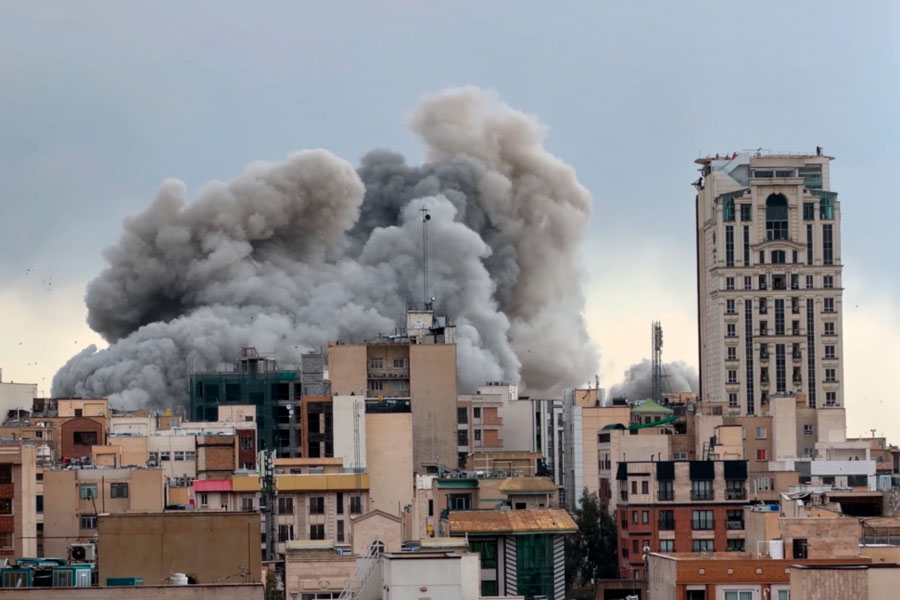
The war in Iran is not fought only with missiles, drones, and sanctions. It is also fought on symbolic terrain, where words matter as much as weapons. In this conflict, at least three religious traditions — Judaism, Christianity, and Islam — have been invoked by different actors to provide meaning, defense, or moral justification for violence.
This is not a new phenomenon. Whenever war is cloaked in sacred language, the conflict ceases to be merely geopolitical and becomes an absolute moral dispute. When God is invoked, the adversary is no longer just a political enemy: he becomes an existential threat, a negation of the good, someone with whom one does not negotiate but must defeat.
Yet this appropriation of religion by political power contradicts the ethical roots of the very traditions it invokes.
God must be outside the missile and inside the conscience
Judaism, at its prophetic core, is a tradition of law and justice, deeply marked by the memory of suffering and the constant warning against mistreating “the other.” Christianity was born as a radical ethic that placed the poor, the persecuted, and the victims at the center, and that distrusted imperial power and violence as a form of redemption. Islam, for its part, is grounded in justice, mercy and moral responsibility before God, with explicit rules — historically ignored — intended to limit violence even in times of war.
And yet today we see how these traditions are invoked not from their spiritual or ethical dimensions, but as identity tools, turned into national or civilizational banners. God no longer appears as a limit on power, but as its endorsement.
Here, a troubling paradox emerges: what began as a critique of domination, accumulation, and human arrogance has gradually been reinterpreted by structures of power seeking to legitimize themselves. In this process, religion stops challenging the conscience and instead shields political decisions that would otherwise be morally questionable.
Particularly troubling is the role of certain strands of Christian nationalism that evoke war as a “just” defense. When Christianity aligns without hesitation with military and economic power, it not only distances itself from its original message — it reverses it.
God does not drop bombs. States, armies, and elites often shield themselves in sacred language to silence doubt and neutralize compassion.
War not only destroys cities: it also corrupts words. In recent days, as attacks and counterattacks multiplied among the United States, Israel, and Iran, reports emerged that U.S. military commanders invoked “the divine plan” and references to the Apocalypse to explain the intervention to their troops; a religious freedom watchdog says it has received more than 200 internal complaints about the use of apocalyptic Christian rhetoric in the chain of command.
The systemic risk when religion becomes a pretext for power
Academic research over the past decades has shown how religion and collective identity intertwine in modern violence: traditions can offer languages of peace, but they can also be instrumentalized as identity banners serving national or expansionist projects. Understanding this ambivalence — and placing safeguards against it — is the responsibility of both those who govern and those who report.
From the 17th century, Sor Juana Inés de la Cruz left us an ethical compass. In Primero sueño, reason rises to the heavens in search of total knowledge… and fails. That “failure” is its victory: acknowledging the limits of understanding as an antidote to arrogance. Her lesson applies to politics: wherever power clothes itself in absolute certainty — and even worse, sacred certainty — unrestrained violence begins.
Three centuries later, Javier Cercas asks a more human question — on life after death — without seeking propaganda or absolution. El loco de Dios en el fin del mundo is not a catechism but a defense of questioning in the face of power; a portrait of faith that survives on the margins and distrusts the throne. Remembering this now matters: when religion merges with nation and state, its evangelical root as a limit on power is betrayed.
What is urgent is to clearly separate faith from war:
Civil language, civil rules. Presenting war as a Christian crusade or a jihad degrades civilian control over the military establishment and turns soldiers — believers or not — into instruments of dogma rather than of the Constitution.
Religious leaders as buffers, not sparks. Academia has documented it: the same traditions used to divide can — and should — serve to contain violence, not incite it.
This call is not against faith; it is in favor of its most uncomfortable truth: the one that judges us all, especially those in power. Prophetic Judaism, evangelical Christianity, and the Islam of mercy were born to place ethical limits on domination, not to sacralize force.
Sor Juana reminded us that intelligence that forgets its limits becomes arrogance; Cercas shows us that faith without questioning becomes propaganda. Let us learn something from both. Amid the noise, Impacto chooses this position: God outside the war, and conscience — critical, humble, human — at the center of every public decision.
Because in the end, there is no side that wins when the sacred turns into gunpowder; only humanity loses.
The attack on the synagogue: Confirmed facts vs. narrative noise
The recent attacks against a synagogue in Michigan and the attempted bombing amid protests and counterprotests in New York City do not appear to be disconnected events. They could be different expressions of the same phenomenon while also serving as the instrumentalization of fear in a context of war, polarization, and accelerated radicalization, where informational truth can easily be undermined.
Although authorities themselves have said that there was no proven direct connection with the international conflict at the time — and that the cases appear to involve digital self-radicalization — the incidents still serve to fuel Islamophobia.
Even though ideologically opposed, both attacks share structural elements: symbolic targets (a synagogue, the home of a Muslim mayor).
Media outlets then rush into speculation, contributing to the spread of fear and disinformation. Truth, in times of war and polarization, does not die from a single shot; it dies from simplification, haste, and fear.
In that terrain, journalism has two choices: to echo the noise or to stand as a barrier against distortion. Because if these events confirm anything, it is that when war is also fought in the realm of information, defending the truth becomes an act of resistance.