


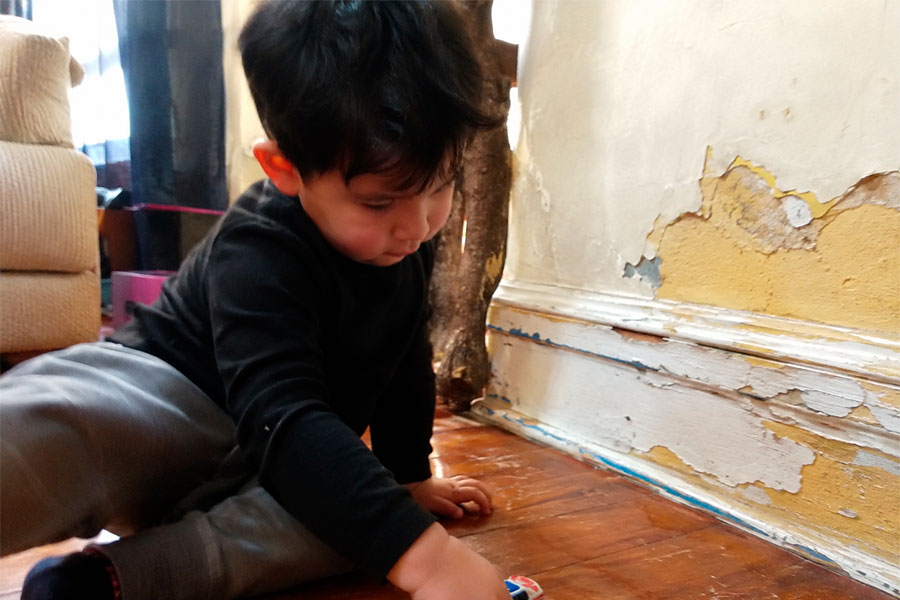
“We are using our kids as canaries in the coal mine,” Shannon Burkett said. She is Cooper Burkett’s mother. Her son is now a 19-year-old film student at New York University in New York City, and a New York City-based advocate working to end lead poisoning. Cooper created a short film, “Forever Chemical,” to tell his story. Shannon’s docudrama podcast, “LEAD: How This Story Ends Is Up to Us,” starring Merritt Wever and Cynthia Nixon, was an official selection at the Tribeca Festival and retells her family’s journey.
In 2008, while workers tore into the building beside Shannon Burkett’s Manhattan apartment, dust came through the walls. Sitting in her living room, she watched the dust hang in the light, a fine haze that drifted down onto the tables and the floor. The demolition next door cut through layers of old lead-based paint dating to the early 1900s. The Environmental Protection Agency tested the family’s apartment and found that the dust was loaded with lead.
Cooper was 9 months old and crawling. Soon after the demolition, Cooper stopped answering to his name. Burkett’s father, a doctor, had the baby’s hearing checked. His ears were fine, but a blood test revealed that lead was the real cause. Cooper’s blood lead level climbed to 19 micrograms per deciliter, more than five times the threshold the Centers for Disease Control and Prevention now uses to identify children with elevated blood lead levels, and his development began to regress.
What happened in that apartment could happen on almost any block in Philadelphia, where more than 82% of homes were built before 1980 and old are demolished next to occupied homes. The federal rule that requires lead-safe work during renovations does not cover the total demolition of a building. The EPA only recommends that crews wet down surfaces and contain the dust. The danger is not new. In 1921, the International Labour Organization adopted a convention banning lead in interior paint, and dozens of countries ratified it. The United States never did. We waited until 1978 to ban lead paint in homes, and the paint from those decades is still on the walls.
Burkett said she never imagined a construction site could poison a baby. In New York, she said, letting dust escape a work zone is illegal, but who, if anyone, was watching? On her block, no one stopped it. In Philadelphia, the question is the same. Permits cost up to $645.00; the Health Department is charged with monitoring them, and Department of Licenses and Inspection has the permits and rules based on federal government standards, but we all know construction is going on everywhere in this city. Is anyone really watching?
Mrs. Burkett went back to school for a nursing degree, and she wants every poisoned child to receive a full neuropsychological evaluation, the same in-depth testing a child gets after a brain injury in a car crash, which insurance often covers. A child with lead poisoning, she said, can lose words, struggle to control emotions and act on every impulse.
Christieanna Tawiah, PhD, NCSP, a psychologist who evaluates children for ADHD, autism and other neurodevelopmental conditions, said lead poisoning can show up in a child as neurological impairment. “We see a multitude of side effects impacting a child’s social-emotional health, executive functioning, attention, and learning capabilities as a result of exposure to lead in any capacity. This exposure interrupts neurotransmitter releases vital to a child’s brain development and normal functioning, directly intensifying neurodivergent conditions. We must increase education about risk factors and raise awareness in settings that impact children.”
The Brain Injury Association of America classifies lead poisoning as a non-traumatic brain injury: damage done not by a blow to the head but by a toxin. Lead enters the brain by mimicking calcium, disrupting the signals nerve cells send to one another. In a young child, the result can look like hyperactivity, aggression, a speech delay, or trouble concentrating. Low-level poisoning often shows no clear signs; doctors rarely test, and the damage may not surface until a child starts school, where it can be mistaken for something else.
A Drexel University analysis found that about 1 in 25 Philadelphia children under 6 had elevated blood lead in 2022, more than double the average for the big cities studied. The burden is not shared equally. Black children in Pennsylvania are poisoned at nearly five times the rate of white children, and Hispanic children at twice the rate, according to a report by Fight Crime: Invest in Kids.
Rosemarie Halt, a health policy consultant who co-chairs the Lead-Free Promise Project, estimates that 11,500 to 12,000 poisoned children in the state are never identified. A growing coalition is trying to change that. The Lead-Free Promise Project, convened by the Philadelphia nonprofit Children First, has grown to nearly 80 member organizations since 2021. It pushes for every child to be tested at ages 1 and 2 and for a state fund to remove lead paint from low-income families’ homes. It helped win Pennsylvania’s first $2 million for residential lead cleanup. Its allies include some unexpected voices. The state’s district attorneys, police chiefs, and sheriffs have endorsed the campaign, and Fight Crime: Invest in Kids, a law enforcement group, is also a member.
In Philadelphia, the National Nurse-Led Care Consortium has rallied behind the state’s testing bill. That bill, House Bill 916, sponsored by Rep. Jose Giral, D-Philadelphia, passed the House 157-44 in June and now awaits action in the Senate. It would require doctors to test children at 12 and 24 months and pregnant women at least once, with private insurers covering the cost. A second measure, House Bill 584, would pay for lead removal with a 50-cent surcharge on every gallon of paint sold. It has sat in committee since February 2025.
Philadelphia families do not have to wait for Harrisburg. The city’s Lead and Healthy Homes Program, at (215) 685-2788, offers free help, including home inspections and lead removal for eligible families. Anyone worried about dust from construction or demolition can call 311.
Burkett has spent 18 years living with what that paint can do. Cooper said in a statement, “The poisoning never fully let go. I still struggle with short-term memory loss, processing issues, and emotional regulation”. This is why Shannon says that our children are telling us where the lead is hiding, but they are paying with their quality of life.