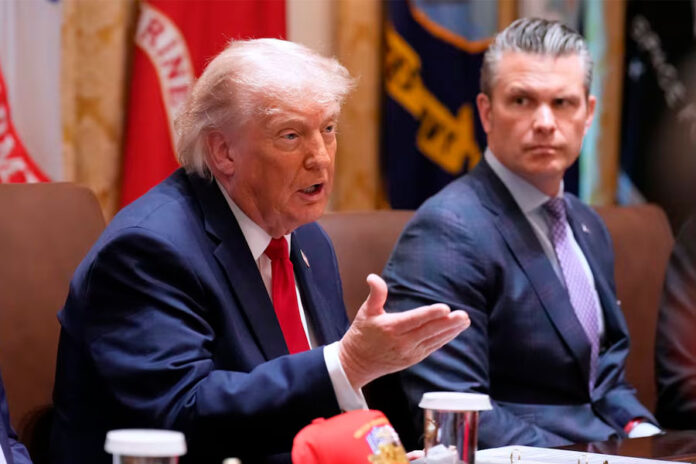


Washington.- El nuevo arancel de 10% aplicado a todos los países del mundo por el presidente, Donald Trump, este viernes, cuenta con excepciones notables para productos estratégicos y esenciales y entrará en vigor el 24 de febrero.
El nuevo arancel basado en la sección 122 de la ley de Comercio de 1974, dejará fuera de la medida a productos como minerales críticos, metales usados en moneda, productos energéticos, informó la Casa Blanca en un comunicado oficial.
Productos ganaderos y agrícolas que habían sido exceptuados en sus aranceles anteriores por presión de empresarios y consumidores también permanecen fuera del gravamen, según la misma fuente.
Los bienes de Canadá y México bajo el T-MEC y textiles de Centroamérica, también quedan al margen. También se mantendrán libres de aranceles libros, donaciones y equipaje acompañado, con el objetivo de «proteger la economía interna» y garantizar que la medida se enfoque en los desequilibrios de pagos internacionales.
Diferencia con anteriores aranceles
Según la Casa Blanca, la sección 122 de la Ley de Comercio de 1974 permite abordar desequilibrios graves en la balanza de pagos mediante recargos sobre importaciones, sin requerir la aprobación del Congreso para cada caso específico.
Esto lo diferencia de aranceles anteriores que se basaban en otras secciones o en acuerdos internacionales, y que enfrentaron obstáculos legales por exceder la autoridad ejecutiva o por no estar directamente vinculados a problemas específicos de pagos internacionales.
Trump ha defendido la medida como parte de su estrategia para reequilibrar las relaciones comerciales y relocalizar la producción en EE. UU., asegurando que, pese a las excepciones, los aranceles continuarán incentivando empleos bien remunerados.
Los aranceles globales anteriores fueron anulados por el Supremo cuyo dictamen afecta a la tarifa global base del 10 % a las importaciones extranjeras y los llamados gravámenes «recíprocos» a los socios comerciales de la mayor economía del mundo, junto a aranceles adicionales del 25 % a México y a Canadá para presionar a estos países a frenar el flujo de drogas como el fentanilo a través de sus fronteras hacia EE. UU.
También se incluyen las decisiones del republicano de aumentar hasta un 50 % los aranceles a Brasil y la India como represalia por el enjuiciamiento a su aliado, el expresidente brasileño Jair Bolsonaro, y la compra de crudo ruso, respectivamente.
A person views posted signs on the locations of the now removed explanatory panels that were part of an exhibit on slavery at President's House Site in Philadelphia, Jan. 23, 2026. (Photo: AP/Matt Rourke/File)
PHILADELPHIA. A U.S. appeals court late Friday said the Trump administration can halt work on a National Park Service slavery exhibit in Philadelphia while it appeals an order to reinstall it.
About half of the large panels at the outdoor exhibit have been restored this week at the site of the former President’s House on Independence Mall. U.S. Circuit Judge Thomas Hardiman, in his order, said the exhibit as it stood Friday must remain in place and the remaining materials must be preserved. The appeals court will now weigh the dispute between the city and the federal government, which began when the administration abruptly removed the exhibit in January, amid an effort to remove information it deems “disparaging” to Americans from federal properties.
Senior U.S. District Judge Cynthia M. Rufe had set a 5 p.m. Friday deadline to restore exhibits on the lives of nine people enslaved at the site under former President George Washington in the 1790s, when Philadelphia served as the nation’s capital. That order is now on hold.
Legal battle continues over slavery exhibit removal
The Park Service describes the exhibit as one “that examines the paradox between slavery and freedom in the founding of the nation.”
The Interior Department has said in court papers that it planned to replace it with its own narrative on slavery. Rufe had said it must work with the city on any new material under a longstanding cooperative agreement.
“(T)he government can convey a different message without restraint elsewhere if it so pleases, but it cannot do so to the President’s House until it follows the law and consults with the city,” Rufe, an appointee of Republican President George W. Bush, wrote in an opinion Friday.
In its own filing Friday to the 3rd U.S. Circuit Court of Appeals, the Justice Department called her ruling “extraordinary” and “an improper intrusion on the workings of a co-equal branch of government.”
One of the panels being rehung Friday morning — titled “History Lost & Found” — details the surprising discovery of artifacts from the President’s House during an archaeological dig in the early 2000s, as work was being done on a new pavilion for the Liberty Bell.
The exhibit had been on display since 2010, the result of years of research and collaboration between the city, the Park Service, historians and other private parties.
Rufe said the federal government was unlikely to succeed at trial. And she said the public –- and the city’s reputation — was being harmed with each passing day.
The city, she said, “is responsible for the public trust in the city’s telling of its own history, its own integrity in telling that history, and preventing erasure of that history, particularly in advance of the semiquincentennial.”
Millions of people are expected to visit Philadelphia, the nation’s birthplace, this year for the 250th anniversary of the country’s founding in 1776. Hardiman said the court would expedite the appeal, but the legal wrangling is still expedited to continue for another month or more, according to a schedule he set.
Kimberly Gegner, a teacher from Philadelphia, visited the site Friday with some of her 6th- to 9th-grade students. As a Black American, she said, it had pained her to see the history removed. But she was grateful to see it going back up.
“This whole case and what happened here — the taking it down and how Mayor Parker and other Pennsylvanians had to go to court to have it restored — is an excellent case of how the Constitution was applied to win this case for Philadelphia,” she said.
Edwin Desamour is the host and creator of The Domino Dialogues Podcast. (Photo: Somos Society)
From The Lighthouse Field, in the heart of the community, a project is making waves in Philadelphia. The Domino Dialogues Podcast was created to preserve history and highlight the greatness of the Puerto Rican and Latino community through meaningful conversations around a domino table.
“I am Edwin Desamour, host of The Domino Dialogues Podcast, an extension of Somos Society. It is an honor to represent not only Puerto Rican culture in Philadelphia, but also Latino culture and how it has evolved over the years. We have been capturing those stories, so it has been very impactful,” Desamour expressed.
The concept stems from the Puerto Rican tradition of gathering around the domino table as a space for storytelling and collective memory. “I remember… you would always hear certain sayings… How can we continue telling stories while also doing something different? Everyone has a podcast. So, how can we do something distinct”? he explained.
He added that as a child, he listened to stories and anecdotes around the domino table, which inspired the show’s format: three people at the table—two guests and the host—and a symbolic fourth presence, the audience. “This way, they can feel like they’re playing a game of dominoes, but at the same time participating in a conversation about the history of Puerto Ricans in Philadelphia,” he said.
The public response to the podcast has been very positive. (Photo: Somos Society)
Each guest represents a key part of local history
“When people sit at the table, for us, they are giants. They are legends. We cannot let their stories go unnoticed, people who paved the way for Puerto Ricans in Philadelphia”, Desamour stated.
Guest selection follows a clear vision. “We meet as a team and choose a theme: art, media, activism, motherhood, fatherhood, resilience. There is so much beauty in our community, people who have sacrificed their time, even time with their families, to pave the way for today’s Puerto Ricans.”
Abigail Torres Meléndez is the co-founder of Somos Society. (Photo: Somos Society)
The Domino Dialogues Podcast is produced by Somos Society, an organization founded by Eric Meléndez and Abigail Torres Meléndez. “I am co-creator and co-founder of Somos Society, and we produce, direct, edit, record, and do all the fun parts,” explained Torres Meléndez.
Eric Meléndez detailed his role: “I am co-founder of Somos Society. I am the program director, show editor, and producer; I handle the editing and all the entertaining aspects.”
Podcast episodes are available on the Somos Society website. (Photo: Somos Society)
The public response has exceeded expectations
“We’ve been surprised by the feedback and how people encourage us to continue. They say, ‘We need this.’ The response has been phenomenal,” Desamour shared.
For the host, the mission is clear: to change narratives and reaffirm collective identity. “Our goal is to preserve history. To know who we are and not lose that. We are good people. Puerto Ricans migrated here to provide, to serve, to make sure their children were successful and educated. They worked hard in factories and did many things. We want to change that narrative and say: No. You come from greatness. You come from good people.”
In one word, he defines the project as “history.” “If we don’t know who we are or where we come from, we will be lost. Sometimes we must go back to find ourselves.”
This initiative seeks to educate and preserve the historical tradition of Puerto Ricans. (Photo: Somos Society)
His message to those who have not yet tuned in is a direct invitation: “Tune in, listen, pull up a chair. Be part of the conversation and keep it alive. We want to start the conversation, but we also want people to research on their own. I can say something, but I want you to question me. Question the show. Look up the people we mention. It’s about starting conversations.”
Finally, the team calls on sponsors and organizations. “If you are a sponsor, a business, or an organization looking to get involved and promote something, please connect with Somos Society, sponsor The Domino Dialogues Podcast, and help push this initiative forward. This is about education. Become a sponsor and donate,” urged Torres Meléndez.
For more information about The Domino Dialogues Podcast, the docuseries, and the interactive map, visit somossociety.com, where visitors can also suggest stories, request interviews, or coordinate community screenings.
The Domino Dialogues Podcast not only preserves historical memory, but it also opens the door for new generations to learn their roots and continue the conversation at home.
Joy was the prevailing tone during the tradition-filled event. (Photo: Haydeé Rosario / Impacto staff)
On February 13, Taller Puertorriqueño held its first domino tournament, a cultural initiative that brought together people of all ages in an atmosphere filled with music, food, and friendly competition. The free event reaffirmed the organization’s commitment to the community and to promoting Puerto Rican traditions in Philadelphia, home to one of the largest Puerto Rican populations outside the island.
Primitiva and her husband, the winners, with Alba Martínez, the tournament organizer. (Photo: Haydeé Rosario / Impacto staff)
Organizer Alba Martínez explained that the idea stemmed from a desire to innovate and create spaces for cultural connection: “Dominoes is culture, it’s a game, and it’s an opportunity to bring people together to create spaces where we feel happy, where we feel united, where we belong. Dominoes are especially important because they are intergenerational. It doesn’t matter your age or your level of experience; anyone can come, read the rules, and play. Essentially, in Philadelphia, we are the third-largest Puerto Rican community in the world, and dominoes, as we know, is a very significant cultural expression. We wanted to open El Taller as a space to celebrate our culture through dominoes,” she said.
Organizers and community leaders were pleased with the large attendance. (Photo: Haydeé Rosario / Impacto staff)
The tournament received support from community organizations, including Congreso de Latinos Unidos as the main sponsor, as well as La Guagua 47 and the Norris Square Senior Community Center. “It’s a free event because we have many partners… And the key is always to say yes. When the community approaches and says, ‘Let’s do something,’ the answer should always be yes,” Martínez added.
The first prize was a handcrafted piece with Puerto Rican cultural elements. (Photo: Haydeé Rosario / Impacto staff)
For El Taller, this event marks the beginning of new cultural initiatives: “And as you see the results, this is the beginning of many good things. El Taller Puertorriqueño is an extraordinary cultural platform… and our vision is to open it every week for something different something that celebrates community and culture,” she affirmed.
Participants in the first domino tournament at Taller Puertorriqueño. (Photo: Haydeé Rosario / Impacto staff)
The event also became a space for reconnection. “This reminds me of my childhood in Puerto Rico. Being here with my children and grandchildren playing dominoes is priceless,” commented José Martínez. Primitiva, who attended with her husband and won the tournament, agreed: “Sometimes routine separates us, but events like this bring us back together. There’s music, food, and above all, camaraderie.”
Janette Díaz, CEO of Congreso Latinos Unidos, participated in the event. (Photo: Haydeé Rosario / Impacto staff)
Janette Díaz, CEO of Congreso, highlighted the intergenerational value of the initiative: “We wanted to join a celebration of the community, and this was a great way to bring everyone together… Walking into that room and seeing so many people reminded me of when I was little and my grandmother and my aunts were together… playing dominoes. Those memories feel warm… This feels truly beautiful and welcoming,” she said.
More than just a competition, the tournament solidified a space where the community can reconnect, share, and reaffirm its cultural identity.
La jueza Cynthia Rufe sale tras inspeccionar el lugar donde estaban los carteles explicativos sobre la esclavitud en la Sala del Presidente en Filadelfia, el 2 de febrero del 2026. (Foto: AP/Matt Rourke)
PHILADELPHIA — A federal judge has denied the Trump administration’s request to delay a Friday deadline to restore an exhibit on the history of slavery at Independence Mall in Philadelphia.
The ruling Friday morning came as restoration work begun Thursday resumed at the site of the former President’s House. Senior U.S. District Judge Cynthia M. Rufe had set a 5 p.m. Friday deadline for its completion, and she held to that timeline, even as the administration appeals her decision.
The Interior Department has said in court papers that it planned to replace the exhibit with its own narrative on slavery, as the administration works to remove information that it deems “disparaging” to Americans from federal properties. Rufe said it must work with the city on new material under a longstanding cooperative agreement.
“As this court established, “(t)he government can convey a different message without restraint elsewhere if it so pleases, but it cannot do so to the President’s House until it follows the law and consults with the city,” Rufe, an appointee of Republican President George W. Bush, said in Friday’s opinion.
In its own filing Friday to the 3rd U.S. Circuit Court of Appeals, the Justice Department called her ruling “extraordinary” and “an improper intrusion on the workings of a co-equal branch of government.”
The appeals court asked the city to respond to the request for an emergency stay of Rufe’s order.
One of the panels being rehung Friday morning — titled “History Lost & Found” — details the surprising discovery of artifacts from the building during an archaeological dig in the early 2000s, as work was being done on a new pavilion for the Liberty Bell.
National Park Service employees worked with care on the exhibits, including those on the nine people enslaved by George and Martha Washington in the 1790s, when Philadelphia served as the nation’s capital. The Park Service describes the outdoor exhibit as one “that examines the paradox between slavery and freedom in the founding of the nation.”
The Trump administration abruptly removed the panels in January, leading the city and other advocates to file suit. They had been on display since 2010, the result of years of research and collaboration between the city, the Park Service, historians and other private parties.
Rufe, in denying the federal government’s request for a delay, said that side was unlikely to succeed at trial. And she said the public –- and the city’s reputation — was being harmed with each passing day.
The city, she said, “is responsible for the public trust in the city’s telling of its own history, its own integrity in telling that history, and preventing erasure of that history, particularly in advance of the semiquincentennial.”
Millions of people are expected to visit Philadelphia, the nation’s birthplace, this year for the 250th anniversary of the country’s founding in 1776.
The U.S. Attorney’s Office in Philadelphia, which is representing the administration in court, declined to comment on the restoration work Friday.
Kimberly Gegner, a teacher from Philadelphia, visited the site Friday with some of her 6th- to 9th-grade students. As a Black American, she said, it had pained her to see the history removed. But she was grateful to see it going back up.
“This whole case and what happened here — the taking it down and how Mayor Parker and other Pennsylvanians had to go to court to have it restored — is an excellent case of how the Constitution was applied to win this case for Philadelphia,” she said.
Personas caminando frente al edificio de la Corte Suprema de Estados Unidos en Washington (EE. UU.). (Foto: EFE/WILL OLIVER)
La Corte Suprema de EE. UU. declaró este viernes que el Gobierno estadounidense se extralimitó en los poderes de emergencia invocados por el presidente Donald Trump para imponer gran parte de sus gravámenes a los socios comerciales del país norteamericano, en un duro revés a la política arancelaria del mandatario.
Con una mayoría clara de 6-3, el Supremo dominado por conservadores le sirvió al republicano uno de los primeros grandes reveses de su segundo mandato, un giro en la tendencia hasta ahora favorable al mandatario en otros temas clave de su agenda.
En representación de la mayoría, el presidente del Tribunal, John Roberts, indicó que el Gobierno no tiene facultades inherentes en tiempos de paz para imponer aranceles con base a la Ley de Poderes de Emergencia Económica Internacional (IEEPA) de 1977 invocada por Trump como pilar de su guerra comercial.
En su fallo, el Supremo considera que el uso de esta legislación por Trump supondría una delegación excesivamente amplia del poder tributario que la Constitución reserva al Congreso, ya que el Alto Tribunal considera que los aranceles son un tipo de impuesto a los ciudadanos.
Las voces del disenso fueron las de los jueces Samuel Alito, Clarence Thomas y Brett Kavanaugh, los magistrados más conservadores del Supremo.
En su opinión, los tres jueces consideran que no se debe limitar al presidente en estas cuestiones pues consideran que la IEEPA puede usarse en temas de política exterior, lo cual aplica en este caso.
Esta decisión en contra de los poderes de Trump para declarar aranceles no impide que el republicano imponga gravámenes bajo otras leyes.
Funcionarios de la Administración ya han dicho que esperan mantener el marco arancelario del presidente con otros basamentos legales, aunque no está claro si aquellos importadores que han pagado por los altos aranceles impuestos por la Administración podrán solicitar y recibir reembolsos, equivalentes a varios miles de millones de dólares.
Trump ha insistido en que sería «muy decepcionante» que el Tribunal Supremo considerara ilegal la implementación de gran parte de los aranceles, que según él, son la clave del éxito económico que está cosechando su Administración y para presionar en materia de política exterior a otras naciones.
También ha reconocido que sería «prácticamente imposible» devolver los cantidades cobradas a los importadores.
El pasado agosto, tras una demanda de dos pequeñas empresas importadoras, una corte de apelaciones del Circuito Federal estimó que Trump no tenía derecho a imponer los llamados «aranceles recíprocos», que oscilan entre el 50 % que pagan Brasil y la India y la base mínima del 10 % que soportan el Reino Unido o la mayoría de países de Latinoamérica.
El tribunal estimó que tampoco tenía autoridad para implementar el gravamen del 25 % impuesto a algunos productos de Canadá, China y México por lo que, Washington considera, esfuerzos insuficientes para frenar la entrada de fentanilo a EE. UU.
Sin embargo, evitó congelar la aplicación de aranceles para dar tiempo a que el Gobierno Federal llevara la causa al Supremo.
The Philadelphia Foundation, in partnership with the Lenfest Institute for Journalism and with support from the William Penn Foundation, launched the second edition of Philly Gives, a community campaign aimed at uniting the city around generosity and civic engagement.
Among the beneficiary organizations are Attic Youth Center, Catholic Charities of Philadelphia, Children’s Crisis Treatment Center (CCTC), Congreso de Latinos Unidos, Esperanza, Project HOME, Jewish Family and Children’s Services (JFCS), Philabundance, SEAMAAC (Southeast Asian Mutual Assistance Associations Coalition), and SHARE Food Program.
More than just a campaign, Philly Gives is a community-driven philanthropic fund. Its mission is to strengthen organizations that address the region’s most urgent needs by connecting donors with local causes and fostering a culture of solidarity that supports the most vulnerable communities in Philadelphia.
This organization has established itself as one of the leading community-based entities in the United States dedicated exclusively to supporting lesbian, gay, bisexual, transgender, queer, and questioning (LGBTQ+) youth. Located in the heart of Center City, Philadelphia, it promotes the development of young people into healthy, independent, and community-engaged adults within a safe, inclusive, and supportive environment.
Its work responds to a persistent reality: many LGBTQ+ youth face prejudice, discrimination, and exclusion, which can lead to vulnerability and isolation. In response, the organization creates a space of belonging where every young person feels seen, heard, and valued. It also provides resources, guidance, and programs that strengthen personal, academic, and professional skills, preparing them to build a more stable future. Through comprehensive support and a strong community network, it fosters well-being, resilience, and youth leadership.
Attic Youth Center, with its dance group, demonstrates inclusion as part of its vision. (Photo: Social Media)
A faith-based organization addressing urgent needs in the Philadelphia area, Catholic Charities supports more than 300,000 residents annually across five counties through nearly 40 programs. These programs provide comprehensive assistance in food security, housing, senior services, immigration legal support, child protection, and resources for individuals with intellectual and developmental disabilities. Inspired by the works of mercy, its mission centers on human dignity and a commitment to promoting well-being regardless of background or circumstance.
The organization also fosters the educational and emotional development of children and youth; provides centers and housing that enhances quality of life for seniors; and promotes inclusion for individuals with disabilities through supported employment, integration programs, and residential options.
Catholic Charities of Philadelphia is a faith-based organization addressing urgent needs in the Philadelphia area (Photo: Courtesy)
An organization dedicated exclusively to children’s mental health, serving children from 18 months to 18 years old. The agency offers mental and behavioral health services in various settings: traditional clinics providing therapy and psychiatric services, intensive in-home interventions, family care coordination, and direct services in more than 46 public, charter, and private schools in Philadelphia.
It also operates the only summer camp in Philadelphia for children with behavioral challenges and maintains culturally specific programs such as Abriendo Caminos, aimed at Mexican and Central American families, and Tamar, focused on African families. Its goal is clear: to integrate children’s mental health services into the spaces where children live, learn, play, and grow.
Children’s Crisis Treatment Center the service is essential to help families meet their basic needs. (Photo: Courtesy)
For 48 years, Congreso has stood as a beacon of empowerment in North Philadelphia. Founded in 1977 by a group of Puerto Rican activists seeking economic justice, well-being, and opportunity for Latino families, the organization provides comprehensive services in education, workforce development, health, housing, and family programs. While it primarily serves Latino women, children, and families, its doors are open to anyone in need.
Its programs include a federally qualified health center offering primary care services, domestic violence prevention programs, victim assistance services, after-school educational activities, GED preparation, and multiple professional certifications such as CDL and EMS. Additionally, it offers homebuyer workshops, foreclosure prevention support, and financial counseling.
At Congreso, essential services are offered to address the community’s priority needs. (Photo: Courtesy)
On July 1, 1986, Nueva Esperanza, Inc. (now known as Esperanza) was founded with the goal of becoming a proactive organization focused on improving the holistic well-being of Latino families. Since its founding, Esperanza has worked to address the community’s multiple needs.
The organization develops educational programs that include in-person and cyber charter elementary and secondary schools, as well as a higher education institution. Esperanza promotes the development of affordable housing and supports low-income families in securing accessible rental opportunities or achieving the dream of homeownership. This work is complemented by immigration services that provide guidance and technical assistance to individuals seeking residency or citizenship, along with community outreach in neighborhoods.
Esperanza is the organization that develops educational programs that include in-person and cyber elementary and secondary schools, as well as an institution of higher education. (Photo: Esperanza)
For 35 years, Project HOME has been one of the most influential and committed organizations working to prevent and end homelessness.
The organization provides permanent and transitional supportive housing, healthcare, educational and employment opportunities, job training programs, and youth activities. Its comprehensive approach addresses both the immediate crisis of homelessness and its root causes. It supports individuals experiencing various forms of housing instability—from those chronically living on the streets to individuals facing mental health challenges, job loss, or grief. It also assists youth aging out of the foster care system and individuals lacking residential stability.
Volunteers from the Project HOME community are fundamental to bringing us closer to ending and preventing chronic street homelessness and alleviating poverty in Philadelphia. (Photo: Courtesy)
With more than 170 years of service, JFCS focuses on providing comprehensive support to individuals of all ages. Although rooted in Jewish values, the organization emphasizes that its services are universal. Programs address basic needs such as housing, food, and access to public benefits, and include a mobile initiative that delivers food and clothing throughout the city.
In mental health, JFCS offers counseling, mobile therapy, and art therapy. The organization also supports Holocaust survivors, provides programs for youth, families, and seniors, and leads initiatives serving neurodiverse individuals and the LGBTQ+ community.
One of the largest hunger relief organizations in the region, Philabundance has served the community for more than 40 years and faces an increasingly challenging landscape. Operating in Southeastern Pennsylvania and Southern New Jersey, it serves nine counties where, according to leadership, rising costs of living have worsened food insecurity.
As a food bank, Philabundance distributes millions of meals each year through 350 partner organizations, including churches, schools, and community centers. Beyond food distribution, it offers a free workforce development program through the Philabundance Community Kitchen, which has operated for 25 years. There, low-income individuals receive culinary training and certification to improve their employment opportunities.
Philabundance celebrates more than 40 years of service to the community. (Photo: Courtesy)
Founded in 1984 to support Southeast Asian refugees, SEAMAAC’s mission has expanded significantly over the past four decades. “Our mission is essentially to help individuals, families, and communities that are economically, socially, and politically vulnerable—and truly help them thrive in Philadelphia, Pennsylvania, and the United States,” explains Thoai Nguyen, the organization’s Executive Director.
Funding comes from city and state contracts, federal programs, private foundations, and individual donors who help fill gaps left by public systems. SEAMAAC serves refugees from Africa, Eastern Europe, Central America, South America, and Mexico. Its philosophy is clear: to strengthen a community, you must serve all of its members.
Founded in 1986 as a food cooperative aimed at bringing affordable food to communities without supermarkets and with limited access to nutritious products, SHARE has evolved into one of the most important food banks in the Philadelphia region. It serves individuals experiencing food insecurity through a network of more than 350 pantries and multiple programs.
Today, the organization operates throughout the metropolitan area, including neighborhoods where need has grown rapidly, such as Northeast Philadelphia and the city’s deep Southwest. Its mission, born from the heart of the community, is supported by hundreds of volunteers who pack food boxes, call seniors to coordinate deliveries, and assist at local pantries. SHARE also operates a home delivery program—especially for older adults—and an educational garden where nutrition workshops are held.
On February 26, organizations will receive the donations raised through Philly Gives. For more information about the initiative and future campaigns, visit phillygives.org.
Share Food Program relies on volunteers, as they are an educational part of the program. (Photo: Courtesy)
The Confluencial Visual Art exhibit at the Duke Gallery was well attended by Philadelphians and suburban neighbors. (Photo. Courtesy)
WALLINGFORD, PA — As the United States approaches the 250th Anniversary of the signing of the Declaration of Independence, the question of representation is not abstract. It is a vital and relevant question. Who is recognized in the story of the development of our country? — and who remains unseen? At the Duke Gallery inside the Community Arts Center, Puerto Rican artists offered a powerful answer.
On February 15, 2026, during the reception for Confluencia Visual, a Puerto Rican Art Exhibit, the gallery was filled with saturated color, conversation, and a rich perspective. The exhibit reception transformed the space into something larger than an art show. It became a gathering of Puerto Rican artists and a statement of historical presence and cultural pride. The audience also reflected the exhibit’s broader reach — longtime urban community members alongside suburban patrons, Spanish and English conversations flowing freely.
(Foto: Cortesía/Aleida García)
The exhibit was conceived by Paul Downie, Director of the Wallingford Art Center, who wanted to ensure Puerto Rican inclusion in the nation’s semiquincentennial observance. Downie reached out to Carmen Febo-San Miguel, former director of El Taller Puertorriqueño, in turn, she contacted longtime arts advocate Johnny Irizarry, former director of the Center for Hispanic Excellence: La Casa Latina at the University of Pennsylvania, former Executive Director of the Lighthouse, former Director of Taller Puertorriqueño, and currently a lecturer of Latin American and Latinx studies at the University of Pennsylvania. Irizarry clearly described the origin of the exhibit. “We didn’t want to do a narrowly curated show.
(Foto: Cortesía/Aleida García)
We wanted to show that historically, the Puerto Rican community has been here in the Philadelphia area and has grown and contributed to our City. The important thing is that artists have been working here for decades. That intention shaped Confluencia Visual — not as a selective showcase, but as evidence of continuity.” Inside the Duke Gallery, color carries weight. Mango oranges and hibiscus reds pulse against white walls. Deep blue tones stretch across canvases like twilight over North Philadelphia rooftops.
(Foto: Cortesía/Aleida García)
The exhibit does not whisper; it declares! Among the featured artists was Luz Selenas, who has documented Puerto Rican life in Philadelphia since 1972. Her presence anchored the exhibit historically and emotionally. “Our community needs an avenue to express our creativity,” Selenas said. “That is why I have always supported young artists. It’s important to encourage them to exhibit and sell their work.”Luz Selenas’s photographs preserve migration stories and neighborhood memories. Faces emerge with dignity — steady, unflinching. Muralist Betsy Casanas presented Las Paredes del Barrio, a dynamic work inspired by the Puerto Rican culture of North Philadelphia in compositions that feel alive with movement. Artist Gilberto Gonzalez exhibited two striking pieces, including Kensington Fire, a work that blends searing oranges and smoky grays — flames rising against an urban skyline. The painting captures both destruction and resilience, reflecting the lived realities of often-overlooked communities. The reception also drew visitors from beyond Philadelphia’s Puerto Rican neighborhoods. Sandra Roberts, a local from Newtown Square, attended with her friend Sherryl Hendershot from the Clay Studio.
Morivivi by artist Michelle Angela Ortiz, paintings of different stages of life, were an exciting center of attention at the Confluencial Visual Exhibition. (Photo: courtesy)
They were admiring the show. Sandra shared that she had hosted her daughter’s sweet sixteen celebration at the Community Arts Center, praising the venue’s welcoming atmosphere. This time, she came specifically to view the work of ceramic artists Roberto Lugo and Nitza Walesca Rosario, bridging traditional craft and contemporary social commentary. Guests enjoyed delicious, traditional Puerto Rican cuisine — aromatic arroz con gandules, tender bacalao con verduras, and notes of flavors as vibrant as the artwork itself. The scent of “comida criolla” lingered in the air, reinforcing that culture is experienced through all senses. The food added its own layer of authenticity. The title Confluencia Visual — visual confluence — is deliberate.
(Foto: Cortesía/Aleida García)
Many possible names were suggested, but “Confluencia” spoke to the organizers. It represents merging generations, merging geographies, merging histories. Established artists expressing community voices, bridging the island and diaspora. Philadelphia is home to one of the largest Puerto Rican populations outside the island, second only to New York, in the words of Johnny Irizarry. Yet cultural representation in regional art institutions has not always reflected that reality. This exhibit addresses that gap.
For Irizarry, the moment is about permanence, not symbolism. “We have always been part of the American story,” he said. “This exhibit shows that clearly.” As winter light faded outside the Duke Gallery, the colors inside remained radiant, layered, unapologetic. If the 250th anniversary of the American Revolution is to truly reflect the breadth of the nation’s history, Puerto Rican contributions and lived experiences must be welcomed, not as an afterthought, but as an essential part of what it means to be a United States citizen and part of the fabric of the United States. It must recognize the generations of Puerto Rican artists who have shaped this country’s cultural landscape with bold color, unyielding vision, and enduring presence. At the Duke Gallery in Wallingford, that recognition has already begun.
WALLINGFORD, PA — A medida que Estados Unidos se acerca al 250 Aniversario de la firma de la Declaración de Independencia, la pregunta sobre la representación no es abstracta. Es una cuestión vital y vigente. ¿Quién es reconocido en la historia del desarrollo de nuestro país y quién permanece invisible? En la Duke Gallery del Community Arts Center, los artistas puertorriqueños ofrecieron una respuesta contundente.
El 15 de febrero de 2026, durante la recepción de Confluencia Visual, una exhibición de arte puertorriqueño, la galería se llenó de color vibrante, conversación y una perspectiva cultural profunda. La recepción transformó el espacio en algo más que una muestra de arte: se convirtió en un encuentro de artistas puertorriqueños y en una declaración de presencia histórica y orgullo cultural. El público también reflejó el alcance amplio de la exhibición: residentes urbanos junto con asistentes suburbanos, conversaciones en español e inglés fluyendo libremente.
The Confluencial Visual Art exhibit at the Duke Gallery was well attended by Philadelphians and suburban neighbors. (Photo: Aleida Garcia)
La exhibición fue concebida por Paul Downie, director del Wallingford Art Center, quien quiso asegurar la inclusión puertorriqueña en la conmemoración nacional. Downie contactó a Carmen Febo-San Miguel, exdirectora de El Taller Puertorriqueño, y ella, a su vez, recurrió al defensor de las artes, Johnny Irizarry, exdirector del Center for Hispanic Excellence: La Casa Latina de la Universidad de Pensilvania, exdirector de Lighthouse, exdirector de El Taller Puertorriqueño y actualmente profesor de estudios latinoamericanos y latinx en la Universidad de Pensilvania.
(Foto: Aleida García)
Irizarry describió claramente el origen de la exhibición: “No queríamos hacer una muestra estrictamente curada. Queríamos mostrar que históricamente la comunidad puertorriqueña ha estado presente en el área de Filadelfia, creciendo y contribuyendo a nuestra ciudad. Lo importante es que los artistas han trabajado aquí por décadas”. Esa intención dio forma a Confluencia Visual: no como una selección limitada, sino como evidencia de continuidad.
(Foto: Aleida García)
Dentro de la Duke Gallery, el color tiene peso. Naranjas de mango y rojos de hibisco vibran contra las paredes blancas. Tonos azules profundos se extienden en los lienzos como el crepúsculo sobre los tejados del norte de Filadelfia. La muestra no susurra; ¡declara!
Entre los artistas destacados estuvo LuzSelenia Salas, quien ha documentado la vida puertorriqueña en Filadelfia desde 1972. Su presencia ancló la exposición en la historia y la emoción. “Nuestra comunidad necesita un espacio para expresar su creatividad”, dijo la veterana “Por eso siempre he apoyado a los artistas jóvenes. Es importante motivarlos a exhibir y vender su trabajo”.
Morivivi by artist Michelle Angela Ortiz, paintings of different stages of life, were an exciting center of attention at the Confluencial Visual Exhibition. (Photo: courtesy)
Las fotografías de LuzSelenia preservan historias de migración y memorias de vecindarios. Rostros emergen con dignidad —firmes, sin titubeos. La muralista Betsy Casanas presentó Las Paredes del Barrio, una obra dinámica inspirada en la cultura puertorriqueña del norte de Filadelfia, con composiciones llenas de movimiento. El artista Gilberto Gonzalez exhibió dos piezas impactantes, entre ellas Kensington Fire, una obra que mezcla naranjas ardientes y grises ahumados —llamas elevándose sobre un paisaje urbano. El cuadro captura destrucción y resiliencia, reflejando las realidades vividas de comunidades frecuentemente ignoradas.
(Foto: Aleida García)
La recepción también atrajo visitantes más allá de los vecindarios puertorriqueños de Filadelfia. Sandra Roberts, residente de Newtown Square, asistió con su amiga Sherryl Hendershot del Clay Studio. Admiraban la exposición. Sandra compartió que había celebrado el “sweet sixteen” de su hija en el Community Arts Center y elogió la atmósfera acogedora del lugar. Esta vez vino especialmente a ver el trabajo de los ceramistas Roberto Lugo y Nitza Walesca Rosario, quienes combinan la artesanía tradicional con comentarios sociales contemporáneos.
Los invitados disfrutaron de deliciosa cocina puertorriqueña tradicional —aromático arroz con gandules, tierno bacalao con verduras— sabores tan vibrantes como las obras expuestas. El aroma de la comida criolla impregnó el ambiente, recordando que la cultura se experimenta con todos los sentidos. La comida añadió su propia capa de autenticidad.
El título Confluencia Visual es deliberado. Se barajaron muchos nombres posibles, pero “Confluencia” resonó con los organizadores: representa la unión de generaciones, geografías e historias. Artistas consolidados expresando voces comunitarias, un puente entre la isla y la diáspora.
Según expresó Johnny Irizarry, Filadelfia alberga una de las poblaciones puertorriqueñas más grandes fuera de la isla, solo superada por Nueva York. Sin embargo, la representación cultural en las instituciones artísticas de la región no siempre ha reflejado esa realidad. Esta exhibición aborda esa brecha.
Para Irizarry, este momento habla de permanencia, no de simbolismo. “Siempre hemos sido parte de la historia estadounidense”, dijo. “Esta exhibición lo demuestra claramente”.
A medida que la luz invernal se desvanecía afuera de la Duke Gallery, los colores en su interior permanecían radiantes, intensos, sin disculpas. Si la celebración de los 250 años de la Revolución Americana quiere reflejar verdaderamente la amplitud de la historia del país, las contribuciones y experiencias vividas de los puertorriqueños deben ser reconocidas no como un añadido, sino como una parte esencial de lo que significa ser ciudadano estadounidense y parte del tejido de los Estados Unidos. En la Duke Gallery de Wallingford, ese reconocimiento ya ha comenzado.
(Foto: Stated Meetings - Philadelphia City Council)
A new Philadelphia law now allows victims of deed fraud to recover some of their financial losses. Previously, only the person who paid the Realty Transfer Tax — sometimes the criminal who committed the fraud — could request a refund. This left victims unable to recover that money even after proving the deed was fake and regaining their property.
Under the new law, homeowners who win their deed‑fraud cases in court can now request a refund of the Realty Transfer Tax paid on the fraudulent transaction. To qualify, the victim must have a court order voiding the fake deed and stating that the Department of Revenue should issue the refund. The refund covers the portion of the tax kept by the City.
To request the refund, victims must send a certified copy of the court order and a refund petition form to the City’s Department of Revenue within three years. Processing takes about six to ten weeks.
People who believe they might be victims of deed fraud should report it immediately, file a police report, seek legal assistance, and sign up for Fraud Guard alerts. After obtaining a court order confirming the fraud, they can apply for the tax refund.
Fill out a refund petition form. Send both documents to the Department of Revenue
Mail your petition to: City of Philadelphia Department of Revenue. P.O. Box 1137