


Everyone is using AI even if you don’t source it. It’s a part of Instagram, Google, even in your everyday life just by using your phone or computer. Companies will make sure you use AI. Before this, AI was a part of a different world. Scientific research to be able to provide better quality for their patience or tech users, it felt like something that was out of reach.
So, when did it become so accessible to the everyday person and why should we be worried about this?
AI tech became popular after the 2020’s covid pandemic. With virtual reality goggles to META AI glasses. But where is all this coming from? Just like any other product being sold there needs to be a source. The source? Big Tech AI Data Centers. It’s no coincidence they have been emerging in different locations, with the first one being built around 2020 in Des Moines, Iowa where “few people in Iowa knew about its status as a birthplace of OpenAI’s” (from apnews.com). But this isn’t just a center that is like any warehouse center, nor is it just a small computer data center. To get AI to work, these warehouses are constructed in areas no one would bat an eye at, where the centers are noisy and the computers overheat due to how much electricity it takes. When Big Tech proposes these centers to be constructed, they hide a lot of specifics, like how they source their water to cool down the computers and prevent the warehouses from overheating, or how much electricity they need to keep the centers working. They often require 300 to over 40,000 acres, housing 1 million to 4 million square feet of facility space. Meaning these are the size of “70 Footballs Fields” (from people magazine).
“It’s like you’re taking the whole Philadelphia airport to a small suburb” Laura, a young Colombian resident of Upper Marion/King of Prussia worries “it’s a supper center that surpasses the airport”
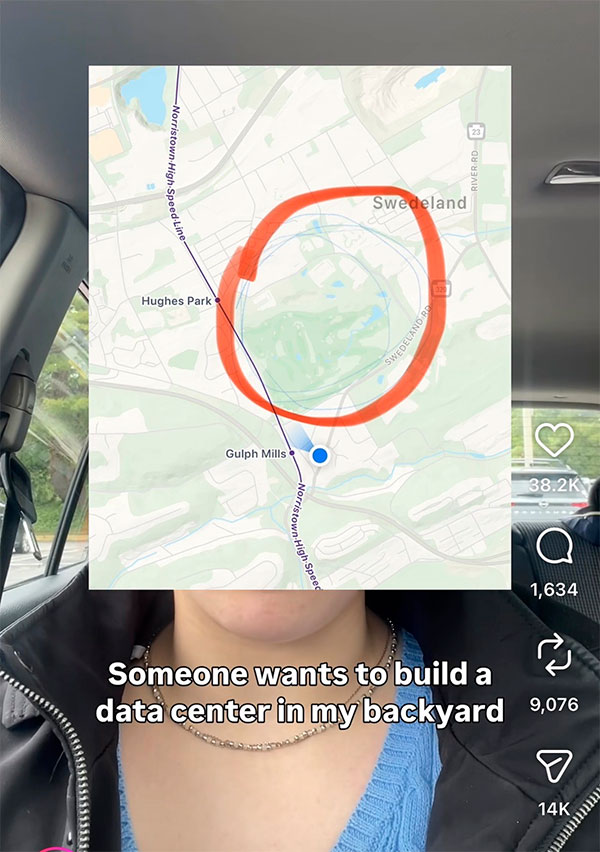
Just like Laura, many others around King of Prussia would be affected by the new project proposed by MLP Ventures, a Philadelphia-area real estate firm founded by developer Brian O’Neill.
“This data center would use 19 times the amount of energy that the whole upper Marion would use. And then there’s the question of pollution, air pollution, noise pollution”
Laura found out about this through an old high school colleague who posted about the data center project on her social media, upset about the news. Laura also felt the same as well as scared and decided to post a video about it. To Laura’s surprise the post went viral, shared about 14K times and gained attention in 24 hours after posting it on the weekend of May 15th.
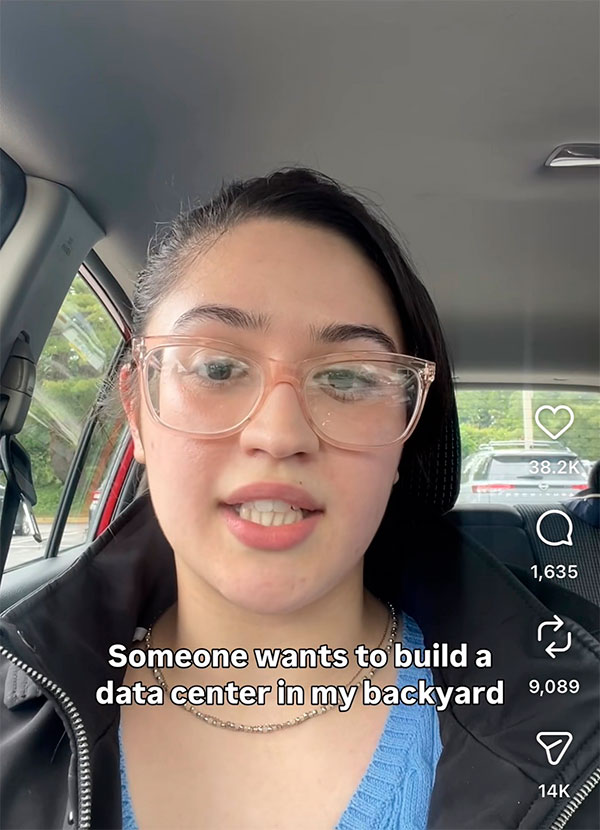
“I don’t have a major social media presence or anything. The response was completely unexpected. It filled me with hope to see the unity the public has over this situation.”
But it also gave Laura a bit of fear. Currently leaders and politicians like Governor Josh Shapiro Sen. Dave McCormick are pro AI data centers and have championed development promising tax revenue and jobs. They push the narrative that these centers are needed. In January 2025, then-president Joe Biden signed an executive order for federal government agencies to support AI data centers on federal sites built by private companies. In its July 2025 AI Action Plan, the second Trump administration supported increased production of these centers.
“This proposal was submitted before Upper Marion Township put in ordinances and regulations to protect its residents. So, it was done intentionally to sneak by them.” Laura looked up «The biggest concern is, it’s not regulated, where they bypass the zoning ordinances, and there’s just a lot of unknowns when it comes to the information behind them. This particular data center states that they will use water that will be sourced elsewhere. But where is this source coming from? We don’t know what the project goal is. We don’t know who its inhabitants are going to be. There’s just a lot of weird coincidences there, where are they going to dump the waste? Because it’s also going to be posted where the Schuylkill River happens to be.” Which runs all the way to Philadelphia neighborhoods drinking water.
Most of these past centers are usually built in areas where there’s a large body of local lake or rivers using fresh water that the residents use. A 2024 report from the United States Department of Energy stated that data centers overall used 17 billion gallons of water per year in the United States.
And it’s not only the water that will be affected. King of Prussia has a lot of limestone. According to a geological report the township supervisors brought in 1967, sinkholes are common in the area underlain by the Conestoga Limestone formation in the Great Valley. Acid and limestone don’t mix creating a lot of sinkholes, which is the reason there’s potholes in some of the areas of Manayunk, Upper Marion and Philadelphia. “Carbonic acid is formed when rainwater picks up carbon dioxide from the lower atmosphere. Air pollution adds to the problem because the rainwater picks up sulfur gases in the urban and industrial area that make it even more acidic.” (https://www.kophistory.org/upper-merion-1971-sinkhole/)
Meaning if these centers that use a lot of water are built on top of these lands filled with limestone, there will be more probability of sinkholes being caused around the area during its construction or if these centers are not monitored properly, affecting the residence even more.
“I have a lot of fear when it comes to this because I am a homeowner. “Laura states “What regulation can they sneak around that can harm us as residents? Environmental, economic, physical, psychological sense.”
These data centers proposal states it will be less than 1,000 feet from resident’s homes which is approximately around 3 football fields. In other areas that have AI data centers most residents report their waters aren’t clean to drink anymore and the noise pollution that these centers provide just to generate one search when using Open AI or ChatGPT becomes inhabitable for anyone. Not only that but most residents are bought out of their homes for these centers to be built. In a 2025 letter to QTS, the county said the AI Data center company owed $147,474 for more than 29 million gallons of water. “The utility director estimated roughly four months of unpaid use, while QTS put the span at about nine to 15 months. «We got this notification from the Fayette County water system saying the residents need to stop watering their lawns,” James Clifton, a lawyer and the resident who obtained the letter. (https://www.yahoo.com/news/articles/data-center-drained-30-million-002000882.html)
Recently, just like in the KOP area, New Brunswick was also hit with other developers’ intentions to build an AI center around their Jersey-Sandford Redevelopment Area near Rutgers University. Their concerns were the same. Who and what are these AI data centers for? Thanks to the residences catching this on time they were able to push back, and the project was canceled this May of 2026, making this a success for the residences.
Laura did what any caring person would do and spoke up about a situation that’s overlooked. “After posting this video, I got involved in some of the other groups that are against this project.” She acted and started looking in ways she was able to help. “Definitely talk with your neighbors, are they aware that this is happening? Organize with local community members or non-profits. A lot of local leaders count on the fact that many people don’t show up to these meetings so make sure that everyone is attending the meetings.”
With the narrative that big tech pushes that we need AI most of the time a lot of older immigrant families become the victims of AI videos or images and can’t differentiate what’s real or fake anymore. Most aren’t tech savvy or possess practical computer and digital skills and use ChatGPT or Open AI for simple things without realizing that it’s causing more harm to communities. There is a way to push back. Such examples are the students of the graduating class of 2026 who have been publicly showing displeasure whenever AI is mentioned during their commencement speech. Having different communities fight back, these AI Data centers that were a threat to them have accomplished to cancel the projects or shut down the center completely. We can go back to a time when AI was not a tool we use every day or where these data centers are not a threat to us anymore.
If you would like to help, the petition that residents have organized for anyone to sign is below.
You can also join the meeting on May 27th which will be held with the Upper Merion Planning Committee on Wednesday, May 27 at 7:00 pm ET.
Where: Freedom Hall Upper Merion Township Building
175 W. Valley Forge Rd King of Prussia, PA 19406.
Petition: https://www.change.org/p/no-ai-data-centers-in-king-of-prussia-pa