The 2024-25 Shapiro-Davis budget doubled down on the $5 million provided last year for the Nonprofit Security Grant Fund Program, securing $10 million to support security enhancements to combat hate crime and protect Pennsylvanians;highest number of nonprofit organizations received grants this year
Harrisburg — Today, the Pennsylvania Commission on Crime and Delinquency (PCCD) announced $10 million in funding for nonprofit organizations to combat hate crimes by enhancing the safety and security of their facilities. This latest round of Nonprofit Security Grant Program funding has been awarded to 208 nonprofit organizations across 31 Pennsylvania counties.
“All Pennsylvanians deserve to worship peacefully, no matter what you look like, where you come from, or who you pray or do not pray to,” said Governor Shapiro. “That’s why, in our latest budget, we doubled the Commonwealth’s investment in the nonprofit security grant fund to help places like mosques, churches, and synagogues equip themselves with security measures. Under Lieutenant Governor Davis’ leadership at PCCD, we’re working together to drive out this funding to our communities and ensure that every Pennsylvanian has the real freedom that comes when you can walk down the street in your community without worrying about violence.”
“The Shapiro-Davis Administration is committed to fostering a sense of safety and belonging for everyone, ensuring that no matter who you are, where you come from, or what you believe in, you can access services without the fear of hate or violence,” said Lt. Governor Austin Davis, chair of PCCD. “Thanks to the additional $5 million our Administration secured in this year’s budget, 102 entities, out of the 208 awarded, who have never received this funding before will be able to strengthen security at their facilities, ensuring those they serve feel safer while accessing services.”
This is the seventh cohort of the Nonprofit Security Grant Fund Program, which has provided $25 million in funding to more than 580 organizations since its inception. Based on reported data of the number of people who visit these facilities, it is estimated that approximately four million people across the Commonwealth have been impacted by this funding to date.
Eligible entities under this solicitation included nonprofit organizations, including faith-based institutions (e.g., churches, synagogues, mosques), community centers, and other organizations and facilities who principally serve individuals, groups, or institutions that are included within a bias motivation category for single bias hate crime incidents, as identified by the FBI’s Hate Crime Statistics publication. Entities will use funding for security enhancements for a wide variety of eligible items including safety and security planning and training, purchase of safety and security equipment and technology, upgrades to existing structures that enhance safety and security, and vulnerability and threat assessments.
More information about the 208 selected applicants, county served, and award amounts can be found on the PCCD website.
The 2024-25 Shapiro-Davis state budget makes significant investments to improve community safety in Pennsylvania through various additional programs at PCCD. That includes doubling the state’s investment in the Nonprofit Security Grant Fund, a $5 million increase— $45 million in total—for the Violence Intervention and Prevention (VIP), and $11.5 million to create a first-ever statewide Building Opportunity through Out of School Time (BOOST) program, to reduce community violence by providing more afterschool opportunities for youth. The VIP and BOOST solicitations are currently open and accepting applications until October 31, 2024.
Governor Shapiro also recently signed an Executive Order re-establishing the Office of Gun Violence Prevention within PCCD. The Office will bring together state agencies working on gun violence prevention to create one comprehensive, coordinated strategy for the Commonwealth to reduce gun deaths, injuries, and crime. Additionally, the Office is seeking input from community stakeholders to understand the impact of gun violence in Pennsylvania communities and identify potential solutions.
Expresidente de EE. UU. Donald Trump. (Foto: EFE/JUSTIN LANE/Archivo)
Having worked on numerous campaigns, I have never seen one of my candidates so fixated on conducting their own opposition research. A well-run campaign has staff dedicated to reading articles, reviewing TV and radio programs and monitoring various online platforms. Their job is to develop responses when needed, allowing the candidate to focus on more critical matters.
However, Donald Trump is trying to do this himself, which is misguided. He should focus on engaging with key donors and voter groups as a candidate.
Instead, he refuses to be interviewed by 60 Minutes, yet watches Kamala Harris being interviewed and starts texting nasty, personal remarks about her. His vocabulary in these attacks is comparable to that of an eighth-grade student.
A few years ago, the right wing attempted to create high-quality comedy programs to counter the many late-night shows that poke fun at Trump and his allies. Unsurprisingly, these efforts failed, and no investor was willing to pour money into that doomed venture.
Meanwhile, Donald stays up late, probably with a double cheeseburger, Diet Coke and a large order of fries, watching show after show as comics mock him during their monologues. Then he spends time ranting on his Truth Social platform about how awful they are.
FEMA has also been attacked by Trump and his supporters, even though he saw on television that FEMA was actively working on the ground. He falsely claimed they weren’t there, then accused them of only helping Democrats, and finally said illegal immigrants were receiving aid. All of these statements were lies and unhelpful to the ongoing relief efforts.
Trump’s campaign, along with the Republican National Committee (RNC), is being run by him rather than his staff. His team needs to get him off the couch and back to campaigning, away from the television.
This situation has many down-ballot Republican candidates worried.
— They must be a U.S. citizen for at least a month before the election.
— They must be a resident of Pennsylvania and the election district where they want to vote for at least 30 days prior to the election.
Anyone meeting these requirements can register in person, online or at many government offices, such as DMVs.
To register, people must provide identification. That can be a Pennsylvania driver’s license, a PennDOT ID card number or the last four digits of an applicant’s Social Security number. To confirm a voter’s identity and current address, counties check ID or social security numbers against a number of government databases.
Some voter registration data then becomes part of the public record, including names, addresses, birth dates voting history and voting district, as well as phone number if voters include that information. Chris Spackman, director of the Dauphin County Bureau of Registration and Elections, said voter registration data can be used for political or non-commercial purposes.
“All those letters that you get asking to vote for this candidate, that’s where they get that information,” he said.
Sensitive information, like ID or any part of a social security number, are protected, even from other branches of the government like the legislature.
New address, party or name? Here’s how to update voter registration
If a voter has changed their name or address since registering, or if a voter wants to change their party affiliation, that update must be completed before the Oct. 21 deadline. If the deadline is missed, the changes will apply for the next election.
Voters can cast a ballot at their past polling location for one election if they moved within Pennsylvania more than 30 days before an election but didn’t update their address. Poll workers may ask these voters to fill out a change of address form at the polling place to update the registration.
Kyle Miller, Pennsylvania policy strategist at Protect Democracy, said there has been a lot of misinformation around noncitizen voting.
“Our county election directors do a fantastic job of making sure that noncitizens are not casting ballots,” he said. “In a very rare instance where that would happen, those ballots would not be counted as a proper vote.”
He said personal information is checked against multiple databases to ensure people are who they say they are.
How voter rolls are kept up to date
Counties regularly remove names from the voter rolls to reflect people who move out of state, die, or are disqualified for other reasons. Registered voters who have not participated in two consecutive federal general election cycles are also removed, in line with state and federal law.
Miller said counties send these “inactive” voters a postcard to confirm they haven’t moved.
Pennsylvania counties finished their annual review and cleaning of voter rolls in August.
“Pennsylvania has a very high-quality list maintenance program,” Miller said. “We ran some numbers earlier this year to look at the voter registration database and we see that about 95 to 99 percent of the expected list maintenance that we would expect to see is happening and has happened already for 2024 in Pennsylvania.”
La investigadora Elisabeth Anne Montgomery, de la Universidad de Miami (EE. UU.), que participa este viernes en A Coruña (noroeste) en una reunión de expertos en patologías gastrointestinales, advierte en una entrevista con EFE de la "misteriosa" inflamación de los ganglios linfáticos atribuible "probablemente a plásticos" ingeridos, de lo que se desconoce sus efectos en la salud. (Foto: EFE/Lavandeira Jr)
La investigadora Elisabeth Anne Montgomery, de la Universidad de Miami (EE. UU.), que participa este viernes en A Coruña (noroeste) en una reunión de expertos en patologías gastrointestinales, advierte de la «misteriosa» inflamación de los ganglios linfáticos atribuible «probablemente a plásticos» ingeridos, de lo que se desconoce sus efectos en la salud.
«Puedo ver todos los días pequeñas partículas» de plástico en el tejido de los «ganglios del tubo digestivo», comenta en una entrevista con EFE la profesora de la Escuela de Medicina Miller de la citada institución académica estadounidense.
Aunque generalmente la inflamación de los ganglios linfáticos de la membrana que conecta el intestino con la pared que rodea la zona del estómago obedece a infecciones virales, se desconocen los efectos de la ingestión de plásticos de aguas embotelladas y otras bebidas y alimentos envasados o procesados.
La presencia de plásticos, o más bien microplásticos, en el tejido se ha convertido en algo «casi normal» que «todo el mundo tiene», señala Montgomery, pero «no sabemos el impacto que puede tener» en la salud de las personas.
Montgomery tiene previsto intervenir en el Complejo Hospitalario de A Coruña en una jornada sobre patología gastrointestinal junto con la investigadora portuguesa Fátima Carneiro, catedrática de la Universidad de Oporto, y el catedrático de Medicina Legal de la Universidad de Santiago de Compostela Ángel Carracedo.
La investigadora estadounidense comenta que «en el pasado había grandes operaciones para pequeños tumores» cancerígenos, pero la situación ha cambiado en los últimos años, incluida la laparoscopia que facilita a los cirujanos acceso al interior del cuerpo humano sin incisión.
«A veces hay errores con las técnicas modernas», manifiesta e incide en que la detección temprana de tumores mediante endoscopia favorece que los pacientes puedan disfrutar de «una vida normal sin mayores problemas» de salud.
«Es importante encontrar pequeños tumores pero no es fácil», observa, y asegura que en casos como el cáncer del esófago «el paciente tiene una enfermedad avanzada ya en el momento en que acude a la clínica»
Montgomery destaca, por otra parte, que «no hay un creciente número de casos de intolerancia al gluten o a la lactosa», que afecta a 1 o 2 % de la población y no ha cambiado en los últimos años, pero sí ha aumentado el conocimiento de esos casos en los países industrializados.
Asimismo, concluye que hay una estabilización de intoxicaciones de salmonelosis, listeriosis y e-coli en alimentos, aunque no en los países en desarrollo.
Nelson Torres, conocido como 'El Burro' y uno de los hombres más buscados en Puerto Rico por narcotráfico y actos criminales, fue capturado este jueves en la isla por las autoridades federales y locales, confirmó a EFE el jefe del FBI en San Juan, Joseph González. (Foto: EFE/Ricardo Figueroa)
San Juan.– Nelson Torres, conocido como ‘El Burro’ y uno de los hombres más buscados en Puerto Rico por narcotráfico y actos criminales, fue capturado este jueves en la isla por las autoridades federales y locales, confirmó a EFE el jefe del FBI en San Juan, Joseph González.
Torres, quien llevaba prófugo desde el año 2017 por ser líder de una organización criminal, fue arrestado en solitario y sin resistencia por agentes del FBI en una residencia en La Parguera, sector en Lajas, municipio en la costa suroeste de Puerto Rico, detalló González.
«Es otro golpe bastante fuerte para esta organización, pero eso no indica que nuestro trabajo está hecho. Seguimos investigando. Para nosotros es un arresto común», sostuvo González.
En el operativo participaron agentes del FBI, del equipo del SWAT en San Juan, la Oficina de Alguaciles de Estados Unidos y de la Policía de Puerto Rico.
El FBI ofrecía una recompensa de 50.000 dólares por información que ayudara a la captura de Torres.
González dijo además que después de la última acusación que se le imputó a Torres a finales de agosto de este año, este le dio seis meses a su equipo de investigación a que lograra dar con el prófugo, pero lo lograron en menos de dos.
En aquel entonces, las autoridades federales arrestaron a 12 personas acusadas de narcotráfico y asesinatos, en un caso en el que hay un total de 52 acusados relacionados con la organización criminal liderada por Torres.
Torres era el líder del narcotráfico en el municipio de Caguas desde 2010.
En mayo pasado, otros cuatro miembros de la organización criminal que dirige Torres fueron arrestados por estar vinculados con un tiroteo que protagonizaron en Caguas y dejó a una mujer, maestra retirada, muerta.
Con esos cuatro arrestos, la cantidad de arrestados en la zona de Caguas, aumentó entonces a 18 personas.
Igualmente, en julio de 2022, Melquiades Santana Martínez, conocido como ‘Merqui’ y uno de los «gatilleros», palabra que se utiliza en Puerto Rico para definir a un asesino por encargo y miembro de la organización de Torres, fue detenido.
Al momento del arresto de Santana por agentes de la División de Inteligencia y Arrestos del Negociado de la Policía, contaba con parafernalia para drogas, dos rifles y cerca de 1.000 municiones, producto de una orden de allanamiento en su residencia.
En la periferia del edificio, donde residía Santana, los agentes del Negociado de Inteligencia y Arrestos de Caguas ocuparon, además, una pistola alterada y cargada junto a varios cargadores.
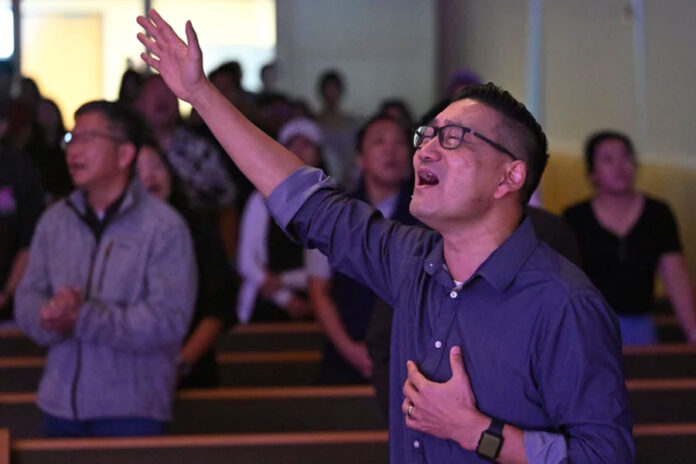
Pastor Owen Lee sings during a service at the Christ Central Presbyterian Church, Sunday, Oct. 13, 2024 in Centreville. (Photo: AP/John McDonnell)
The Rev. Wayne Lee leads an English-speaking church of second- and third-generation Chinese Americans in the heart of Philadelphia’s Chinatown.
His 120-strong evangelical Christian congregation in the critical swing state of Pennsylvania is under the same umbrella as two other immigrant congregations totaling 500 members who speak Mandarin and Cantonese respectively. While those members hold conservative views and support former president Donald Trump, Lee’s younger flock tends to lean left.
“We’re just one church,” he said. “But we’re so diverse that it’s hard to make a blanket statement about political affiliation.”
This community in Philadelphia reflects experiences among the nation’s larger Asian American Christian population. Asian American evangelicals are a diverse, evolving group of voters increasingly seeking to distinguish themselves from their white counterparts.
Lee and others emphasize that while they still hold theologically conservative views on abortion and LGBTQ+ issues, their opinions on those and other issues such as immigration and racial equity tend to be more nuanced and diverse.
Pastors and leaders in the Asian American Christian community say younger evangelicals are moving away from their parents’ and grandparents’ more unconditional loyalty to the Republican Party. That makes them part of a key demographic — independent voters in battleground states who could swing tight elections at the national and local level.
Reaching out to this population can be challenging, experts say. While a few justice organizations gained traction due to increases in anti-Asian hate crimes during the COVID-19 pandemic, political and civic engagement is still relatively rare in Asian American communities.
Asian Americans are the fastest growing voting bloc in the country along with Latinos. Among Asian Americans, Christians are the single largest group of voters, followed by those unaffiliated with religion. According to a 2023 Pew Research Center survey, about a third of Asian American adults identify as Christian. Additionally, about 18% said they felt “close to” Christianity for reasons such as family background, which means a little over half of Asian Americans feel connected to Christianity.
Only 10% specifically identify as born-again or evangelical Protestants. But that number might not include those who hesitate to label themselves “evangelical” because that word now denotes a political identity rather than a religious one, said Jane Hong, associate professor of history at Occidental College in Los Angeles.
“With the rise of the religious right, the term ‘evangelicals’ has been used as a partisan category connected usually to white, conservative Christians,” she said.
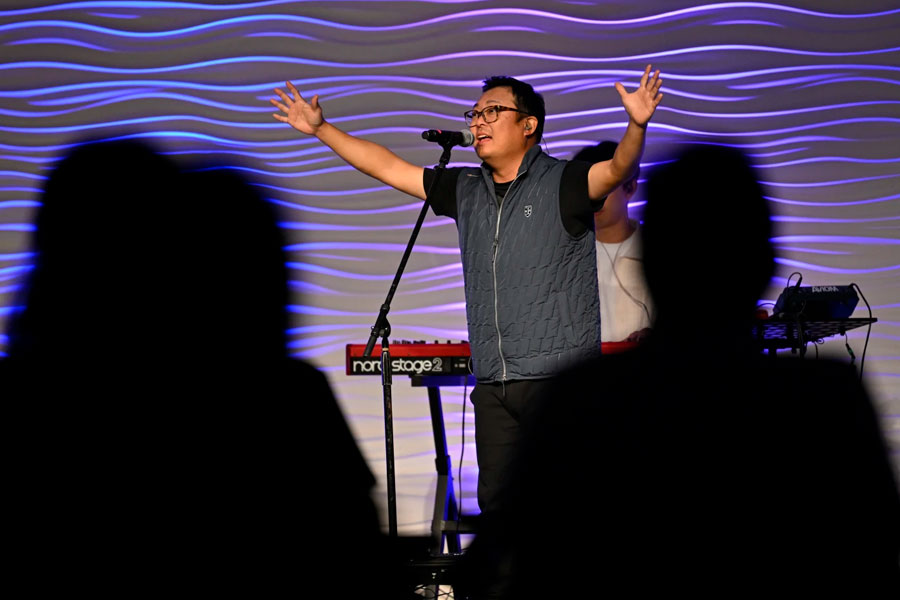
Sun Young sings during a service at the Christ Central Presbyterian Church, Sunday, Oct. 13, 2024 in Centreville. (Photo: AP/John McDonnell)
Many Asian Americans remain theologically conservative
Rather, Asian American Christians, particularly immigrants, widely consider themselves evangelical in a theological sense because of their historic connection to U.S. missionaries in their home countries, said the Rev. Walter Kim, president of the National Association of Evangelicals.
These are people who relate to the key elements of evangelism — submitting to the authority of Scripture, understanding the need to convert and the belief that Christ’s crucifixion is the only sacrifice that can atone for sin.
“The Asian American Christian’s identity is the convergence of cultural experience, historical background and core theological transformation,” Kim said. “Many scholars have argued that Korean Americans, regardless of their denomination, tend to be evangelical because Korean Christianity was heavily influenced by U.S. evangelicals.”
In the Asian American and South Asian diaspora, even some Catholics and Pentecostals count themselves as evangelical.
Owen Lee, senior pastor of Christ Central Presbyterian Church in Centreville, Virginia, who leads a 600-strong Korean American congregation, said Asian American Christians, for a long time, believed they were part of white evangelical spaces — until Trump’s candidacy in 2016.
“To see white evangelicals rallying around (Trump) was discombobulating,” Lee said. “They wanted, for the first time, to distance themselves from white evangelicals without distancing from evangelicalism. White evangelicals tend to be single-issue voters, but that’s not the case with us. Yes, abortion matters to us, we are pro-life. But a candidate’s character matters as well.”
This year, ahead of the presidential election, Lee said, “politics fatigue” appears to have set in and his community members don’t seem happy with either candidate.
“I do hope and pray Asian American Christians take their civic responsibility seriously,” he said. “We should care about how our society is governed and run.”
Pastor Raymond Chang, president of the Asian American Christian Collaborative, an ecumenical nonprofit that began as a response to combating anti-Asian hate crimes during the pandemic, said neither political party is taking this important voting bloc seriously.
“We don’t fall neatly within party lines,” he said, adding that people’s political leanings often depend on their transnational history, family heritage and the way they experience life in America.
“We’re often quiet from the pulpit and the pews when it comes to politics,” he said. «We don’t see much civic engagement beyond voting, but we do vote.”
James Cho, a former seminary professor who has led a Chinese American congregation in Orange County, California, believes this could be a “time of transformation” for Asian American evangelicals even though some are not as politically active as they were four years ago.
Cho, who had always voted Republican, said he sat out the 2016 election because he didn’t like either candidate. In 2020, he said he “quietly voted for Joe Biden.” This time, Cho has decided to vote for Harris. What moved the needle for him was Trump’s baseless claims that Haitian immigrants in the city of Springfield, Ohio, were eating their neighbors’ pets.
“As immigrants and children of immigrants, we’ve all felt alienated at some point in our lives,” he said, adding that some Asian communities face similar stereotypes. “It hits us hard to see another group of immigrants targeted in that manner.”
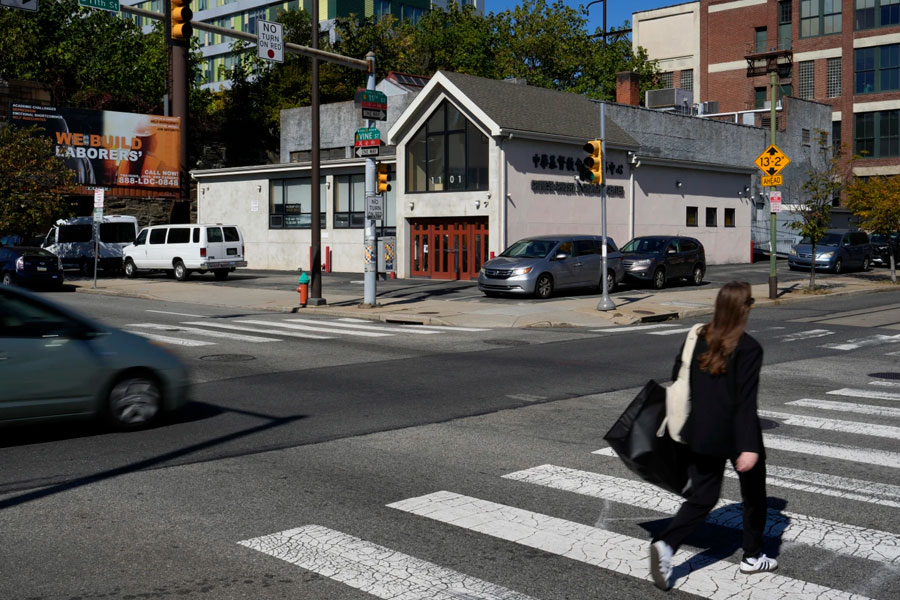
A pedestrian walks near the Chinese Christian Church and Center, Thursday, Oct. 10, 2024, in Philadelphia. (Photo: AP/Matt Slocum)
Younger evangelicals are less loyal to the GOP
Cho sees a chasm between white and Asian American evangelicals — especially the younger generation — quickly widening. For example, Cho says he believes in the separation of church and state, and that the church “should not play a political role in the LGBTQ issue.”
“While I believe it’s a sin to be gay, I also believe I’m a sinner just like them,” he said. “To discriminate against someone who is gay is just wrong.»
The political diversity of church members can be a challenge for pastors. In Philadelphia’s Chinatown, Pastor Wayne Lee says he navigates that landmine by not divulging his political leanings. But he does have conversations with relatives in an attempt to understand their political allegiances.
The pastor said he asked an older relative if he was aware that a vote for Trump could mean immigrating to the U.S. could get more complicated for their family members or make life difficult for existing community members. The response he got was that a vote against Trump would be a vote against God.
The origins of Asian American churches influenced their evolution, said Jerry Park, associate professor of sociology at Baylor University in Waco, Texas. In immigrant churches, elements of ethnic culture were mixed in with religious practice, he said. But as they became more exposed to white evangelical teachings, they started viewing that as the authentic version of Christianity.
“For example, patriarchy is a part of Confucianism,” Park said. “But the churches here, instead of citing Confucianism, pointed to white evangelical rhetoric to justify the subordination of women. So in this racialized environment, we need to question who we’re leaning on to understand our own culture and religious practices.”
For politicians and parties that are attempting to reach out to Asian American Christians, it is important that they don’t assume it is a monolithic group, said Walter Kim.
“There is a diversity of political and social concerns,” he said. “This gives both parties an opportunity to step back from political rhetoric to understand how to negotiate complex issues and build consensus and unity across the community.”
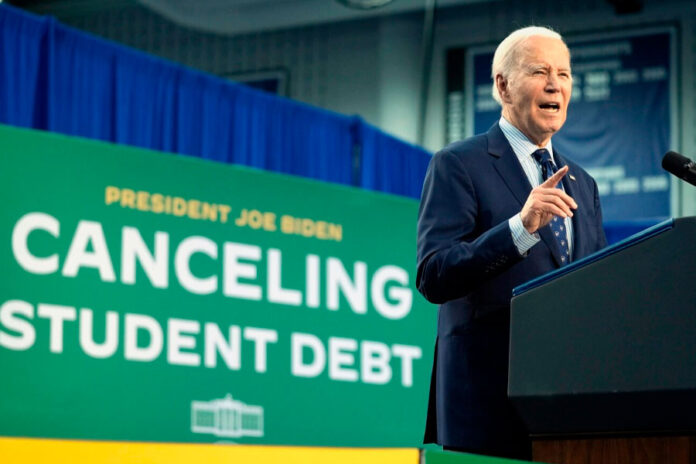
El presidente estadounidense Joe Biden habla sobre la deuda de préstamos estudiantiles, el 8 de abril de 2024, en Madison, Wisconsin. (Foto: VOA/Archivo)
Un programa de condonación de préstamos de estudios para trabajadores públicos había beneficiado a sólo 7.000 personas hasta hace dos años. El Programa de Perdón de Préstamos por Servicio Público se creó en 2007.
Un programa de condonación de préstamos de estudios para trabajadores públicos ha aliviado la situación de más de un millón de estadounidenses, desde los apenas 7.000 de antes de que el gobierno del presidente Joe Biden actualizase la iniciativa hace dos años.
El presidente anunció el hito este jueves, afirmando que su gobierno restablecía así una promesa a los maestros, bomberos, enfermeras y otros funcionarios públicos del país. Celebró la marca pese a que el programa general sigue paralizado por los tribunales tras los recursos legales presentados por estados gobernados por el Partido Republicano.
“Durante demasiado tiempo, el gobierno no cumplió sus compromisos», apuntó Biden en un comunicado.
“Nos comprometimos a solucionarlo, y gracias a las acciones de nuestro gobierno, ahora más de un millón de trabajadores de servicios públicos han recibido la ayuda a la que tienen derecho por ley».
El Programa de Perdón de Préstamos por Servicio Público se creó en 2007 con la promesa a los graduados universitarios de que el resto de sus préstamos federales de estudios quedarían anulados tras 10 años en empleos gubernamentales o sin ánimo de lucro.
Pero desde 2017, la gran mayoría de los solicitantes fue rechazada debido a unas complicadas y poco conocidas normas de elegibilidad.
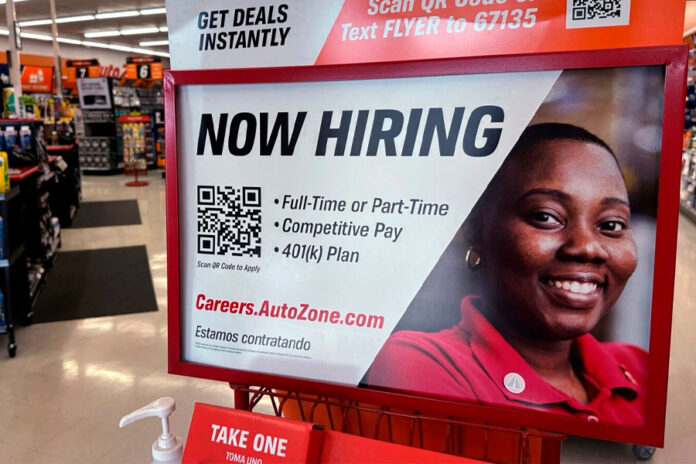
Un cartel de contratación se exhibe en una tienda minorista en Buffalo Grove, Illinois, el viernes 6 de septiembre de 2024. (Foto: VOA/Archivo)
El descenso de nuevas solicitudes de subsidio por desempleo es inesperado, pero los efectos de una huelga y dos huracanes podrían disparar el número en las próximas semanas.
El número de estadounidenses que presentaron nuevas solicitudes de subsidio por desempleo descendió inesperadamente la semana pasada, pero podría seguir siendo alto en el corto plazo debido a los efectos de los huracanes Helene y Milton, que oscurecen el panorama del mercado laboral.
Hubo 19.000 solicitudes iniciales de subsidios estatales por desempleo menos en la semana que terminó el 12 de octubre, para un total de 241.000 ajustadas estacionalmente, informó el jueves el Departamento de Trabajo.
Los economistas encuestados por Reuters habían previsto 260.000 solicitudes. En la semana anterior, habían alcanzado su nivel más alto en un año, debido al huracán Helene, que devastó Florida y amplias zonas del sureste de Estados Unidos a finales de septiembre.
Es probable que la disminución de solicitudes tras Helene se vea contrarrestada por el aluvión de solicitudes que se espera por Milton, que azotó Florida semanas después de Helene.
Una huelga afecta el mercado laboral
La huelga de un mes de unos 33.000 operarios de Boeing BA.N, que está afectando a la cadena de suministro del fabricante de aviones y otros de sus trabajadores, también está enturbiando el panorama del mercado laboral.
El informe de solicitudes cubrió la semana durante la cual el Gobierno encuestó a los empresarios para el componente de nóminas no agrícolas del informe de empleo de octubre. Los economistas esperan que los funcionarios de la Reserva Federal no concedan demasiada importancia al informe de empleo cuando se reúnan a principios de noviembre.
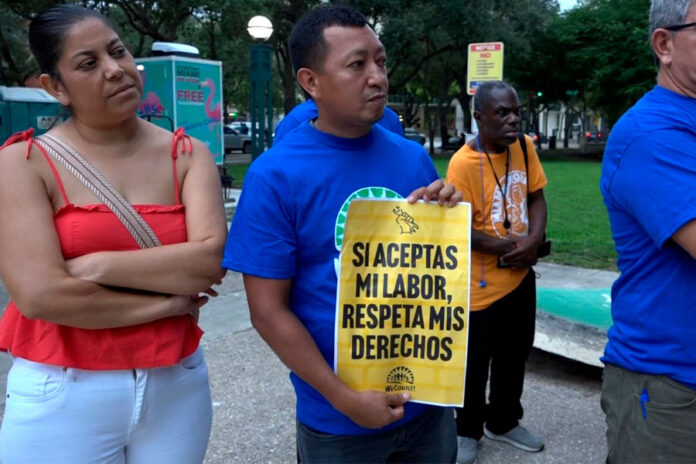
Un grupo de trabajadores de la construcción indocumentados protestan en Miami, Florida, el 16 de octubre de 2024, exigiendo mejores condiciones laborales. (Foto: VOA/ANTONI BELCHI)
Los trabajadores de la construcción en el sur de Florida ganan como promedio 19 dólares por hora, aunque algunos pueden llegar a recibir menos que eso. Muchos en situación migratoria irregular denuncian condiciones laborales precarias y falta de protección.
Hace 20 años que Luciano Pascual dejó su México natal para emprender una nueva vida en Estados Unidos. Empezó trabajando como aprendiz en el sector de la construcción y ahora realiza labores de carpintería en el sur de la Florida, donde reside desde hace más de una década.
En los últimos años, la demanda de trabajo ha aumentado en gran medida debido a que esta región del país está registrando un enorme crecimiento en el sector de la construcción de viviendas. Pascual ha notado una alta demanda en su trabajo, pero reconoce que las condiciones laborales son “pésimas”, tanto a nivel de salario, como de protección por parte de su empleador.
“Llevo más de diez años en la construcción y no ha cambiado nada”, dijo Pascual a la Voz de América.
Él, junto a varios de sus compañeros, se movilizan para exigir a las autoridades del sur de la Florida que impulsen nuevas regulaciones para mejorar las condiciones laborales en el sector de la construcción, especialmente para aquellos que como él no tienen documentos para trabajar legalmente en EE. UU.
“Necesitamos seguridad, sobre todo cuando hay mucho calor. Necesitamos protección con el agua, con el tiempo de descanso y que se cumplan las normas, porque prácticamente es muy difícil trabajar con estas condiciones, con calor extremo y sin tener el líquido apropiado”, apunta el hombre, nacido hace 40 años en el estado mexicano de Toluca.
Los salarios del sector en números
Los salarios por hora en la industria de la construcción comercial en el sur de Florida son considerablemente bajos en comparación con otras regiones del país, según una encuestadel proyecto WeCount!publicada este jueves.
El estudio muestra que el salario medio por hora de los trabajadores de la construcción comercial en esta zona es de 19 dólares, con grandes disparidades entre los diferentes oficios.
Operadores de maquinaria pesada, trabajadores del hierro y electricistas son los que reportaron los salarios más altos dentro del sector. Sin embargo, los obreros, instaladores de paneles de yeso y quienes se dedican a trabajos de plomería figuran entre los peor remunerados. Señalan como particularmente preocupante que el 48 % de los obreros y el 17 % de los instaladores de paneles de yeso ganan menos de 15 dólares por hora.
A pesar de que la mayoría de los encuestados (56 %) ha trabajado para el mismo empleador durante un año o más, y un 27 % ha permanecido tres años o más, los resultados sugieren que el progreso salarial con el tiempo es limitado. Los bajos salarios indican, según el sondeo, que las mejoras en los ingresos son mínimas, incluso con la experiencia adquirida.
Reclamos de mejoras salariales
Arturo Rizo, un nicaragüense que ha trabajado en California y Nevada y que desde 2023 se desempeña como electricista en Miami, reconoce que ahora mismo está cobrando lo mismo que “hace 14 años” cuando estaba en los estados del oeste del país.
“El costo de la vivienda es exagerado y con estos salarios prácticamente se ralla la miseria, teniendo en cuenta el trabajo que hacemos, que es duro y, en mi caso, es muy técnico”, expresó, reivindicando la necesidad de «unos mejores beneficios para tener un poco de vida digna”:
«Estamos construyendo edificios de lujo que, sin nosotros sería imposible, y en cambio nosotros vivimos prácticamente en la miseria. Necesitamos lo mínimo para tener una vivienda digna que, por ahora, no nos lo podemos permitir con nuestros salarios», agregó al respecto.
Reconoce que los datos que se desprenden de ese estudio “son muy ilustrativos” en tanto que los trabajadores de la construcción ganan “entre 16 y 19 dólares la hora”, cuando, según él, se debería estar cobrando “entre 25 y 35 dólares la hora”, de acuerdo con el costo de vida del sur de la Florida.
La situación de los indocumentados
Carlos Antonio, otro empleado residente en Miami, pero nacido en el estado mexicano de Oaxaca, lamenta que la situación es especialmente complicada para las personas que no cuentan con estatus legal en Estados Unidos, ya que se enfrentan “a abusos laborales constantes” y que, en muchas ocasiones, “no son pagados debidamente”.
“Al no contar con los papeles adecuados para estar trabajando acá, me siento vulnerable porque pueden abusar de mí en el trabajo”, relata el joven, de 27 años, que acudió a la concentración con el uniforme de trabajo y recordó que hace unos meses un empleador le quedó debiendo “casi 3.000 dólares y no se pudo reclamar por el miedo a las consecuencias por no tener papeles”.
Además, lamenta que no existe ningún tipo de protección legal por parte de las administraciones públicas para abordar este tipo de situación ya que, de hacerlo de forma privada, “supone un costo que es imposible de asumir”.
“Me siento como uno de los olvidados porque, por más que uno quiera exigir al final de cuentas, los jefes y dueños de empresas llegan incluso a amenazar con el despido y por eso me siento tan vulnerable”, insiste sobre su caso.
La comisión del condado de Miami-Dade, que está al sur de la Florida, ha expresado su intención de revisar su legislación local para tratar de buscar soluciones y protecciones laborales a los trabajadores de la construcción, así como a los agricultores y otros trabajos que realizan mayoritariamente migrantes. Hasta el momento, no se ha tomado alguna medida adicional.
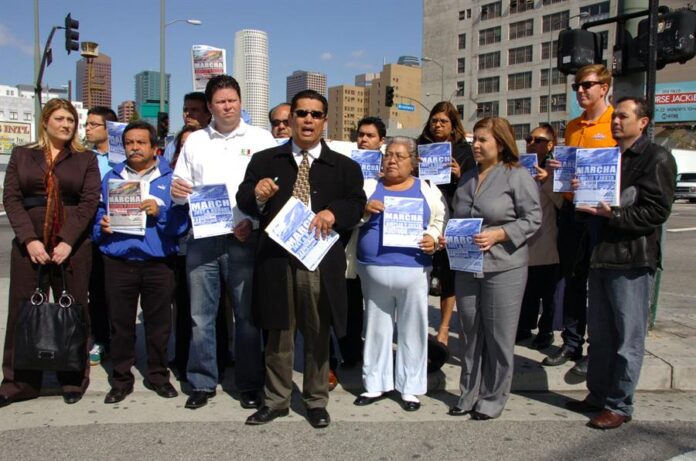
Imagen de archivo de Juan José Gutiérrez (c., de negro), junto a dirigentes de organizaciones defensoras de los derechos de los inmigrantes pertenecientes a la Coalición por los Derechos Plenos de los Inmigrantes, en Los Ángeles (California). (Foto: EFE/Iván Mejía)
Activistas conmemoraron este miércoles 30 años de una multitudinaria marcha en Los Ángeles contra la Proposición 187, una medida republicana que pretendía acelerar la deportación de indocumentados, y despertó la más grande manifestación de hispanos en Estados Unidos hasta esa fecha.
La manifestación que reunió a más de 70.000 personas el 16 de octubre de 1994 se convirtió en la primera gran manifestación de latinos en EE. UU. contra una propuesta de ley que los perjudicaba.
Juan José Gutiérrez, director de la Coalición de los Derechos Plenos para los Inmigrantes (CDPI), dijo a EFE, que esta conmemoración “se da en un momento crucial porque nuevamente los inmigrantes y los indocumentados están amenazados” por políticos que los usan como chivos expiatorios.
La marcha reunió a miles de personas que pedían a los votantes no aprobar el Proyecto de ley 187, que prohibía a los indocumentados el acceso a la salud y la educación pública en California.
Aunque la norma fue aprobada en las elecciones del 8 de noviembre de 1994, tras recibir el impulso del entonces gobernador, el republicano Pete Wilson (1991-1999), nunca entró en vigor debido a una serie de demandas que argumentaba que la ley era inconstitucional, y además cambió el color político de este poderoso e influyente estado para dejarlo en manos demócratas.
El movimiento contra la Proposición 187 representó un despertar para los hijos de inmigrantes nacidos en Estados Unidos, que decidieron luchar contra las políticas antiinmigrantes.
Gutiérrez cree que la conmemoración de este día sirve como recordatorio de que los latinos y los inmigrantes deben unirse ante las amenazas de candidatos como el expresidente Donald Trump (2017-2021), que ha prometido deportaciones masivas si llega a la Casa Blanca.
“Pero también sirve para recordar que cuando decidimos unirnos logramos grandes cambios, que se demuestran en el cambio de California, que pasó de ser un estado republicano a ser un estado de mayoría demócrata”, señaló Gutiérrez.
A la conmemoración de este miércoles se unió el cónsul general de México, Carlos González Gutiérrez, que en 1994 era el encargado de manejar las relaciones de las comunidades migrantes en la sede diplomática y defendió a los mexicanos que estaban en la mira de los ataques.
Como parte de la conmemoración se develó una fotografía que muestra la masiva respuesta a la manifestación que se llevó a cabo en el centro de Los Ángeles.