


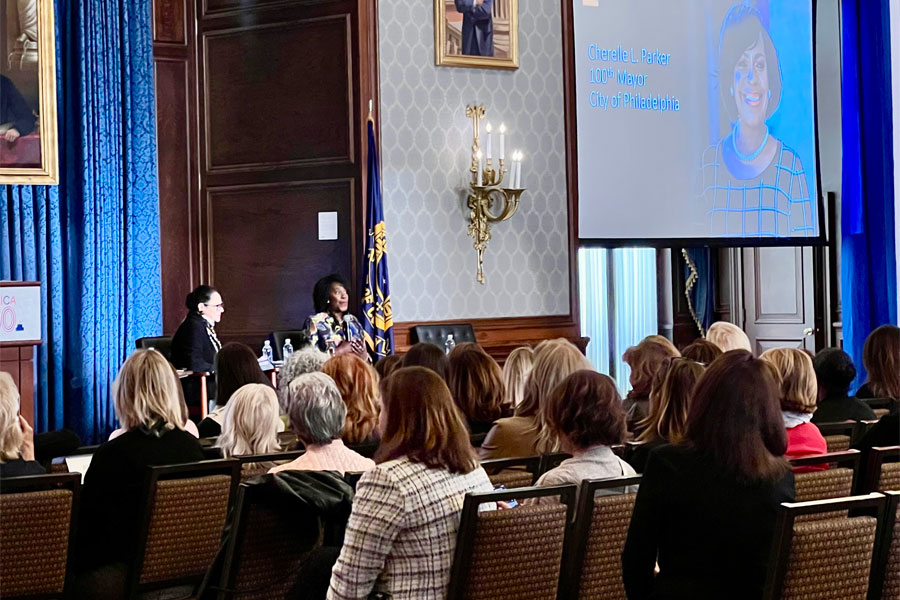
PHILADELPHIA, PA_Long before Mayor Cherelle Parker walked through the brass-framed doors of the Union League of Philadelphia that Tuesday afternoon, the mahogany-paneled ballroom at 140 South Broad Street was already humming with purpose. Women in tailored blazers had gathered from every sector of the city’s leadership — business, government, nonprofits, and philanthropy — their conversations layered over the soft clink of water glasses and the low murmur of a city in motion outside.
The agenda before the mayor’s arrival was weighty: a close look at the city’s proposed Fiscal Year 2027 budget and a shared vision for a cleaner, greener Philadelphia — both in this landmark year marking the nation’s 250th anniversary and in the years stretching beyond.
Across the city, in corner stores and cramped Kensington apartments, the policies discussed in that gilded room carry real weight. Carmen Melendez, 68, still rises before dawn to clean office buildings in Center City. She collects Social Security, but the payments don’t stretch as far as they once did — and the rent on her Kensington apartment keeps climbing.
“I am afraid that as my health begins to decline as I get older, I will not be able to meet my financial needs,” Carmen said. “How do you plan for a future with such radical changes?”
Melendez is exactly the kind of resident Mayor Parker says her agenda is designed to protect.
Then the mayor arrived — and the room shifted. Mayor Parker settled into a chair at the front of the ballroom, across from the event moderator, beneath a large portrait of Abraham Lincoln. As she began to speak, the conversation grew warmer, more personal, more urgent. Heads tilted forward. Nods rippled through the rows. From somewhere near the back, soft “ahas” and quiet “yeses” broke through the formal air. She was not delivering a policy address. She was speaking, it seemed, directly to every woman in that room.
“Two of our Union League member groups collaborated to make this event happen,” said Breanna Pleis, Assistant Director of Member Events at the Union League. “We wanted to highlight the Mayor’s female cabinet and give our members the chance to learn how they can support her work toward a cleaner, greener, and stronger Philadelphia.”
The fireside chat — organized around the mayor’s vision for revitalizing commercial corridors, transforming housing and urban development, and advancing philanthropy and wellness across the city — quickly took on a tone that transcended policy.
When the moderator asked how she stays resilient in an often-contentious political climate, Mayor Parker answered without hesitation.
“I stay focused on the center, on the nucleus,” she said. “I don’t forget who I am or where I came from.”
She spoke of her grandmother’s lasting influence on her life and perspective. She invoked advice she received from Augusta “Gussie” Clark — a groundbreaking Philadelphia political figure who served as a City Council At Large Member from 1972 to 1979 — who told her simply: “No one can be you, better than you.” The instruction was direct: be yourself.
“We don’t have to wear masks anymore,” Mayor Parker told the room. “I strongly encourage you to hold on to your core.”
At one point, the mayor paused and smiled, noting she was glad to be in a room full of estrogen, adding, with a knowing laugh, that in political circles, that doesn’t happen often. The room filled with knowing chuckles.
The policy substance emerged steadily. Among the mayor’s most ambitious commitments is the Housing Opportunities Made Easy (H.O.M.E.) initiative — a $2 billion plan backed by $800 million in municipal bonds aimed at creating and preserving 30,000 housing units across Philadelphia. For aging, working-class residents — women like Carmen Melendez in Kensington, who are one illness or rent hike away from losing their home, the program expands eligibility for housing assistance to seniors earning between 60 and 80 percent above the poverty line, a range that has historically left middle-need households without support. The city issued the first $400 million in H.O.M.E. bonds in March.
As the questions deepened, so did the mayor’s candor. She named the barriers, the inherited disadvantages, the weight of expectation that follows women in public life. And then, without drama, she explained how she navigates it: by refusing to become someone else.
For Cathy Scott, retired president of Local 47 AFSCME and a commissioner on the Women’s Commission of Philadelphia, the mayor’s housing commitment landed with personal weight. Like others in the room, she reached for a single word to describe what she had witnessed: authentic.
“As a senior citizen, I am very concerned about the ability of seniors to stay in their homes,” Scott said. “I am happy to hear that housing assistance will be expanded to seniors at 60 to 80 percent above the poverty line.”
As the fireside chat drew to a close, Mayor Parker acknowledged what was visible to anyone in that room: many of the women seated before her were already doing the work — already showing up, already investing in the city they called home. She simply asked for continued support and for others to get on board. Cards were exchanged. Coats were gathered. Resolve settled quietly in the air.
Vivian Denkins, a career professional at Mid Penn Bank who came that afternoon because she believes in the city’s economic future — and in the opportunities it holds for herself and her family — did not hesitate when asked what she was taking home from the room.
“I am inspired by the Mayor,” Denkins said. “Today, we had a chance to see her human side. She is authentic, approachable, and listens to what people have to say.”