El músico y realizador René Pérez Joglar, conocido profesionalmente como Residente, posa en Nueva York en una fotografía del 12 de julio de 2019. Residente lanzó su segundo álbum solista “Las letras ya no importan” el 22 de febrero de 2024. (Foto: AP/Brian Ach/Invision/Archivo)
Al hablar de sí mismo, de su país y del mundo, en 23 canciones que van de la balada, al son cubano, la música clásica y la experimental, el rapero puertorriqueño Residente toma un enfoque maximalista para su álbum “Las letras ya no importan”. Su principal búsqueda fue la libertad creativa.
“No es que no haya trabajado con libertad antes, pero siempre traté de mantener un equilibro con la idea de que quería ser accesible para todos”, dijo Residente en una entrevista por videollamada reciente desde Nueva York. “Y creo que ahora me voy a olvidar de eso y voy a pensar más en mí, como artista lo que me encantaría hacer es ir tan alto como pueda”.
“Es un álbum muy importante porque está marcando una transición, siempre tengo álbumes que marcan transiciones en mi carrera”, agregó.
La variedad también se refleja en sus invitados, de Christian Nodal a Rauw Alejandro, Silvia Pérez Cruz, Arcángel y Wos.
“Las letras ya no importan” comienza con un mensaje de voz de una amiga violinista de Residente llamada Valentina en el que lo saluda y lamenta no poderlo ver. Residente la había conocido en París hace unos siete años. Valentina murió por suicidio y tras su partida Residente encontraba el número 313 por todas partes.
“La pasé tan bien con ella que siempre se me quedó como que en el espíritu y cuando me enteré de lo que ocurrió no lo podía creer”, dijo.
El segundo tema del álbum se titula “313”, el último mensaje que le envió Valentina llegó a las 3:13. En su video actúan Penélope Cruz, Pérez Cruz y cerca de una veintena de bailarinas con tutús rosados y máscaras de encaje. El video fue filmado en el Palacio Real de la Granja de San Ildefonso en Segovia, España.
“Todo se fue conectando poco a poco”, dijo Residente. “La parte musical empezó como un sueño, yo casi nunca he trabajado temas así. Fue como yo dejándome llevar por un instinto que me iba guiando”.
En el álbum, hay varias rimas sobre el hecho de que Residente, cuyo nombre verdadero es René Perez Joglar, ya tiene más de 40 años, como en “Yo no sé pero sé” con SFDK, “Quiero ser baladista”, su balada con Ricky Martin, y “Ron en el piso” donde canta «No es que me ofenda, pero me siento viejo/Cuando los chamaquito’ ahora me dicen ‘Leyenda’», cuyo video tiene un funeral simbólico de su versión joven e integrante de Calle 13.
“Para mí han sido la mejor década de mi vida”, dijo. “Me los he disfrutado y los sigo disfrutando, me gustan y me siento súper contento de esta década que estoy pasando. Sí estoy más consciente del tiempo y de cómo pasa, pero más que por mí por la gente a mi alrededor, pierdo amigos, mueren, veo a mis papás más mayores, viendo el tiempo cómo va corriendo, pero me siento súper contento”.
“Hice un cambio drástico a los 40, como que desde los 39 o 38 empecé a alejarme de cosas para empezar otras, hacer cosas nuevas” agregó.
Parte de esas “cosas nuevas” es su faceta como actor en la película “In the Summers” de la directora queer colombiana-estadounidense Alessandra Lacorazza, que se llevó el Gran Premio del Jurado en la 40ª edición del Festival de Cine de Sundance. En el filme, Residente interpreta a un padre de familia adicto.
“Fue una experiencia súper bonita, tan bonita que lo quiero volver a hacer y quiero hacerlo más veces; estoy trabajando en esa transición de moverme de la música a la actuación y a la dirección”, apuntó el artista galardonado con 28 Latin Grammy y un Grammy. “Me encantó pasar por el proceso, lo que sentí mientras actuaba es algo que siento en algunas canciones cuando las canto en vivo en los conciertos y se siente bien, es una cosa del alma”.
“Las letras ya no importan” es el segundo álbum solista de Residente y el primero en siete años.
Además de mirar en su interior, Residente también canta sobre la represión en Latinoamérica en “This is Not America”, uno de los primeros temas que lanzó del disco en 2022; la “ironía” de vivir en Puerto Rico a ritmo de son con Al2 El Aldeano en “En talla”, y de la resistencia de culturas como la palestina en “Bajo los escombros”, un tema para el que invitó a la cantante Amal Murkus y otros músicos palestinos. Uno de ellos estuvo en Gaza durante el bombardeo y grabó imágenes que le hizo llegar a Residente.
“Es horrible lo que está ocurriendo y no tiene ninguna justificación”, dijo Residente. “Tan horrible como los secuestros que han ocurrido en Israel, como todo lo que está ocurriendo en Gaza”.
En contraste con el pasado, en enero disminuyeron los precios del petróleo y del gas natural, a pesar de los conflictos armados en curso en Europa y en el Medio Oriente. El principal factor contribuyente a esta diferencia es el retorno de Estados Unidos como el principal productor de petróleo y de gas natural, junto a creciente producción de crudo en Brasil, Colombia y Guyana. Entretanto, ha disminuido el porcentaje de la producción mundial contribuido por la Organización de Países Exportadores de Petróleo y asociados, incluyendo a Rusia, desde casi la mitad en la década de los años setenta, a un tercio en 2020.
Por ejemplo, con 13 millones de barriles producidos por día, el año pasado en Estados Unidos los precios del crudo se mantuvieron en alrededor de $70 por barril, mientras que el galón de gasolina sin plomo ha disminuido a menos de $3.50, desde $5.00 el año pasado. El descenso en el precio del gas natural es más pronunciado, debido también a un invierno leve y producción abundante. En enero, la producción diaria de gas natural en Estados Unidos disminuyó levemente a 104,000 millones de pies cúbicos, desde el récord de 106,000 millones diarios de pies cúbicos alcanzado en diciembre pasado, mientras que los precios en febrero disminuyeron 18 por ciento desde el año pasado. Además, con 11 por ciento de su producción doméstica exportado a los mercados europeos y asiáticos, Estados Unidos se ha convertido en el principal exportador mundial de gas natural licuado
By contrast to the past, in January both oil and natural gas prices decreased, despite the ongoing armed conflicts in Europe and the Middle East. The main contributing factor to this difference is the return of the United States as the main producer of oil and natural gas, together with increased production in Brazil, Colombia, and Guyana. Meanwhile, the percentage of world production contributed by the Organization of Petroleum Exporting Countries and associates, including Russia, has decreased, from almost half in the seventies, to one third in 2020.
For instance, with 13 million barrels produced per day, last year in the US oil prices remained at around $70 per barrel, while a gallon of unleaded gasoline has fallen to less than $3.50, from almost $5.00 a year ago. The decrease in natural gas prices is more pronounced, due also to a mild winter and abundant production. In January, daily production of natural gas in the United States decreased slightly to 104 billion cubic feet, from a record of 106 billion cubic feet reached last December, while prices in February decreased 18 percent from a year earlier. Additionally, with 11 percent of its domestic production exported to European and Asian markets, the United States has become the main world exporter of liquified natural gas.
*International analyst and consultant, former Director ECLAC Washington. Commentator on economic and financial issues for CNN en Español TV and radio, UNIVISION, TELEMUNDO and other media.
Philadelphia Flyers alumni Patrick Sharp skates in Philadelphia, Friday, Jan. 26, 2024. It has been 20 years since the Philadelphia Flyers and Ottawa Senators took part in a brawl-filled slugfest in South Philly. It remains the record for the most penalty minutes in a game in NHL history with 419. (Photo: AP/Matt Rourke)
PHILADELPHIA. — The 2004 brawl between the Philadelphia Flyers and Ottawa Senators still holds the NHL record for the most penalty minutes in a game in NHL history with 419. It ended with 21 fighting majors, 20 ejections and a handful more misconduct penalties. Only one suspension was doled out.
Twenty years later, those who were there recall how it all went down.
WHAT LED TO IT
On Feb. 26, Ottawa’s Martin Havlat high-sticked Philadelphia’s Mark Recchi in the head. He was suspended for two games. The next game came on March 4, a rematch between the Senators and the Flyers, whom they had eliminated the previous two playoffs.
Recchi: “(League executive) Colin Campbell did a good job there.”
Flyers winger John LeClair: “That’s what started it, obviously. Nobody forgets that kind of stuff.”
Flyers goaltender Robert Esche: “There was bad blood going in. It was toward the end of the season, obviously, and I think all of us were getting ready for the playoffs. But for whatever reason, that March day it was a weird springtime or something.”
Senators tough guy Todd Simpson: “The first 55 minutes it was just a regular game. Nobody said to me, ‘Oh, look out, they’re going to be going after Havlat,’ and I didn’t really feel like they were during the game. Nothing really happened during the game. It was pretty run of the mill, just a game in early March.»ROUND 1
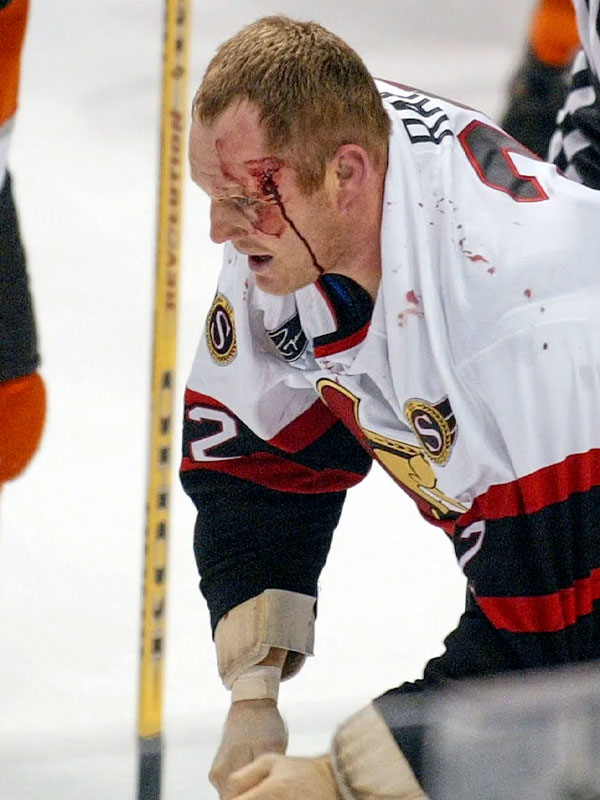
With under 1:45 left in regulation and the Flyers up 5-2, Philadelphia’s Donald Brashear picked a fight with Rob Ray, a bout between two of the most frequent fighters in league history.
Brashear: “You want to make something happen, and you want to get respect back. Something had to be done.”
Esche: “Brash had it made up in his head how that night was going to go at the end of the day. He went up and down the ice if I remember right. Then he came back in front of me, off to the corner they started fighting. It was actually a good fight. Brash was doing a great job.”
Ray: “It was just Donald and I in front and a lot of going on. And I remember coming out of it and I was leaking from the corner of both eyes. And I’m like, ‘I have never been cut before really in anything like that.’”
Senators captain Daniel Alfredsson: «It kind of evolved from there.”
Senators winger Peter Bondra: «It almost felt like the water in a pot started boiling, and one thing pushed to another.”ESCALATION
Simpson: “The linesman’s taking Brashear over to the bench or to the dressing room. They’re taking Brashear over toward the bench to go to his dressing room and then he just suckered Brian Pothier. Like he just wound up and slugged him, and then I was right there and so I jumped Brashear and grabbed him and it was just a huge brawl.”
Flyers forward Patrick Sharp: “I was on the first shift, the first wave of the brawl, so I actually got pounded pretty good by Todd Simpson (who) grabbed me. … Then another one escalated, and I was on the ice just kind of chilling and I found myself in a 6-on-6 brawl. That’s when Eschie and (Ottawa goaltender) Patty Lalime went at it.»
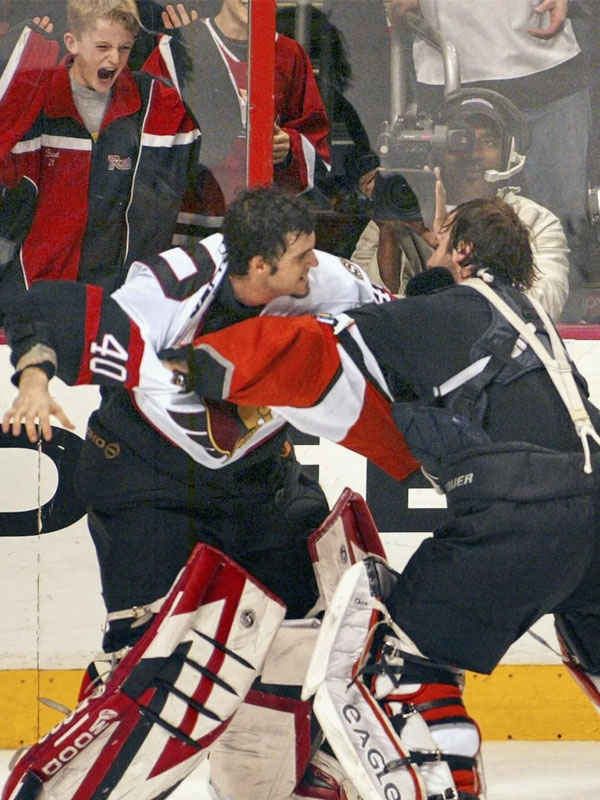
Esche: “All hell broke loose. I remember Danny Markov laying on the ice and there was a scrum going on. I went over to go pick somebody up and then I turn around and Patrick Lalime was right there, no helmet, no nothing. I was like, ‘Oh, what are you doing here?’ I was shocked. But it was fun.”
Sharp: “The crowd was going crazy. The refs were taking a lot of time to figure out who was kicked out of the game and what the penalties were going to be, and I was able to kind of sneak through it all. I didn’t get any penalties during that brawl, so I stayed in the game. And it was like every whistle there was another brawl going, and slowly but surely the bench was getting quieter and less and less bodies on the ice.”
Simpson: “Someone came into the room and said, ‘Simmer, you didn’t get a penalty, you’re still in the game.’ I’m like, ‘Oh, this is awesome, I’m going to find somebody.’ I went back on the bench, and I’m sitting there and I’m all excited because we’re trying to get some revenge on somebody and then the linesman comes over. He’s like, ‘Todd, what are you doing? You’ve got whatever, 5 and a misconduct.’ That’s kind of what I thought, so I went back to the dressing room for the second time.”
Ottawa Senators’ Rob Ray is led bleeding from a fight with Philadelphia Flyers’ Donald Brashear in the third period of an NHL hockey game March 5, 2004, in Philadelphia. It has been 20 years since the Philadelphia Flyers and Ottawa Senators took part in a brawl-filled slugfest in South Philly. It remains the record for the most penalty minutes in a game in NHL history with 419. (Photo: AP/H. Rumph, Jr./File)
ROUND 2
There was still 1:42 left in the game but tempers were still simmering and it wasn’t long before whistles blew again as the fighting continued.
Senators center Bryan Smolinski: “Once that kind of subsided, I think it might’ve been our turn to maybe respond, and I know we did with (Zdeno) Chara and (Chris Neil). It was so much fun.»
LeClair: “Some of it was guys picking the wrong guys to dance with (Chara fighting Mattias Timander and Neil fighting Radovan Somik), so, all right, you’re going to do that, the next shift up we’re going to do this and that kind of stuff went on.”
Recchi: “We had guys that I don’t think ever had a fight in their life before and that were fighting.”
Ray: “I’m sitting in the (locker) room and I’m in there with the trainers and shooting the crap and then every stoppage of play, there’d be one or two more guys coming in.”
Esche: “Then it just kept on going and going and going. Sometimes you can’t make sense of those things.»
Flyers defenseman Chris Therien: “I was watching it all from the locker room. It was like, jeez, one guy’s coming in and then another. I’m like, ‘What the hell’s going on out there?’”
Flyers coach Ken Hitchcock: “I guess I was the instigator of the whole thing, I think. My whole thing was I knew (Senators coach Jacques Martin) was down two players. Two players got injured during the game, and I tried to run his bench out. That’s what I tried to do. I knew he had two less players, and so I just tried to run his bench out so he’d have zero and I’d have two left.»ROUND 3
There was still 1:39 on the clock. The brawling, incredibly, wasn’t over.
Sharp: “The building was rocking, sorting out the penalties and Hitch came over and tapped me on the shoulder and said, ‘When 39 gets on the ice, you’re up.’ And 39, I’m thinking to myself, ‘Who the heck’s 39? Is that Dominik Hasek? Who is that?’ And I looked over and it was Jason Spezza, who we shared the same agent at the time and Spezz became a good friend of mine.”
Smolinksi: “I remember just saying, ‘Can we let at least 30 seconds ago before we do anything silly?’ And I think they won the faceoff, (Recchi) ran around because he was hot and somehow we ended up at center ice, him and I.”
Recchi: “We were like, ‘Hey, it’s our turn, let’s go, boys.’ Then you jump on the ice. Johnny (LeClair) all of a sudden was fighting somebody and I turned around and grabbed the first guy and let’s go, and everybody else was going as well.”
Sharp: “Spezz jumped on the ice and I just remember thinking, ‘He’s a top pick in the draft and I’m going to try to chase him around the ice and someone tougher is going to grab me.’ It’s one thing to fight when you’re in the NHL when it’s a spur of the moment, but when you have time to think about it once it’s coming, you get butterflies in your stomach. And I looked over, I saw Simon Gagne and he just gave me a look like, ‘Good luck, man.’”
Smolinski: “Both coaches are screaming at each other. I remember (Flyers assistant) Craig Hartsburg screaming, and he was one my idols. I’m like, ‘My idol is actually screaming at me.’»
Therien: “It gets to a point where it ends up being more like a WWE event than an actual hockey game.”
Sharp: “I just looked at Spezz and said, ‘We’ve got to go here.’ He was ready to go anyway. I think at that point everybody that was on the ice was ready to go.»
Alfredsson: “I was lining up with (Sami) Kapanen and we said, ‘Should we go as well?’ And we decided not to.”
Bondra: “(There were) only five guys or six guys left on each side, and we had a power play. I was in front of the net, and Sean Burke, he was kind of yelling or he asked me to go fight or something or he was trying to get something. At that time, I didn’t react. If you jump me, I probably most likely have to hold him somehow, but I felt like there’s no way I’m going to initiate it or just go after him.»
Alfredsson: “When what ended up being the last fight was over, I was still on the ice and looking over on the bench, there was more coaches than players left.”
Ottawa Senators goalie Patrick Lalime (40) and Philadelphia Flyers goalie Robert Esche join in the fight-filled final 1:45 of the third period of an NHL hockey game March 5, 2004, in Philadelphia. It has been 20 years since the Philadelphia Flyers and Ottawa Senators took part in a brawl-filled slugfest in South Philly. It remains the record for the most penalty minutes in a game in NHL history with 419.(Photo: AP/George Widman/File)
THE AFTERMATH
Sharp: “In the moment, it was awesome. I had so many messages after the game, and the building, the energy, the fans, it was loud. I felt like a tough guy skating off the ice, that’s for sure.”
Martin: “It was kind of unusual for our team, really, because we weren’t known as a team that was a physical team or an aggressive team … I know (Flyers general manager) Bobby Clarke was trying to get at the dressing room and get at me.”
Hitchcock: “Clarkie and I were really upset at the time.”
LeClair: “I thought it was great team-building for our team. Everybody was involved, the way the guys stuck up for each other, I thought it was a good thing to see how close that team was and what we did for our team. It’s just one of those things that happens in hockey. It wasn’t planned or anything like that. That’s kind of the way the game went.”
Alfredsson: «I don’t think anybody anticipated going to that level, but it did. And I think for us going forward, it was a unifying moment for the group.”
Smolinski: «The bell rang, we stepped up to it. Everyone had to do what they did, and I think both teams became a closer-knit team after that because everyone knew that you had to step up for your teammates.”
Recchi: “That just shows you how close we were. And we were probably going that direction anyways, but that never hurts you.”
The Senators made the playoffs for an eight consecutive season. The Flyers reached Game 7 of the Eastern Conference Final before losing to eventual Stanley Cup champion Tampa Bay.
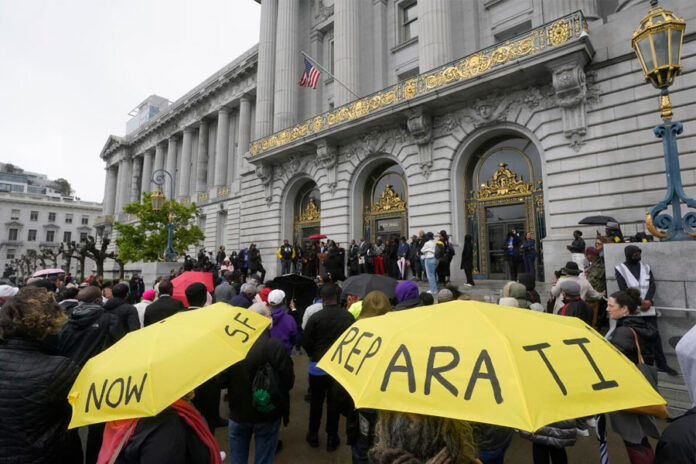
A crowd listens to speakers at a reparations rally outside of City Hall in San Francisco, on March 14, 2023. San Francisco's supervisors will offer a formal apology to Black residents for decades of racist laws and policies perpetrated by the city. All 11 supervisors have signed on as sponsors of an apology resolution to be voted on Tuesday, Feb. 27, 2024. (Photo: AP/Jeff Chiu/File)
San Francisco’s supervisors plan to offer a formal apology to Black residents for decades of racist laws and policies perpetrated by the city, a long-awaited first step as it considers providing reparations.
The San Francisco Board of Supervisors is scheduled to vote Tuesday on the resolution apologizing to African Americans and their descendants. All 11 members have signed on as sponsors, guaranteeing its passage. It would be one of the first major U.S. cities to do so, following Boston in issuing an apology and later voting to form a reparations task force in 2022.
The resolution calls on San Francisco not to repeat the harmful policies and practices, and to commit “to making substantial ongoing, systemic, and programmatic investments” in Black communities. There are about 46,000 Black residents in San Francisco.
“An apology from this city is very concrete and is not just symbolic, as admitting fault is a major step in making amends,” Supervisor Shamann Walton, the only Black member of the board and chief proponent of reparations, said at a committee hearing on the resolution earlier this month.
Others say the apology is insufficient on its own for true atonement.
“An apology is just cotton candy rhetoric,” said the Rev. Amos C. Brown, a member of the San Francisco reparations advisory committee that proposed the apology among other recommendations. “What we need is concrete actions.”
Rev. Amos Brown speaks during a rally in support of reparations for African Americans as Supervisor Shamann Walton, left, listens outside City Hall in San Francisco, on Sept. 19, 2023. San Francisco’s supervisors will offer a formal apology to Black residents for decades of racist laws and policies perpetrated by the city. All 11 supervisors have signed on as sponsors of an apology resolution to be voted on Tuesday, Feb. 27, 2024. (Photo: AP/Eric Risberg/File)
An apology would be the first reparations recommendation to be realized of more than 100 proposals the city committee has made. The African American Reparations Advisory Committee also proposed that every eligible Black adult receive a $5 million lump-sum cash payment and a guaranteed income of nearly $100,000 a year to remedy San Francisco’s deep racial wealth gap.
But there has been no action on those and other proposals. Mayor London Breed, who is Black, has stated she believes reparations should be handled at the national level. Facing a budget crunch, her administration eliminated $4 million for a proposed reparations office in cuts this year.
Reparations advocates at the previous hearing expressed frustration with the slow pace of government action, saying that Black residents continue to lag in metrics related to health, education and income.
The resolution apologizes to African Americans and their descendants “for systemic and structural discrimination, targeted acts of violence, and atrocities; and committing to the rectification and redress of past policies and misdeeds.”
The resolution contains findings, including property redlining, the razing of the historically Black Fillmore neighborhood in the name of urban renewal, and intentional policies and practices by the city that robbed Black residents of opportunities to build generational wealth.
Black people, for example, make up 38% of San Francisco’s homeless population despite being less than 6% of the general population, according to a 2022 federal count.
In 2020, California became the first state in the nation to create a task force on reparations. The state committee, which dissolved in 2023, also offered numerous policy recommendations, including methodologies to calculate cash payments to descendants of enslaved people.
But reparations bills introduced by the California Legislative Black Caucus this year also leave out financial redress, although the package includes proposals to compensate people whose land the government seized through eminent domain, create a state reparations agency, ban forced prison labor and issue an apology.
Cheryl Thornton, a San Francisco city employee who is Black, said in an interview after the committee hearing that an apology alone does little to address current problems, such as shorter lifespans for Black people.
“That’s why reparations is important in health care,” she said. “And it’s just because of the lack of healthy food, the lack of access to medical care and the lack of access to quality education.”
Other states have apologized for their history of discrimination and violence and role in the enslavement of African Americans, according to the resolution.
In 2022, Boston became the first major city in the U.S. to issue an apology. That same year, the Boston City Council voted to form a reparations task force.
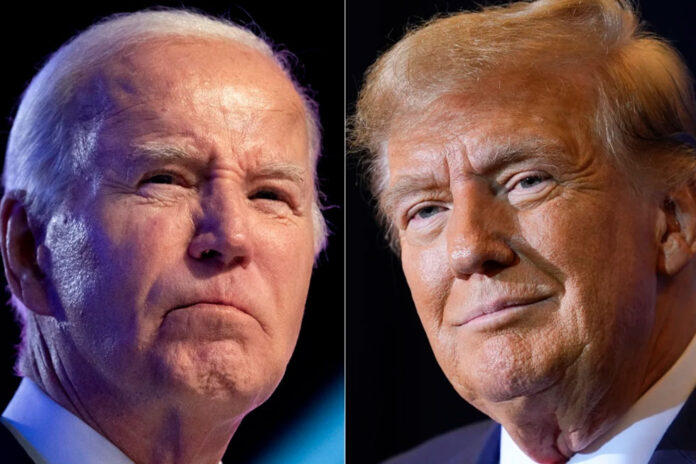
El presidente Joe Biden (i) en una foto tomada el 5 de enero de 2024, y el expresidente Donald Trump (d) en una foto tomada el 19 de enero de 2024. (Foto: AP)
Si bien Joe Biden y Donald Trump están marchando hacia sus respectivas nominaciones presidenciales, las primarias de Michigan que se realizan el martes plantean peligros políticos para ambos.
A pesar de su indudable dominio sobre el Partido Republicano, Trump enfrenta un bloque persistente de votantes que favorecen a su único rival, la exembajadora ante la ONU, Nikki Haley, y que son escépticos sobre sus probabilidades en una revancha contra Biden.
En cuanto a Biden, está enfrentando quizás su mayor obstáculo electoral hasta la fecha: un enérgico movimiento de votantes desilusionados con su manejo de la guerra en Gaza y su relación con el primer ministro israelí Benjamin Netanyahu, que consideran de un apoyo excesivo.
Tales dinámicas quedarán a prueba en las primarias de Michigan, las últimas antes del Supermartes y las de un estado que será vital para ganar las elecciones de noviembre. Aun si ambos ganan de manera aplastante, que es lo que se espera, ambas campañas estarán escudriñando sus respectivos puntos débiles en un estado que Biden ganó por apenas 3 puntos porcentuales en 2020.
En una entrevista con una radio local de Michigan, Biden dijo que ése será “uno de cinco estados” que determinarán el ganador en noviembre.
Michigan tiene la mayor concentración de estadounidenses de ascendencia árabe: más de 310.000 ciudadanos allí tienen raíces del Oriente Medio o del norte de África. Casi la mitad de los aproximadamente 110.000 habitantes de Dearborn tienen ascendencia árabe.
El estado se ha convertido en el epicentro del descontento demócrata por las acciones de la Casa Blanca respecto de la guerra entre Israel y el grupo palestino Hamás, que lleva casi cinco meses y que se desató luego que Hamás atacó a Israel el 7 de octubre, matando a unas 1.200 personas, en su mayoría civiles, y llevándose como rehenes a más de 200. Israel ha reaccionado bombardeando Gaza, matando a casi 30.000 personas de las cuales, según funcionarios palestinos, las dos terceras partes son mujeres y niños.
Hay algunos demócratas que, molestos por el hecho de que Biden ha apoyado la ofensiva israelí y ha resistido los pedidos de un cese de fuego, han llamado a votar “sin compromiso”.
La campaña por el “sin compromiso”, que empezó plenamente hace apenas unas semanas, tiene el apoyo de funcionarios como la legisladora demócrata Rashida Tlaib, la primera palestina-estadounidense en llegar al Congreso, y el excongresista Andy Levin, quien perdió una primaria demócrata hace dos años cuando grupos proisraelíes invirtieron más de 4 millones de dólares para derrotarlo.
Las notificaciones de defunciones recibidas han sido de cinco casos confirmados, 16 casos probables y 14 sospechosos, detalla un boletín especial de Vigilancia de Leptospirosis, División de Epidemiología e Investigación del DS. (Foto: EFE/Thais Llorca/Archivo)
San Juan, Puerto Rico.– Unas 35 personas murieron en Puerto Rico en 2023 asociadas con leptospirosis, una enfermedad bacteriana que puede afectar gravemente a los riñones e hígado y causar meningitis, dificultad para respirar y sangrado, informa este martes el Departamento de Salud (DS) local.
Las notificaciones de defunciones recibidas han sido de cinco casos confirmados, 16 casos probables y 14 sospechosos, detalla un boletín especial de Vigilancia de Leptospirosis, División de Epidemiología e Investigación del DS.
De los 14 casos sospechosos, tres se encuentran bajo investigación, diez casos sospechosos fueron adjudicados a otras causas de muertes y un caso se mantuvo clasificado como sospechoso luego de finalizada la investigación.
El mes de enero fue el más mortal con 6 fallecidos, y marzo y septiembre le siguieron con 5 cada uno.
En total, durante 2023 se reportaron 1.573 casos en 76 de los 78 municipios de la isla de todas las regiones del DS.
La región con más casos totales reportados fue Ponce con 424, y el municipio con más número de casos totales reportados fue San Juan con 193.
El municipio con mayor número de casos confirmados y probables fue Adjuntas con 33.
Mientras, según el más reciente Informe Mensual de la Vigilancia de Leptospirosis -16 de febrero de 2024- para el periodo del 1 de enero de 2023 al 3 de febrero de este año el DS ha recibido preliminarmente 2.463 reportes de leptospirosis en la isla.
En ese periodo, se recibieron 311 casos que cumplieron con la definición de caso, especifica la agencia sanitaria en el informe.
Estos se distribuyen en 263 casos probables y 48 casos confirmados.
Mientras, para el periodo del 31 de diciembre de 2023 al 3 de febrero de 2024 se han recibido preliminarmente 22 reportes que cumplieron con la definición de caso.
Estos se distribuyen en 18 casos probables y 4 casos confirmados.
La incidencia del periodo fue estimada preliminarmente en 0,65 por cada 100.000 habitantes.
El nivel más bajo de incidencia se observó durante el mes de abril del año 2023, con una tasa de 0,47 por cada 100.000 habitantes, mientras el nivel más alto se observó durante el mes de octubre del año 2023 con una tasa de 1,06 casos por cada 100.000 habitantes.
Entre los primeros síntomas de la enfermedad destacan: fiebre, dolor de cabeza, dolores musculares, ojos enrojecidos, vómitos, diarrea, dolor abdominal, ictericia (piel y ojos amarillentos), sarpullido y tos.
Una donación de mil millones de dólares permitirá a la Escuela de Medicina Albert Einstein, del condado neoyorquino del Bronx, ofrecer clases gratuitas a sus alumnos.
El gesto fue anunciado este lunes por la institución en un comunicado.
«Este regalo histórico -el mayor hecho jamás a una escuela médica en el país- asegurará que ningún estudiante de Einstein tenga que pagar su matrícula nunca más», dijo el centro.
La donante, Ruth Gottesman, fue profesora de la escuela, que se encuentra en uno de los barrios más deprimidos de la Gran Manzana.
Según el periódico The New York Times, el Bronx cuenta con una alta tasa de muertes prematuras y es el condado menos salubre de Nueva York, mientras que la mayor cantidad de donaciones a hospitales y escuelas de medicina las suele recibir el vecino, y rico, Manhattan.
Gracias al dinero de Gottesman, que le dejó en herencia su marido, un inversor de Wall Street que fue protegido de Warren Buffett, al morir hace dos años, los estudiantes de Einstein no tendrán que enfrentarse a los cientos de miles de dólares de deuda estudiantil que suelen acumular durante la carrera.
La escuela espera que la donación «atraiga a un grupo de individuos con talento y diversos que de otra manera tal vez no tengan los medios para plantearse una educación médica», según el comunicado.
No es la primera vez que un colegio de medicina neoyorquino ofrece matrículas gratuitas a sus estudiantes. En 2018, la Escuela de Medicina de la Universidad de Nueva York anunció un programa similar para hacer frente a los altos costes que afrontan los alumnos del país.
Gottesman, por su parte, no ha querido que su apellido quede inmortalizado como parte de la donación, pero sí puso una condición: que el colegio mantenga el nombre de Albert Einstein, que el legendario físico accedió a dar al centro cuando abrió sus puertas, en 1955.
Candidata presidencial opositora de la coalición Fuerza y Corazón por México, Xóchitl Gálvez, hablando tras haberse registrado como candidata formal en el Instituto Nacional Electoral (INE), en la Ciudad de México (México). (Foto: EFE/Sáshenka Gutiérrez/Archivo)
Ciudad de México, .- Con un total de 226.661 solicitudes recibidas a través del Sistema de Registro para Votar desde el Extranjero (SRVE), el Instituto Nacional Electoral (INE) de México cerró el 25 de febrero el periodo de registro para que ciudadanos mexicanos residentes en el extranjero participen en las elecciones 2024, informó este lunes la autoridad electoral.
En un comunicado, el INE indicó que con ese número rebasó la cifra obtenida en la pasada elección federal de 2018, donde el número de inscripciones fue de 181.873 ciudadanos, es decir, para las elecciones de 2024 se registraron un 24.63 % más de mexicanos residentes en el extranjero.
«Todas las solicitudes recibidas están sujetas a un periodo de revisión y determinación de procedencia hasta el 5 de marzo, por parte de la Dirección Ejecutiva del Registro Federal de Electores (DERFE), a fin de garantizar que cumplan con los requisitos establecidos en la normatividad vigente», apuntó el INE.
El INE recordó que el pasado 15 de febrero, el Consejo General del organismo aprobó extender por segunda ocasión el plazo de registro para ejercer el voto desde el extranjero, del 20 al 25 de febrero, esto «en respuesta al creciente interés de los mexicanos residentes en el extranjero y con el fin de ampliar las posibilidades de participación ciudadana fuera del país».
Dicho periodo adicional permitió la inscripción de más de 35.000 connacionales, pues con corte al 20 de febrero se habían recibido 190.843 solicitudes.
De acuerdo con el artículo 334 de la Ley General de Instituciones y Procedimientos Electorales (LGIPE), el plazo para solicitar la inscripción a la Lista Nominal del Electorado en el Extranjero es del 1 de septiembre al 15 de diciembre del año previo a la elección; no obstante, el INE aprobó, en un primer momento, ampliar el plazo hasta el 20 de febrero de 2024 y, posteriormente, avaló extenderlo 5 días más.
El órgano electoral indicó que la modalidad que más se eligió fue la electrónica por internet con el 69,86 % del total, seguida de la vía postal con 22,93 % y el voto presencial con 7,2 % y precisó que el 84,7 % de las solicitudes de registro se realizaron a través de la página votoextranjero.mx y el 15.30 % restante vía Inetel.
De las solicitudes recibidas, el INE expuso que 120.756, equivalente al 53,27 %, fueron realizadas por hombres, mientras que 105.905, el 46,72 %, correspondieron a mujeres.
Mientras que el grupo de edad donde se concentró el mayor número fue el de 53 años o más con 58133; seguido del grupo de 42 a 47 años con 36.063 y el de 48 a 53 años con 35.943.
Según los datos del SRVE, 131.693 solicitudes de registro se hicieron con una Credencial para Votar expedida en el extranjero y Estados Unidos fue el país con mayor número de solicitudes con 156.856, seguido de Canadá con 16.720 y España con 13.472.
México tendrá las elecciones más grandes de su historia el 2 de junio, cuando más de 97 millones de mexicanos están llamados a renovar 20.375 cargos federales, incluyendo la presidencia, los 500 escaños de la Cámara de Diputados y los 128 del Senado, así como nueve gobiernos estatales.
A Philadelphia car theft suspect who had his hands cuffed behind him fled from two police officers outside a hospital where he had been taken for examination, police said Monday.
Alleem Bordan, 29, had been arrested after he was found asleep early Sunday in a car that had been reported stolen Thursday while the owner was making a food delivery, Deputy Commissioner Frank Vanore said. Bordan complained of pain early Monday and was taken to Temple University Hospital’s Episcopal Campus in northeast Philadelphia.
Bordan — who police said sometimes has used the spelling Borden — was being walked back to a vehicle by two officers after he was discharged from the hospital when he ran from them and escaped, still with his hands cuffed behind him, Vanore said.
Bordan, described as 5-foot-6 (168 centimeters) and 145 pounds (65 kilograms) with braids and a beard, has other arrests in Philadelphia and elsewhere, including two other vehicle thefts, but is not considered dangerous, Vanore said. Anyone spotting him is being asked to call 911.
The Defender Association of Philadelphia, listed in court documents as representing Bordan, declined to comment Monday.
On Jan. 24, a teenager awaiting trial in a homicide case escaped from staff members of the city’s juvenile detention center outside a different Philadelphia hospital. He was recaptured five days later by federal marshals