

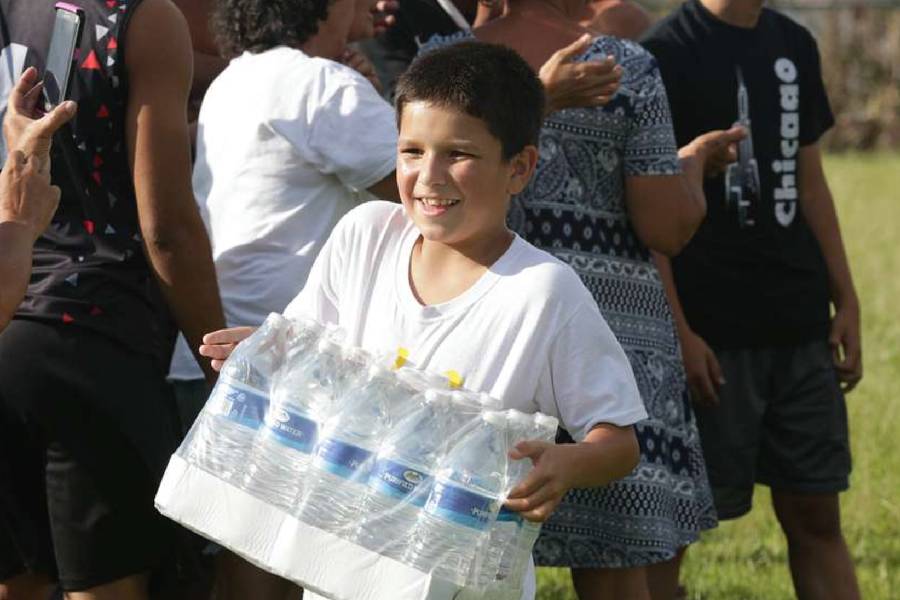
In Santurce, a boy named Joseíto stands in line for water under the hard Puerto Rican sun. He is thirsty and hot, but patient. Around him, other children cradle empty milk jugs, fathers steady five-gallon drums, and elders wait with the weary discipline of people who have survived too many emergencies before.
The water truck, guarded and delivered with the help of the National Guard, has become part of daily life in some communities. On an island surrounded by ocean, the cruelest irony is thirst.
For families in Philadelphia’s Puerto Rican community, that crisis travels 1,500 miles north with pleas from relatives describing weak faucets, dry taps, public water lines, and the fear that unsafe water could bring stomach illness or infection into already-strained homes.
The Puerto Ricans on the island have faced hurricanes, blackouts, earthquakes, and the long grief of Hurricane María. But this crisis feels different to many because it does not seem to be born solely of nature. It is the result of human indifference, neglect, and corruption — one more failure handed down to children like Joseíto.
Iraida Afanador, a native Puerto Rican and longtime Philadelphia advocate, does not soften her anger. “For decades, Puerto Rico has had insufficient investment in its pipelines and treatment facilities,” she said. “Politicians treat the money in government as if it were theirs for the taking — and the corruption is more rampant now under this new administration.”
The collapse has been years in the making. In San Juan and the surrounding areas, families have dealt with water and electrical services that are on and off, with long outages. In June, problems with the island’s aging water system left tens of thousands of customers with little or no service. Gov. Jenniffer González activated the National Guard in October of 2025 to help distribute potable water, while San Juan Mayor Miguel Romero sued Puerto Rico’s water authority over the outages.
The government has pledged $217 million in water-related repairs. But for families standing in line, promises do not fill a bucket.
Teo Melendez, a native of Vieques now living in Philadelphia, said the crisis reflects a deeper pattern.
“There is a lot of corruption in the government and in the water company itself,” he said. “This has gone on twelve, thirteen years and even more after María.”
The Puerto Rico Aqueduct and Sewer Authority, known as PRASA, is responsible for water treatment and distribution across the island. Yet a staggering share of treated water is lost before it reaches customers, through aging pipes, leaks, broken infrastructure, inaccurate meters, and unauthorized hookups. In a place where families are paying for bottled water, laundromats, private tanks, and medical costs, every lost gallon feels like betrayal.
Hiram Carmona, a native Puerto Rican now in Philadelphia, sees the crisis as part of a wider unraveling.
“Years of rolling blackouts gave way to dry taps — one fragile system after another,” he said. “The colony of Puerto Rico is showing its age. The corruption is endless.”
The burden falls hardest on working-class and poor families, who have the fewest choices. Some residents pay hundreds of dollars to fill private water tanks. Others haul buckets to flush a toilet, wash a plate, bathe a child, or care for an elderly family member.
Health officials and emergency organizations warn that water from uncertain sources should be treated before use because it can carry bacteria, parasites, and other contaminants that cause disease. But public-health advice can feel hollow when the basic question remains unanswered: Why must families fight this hard for water?
In Santurce, Joseíto waits. Someday, he may learn the words adults use for this crisis — infrastructure, austerity, corruption, colonial neglect, climate pressure. For now, he knows only the heat, the line, the empty jug, and the hope that the truck arrives before the water runs out.
His future, like Puerto Rico’s, is still being decided.