

Pressure on German Chancellor Friedrich Merz and his government has increased following the landslide victory of the far-right Alternative for Germany (AfD) on Sunday in the eastern state of Saxony-Anhalt, which has shocked the coalition parties.
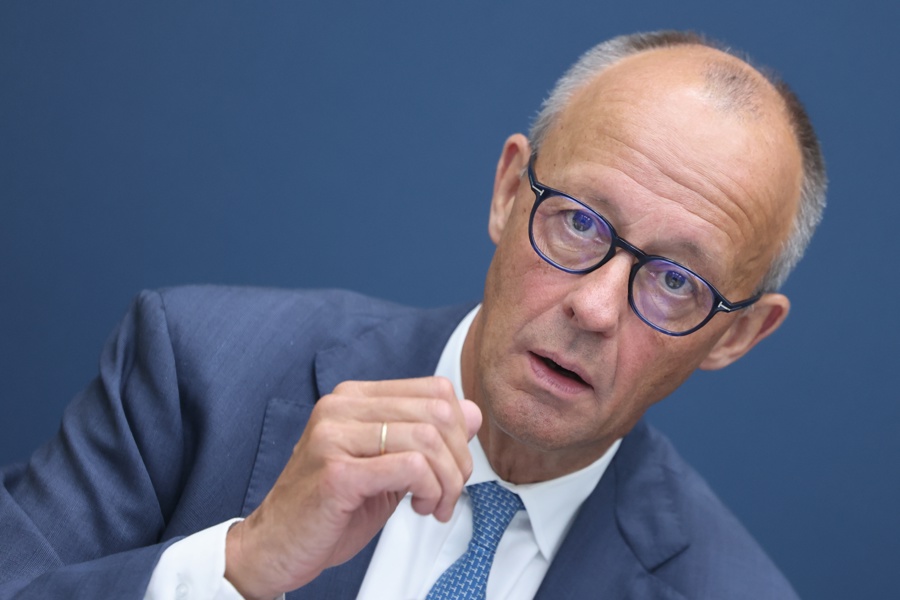
“We are all deeply shocked. We did not expect it this way. Of course, we have to accept it,” Merz said after a meeting with the leadership of his party, the Christian Democratic Union.
Merz added that when a large number of citizens “vote for political parties that fundamentally call into question our country’s democratic institutions and rules of the game, then that is an election result we cannot simply move past as if it were business as usual.”
The AfD won the election with 43.8% of the vote, compared to 17.2% for Merz’s Christian Democratic Union, 9.3% for the Social Democratic Party (SPD), 8.9% for the Greens, 8.6% for The Left, and 5.3% for Sarah Wagenknecht’s Left-Wing Alliance (BSW).
When Merz took over as CDU chairman four years ago, he set a goal of halving the AfD’s share of the vote.
In Saxony-Anhalt, however, the far right has doubled its result from the 2021 election, while the CDU’s share has been cut in half.
Worst defeat in decades
Merz acknowledged that his party suffered its worst defeat in decades and addressed the debate over his future as chancellor, noting that he was elected for four years, until 2029, but promised that neither he nor his party would shirk responsibility.
He also promised to protect the fundamental values enshrined in the Constitution amid the rise of the far right.
»Majorities change. Governments and their policies are always subject to the judgment of voters. This is the very foundation of democracy. But there is one thing that cannot be questioned: the values of the Basic Law, our Constitution and the rules of our coexistence,» he declared.
Insistence on Reforms
Merz, often criticized for allegedly lacking empathy, admitted that the popularity of the government of conservatives and Social Democrats is at a low point and that he may need to communicate more effectively so that Germans feel heard.
However, he said that, although he had expected faster results from the government’s reforms, especially in restoring economic competitiveness, he and the coalition are convinced of the path they have taken to pull Germany out of its structural problems and mistakes created under previous administrations as well, even if some measures are causing unease among the population.
On the SPD side, however, there does not seem to be as much conviction regarding the reformist course, and Finance Minister and Vice Chancellor Lars Klingbeil said the result has been “a signal to Berlin” that calls for reflection on certain aspects of the agreed-upon reform plans.
“I know that many decisions we’ve made in Berlin have sparked debate,” such as the plans to eliminate early retirement at age 63 without pay cuts. “That is a reason to reflect on our policies and the reformist course, and that is what we will do,” said the SPD co-chair.
Defense of Aid to Ukraine
Given that one of the AfD’s campaign arguments is criticism of aid to Ukraine and the alleged need to normalize relations with Russia, Merz insisted on the imperative of defending Germany and Europe against the Russian threat.
The chancellor warned that the threat to Germany’s internal security “is not abstract, but very concrete” and that if support for Ukraine is withdrawn, “the situation will not improve tomorrow, but will worsen even further,” because what the Kremlin seeks is to “destabilize the value system” of the West.
Merz acknowledged once again that he may need to explain his decisions and those of the government to the public so they can better understand their importance, including on the issue of Russia.
He has little time left to improve communication, as on the 20th there are two more elections in Mecklenburg-Western Pomerania and Berlin, where the AfD currently ranks first and third in voter preference, respectively.