


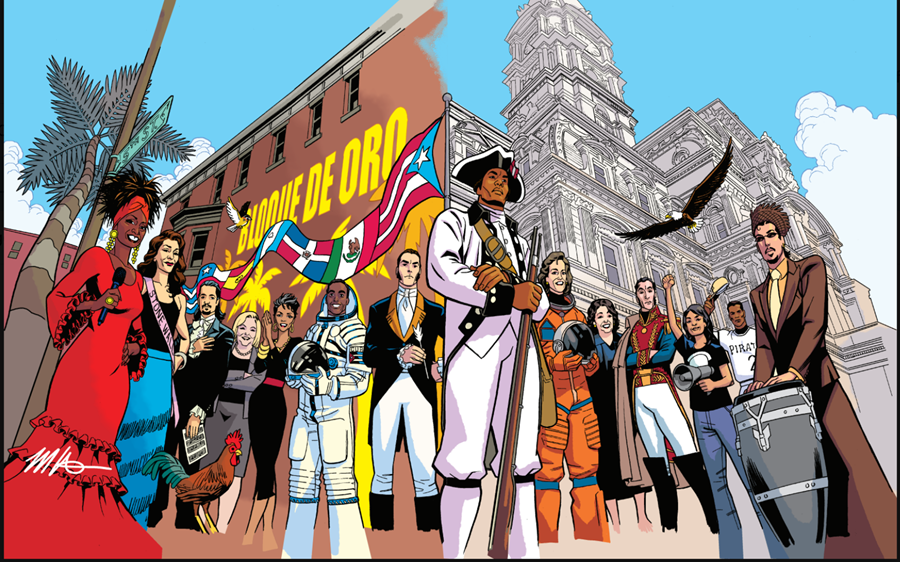
From before independence to today’s economic and demographic growth, Latinos have helped build this nation and will continue to play a vital role in its future.
How Does Our Understanding of the United States Change When We Recognize Latino Participation in Its Construction?
As the United States celebrates its independence every Fourth of July, it is worth remembering that the nation’s story did not begin solely with the thirteen English colonies. Long before 1776, Spanish explorers, missionaries, and settlers were already traveling across vast regions of North America. In fact, Spanish was the first European language spoken in much of what is now U.S. territory, and cities such as St. Augustine, Florida—founded in 1565—existed centuries before the country became an independent nation.
The Hispanic presence not only predates the United States but is also part of its very foundation. According to actor and documentarian John Leguizamo, approximately 10,000 Latinos participated in the struggle for independence, although their contributions have received little attention in traditional historical narratives
That history is the central focus of American Historia: The Untold History of Latinos, the PBS documentary series created and hosted by Leguizamo. Throughout the series, he revisits key moments in history to recover the stories of Latino heroes and heroines whose contributions have been overlooked or minimized. The project explores a timeline stretching from pre-Columbian civilizations to the present day, demonstrating how Latinos have influenced the cultural, economic, and political development of the United States.
But the American Revolution also inspired the independence movements of Latin America. The success of the colonies in 1776 demonstrated that it was possible to break away from an empire and build a sovereign nation, becoming a model for leaders such as Simón Bolívar, José de San Martín, and Miguel Hidalgo in the struggles that transformed the continent during the nineteenth century.
Today, that shared history reminds us that the independence movements across the Americas are part of a common legacy—a continuing pursuit of liberty, representation, and justice.
A pivotal chapter in Hispanic-American history occurred during the nineteenth century with U.S. territorial expansion. Following the Mexican-American War (1846–1848), the Treaty of Guadalupe Hidalgo transferred more than 900,000 square miles (2.3 million square kilometers) of Mexican territory to the United States. This included present-day California, Nevada, Utah, Arizona, and parts of Colorado, Wyoming, New Mexico, and Texas. Approximately 75,000 to 100,000 Mexican residents became U.S. citizens virtually overnight without moving from their homes. In other words, a significant portion of the Latino population did not migrate to the United States—the United States expanded over them.
In 1898, after the Spanish-American War, Puerto Rico became a U.S. territory, incorporating another large Spanish-speaking community into the nation’s political and cultural fabric.
Throughout the twentieth and twenty-first centuries, the Latino population continued to grow through immigration from Mexico, the Caribbean—including Cuba, Puerto Rico, and the Dominican Republic—and Central America, driven by labor demand, geographic proximity, and political and economic conditions throughout the region.
Today, that presence is impossible to ignore. Approximately one in five Americans is Latino, making Latinos the nation’s fastest-growing demographic group. By 2060, they are projected to represent more than one-quarter of the U.S. population.
Their economic contribution is equally significant. Nationally, Latino economic output has reached approximately $4.4 trillion. In Pennsylvania, Latinos have become one of the state’s principal economic engines. According to the Latino Donor Collaborative, Pennsylvania’s Latino economy generated $36 billion in 2021 and accounted for nearly one-fifth of the state’s economic growth during the previous decade.
For these reasons and many more, Latinos do not see themselves as guests at America’s celebration—we are among its hosts. Despite political and ideological forces that seek to diminish our contributions or question our place in the national story, history tells a different tale. Through our collective efforts, we celebrate our past, our present, and our future.
This story will continue.