


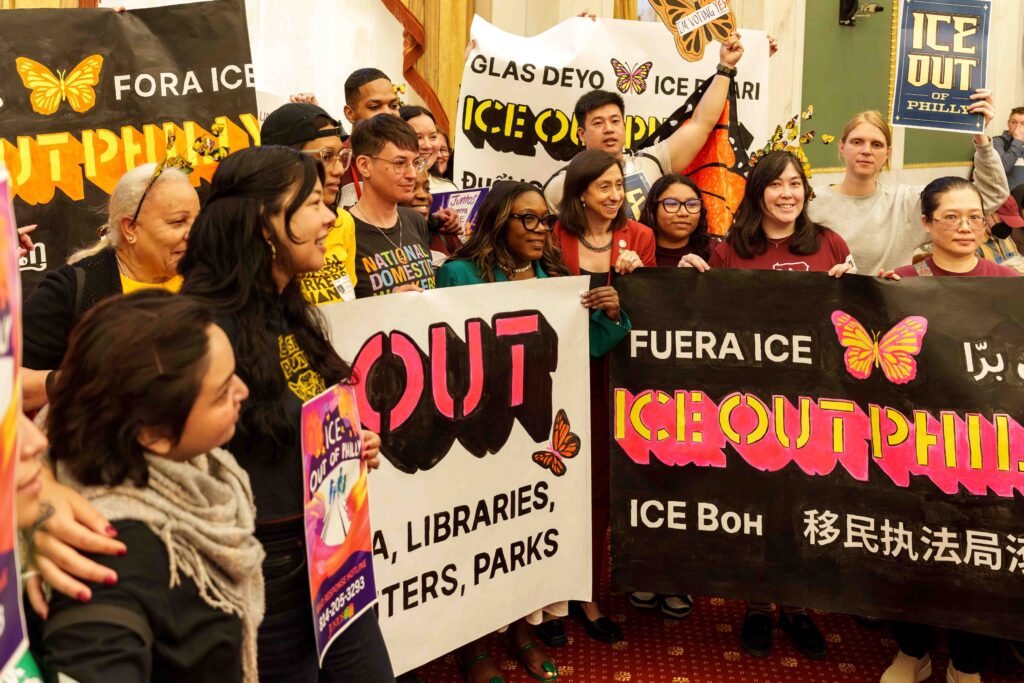
Philadelphia, PA – Chants rolled through Philadelphia City Hall on Monday as families, organizers, students, faith leaders, and advocates gathered for a hearing on the proposed ICE Out legislative package.
Before the hearing settled into testimony, the feeling in the building was already clear. People came carrying urgency and fear. And they came to ensure City Council understood that for many immigrant communities, this conversation is personal.
The hearing focused on a package introduced earlier this year by Councilmember At-Large Rue Landau and Minority Leader Kendra Brooks. Provisions in the package include limiting cooperation with ICE, protecting people’s personal information, and banning discrimination based on citizenship or immigration status.
The bills would also keep ICE from using city property without a judicial warrant, formally prohibit 287(g) agreements, and require greater transparency from law enforcement by restricting the use of masks and unmarked vehicles except in limited cases.
Over 70 local organizations have signed on in support of the ICE Out legislation, as well as thousands of individual Philadelphia residents.
Inside Council chambers, city officials answered questions about policy, public safety, city data, and legal boundaries. But some of the strongest testimony came from community members and advocates who spoke about policy and what fear looks like when it settles into daily life.
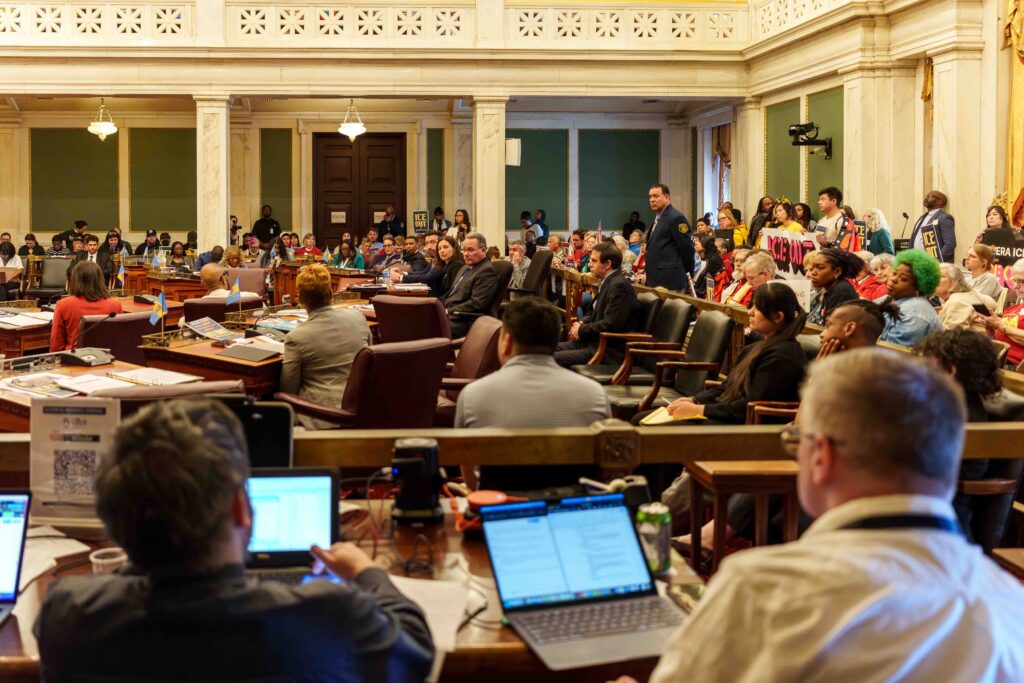
“This is a nation built by immigrants; that is the story of the nation we are,” Landau said during the hearing. “Democracy has asked us to not look away, especially when fascism rears its head and bangs its hands on the door.”
Minority Leader Kendra Brooks also spoke to the urgency of the hearing, saying, “If we are more worried about poking the bear than protecting our own, then we are letting this city be bullied.”
Councilmember Jamie Gauthier spoke to the larger truth underneath the debate, saying immigration has been central to the city’s growth. “The only reason Philadelphia has grown in the last 2 decades is because of immigration,” Gauthier said.
Again and again, the testimony returned to the same question: what does it actually mean for Philadelphia to call itself a welcoming city?
Charlie Ellison, Director of the Office of Immigrant Affairs, testified on behalf of the Parker administration, which has publicly signaled it would not stand in the way of the legislation while also raising legal and technical questions about implementation.
Council President Kenyatta Johnson pressed administration officials on what the protocol would be if ICE sought information from city offices. City Solicitor Renee Garcia said the city has not received requests of that kind and does not collect and disclose immigrant information in the way many residents fear.
Questions around policing drew some of the room’s closest attention.
Deputy Police Commissioner Francis Healy said the Philadelphia Police Department’s role is centered on public safety and that officers are not involved in civil immigration enforcement. “…Our bottom line is public safety. The only time Philadelphia PD officers get involved is when violence is shown,” said Healy.
Still, what stayed at the center of the hearing was not just what city policy says, but whether immigrant communities are protected by it.
When asked about what citizens can do when they see an issue, Commissioner Healy stated: “Very simply, call 911, and do not confront the issue directly.” This response triggered a rebuttal by the public in attendance, some of whom stated that 911 operators have not been answering their calls.
Keisha Hudson of the Defender Association of Philadelphia spoke about the gap between written policy and lived reality. Hudson, who said she is an immigrant from Jamaica, told Council that policies on paper are not enough without legal support and real resources behind them. She described a climate in which clients and witnesses are afraid to go to court because plainclothes ICE officers have carried out civil arrests around court dates.
That fear echoed throughout the room.
Linda Hernandez of Juntos told the Council that immigrant communities are too often treated like enemies instead of neighbors. “We are not the enemy. The real problem is the broken system…we have all witnessed kidnappings…each case shows a bigger problem: people facing injustice because of racism.”
Judith Bernstein-Baker, a longtime refugee and immigrant advocate in Philadelphia, spoke about refugees who come to this city. “Refugees who I represent are afraid to go to church…they come to our city full of hope, and now they are full of fear.”
At the end of the day, what remained was a clear message from the room: immigrant communities in Philadelphia are asking the city to do more than speak kindly about them. They are asking for protection that is real and enforceable.
By the close of the hearing, that call had translated into movement. The ICE Out package advanced with a favorable recommendation, clearing an important step toward final passage and moving on to a final City Council vote.
This vote could take place as early as April 23rd and It will show whether Philadelphia is ready to turn its support for immigrant communities into law.