


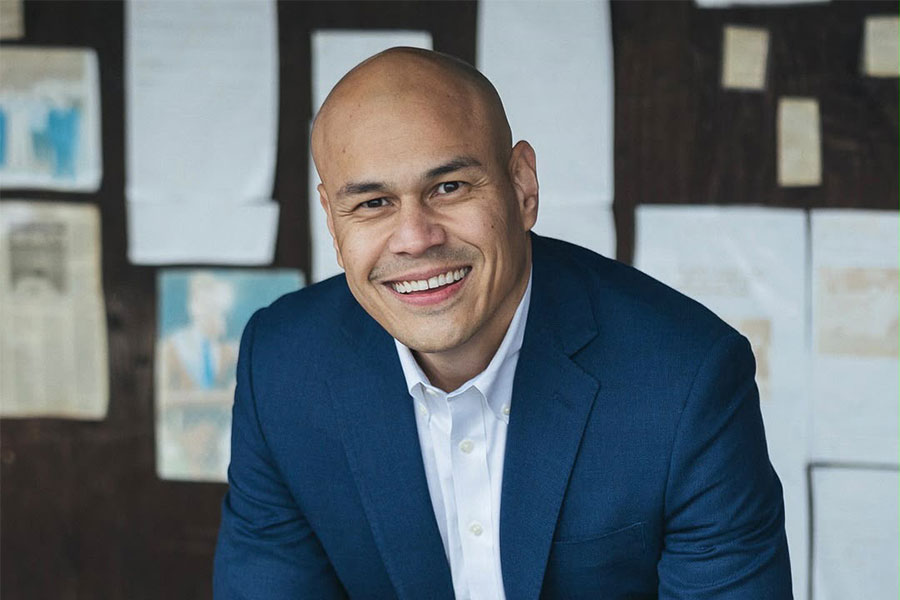
As a boy in the South Bronx, Jorge Aguilar faced a daunting reality. Surrounded by a troubled and violent neighborhood, he didn’t dream about the future. He couldn’t afford to. «I didn’t have a vision of the future. Definitely nothing in the long term,» Aguilar said. «Life was acute and immediate.»
Born in Costa Rica, Aguilar immigrated to the United States at age 7 with his mother and settled in the Bronx in New York. Danger, he said, was everywhere, and it never let up. «The scariness remained present every day, and it became chronic,» he said. «It got to a point where you just expected danger every day, in any direction, and it was the default. I learned to keep my head down, stay quiet, and avoid trouble before it found me. What kept me going was not hope,» he said, but «the instinct every human being carries. We are just wired to find a way to survive when in peril. As a child, I thought, «I just need to survive today, and tomorrow we’ll figure it out again.»
Dr. Aguilar’s life turned when he entered Student Sponsor Partners, a New York nonprofit started by Peter Flanigan and other investment bankers that places at-risk students from across the city in mostly Catholic high schools. He was matched with Chris, an investment banker who paid tuition and mentored him for all four years. «I was finally in a safe environment,» Aguilar said. «Within that environment, if I ever did something right, I received praise for it, which propelled me forward.» Chris took me to every science museum and introduced me to everyone he knew who was in science. «That really opened up my eyes to infinite possibilities,» he said.
His teachers, coaches, and mentors stood by him at 17, when he received a deportation letter. They told him to keep earning his grades and promised they had his back. «And they ultimately did,» said Aguilar.
College brought a different kind of fear. Aguilar earned a scholarship to Swarthmore College, just outside Philadelphia, as he told Humans of New York in 2021. His first year, he studied as long as his classmates, often longer, and still earned far lower grades. «It felt like an insurmountable obstacle,» he said. «It was almost like hopelessness. It was a dark, uncomfortable feeling in my stomach. Year by year, he noticed he was not alone. Other students were struggling too, mostly minority students from schools like his, but also white students from Appalachia and other poor communities.
After graduating from college, he asked his professors to recommend him for a Ph.D. program in microbiology, the career he had worked toward since high school. They said no. He was devastated and angry. «Like an injustice had been done,» he said. «And so that anger spoke and said, ‘Well, I will show you. I will show you.'» For the next five years, he worked by day as a research assistant, first at the University of Pennsylvania and then at Columbia University. At night, he used his employee tuition benefits to take undergraduate science courses alongside Ivy League students.
I got A’s for the first time since high school,» he said. He studied for the MCAT at night and on weekends and scored in the top 5 percent nationally. Then he went back to his professors with his grades, his publications, and his score. «I felt pride, because I knew I had accomplished something improbable,» he said. This time, they wrote the letters, and he went on to medical school.
The doubts did not end with a medical degree. Aguilar trained first in pediatrics, and from his first days in that program, he said, he was told he might not be smart enough for the program. For a year, he worked 80 hours a week, trying to change their minds. When he realized he could not change their hearts, he left. «I followed my heart, and I pursued training in child psychiatry,» he said, “because I still wanted to work with kids as a physician.”
Today, Dr. Jorge Aguilar is a double-board-certified psychiatrist at Montefiore Einstein, a consultant to Major League Baseball and Major League Soccer on mental health and mental performance, and the team psychiatrist for New York City FC. Aguilar said every step of his road to medicine came with fear and doubt. That is the point. «By definition, to be brave, to be courageous, you have to feel fear. You have to experience doubts,» he said. «And then do it anyway.» If there is no fear, if there are no doubts, that’s not brave. That’s not courage. That’s a walk in the park,» he said. «And no one’s gonna clap for a walk in the park.»
Resilience, he said, can be taught, trained, and built through experience. «I would define resilience as how much force one can take without falling down,» he said. «And if you do fall down, how fast can you bounce back?» With his athletes, that means training «the ability to do what is most important, even when it is difficult to do so.»
Aguilar’s advice begins with a hard step: accept that, for now, the critics may be right. «Now we need to show them that those numbers are a reflection of my past circumstances,» he said, «that they are not a reflection of my capability and my future potential.» Then he said, «Start tomorrow.» Decide on the degree or career you want, and work backward to what you must do today. And give yourself time. The longer road makes you better at your profession. «What makes a journey honorable,» said Dr. Aguilar, «is how difficult, even improbable, it was to begin with. So don’t let the doubts and don’t let the fears dissuade you from starting and seeing through a journey that could fill you with pride for the rest of your life.»