

“¿Clase, clase?” “¡Sí, sí!” “¿De qué color era la casa de Frida Kahlo?” “¡Azul!”
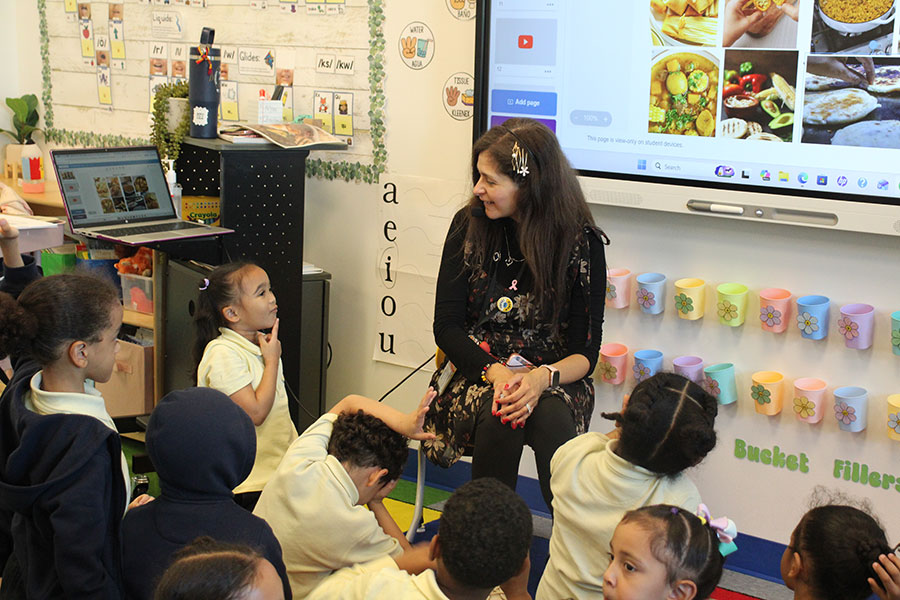
Kindergarten students at Esperanza Academy Charter School participate in their weekly Spanish class with Ms. Beatriz Strohm, an experienced educator in her second year at the school. During this lesson, students learn vocabulary through songs, watch a video about Frida Kahlo, and color an illustration after telling their teacher in Spanish which color they are going to use.
At Esperanza Academy, Spanish instruction begins in kindergarten and continues through high school, where students have the opportunity to earn the Seal of Biliteracy. In the early elementary grades, students are introduced to vocabulary, culture, history, and other topics related to the language. As they advance into fourth and fifth grade, they develop more complex skills and deepen their knowledge. In addition to this ongoing curriculum, the school offers numerous special activities during Hispanic Heritage Month, further expanding students’ learning about Latino history, art, and culture.
Though 91% of the student body is Latino and the school is rooted in a bilingual community, students represent a range of Spanish proficiency levels, from those who don’t speak any Spanish to those who are learning English. Some students have a strong connection to their cultural roots, while others do not. Mrs. Strohm, who is originally from Colombia and learned English as an adult, wants all her students to understand that being bilingual is a superpower and that being able to speak two languages is something special. Mrs. Strohm explained, “We want Spanish to be part of our [school] culture. It’s part of our vision and mission for kids to [speak] two languages.” She encourages her students to be proud of their cultural heritage and to use Spanish as a tool to relate to others.
No matter their ethnicity or Spanish proficiency level, there is something for every student in Spanish class. In class discussions, they exchange country-specific vocabulary, talk about the celebrations and foods that are special to them, and share what has been passed down to them from parents and grandparents. Students who are new to learning Spanish share their excitement about the new things they picked up during their lessons. Her students are not only acquiring Spanish, but are also sharing and learning about each other’s cultural backgrounds in the process.
The way that Mrs. Strohm facilitates her classes is a beautiful reflection of her own experience. She is grateful for the opportunity to meet people from different countries and cultures here in the US, and also finds joy in the sense of home and belonging that she has found at Esperanza Academy: “I feel Esperanza is my second family…. Everything that I had in Colombia, I have here in another version. An American version, with beautiful, beautiful people.” Her passion for her students and joy in sharing her language and culture are opening doors of learning for her students and setting them up for a successful journey toward bilingualism.