


Dolores Huerta, one of the most influential Mexican American and Latino social leaders in the United States, died on October 28 at the age of 96. The news reached me around noon as I arrived at the Centro de Cultura, Arte, Trabajo y Educación (CCATE), the organization that a group of Latin American immigrants and I founded fifteen years ago in Norristown, Pennsylvania. I stood outside the building for a few moments, reflecting on the legacy of a woman who devoted her life to the pursuit of social justice. A brief but meaningful encounter I had with her years ago suddenly took on new significance.
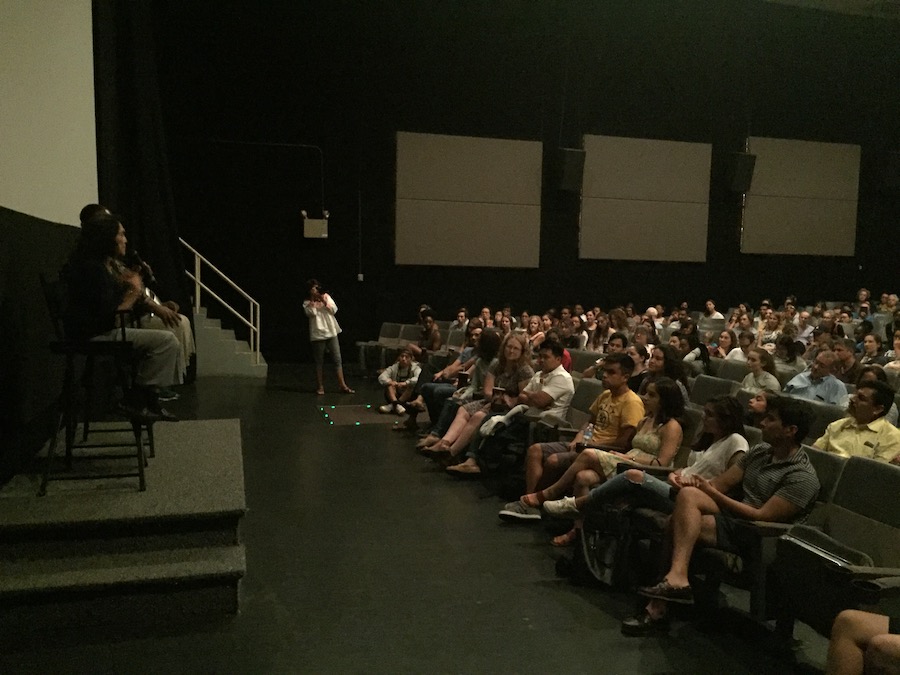
It was September 16, 2017, during celebrations marking the independence of Mexico and several Central American nations, when Huerta came to Philadelphia for a screening of Dolores, the documentary chronicling her life and work. Members of CCATE’s reading circle and the Artivistas, a collective of immigrant women artists and organizers, secured tickets to attend the event at the Ritz Five theater in Old City. Following the screening, Huerta was scheduled to participate in a public conversation.
Her seat happened to be directly next to mine.
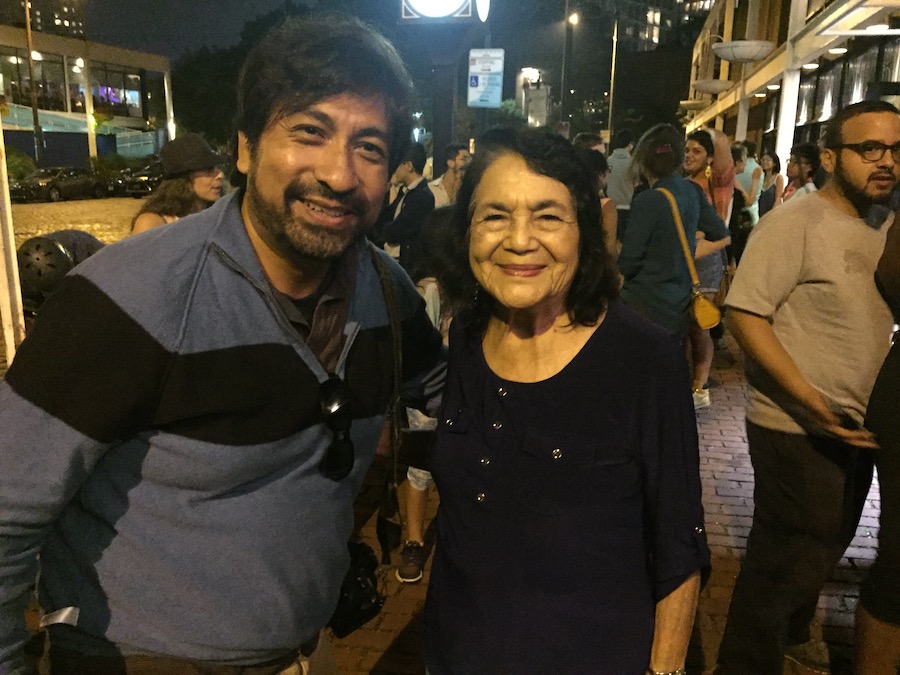
Shortly before the discussion began, she arrived and asked if I would walk with her to the front of the auditorium. Leaning lightly on my arm, she asked my name as we made our way through the crowd. Once we reached the stage, she asked me to stay nearby.
The documentary revisited some of the defining moments of an extraordinary life. In 1962, Huerta co-founded the United Farm Workers union alongside César Chávez, helping to build a movement that transformed labor conditions for thousands of farmworkers across the United States. Through strikes, boycotts, and negotiations, she secured better wages and workplace protections for a population that had long been exploited and ignored. Decades later, she would receive the Presidential Medal of Freedom, the nation’s highest civilian honor. At the ceremony, President Barack Obama noted that his famous campaign slogan, «Yes We Can,» traced its roots to Huerta’s enduring rallying cry: “Sí se puede.”
Yet Huerta’s activism extended far beyond labor organizing. Over time, she came to see that economic exploitation was deeply intertwined with other forms of inequality. She championed the rights of women, immigrants, LGBTQ+ communities, and low-income workers. Within the farmworker movement itself, she witnessed firsthand the discrimination, marginalization, and violence many women faced. Only months before her death, she revealed that she had experienced sexual abuse at the hands of César Chávez, a disclosure that reverberated across activist circles because of Chávez’s iconic place in the collective memory of social justice movements.
The revelation prompted a difficult but necessary reassessment of history. Far from weakening movements, such reckoning can strengthen them when undertaken honestly. Huerta understood that justice cannot be built on silence.
In the decades that followed, she became active in feminist spaces while maintaining an independent perspective. She argued that much of mainstream feminism, shaped largely by white, middle-class women and academic institutions, failed to reflect the realities of farmworkers, domestic workers, factory laborers, and immigrant mothers. From that conviction emerged a grassroots feminism grounded in community experience and attentive to the intersections of gender, class, ethnicity, and migration.
When the question-and-answer session ended, I returned to assist her. She told me she was tired and would like some water. Together we walked to a quieter area of the theater and found a place where she could rest for a few minutes. It was there that we had a conversation I still carry with me.
I spoke about CCATE, our educational programs, and the learning communities we had built. She was particularly intrigued by our use of circle-based learning, inspired in part by Latin American community traditions. She smiled.
“Obed,” she said, “what you’re doing is something I wish we could have done. Our generation had to fight to open the road. You are building the second floor. The struggle continues when you help students and communities understand their rights and transform their reality.”

But it was when I told her about the Artivistas that her face truly lit up.
I described how women such as Diana, Laura, Lourdes, Lupita, and Jenny helped us better understand immigrant women’s experiences through art, storytelling, and collective organizing.

“Where are they?” she asked.
I told her several of them were outside the theater.
“Then let’s go meet them,” she replied without hesitation.

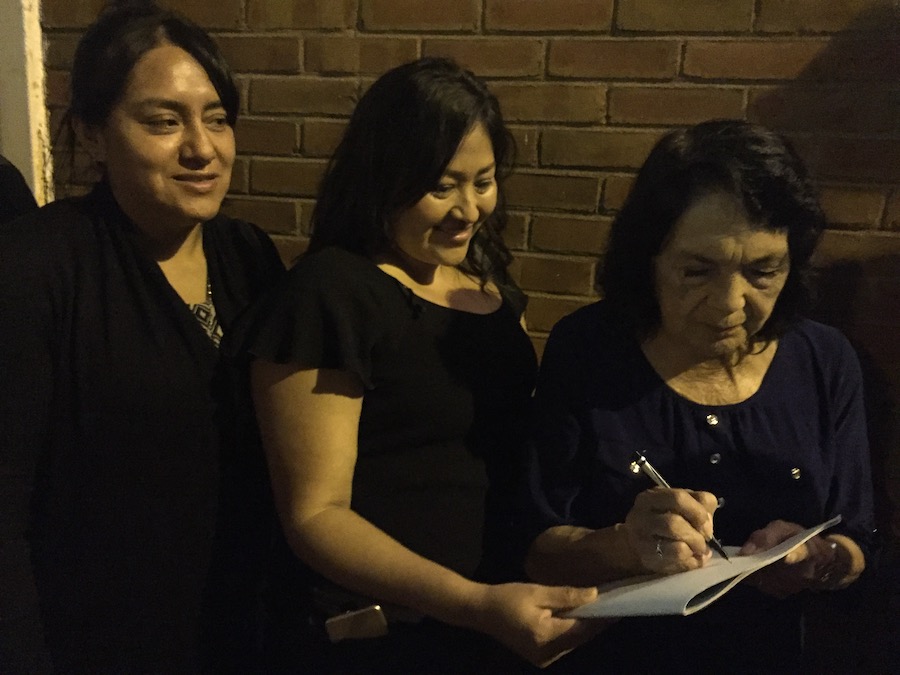
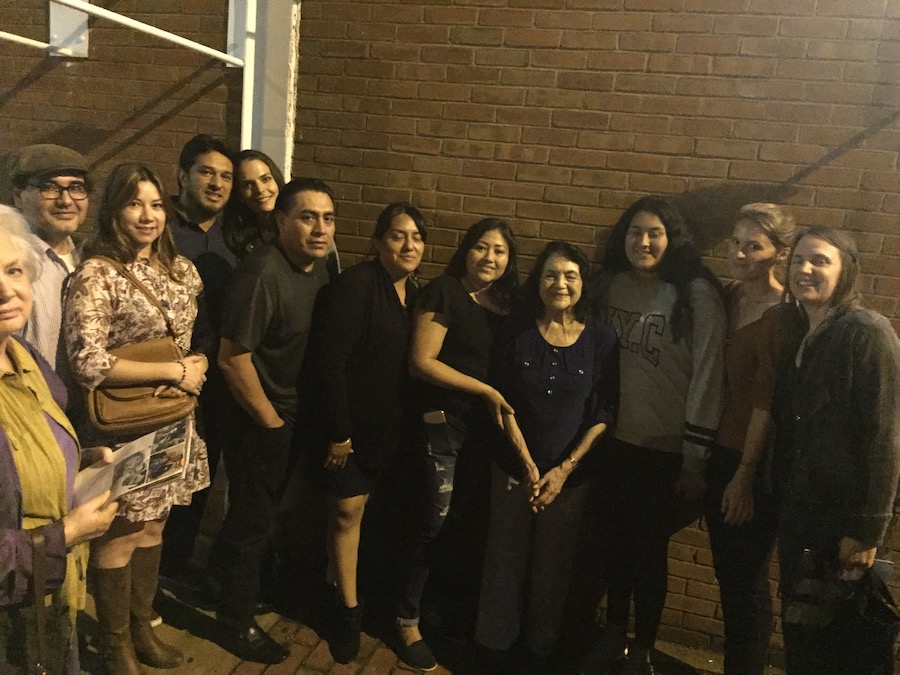
We slipped out a side entrance to avoid the crowd. In the distance, I spotted Dr. Holly Link and the rest of our group. Dolores walked over to greet them, embracing them and speaking with them one by one. A photograph from that evening has since become a small collective treasure.
Today, as her passing leaves many of us with a profound sense of loss, we remember the dignity with which she fought. And in that memory, we find ourselves reaffirmed by the words she gave to generations of people seeking justice: Sí se puede.