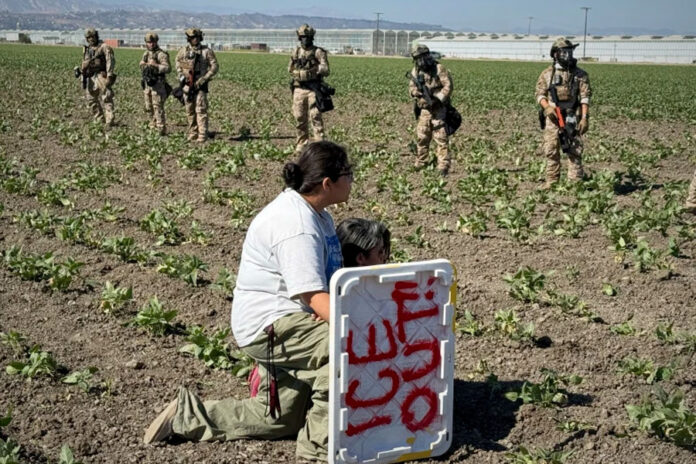
A demonstrator kneels in front of federal agents in a farm field during an immigration raid in Camarillo, Calif., Thursday, July 10, 2025. (Photo: AP/Michael Owen Baker/File)
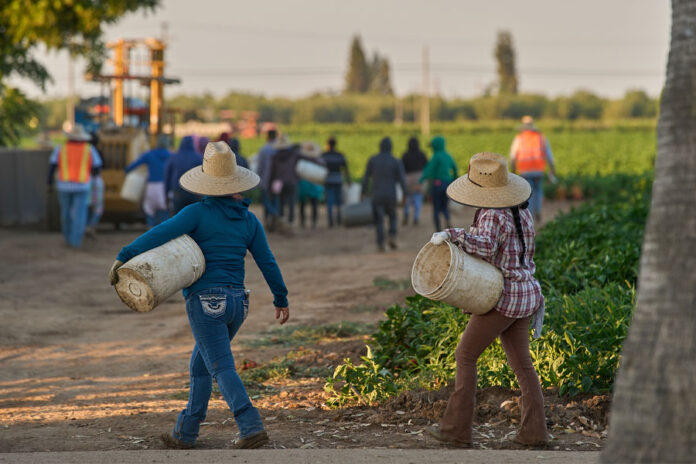
It’s tomato season and Lidia is harvesting on farms in California’s Central Valley.
She is also anxious. Attention from U.S. Immigration and Customs Enforcement could upend her life more than 23 years after she illegally crossed the U.S.-Mexico border as a teenager.
“The worry is they’ll pull you over when you’re driving and ask for your papers,” said Lidia, who spoke to The Associated Press on condition that only her first name be used because of her fears of deportation. “We need to work. We need to feed our families and pay our rent.”
As parades and other events celebrating the contributions of workers in the U.S. are held Monday for the Labor Day holiday, experts say President Donald Trump’s stepped-up immigration policies are impacting the nation’s labor force.
More than 1.2 million immigrants disappeared from the labor force from January through the end of July, according to preliminary Census Bureau data analyzed by the Pew Research Center. That includes people who are in the country illegally as well as legal residents.
Immigrants make up almost 20% of the U.S. workforce and that data shows 45% of workers in farming, fishing and forestry are immigrants, according to Pew senior researcher Stephanie Kramer. About 30% of all construction workers are immigrants and 24% of service workers are immigrants, she added.
The loss in immigrant workers comes as the nation is seeing the first decline in the overall immigrant population after the number of people in the U.S. illegally reached an all-time high of 14 million in 2023.
“It’s unclear how much of the decline we’ve seen since January is due to voluntary departures to pursue other opportunities or avoid deportation, removals, underreporting or other technical issues,” Kramer said. “However, we don’t believe that the preliminary numbers indicating net-negative migration are so far off that the decline isn’t real.”
Trump campaigned on a promise to deport millions of immigrants working in the U.S. illegally. He has said he is focusing deportation efforts on “dangerous criminals,” but most people detained by ICE have no criminal convictions. At the same time, the number of illegal border crossings has plunged under his policies.
Pia Orrenius, a labor economist at the Federal Reserve Bank of Dallas, said immigrants normally contribute at least 50% of job growth in the U.S.
“The influx across the border from what we can tell is essentially stopped, and that’s where we were getting millions and millions of migrants over the last four years,” she said. “That has had a huge impact on the ability to create jobs.”
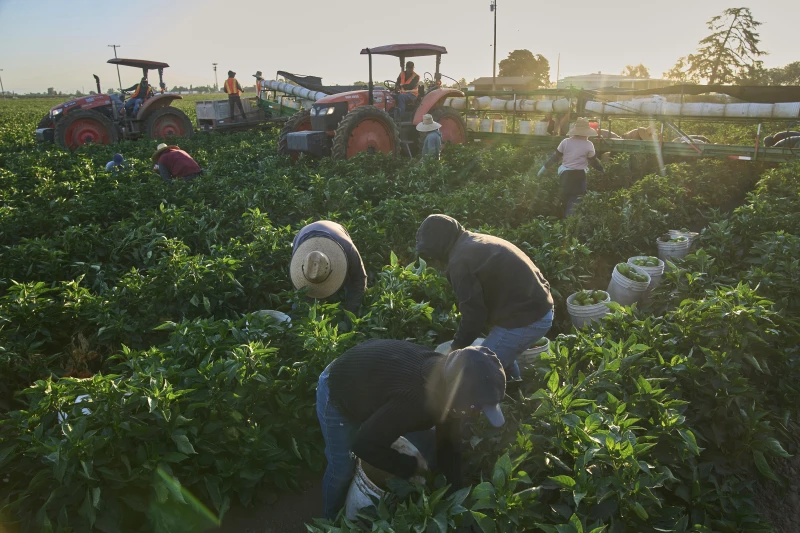
Migrant farmworkers pick a vegetable crop on an early morning in Fresno, Calif., on July 18, 2025. (Photo: AP/Damian Dovarganes/File)
‘Crops did go to waste’
Just across the border from Mexico in McAllen, Texas, corn and cotton fields are about ready for harvesting. Elizabeth Rodriguez worries there won’t be enough workers available for the gins and other machinery once the fields are cleared.
Immigration enforcement actions at farms, businesses and construction sites brought everything to a standstill, said Rodriguez, director of farmworker advocacy for the National Farmworker Ministry.
“In May, during the peak of our watermelon and cantaloupe season, it delayed it. A lot of crops did go to waste,” she said.
In Ventura County, California, northwest of Los Angeles, Lisa Tate manages her family business that grows citrus fruits, avocados and coffee on eight ranches and 800 acres (323 hectares).
Most of the men and women who work their farms are contractor-provided day laborers. There were days earlier this year when crews would be smaller. Tate is hesitant to place that blame on immigration policies. But the fear of ICE raids spread quickly.
“People were being taken out of laundromats, off the side of the road,” Tate said.
Lidia, the farmworker who spoke to the AP through an interpreter, said her biggest fear is being sent back to Mexico. Now 36, she is married with three school-age children who were born here.
“I don’t know if I’ll be able to bring my kids,» said Lidia. «I’m also very concerned I’d have to start from zero. My whole life has been in the United States.”
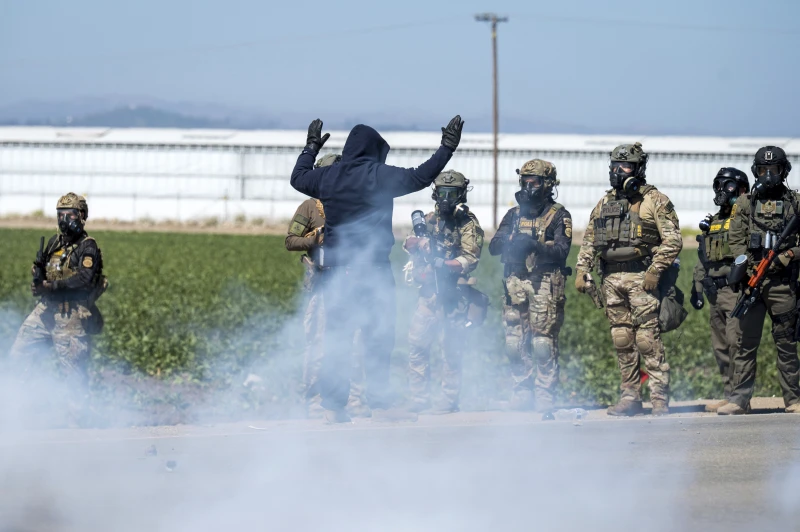
Federal immigration agents toss tear gas at protesters during a raid in the agriculture area of Camarillo, Calif., Thursday, July 10, 2025. (Photo: AP/Michael Owen Baker/File)
From construction to health care
Construction sites in and around McAllen also “are completely dead,” Rodriguez said.
“We have a large labor force that is undocumented,” she said. “We’ve seen ICE particularly targeting construction sites and attempting to target mechanic and repair shops.»
The number of construction jobs are down in about half of U.S. metropolitan areas, according to an Associated General Contractors of America analysis of government employment data. The largest loss of 7,200 jobs was in the Riverside-San Bernardino-Ontario, California, area. The Los Angeles-Long Beach-Glendale area lost 6,200 jobs.
“Construction employment has stalled or retreated in many areas for a variety of reasons,” said Ken Simonson, the association’s chief economist. “But contractors report they would hire more people if only they could find more qualified and willing workers and tougher immigration enforcement wasn’t disrupting labor supplies.”
Kramer, with Pew, also warns about the potential impact on health care. She says immigrants make up about 43% of home health care aides.
The Service Employees International Union represents about 2 million workers in health care, the public sector and property services. An estimated half of long-term care workers who are members of SEIU 2015 in California are immigrants, said Arnulfo De La Cruz, the local’s president.
“What’s going to happen when millions of Americans can no longer find a home care provider?» De La Cruz said. “What happens when immigrants aren’t in the field to pick our crops? Who’s going to staff our hospitals and nursing homes?” ___ An earlier version of this story incorrectly referred to the name of the U.S. Immigration and Customs Enforcement agency. The name is not Immigration Control and Enforcement.
Jornaleros inmigrantes se dirigen a los cultivos, el 18 de julio de 2025, en Fresno, California. (Foto: AP/Damian Dovarganes/Archivo)
Es temporada de tomates y Lidia es una de las personas que trabaja en la cosecha en las granjas del valle del centro de California
Está algo intranquila. La atención del Servicio de Control de Inmigración y Aduanas de Estados Unidos (ICE por sus iniciales en inglés) podría trastornar su vida más de 23 años después de que cruzó ilegalmente la frontera entre Estados Unidos y México cuando era una adolescente.
“Lo que preocupa es que te detengan mientras conduces y te pidan papeles”, dijo Lidia, quien habló con The Associated Press con la condición de que se le identificara únicamente con su primer nombre por temor a ser deportada. «Necesitamos trabajar. Necesitamos alimentar a nuestras familias y pagar la renta».
Mientras se llevan a cabo desfiles y otros eventos para conmemorar el Día del Trabajo y las contribuciones de los trabajadores en Estados Unidos, los expertos aseguran que las estrictas políticas de inmigración del presidente Donald Trump han afectado a la fuerza laboral del país.
Más de 1,2 millones de inmigrantes han dejado la fuerza laboral del país en los primeros siete meses del año, de acuerdo con los datos preliminares de la Oficina del Censo, los cuales fueron analizados por el Pew Research Center. Eso incluye a residentes legales y personas que están en el país sin autorización legal.
Los inmigrantes constituyen casi el 20% de la fuerza laboral de Estados Unidos y estos datos revelan que el 45% de los trabajadores en los sectores de la agricultura, pesca y silvicultura son inmigrantes, de acuerdo con la investigadora principal de Pew, Stephanie Kramer. Aproximadamente el 30% de todos los trabajadores de la construcción son inmigrantes, al igual que el 24% de los trabajadores de servicios.
La pérdida de trabajadores inmigrantes se produce mientras el país registra su primer descenso en el total de población inmigrante luego de que el número de personas que se encontraban en Estados Unidos sin permiso legal alcanzó un máximo histórico de 14 millones en 2023.
«No está claro cuánto del descenso que hemos visto desde enero se debe a salidas voluntarias para buscar otras oportunidades o para evitar la deportación, expulsiones, subregistros o algún otro problema técnico», señaló Kramer. «Sin embargo, no creemos que los números preliminares que indican una migración neta negativa estén tan alejados de la realidad como para que el descenso no sea real».
Trump hizo campaña con la promesa de deportar a millones de inmigrantes que trabajan ilegalmente en Estados Unidos. Ha dicho que enfoca sus esfuerzos de deportación en «criminales peligrosos», pero la mayoría de las personas que han sido detenidas por el ICE no tienen condenas penales. Al mismo tiempo, el número de cruces ilegales en la frontera sur ha disminuido durante su mandato.
Pia Orrenius, economista laboral en el Banco de la Reserva Federal de Dallas, dijo que, por lo general, los inmigrantes contribuyen al menos con el 50% del crecimiento del empleo en Estados Unidos.
«La afluencia a través de la frontera, por lo que podemos decir, prácticamente se ha detenido, y ahí es donde estábamos recibiendo a millones y millones de migrantes en los últimos cuatro años», explicó. «Eso ha tenido un gran impacto en la capacidad de crear empleos».
“Las cosechas se desperdiciaron”
Al otro lado de la frontera con México, en McAllen, Texas, los campos de maíz y algodón están casi listos para la cosecha. A Elizabeth Rodriguez le preocupa que no haya suficientes trabajadores disponibles para las desmotadoras y otras máquinas una vez que los campos queden despejados.
Las redadas migratorias en granjas, negocios y sitios de construcción lo paralizaron todo, dijo Rodriguez, directora de defensa de los trabajadores agrícolas para National Farmworker Ministry.
“En mayo, durante el pico de nuestra temporada de sandías y melones”, estas acciones retrasaron la cosecha, destacó. “Muchas cosechas se desperdiciaron”.
En el condado de Ventura, al noroeste de Los Ángeles, Lisa Tate gestiona el negocio familiar que cultiva cítricos, aguacates y café en ocho ranchos que abarcan alrededor de 323 hectáreas (800 acres).
La mayoría de los hombres y mujeres que trabajan en sus granjas son jornaleros que son proporcionados por contratistas. A principios del año hubo días en que los equipos eran más pequeños. Tate titubea al momento de culpar a las restricciones migratorias. Pero el miedo a las redadas del ICE se propagó rápidamente.
Decenas de trabajadores agrícolas de la zona fueron arrestados a mediados de este año.
«Estaban deteniendo a personas en las lavanderías, a un costado de la carretera», comentó Tate.
Lidia, la jornalera que habló con la AP a través de un intérprete, dijo que su mayor temor es ser enviada de regreso a México. Ahora, con 36 años, está casada y tiene tres hijos en edad escolar que son ciudadanos estadounidenses.
«No sé si podría llevarme a mis hijos», comentó. «También me preocupa mucho tener que empezar de cero. He estado toda mi vida en Estados Unidos».
De la construcción a la atención médica
Los sitios de construcción dentro y en los alrededores de McAllen también «están completamente muertos», dijo Rodriguez.
«Tenemos una gran fuerza laboral que es indocumentada», declaró. «Hemos visto que el ICE se está enfocando particularmente en sitios de construcción e intentando apuntar a talleres de mecánica y reparación».
El número de empleos en la construcción en las zonas metropolitanas del país ha disminuido prácticamente por la mitad, de acuerdo con un análisis de datos de empleo del gobierno realizado por la Associated General Contractors of America. La pérdida más grande, 7.200 empleos, fue en el área de Riverside-San Bernardino-Ontario, California. La zona de Los Ángeles-Long Beach-Glendale perdió 6.200 empleos.
«El empleo en la construcción se ha estancado o ha retrocedido en muchas zonas por diversas por una razones», indicó Ken Simonson, economista en jefe de la asociación. «Pero los contratistas informan que contratarían a más personas si tan sólo pudieran encontrar más trabajadores calificados y dispuestos y si las restricciones de inmigración no estuvieran interrumpiendo el suministro de mano de obra».
Kramer, del Pew Research Center, también advierte sobre el posible impacto en el sector de la atención médica. Afirma que los inmigrantes constituyen aproximadamente el 43% de los asistentes de atención médica a domicilio.
El sindicato Service Employees Internacional Union representa a unos 2 millones de trabajadores del sector salud, el sector público y servicios de propiedad. Se calcula que la mitad de los trabajadores de atención a largo plazo que son pertenecen al sindicato en California son inmigrantes, declaró Arnulfo De La Cruz, presidente de la filial local.
«¿Qué va a pasar cuando millones de estadounidenses ya no puedan encontrar un proveedor de atención médica a domicilio?» preguntó De La Cruz. «¿Qué pasa cuando los inmigrantes no están en el campo para cosechar nuestros cultivos? ¿Quién va a dotar de personal a nuestros hospitales y asilos de ancianos?».
Mientras el país celebra el esfuerzo y la dedicación de los trabajadores este Día del Trabajo, las grandes farmacéuticas —las Big Pharma— siguen tomando decisiones que perjudican a los trabajadores estadounidenses. Año tras año, deslocalizan empleos y producción hacia el extranjero para evadir impuestos y reducir costos, mientras continúan cobrando los precios más altos del mundo por medicamentos recetados en Estados Unidos.
¿Cómo afectan las Big Pharma a los trabajadores americanos?
🔹 Deslocalización de empleos: El 78% de los medicamentos recetados en EE. UU. se fabrican fuera del país. Los ingredientes activos de los medicamentos más costosos se producen principalmente en Europa, lo que significa menos empleos bien remunerados para los estadounidenses.
🔹 Evasión fiscal: En 2022, las Big Pharma pagaron solo un 10% en impuestos, mientras que el trabajador promedio destinó casi el 30% de sus ingresos. En 2023, su deuda tributaria fue negativa: -$250 millones. Esto se logra trasladando operaciones al extranjero.
🔹 Precios excesivos: Los estadounidenses pagan al menos tres veces más por medicamentos que los ciudadanos de otros países desarrollados. En muchos casos, las ganancias por ventas en EE. UU. superan las de todos los demás países combinados.
¿Qué se está haciendo?
El expresidente Trump dio un paso inicial con su orden ejecutiva de Nación Más Favorecida, buscando que los precios de medicamentos en EE. UU. se alineen con los más bajos del mundo. Sin embargo, las Big Pharma están presionando para proteger sus beneficios.
Una encuesta nacional reciente muestra que el 78% de los votantes apoyan reformas que den prioridad a los trabajadores americanos. Es hora de que los líderes en Washington escuchen y actúen para que las Big Pharma rindan cuentas.
La Alianza para la Reforma Farmacéutica (PRA) está creando mayor conciencia sobre las prácticas anticonsumidor de Las Big Pharma, que están provocando el aumento desmesurado de los precios en Estados Unidos para una amplia gama de medicamentos esenciales. Lea más: www.pharmareformalliance.com.
Un grupo de 'Lolitas' en homenaje a la nacionalista Lolita Lebrón, participan este domingo durante una marcha desde el Capitolio para reclamar la independencia para Puerto Rico, en San Juan (Puerto Rico). (Foto: EFE/Thais Llorca)
San Juan.– Unas 3.000 personas marcharon este domingo por las históricas calles del Viejo San Juan a favor de la independencia de Puerto Rico, una iniciativa que se expandió también a varias ciudades de Estados Unidos con el propósito de exigir la descolonización de la isla.
La Marcha Por La Independencia de Puerto Rico, como llevó por nombre esta cita, arrancó desde el lado sur del Capitolio (Parlamento), luego de que la cantante iLe interpretara el himno revolucionario, para recorrer la calle San Francisco hasta llegar al Tribunal Federal.
La actriz Magali Carrasquillo, quien acudió a la marcha, dijo a EFE que quiere que su país «sea libre y soberano».
El actual estatus político de Puerto Rico como Estado Libre Asociado, establecido en 1952, da a la isla cierto grado de autonomía y un Gobierno y Parlamento locales, pero deja bajo el control de EE. UU. áreas como defensa, fronteras y relaciones diplomáticas.
Carrasquillo afirmó que su respaldo a la independencia no es solo por los poderes políticos que ostenta EE. UU. sobre la isla, sino también por una Junta de Supervisión Fiscal que maneja los gastos del Gobierno local.
«Aquí manda otra gente, que toma decisiones de nuestras vidas, de nuestros bolsillos, que no le importan nada. Entonces, yo quiero que esto termine, que se tome una decisión, sea cual sea, la que la mayoría avale», afirmó.
Personas participan este domingo durante una marcha desde el Capitolio para reclamar la independencia de Puerto Rico, en San Juan (Puerto Rico). (Foto: EFE/Thais Llorca)
La también profesora de actuación acudió a la marcha vestida como miembro de ‘Las Lolitas’, un grupo de mujeres que personifican a Lolita Lebrón, exlíder del movimiento independentista de Puerto Rico que cumplió más de 25 años de cárcel por tirotear al Congreso de EE. UU. el 1 de mayo de 1954.
«Lolita es un ejemplo de perseverancia, fuerza y dignidad. Lolita no entró al Congreso a matar a nadie. Ella misma lo dijo que disparó al techo. Su plan fue llamar la atención sobre la terrible situación colonial que vivimos en Puerto Rico, que no se ha solucionado», explicó Carrasquillo.
‘Lucha sí, entrega no’ y ‘Solo me sé tres palabras en inglés: yankees go home’ fueron algunas de las consignas que los manifestantes expresaron a viva voz durante la marcha.
Igualmente, otras personas colocaron antifaces a las estatuas de los expresidentes estadounidenses Dwight Eisenhower y John F. Kennedy, ubicadas en una avenida frente al Capitolio.
La marcha, además de en San Juan, se llevó a cabo en los estados de Ohio, Illinois, Florida, Massachusetts, Nueva Jersey y Nueva York, donde residen más de 5 millones de puertorriqueños.
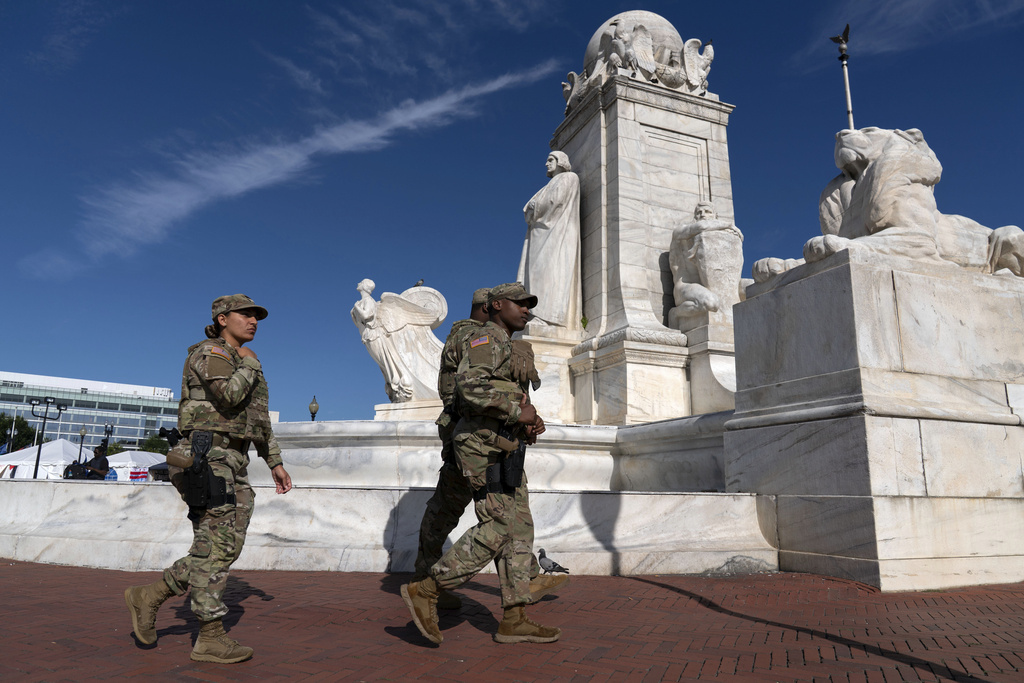
Integrantes de la Guardia Nacional de Luisiana, arriba, patrullan Union Station, el sábado 30 de agosto de 2025, en Washington. (AP Foto/José Luis Magaña)
WASHINGTON (AP) — Eric McWilliams, de filiación demócrata, no aprueba que Donald Trump envíe efectivos de la Guardia Nacional a ciudades como Washington, D.C. Y ciertamente no respalda la mayoría de las políticas del presidente.
Pero el veterano de la Armada y empleado de mantenimiento retirado, de 63 años, sí elogia a Trump por una cosa. “En lo que respecta a la delincuencia”, observó, “está bien. Lo está haciendo bastante bien. Cómo lo hace es otra cuestión”.
“La delincuencia es un gran problema”, continuó. “Al menos él está haciendo algo”.
Las opiniones de McWilliams reflejan el sentir de muchos demócratas, según una encuesta reciente de The Associated Press-NORC Center for Public Affairs Research, una organización apartidista de investigación. Revela que, si bien la mayor parte desaprueba la gestión del tema por parte de Trump, una gran mayoría —68%— considera la delincuencia un “problema grave” en las grandes ciudades. Eso a pesar de que las estadísticas muestran que el crimen, en general, ha disminuido en todo Estados Unidos, y que algunas ciudades registran los niveles más bajos en 30 años.
Los resultados ponen de relieve el reto que enfrentan los líderes demócratas. Deben encontrar un equilibrio entre criticar las políticas de Trump —profundamente impopulares entre la base de electores demócratas— y a la vez no desestimar las preocupaciones generalizadas sobre la seguridad, que se ven amplificadas en muchas fuentes de noticias y en foros en línea como Facebook y la popular aplicación Nextdoor.
Esto podría crear una vulnerabilidad para el partido de cara a las elecciones intermedias del próximo año.
Trump presiona a los demócratas para que se involucren en un tema en que él tiene ventaja
La gran mayoría de los estadounidenses —el 81%— también considera que la delincuencia es un “problema grave” en las grandes ciudades. Esto incluye a casi todos los republicanos, a aproximadamente tres cuartas partes de los independientes y a casi 7 de cada 10 demócratas.
No obstante, el tema es complejo, incluso para aquellos a quienes les preocupa. En entrevistas, los participantes que se oponen a la toma de control sin precedentes del departamento de policía de Washington, D.C. por parte de Trump, y a sus amenazas de expandir esas iniciativas a otras ciudades, expresaron alarma, calificando sus acciones de antiestadounidenses y de formar parte de lo que consideran un intento de distraer al público de temas que la Casa Blanca preferiría que ignorara.
Integrantes de la Guardia Nacional de Luisiana patrullan Union Station el sábado 30 de agosto de 2025 en Washington. (AP Foto/José Luis Magaña)
Creen que sería mejor invertir recursos en labores policiales con la colaboración de la comunidad, en servicios de salud mental y en la aprobación de leyes significativas para sacar las armas de fuego de las calles.
Pero muchos también lamentaron el estado de la seguridad pública en el país, incluso si dijeron sentirse seguros en sus propios barrios y reconocieron que la delincuencia violenta ha disminuido tras el pico que alcanzó durante la pandemia de COVID-19. Varios señalaron que ellos o sus vecinos habían sido víctimas de delitos graves, y se quejaron de lo que consideran fue una respuesta policial mediocre.
Brian Cornelia, de 62 años, maestro de obras jubilado y demócrata de toda la vida que vive en Michigan, cerca de Marquette, está descontento con el desempeño de ambos partidos.
“Quitarle recursos a la policía fue una locura”, manifestó. “Ahora, con Trump, lo que él está haciendo también es una locura”.
Dijo que la delincuencia “no es para nada” un problema donde él vive y “ha disminuido en todas partes”, pero de todas formas aprecia que Trump haga algo al respecto.
“Algo está sucediendo. Ya veremos si ayuda o no, pero es mejor que no hacer nada”, expresó. En cualquier caso, opinó que Trump había acorralado a los demócratas.
“Es grave. ¿Cómo vas a decir que no quieres que se lidie con la delincuencia?”, planteó. “Si discutes con él, ¿qué? ¿Eres blando con la delincuencia? Es una paradoja sin salida”.
Críticas a las tácticas de Trump
Pero incluso quienes dan crédito a Trump cuestionan sus tácticas.
Aproximadamente 8 de cada 10 demócratas responden que es “completamente” o “algo” inaceptable que el presidente tome el control de los departamentos de policía locales, como lo hizo en Washington. Y aproximadamente 6 de cada 10 dicen que es inaceptable que el gobierno federal utilice al Ejército y a la Guardia Nacional para apoyar a la policía local.
“No apruebo que los soldados nacionales tengan autoridad sobre nuestros compatriotas estadounidenses”, expresó McWilliams, el veterano de la Armada. “No se debería utilizar a nuestras fuerzas armadas para patrullar a nuestra propia gente. Eso lo convierte en un Estado autoritario”.
McWilliams, quien vive en White Hall, Pensilvania, agregó que la delincuencia “es prácticamente inexistente” en su barrio, donde él ni siquiera cierra la puerta con llave. Pero le preocupa la situación en la cercana Allentown y en todo el país, y destacó el tiroteo masivo mortal ocurrido esta semana en una iglesia de Minneapolis.
“Me alegra que él quiera combatir el crimen porque, bueno, nadie más lo hace. Ciertamente no lo hacen nuestros alcaldes y gobernadores y departamento de policía”, señaló, y los acusó de ser “demasiado políticamente correctos” como para implementar tácticas controvertidas, tales como la de “detener y registrar”, que él cree que funcionan.
Otros son mucho más escépticos.
“Creo que él es simplemente terrible”, manifestó Carolyn Perry, de 79 años, demócrata de toda la vida y enfermera jubilada que vive en Filadelfia. Ella considera que las acciones de Trump son una excusa para atacar a las ciudades de mayoría demócrata que no votaron por él.
“Creo que esta cosa de la Guardia Nacional que está haciendo es ridícula”, lamentó. “Es casi como una ley marcial. Y ahora andan caminando por ahí con armas”.
La demócrata Star Kaye, de 59 años, que vive en Downey, California, cerca de Los Ángeles, coincidió y criticó duramente a Trump por usar al Ejército contra los habitantes, algo contra lo que, dijo ella, fue una de las razones por las que se libró la guerra de Independencia.
“Por supuesto, viviendo en una gran ciudad, entiendo las preocupaciones respecto a la delincuencia”, agregó. “Pero no creo que una estrategia autoritaria sea la forma correcta de resolverlas”.
Si el presidente realmente quisiera abordar el problema, argumentó, invertiría en departamentos de policía locales, en lugar de desviar recursos para efectuar redadas migratorias. Ella considera que esa represión forma parte de un empeño más amplio para apoyar las posibilidades de los republicanos en las elecciones intermedias del próximo año.
“Creo que querrá enviar soldados a las calles con el fin de intimidar a la gente para que no vote”, dilucidó.
Los demócratas intentan encontrar un mensaje propio
Parte del reto para los demócratas es que, históricamente, la delincuencia no ha sido un problema prioritario para su base.
Una encuesta de Gallup efectuada en abril encontró que solo aproximadamente un tercio de los demócratas respondieron estar “muy preocupados” por la delincuencia y la violencia, y que era más probable que les preocupen la economía, las prestaciones de seguridad social, el medio ambiente, el hambre y la indigencia.
Integrantes de la Guardia Nacional de Luisiana patrullan Columbus Circle, afuera de Union Station, el sábado 30 de agosto de 2025, en Washington. (AP Foto/José Luis Magaña)
Tradicionalmente, la delincuencia también ha sido un tema más importante para los republicanos, incluso en las elecciones de 2024.
Los demócratas reconocieron esa brecha la semana pasada, en una reunión nacional del partido en Minneapolis. En una presentación a los miembros del Comité Nacional Demócrata, los estrategas del partido pusieron de relieve que los republicanos gastaron aproximadamente tres veces más en anuncios relacionados con la delincuencia que los demócratas en años de elecciones presidenciales recientes.
Instaron a los demócratas a no imitar la retórica de “mano dura contra la delincuencia” que los republicanos han adoptado durante décadas, sino a dejar claro que «hablan en serio con respecto a la seguridad, no sobre tácticas de miedo vacías”.
“No muerdan el anzuelo de Trump contra la delincuencia. En lugar de ello, apoyen soluciones para prevenir la delincuencia, responder a las crisis y detener la violencia», instaron en una presentación de diapositivas.
Algunos políticos demócratas tratan de hacer precisamente eso.
Entre ellos se encuentra J.B. Pritzker, gobernador de Illinois, quien ha rechazado las amenazas de Trump de expandir sus iniciativas a Chicago. Defendió el enfoque demócrata, y dijo que las iniciativas locales para combatir el crimen han dado resultados.
“También somos duros contra la delincuencia”, declaró Pritzker a The Associated Press en una entrevista el miércoles. Trump, agregó, “hace creer a la gente ciertas cosas que él no cumple».
“No obstante, lo que el presidente sí ha hecho es dificultar que se actúe con firmeza contra la delincuencia”, denunció.
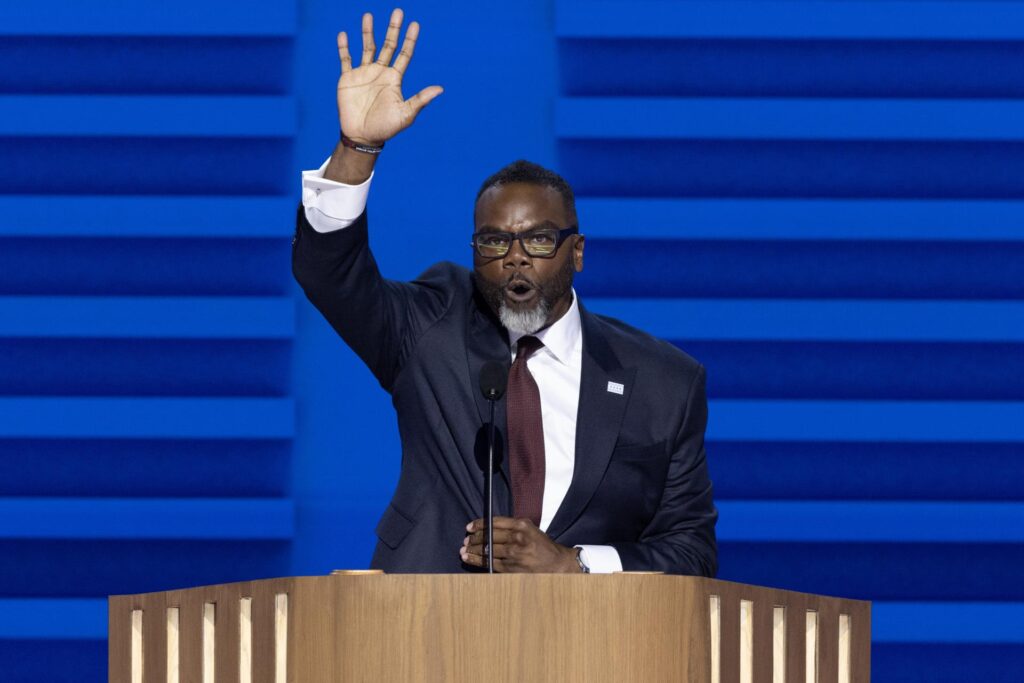
Fotografía de archivo del alcalde de Chicago, Brandon Johnson. EFE/Michael Reynolds
El alcalde de Chicago, Brandon Johnson, firmó el sábado una orden ejecutiva que instruye a todos los departamentos de la ciudad a no colaborar con el Gobierno federal, adelantándose a una posible militarización de la urbe, con la que ha amenazado la Administración de Donald Trump, para combatir el crimen.
«Hoy firmo una orden ejecutiva que lanzará la iniciativa ‘Protegiendo a Chicago'», afirmó el alcalde demócrata en una rueda de prensa, en la que explicó que la medida ordena que «el Departamento de Policía de Chicago no colaborará con el personal militar en patrullas policiales o en la aplicación de la ley de inmigración civil».
Johnson respondió así a las amenazas sobre un posible despliegue militar en Chicago con el que amenazó recientemente el presidente estadounidense, Donald Trump, a imagen de lo que hizo recientemente en Washington D.C., también bajo una alcaldesa demócrata.
Esta estrategia, no obstante, podría venir acompañada de un aumento de las redadas contra migrantes indocumentados.
«No queremos ver tanques en nuestras calles. No queremos ver familias destrozadas. No queremos que las abuelas sean arrojadas a la parte trasera de furgonetas sin identificar. No queremos ver a los habitantes de Chicago sin hogar acosados o desaparecidos por agentes federales», subrayó Johnson.
Y agregó que la orden instruye al Departamento de Leyes «a seguir todos y cada uno de los mecanismos legales para responsabilizar a esta Administración por violar los derechos de Chicago».
El alcalde indicó que esta medida se alinea con los intereses del gobernador de Illinois, el también demócrata J.B. Pritzker, y precisó que ha estado en contacto con compañeros demócratas de Los Ángeles para saber qué le puede esperar a Chicago.
Además de en la capital, el Gobierno de Estados Unidos ya desplegó miles de efectivos de la Guardia Nacional en Los Ángeles durante el estallido de unas protestas contra las redadas migratorias el pasado junio.
Trump es «la mayor amenaza para nuestra democracia que jamás haya experimentado la historia de nuestro país», sentenció Johnson en su alocución.
Colvin reportó desde Nueva York. Los periodistas de The Associated Press, Sophia Tareen, en Chicago, y Steve Peoples, en Minneapolis, contribuyeron a este despacho.
La encuesta AP-NORC de 1.182 adultos se realizó del 21 al 25 de agosto y utilizó una muestra extraída del Panel AmeriSpeak de NORC, basada en probabilidades y diseñada para ser representativa de la población estadounidense. El margen de error de muestreo para los adultos en general es de más/menos 3,8 puntos porcentuales.
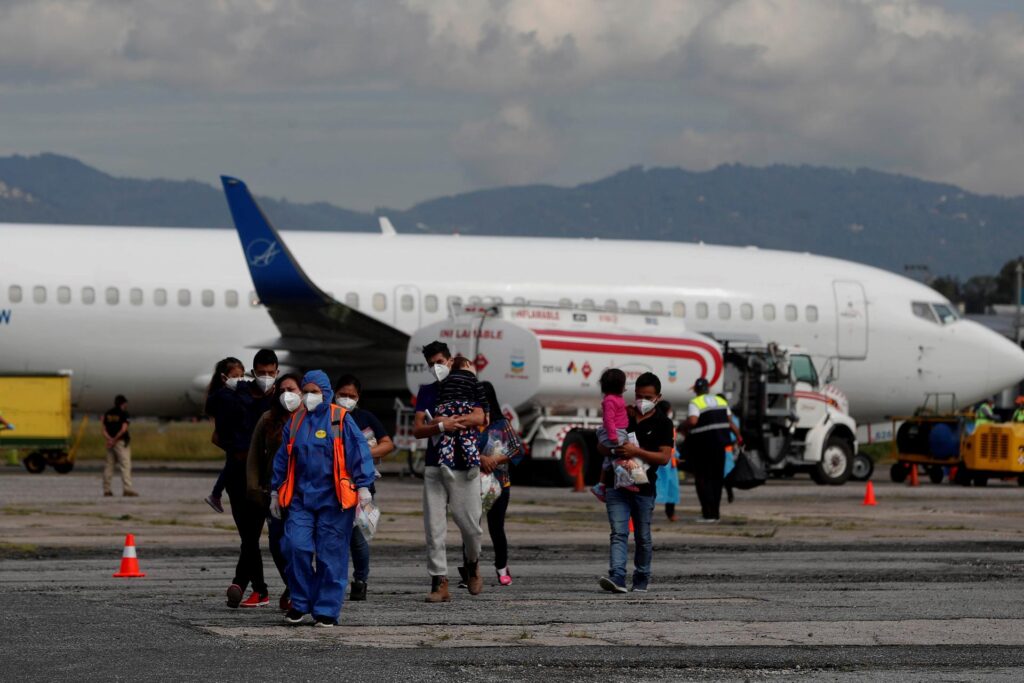
Personas se suben a un avión en Harlingen, Texas, el 31 de agosto del 2025, mientras cuatro autobuses se acercan al aeropuerto para dejar a varios pasajeros. (AP foto/Valerie Gonzalez)
Una jueza estadounidense bloqueó temporalmente este domingo los planes del Gobierno del presidente Donald Trump para deportar a cientos de menores guatemaltecos que llegaron solos a Estados Unidos y que se encuentran bajo custodia de las autoridades.
La jueza del distrito de Columbia Sparkle L.Sooknanan ordenó al Ejecutivo no deportar durante dos semanas a los niños procedentes de Guatemala, que fueron incluidos en una solicitud de emergencia del Centro Nacional de Derecho Migratorio, para detener su repatriación.
Según los abogados de los menores, de entre 10 y 16 años, la Administración violó el debido proceso, puesto que los niños tienen casos pendientes ante tribunales de inmigración, e ignoró las protecciones especiales de quienes cruzaron solos la frontera entre México y Estados Unidos.
En una audiencia por la tarde, la magistrada dijo que era «sorprendente» que el Gobierno esté «intentando sacar del país a menores de edad en plena madrugada durante un fin de semana festivo».
La orden de Sooknanan se produjo cuando varios de los niños ya se encontraban subidos a aviones que los iban a mandar de vuelta a Guatemala, según el representante del Departamento de Justicia, Drew Ensign.
El letrado agregó que el Gobierno desconocía la orden emitida por la jueza a primera hora del domingo cuando estaba trasladando a los menores a los aviones.
Fotografía de archivo de un vuelo de deportación de guatemaltecos desde Estados Unidos. EFE/ Esteban Biba
Según el medio CNN, la medida aplicaría a 600 niños procedentes de Guatemala que actualmente se encuentran bajo custodia del Departamento de Salud y Servicios Humanos (HHS, en inglés).
Datos de la Oficina de la Administración para Niños y Familias, dependiente del HHS, revelan que Estados Unidos tenía bajo custodia a 2.198 menores no acompañados en julio. Sin embargo, no desvela sus nacionalidades.
La mayoría de menores que cruzan la frontera terrestre entre Estados Unidos y México solos proceden de Guatemala, Honduras y El Salvador, según la ONG ‘Save The Children’.
La repatriación supone también un reto para la Administración Trump a la luz del Acuerdo Flores, vigente desde hace tres décadas. Un tribunal federal en Los Ángeles (California) supervisa actualmente la implementación del pacto al que el Ejecutivo estadounidense ha querido poner fin.
El pacto, que se firmó en 1997 tras años de litigio, establece que las autoridades federales no pueden mantener en centros de detención a menores de edad indocumentados por más de 20 días y se les debe garantizar su seguridad y bienestar.
Un familiar de un menor de edad deportado desde Estados Unidos revisa la lista de deportados afuera del Aeropuerto Internacional La Aurora en Ciudad de Guatemala el 31 de agosto del 2025. (AP foto/Moises Castillo)
Fotografía sin fecha específica de toma cedida por Rimas Sports que muestra al piloto de automovilismo Sebastián Montoya. (Foto: EFE/Rimas Sports)
San Juan.– La agencia deportiva puertorriqueña Rimas Sports, que representa a deportistas como los peloteros Fernando Tatis Jr y Ronald Acuña Jr, anunció este sábado que ha firmado al piloto colombiano Juan Pablo Montoya y a su hijo, Sebastián Montoya.
«Con Juan Pablo y Sebastián Montoya, no solo firmamos a dos pilotos; apostamos por un legado y una visión compartida», afirmó Alejandro Padrón, director de la agencia, en un comunicado de prensa.
«Rimas Sports está comprometida con potenciar historias que inspiran en todo el mundo, y esta es una de las más poderosas que el deporte tiene para ofrecer hoy», enfatizó.
Esta firma marca un punto de inflexión en la estrategia de expansión de Rimas Sports dentro del mundo del automovilismo, al sumar a su plantilla a una de las duplas más emblemáticas y prometedoras del deporte.
Juan Pablo Montoya ostenta en su palmarés siete victorias en Grandes Premios de Fórmula 1, múltiples campeonatos en IndyCar y triunfos en NASCAR y en las 24 Horas de Daytona.
Además, fue protagonista en escuderías legendarias como Williams y McLaren, compitiendo codo a codo con los grandes campeones de la era dorada de la F1, y dejó huella en los circuitos más emblemáticos del calendario mundial: Mónaco, Monza, Spa y Silverstone.
Su hijo, Sebastián, de tan solo 20 años, representa la nueva generación del talento latinoamericano en el automovilismo global.
Su paso por el prestigioso Red Bull Junior Team, su experiencia en campeonatos europeos como la FRECA y la F3 Internacional, y su madurez dentro y fuera de pista, lo convierten en un contendiente real para Fórmula 1 en el corto plazo.
«Unirme a Rimas Sports es el paso perfecto para avanzar en mi carrera», aseguró Sebastián Montoya.
«Su visión, compromiso y conexión con la cultura latina los hacen el socio ideal para ayudarme a alcanzar mis metas en el automovilismo. Estoy emocionado de continuar el legado de mi familia mientras construyo mi propio camino hacia la Fórmula 1», agregó.
Rimas Sports representa también a la piloto colombiana Tatiana Calderón, con experiencia en F2, IndyCar, WEC y otras plataformas de primer nivel.
Con este tridente colombiano, Rimas Sports se posiciona como una fuerza representativa del talento latino en un ecosistema altamente competitivo y tradicionalmente dominado por Europa.
Tocando Puertas brought together patients, volunteers, and doctors in a welcoming environment filled with information about cancer (Photo: Haydeé Rosario / Impacto staff)
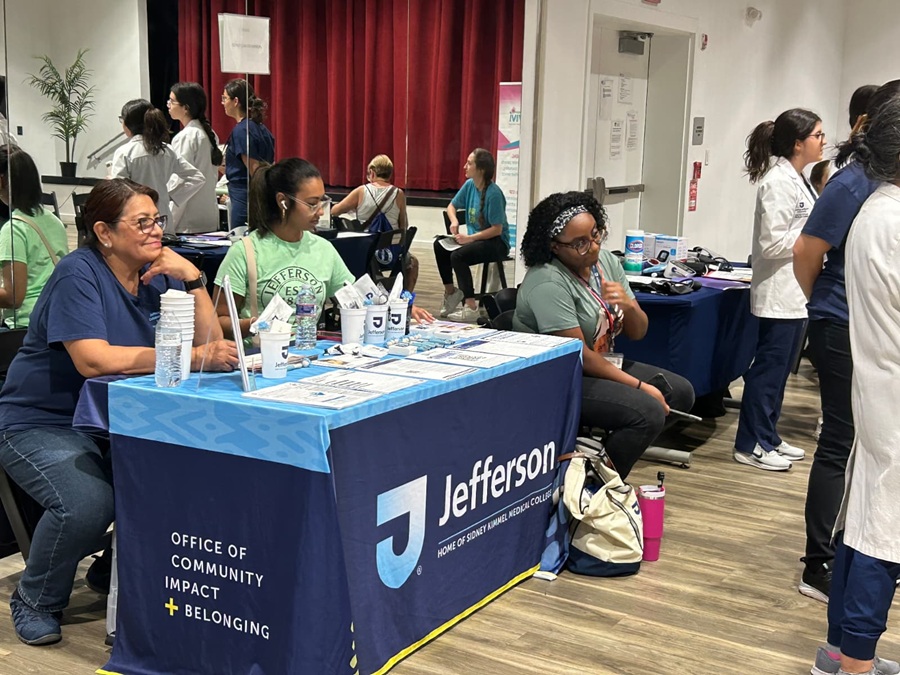
Last Saturday, August 23, Moriviví held its community event “Tocando Puertas, Cambiando Vidas” at the Taller Puertorriqueño, bringing together patients, caregivers, and volunteers. This nonprofit organization, dedicated to supporting Latino cancer patients, reaffirmed its commitment to providing emotional, educational, and spiritual support in a culturally sensitive environment.
“This event is a reminder that you are not alone,” said Marla Vega, executive director and founder of Moriviví. “Although there were fewer free medical screenings this year due to budget cuts, Spanish-speaking doctors were present to inform and engage with the community.”
This was the case with Dr. Ana María López from Jefferson University, who offered advice on how to take care of oneself following a cancer diagnosis: “Early detection saves lives, that’s what we aim for: to have people informed about their condition and seek help in time. I am also grateful to this group of medical students who provided information about different types of cancer to continue educating the community.”
Attendees enjoyed workshops and talks on prevention, nutrition, and resources for uninsured patients. Among the participants were Crisol Mente, from Drexel’s mental health program, and the Health Promotion Council, who registered people for free mammography services.
The Health Promotion Council registered individuals for free mammogram services (Photo: courtesy of Moriviví)
One of the speakers, Carol Persaud, Health Coach, shared a message of guidance: “The most important things for health are good nutrition, staying active, exercising regularly, and cultivating a positive attitude. The mind and body work together, and that energy can make a difference.”
Volunteers and cancer survivors expressed the importance of mutual support: “Moriviví gave me words when I couldn’t speak, and now I can help other women find their voice.” Daisy added, “Being a caregiver is also a heavy emotional burden, and here there is space for us.”
In addition to monthly workshops in hospitals and community spaces, Moriviví organizes recreational and educational activities, strengthening the support network in Philadelphia.
“We want every person who walks through our doors to feel that they can open their leaves again, like the moriviví plant. That there is still life, fight, and hope,” concluded Marla.
Moriviví doesn’t stop, and preparations are already underway for the Super Bingo on September 27. For more information about this and other events, you can visit Moriviví’s social media @grupomorivivicancer or call 215-290-7012.
Filadelfia – En reconocimiento al Día de Concientización sobre Sobredosis, la Oficina de Seguridad Pública de la Ciudad de Filadelfia lanzó el pasado 29 de agosto la iniciativa “Naloxona en Negro” (Naloxone in Black), una campaña enfocada en la prevención de sobredosis y el aumento del acceso a naloxona en comunidades negras.
La iniciativa, liderada por la Unidad de Respuesta a Sobredosis (ORU) en colaboración con el Departamento de Bomberos de Filadelfia, el Departamento de Programas sobre Drogas y Alcohol de Pensilvania (DDAP) y con el apoyo de Vital Strategies, busca reducir las barreras de acceso a este medicamento que salva vidas.
¿Qué incluye la campaña?
🔹 Cajas de distribución comunitaria: Cada estación de bomberos en Filadelfia ahora cuenta con una caja de distribución de naloxona, ubicada en el exterior del edificio, accesible las 24 horas. Los residentes pueden tomar tanta naloxona como necesiten, sin preguntas ni requisitos.
🔹 Acceso anónimo y sin estigmas: La estrategia busca eliminar el miedo al estigma que muchas veces impide que las personas accedan a naloxona por medios tradicionales como farmacias o centros de recursos.
🔹 Impacto en comunidades afroamericanas: Entre 2018 y 2022, las muertes por sobredosis aumentaron un 87% entre afroamericanos en Filadelfia, mientras que disminuyeron un 12% entre residentes blancos. Esta campaña busca cerrar esa brecha y salvar vidas.
🔹 Sostenibilidad del programa: La ciudad contratará personal dedicado para mantener las cajas abastecidas, ofrecer capacitación comunitaria y recopilar datos sobre el impacto de la iniciativa.
Voces de apoyo
“La seguridad pública no solo significa responder a emergencias, sino también garantizar que nuestras comunidades tengan los recursos que necesitan”, dijo Adam Geer, director de Seguridad Pública.
“Cuando tienes naloxona en tus manos, tú puedes ser el primer respondedor en momentos críticos”, expresó Martin McCall, Comisionado Adjunto de Servicios Médicos de Emergencia del Departamento de Bomberos.
“El acceso a la naloxona es fundamental porque este medicamento realmente salva vidas”, afirmó la Secretaria Dra. Latika Davis-Jones, del DDAP.
Para más información sobre qué es la naloxona, cómo administrarla y opciones de tratamiento, visita el sitio web oficial de la Ciudad de Filadelfia.
Este contenido forma parte de Every Voice, Every Vote, un proyecto colaborativo gestionado por The Lenfest Institute for Journalism. El apoyo principal para Every Voice, Every Vote en 2024 y 2025 lo proporciona William Penn Foundation con fondos adicionales de The Lenfest Institute for Journalism, Comcast NBC Universal, The John S. and James L. Knight Foundation, Henry L. Kimelman Family Foundation, Judy y Peter Leone, Arctos Foundation, Wyncote Foundation, 25th Century Foundation y Dolfinger-McMahon Foundation. Para obtener más información sobre el proyecto y ver una lista completa de los patrocinadores, visite Every Voice, Every Vote . El contenido editorial es creado sin intervención de los donantes del proyecto.
Preocupados por la inflación, los estadounidenses han estado atentos a precios de productos cotidianos como los huevos y la gasolina. Pero un gasto menos conocido debería causar más alarma: el aumento de las primas de los seguros médicos. Llevan años subiendo, y ahora lo están haciendo a un ritmo sin precedentes.
Hay que considerar que, entre 2000 y 2020, el precio de los huevos fluctuó entre poco menos de $1 y aproximadamente $3 la docena; alcanzó los $6,23 en marzo, pero luego bajó a $3,78 en junio.
El precio promedio de la gasolina, tras oscilar entre $2 y $4 el galón durante más de una década a partir de 2005, alcanzó un máximo de $4,93 en 2022 y recientemente volvió a bajar a poco más de $3.
Mientras tanto, desde 1999, las primas de los seguros médicos para las personas con cobertura médica a través del empleador se han más que cuadruplicado. Solo entre 2023 y 2024, aumentaron más del 6% tanto para la cobertura individual como familiar, un alza más pronunciada que la de los salarios y la inflación general.
Para muchas personas que tienen planes médicos creados por la Ley de Cuidado de Salud a Bajo Precio (ACA) —porque trabajan para pequeñas empresas o pagan su propia cobertura— es probable que las tarifas hayan aumentado de forma aún más drástica. En este mercado, los reguladores estatales examinan minuciosamente los aumentos de tarifas propuestos por las aseguradoras, pero solo si superan el 15%.
Y la situación está a punto de empeorar: para 2026, las aseguradoras en los mercados de ACA han propuesto nuevos precios exorbitantes: en Nueva York, UnitedHealthcare propuso un aumento del 66,4%. HMO Colorado solicitó un aumento promedio de más del 33% en ese estado. En Washington, el aumento promedio propuesto por todas las aseguradoras es del 21,2%, y en Rhode Island es del 23,7%.
Según Business Group on Health, un consorcio de grandes empleadores, “los costos reales de la atención médica han aumentado un 50% acumulado desde 2017”. En una encuesta independiente publicada en 2021, el 87% de las empresas afirmó que, en los próximos cinco a 10 años, el costo de proporcionar seguro médico a sus trabajadores se volvería “insostenible”.
Y las aseguradoras del mercado de ACA están aumentando las primas un promedio del 20% para el próximo año, según un nuevo análisis. Imaginemos que los pagos de alquiler o hipoteca de decenas de millones de estadounidenses aumentaran repentinamente en esa cantidad.
En teoría, los que regulan los seguros podrían exigir que se redujeran las tarifas propuestas, y esto sucede a menudo. Sin embargo, algunos estados son más activos que otros en este sentido. Y todos temen que una interferencia regulatoria excesiva pueda expulsar a las aseguradoras de sus mercados.
Las aseguradoras ofrecen muchas explicaciones para sus cálculos, algunas de las cuales están relacionadas con las recientes medidas del Congreso y del presidente Donald Trump.
Por ejemplo, se espera que los nuevos aranceles a los socios comerciales de Estados Unidos aumenten el costo de los medicamentos y los suministros médicos. Mientras tanto, las reducciones en el gasto en salud incluidas en el proyecto de ley de presupuesto del Partido Republicano, junto con la expiración de algunos subsidios a las primas de la era Biden a finales de este año, provocarán que muchas personas pierdan su seguro médico.
Se prevé que cerca de 16 millones de estadounidenses se quedarán sin seguro en 2034, en muchos casos porque mantenerlo se volverá inasequible.
Dado que es probable que la mayoría de estas personas sean jóvenes o sanas, el grupo de riesgo de quienes permanezcan asegurados será mayor y más enfermo, y por lo tanto, más costoso de cubrir.
“En última instancia, creemos que el mercado de ACA probablemente será más pequeño y estará más orientado a la necesidad del paciente el próximo año”, escribió Janey Kiryluik, vicepresidenta de comunicaciones corporativas de Elevance Health (anteriormente conocida como Anthem), en un correo electrónico. Agregó: “Nuestra postura refleja una acción disciplinada temprana”.
Recuerda que la mayoría de las aseguradoras en el país son empresas públicas con fines de lucro; por lo tanto, tienden a actuar en beneficio de sus accionistas, no de los pacientes cuya atención médica cubren.
Las grandes empresas que gestionan sus propios planes de salud podrían negociar mejores condiciones para sus trabajadores. Pero las empresas más pequeñas, en su mayoría, tendrán que aceptar las ofertas.
Las primas no son el único aspecto del seguro médico que se está volviendo más caro. Los deducibles (el dinero que los beneficiarios deben pagar de su bolsillo antes que el seguro entre en vigencia) también están aumentando. El deducible promedio para un plan plata estándar de ACA en 2025 era de casi $5.000, aproximadamente el doble que en 2014. (Para quienes tienen seguro médico a través de su empleador, el promedio es de poco menos de $2.000).
Algunos estados intentan frenar la tendencia ofreciendo una “opción pública” estatal, un plan de seguro básico y asequible que los pacientes pueden elegir. Sin embargo, han tenido dificultades porque una tasa de pago más baja para los trabajadores generalmente significa menos proveedores participantes y un acceso reducido a la atención médica.
Si los votantes prestaran tanta atención al precio del seguro médico como al costo de la gasolina y los huevos, tal vez los funcionarios electos responderían con más medidas.
KFF Health News es una redacción nacional que produce periodismo en profundidad sobre temas de salud y es uno de los principales programas operativos de KFF, la fuente independiente de investigación de políticas de salud, encuestas y noticias.