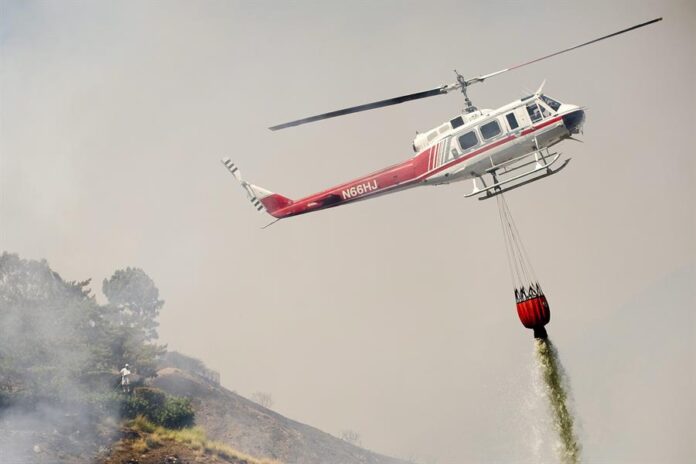
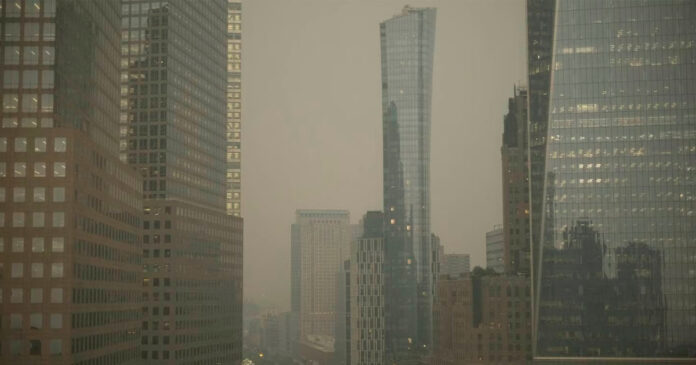
El humo de centenares de incendios forestales en el este de Canadá está provocando el dramático descenso de la calidad del aire en algunas de las principales ciudades del país lo que está provocando que las autoridades recomienden limitar las actividades en el exterior.
El Servicio Meteorológico de Canadá colocó este martes a la capital canadiense, Ottawa, en la peor clasificación de su escala de calidad de aire y advirtió que la población debe permanecer en el interior lo máximo posible, especialmente las personas de edad más avanzada, niños e individuos con dificultades respiratorias.
Toronto, la más poblada del país, estuvo todo el día cubierta por una capa de humo que oscurecía los rayos del sol, a la vez que un olor a quemado impregnaba toda la ciudad.
Las mismas escenas se repetían en Montreal y la ciudad de Quebec.
Las consecuencias de los incendios se extienden más allá de las fronteras canadienses y el humo también afectaba este martes a puntos de Estados Unidos como Nueva York.
Las autoridades canadienses han advertido que no prevén que la calidad del aire mejore en varios días.
El humo que cubre gran parte de Canadá es fruto de los más de 400 incendios activos en el país, de ellos unos 150 en Quebec, una cifra muy superior a lo habitual para esta época del año.
De hecho, este año ya se han producido 2.200 incendios forestales que han quemado 3,3 millones de hectáreas de bosque y vegetación, más de 10 veces la media de la superficie quemada durante la pasada década.
El Gobierno canadiense ha advertido que las previsiones meteorológicas para el verano, que anticipan condiciones secas y temperaturas muy elevadas, hacen temer que este año será uno de los peores en incendios forestales de la historia del país.
This photo combination of images first row left to right; Los Angeles Angels' Shohei Ohtani, April 9, 2023, in Aneheim, Ca., Milwaukee Brewers' Willy Adames, May 24, 2023, in Milwaukee, Cincinnati Reds' Jake Fraley, May 13, 2023, in Miami, 2nd row, left to right; Washington Nationals Corey Dickerson, May 17, 2023, Miami, Kansas City Royals' Jackie Bradley Jr., May 23, 2023, in Kansas City, and Miami Marlins' Jorge Soler, May 6, 2023, wearing run-scoring celebratory attire when they return to their team dugouts. (Photo: AP)
PITTSBURGH.— There are very few things that make Scott Bonnett panic.
Spending the last 15 years making sure the Pittsburgh Pirates have whatever they need whenever they need it has taught the longtime equipment manager the importance of being prepared for anything.
Well, almost anything.
Bonnett found himself in the dugout in Seattle late last month watching Andrew McCutchen round third following a leadoff home run against the Mariners when joy was quickly replaced by panic. The pathologically meticulous Bonnett scanned the end of the bench looking not for a helmet or a glove or pine tar but … a rubber sword and a black suit jacket that looks like it got attacked by an overzealous tailor with an affinity for patches.
Welcome to major league baseball in 2023, where an ever-increasing number of homers and big hits aren’t met with simple fist bumps or forearm bashes but a full-on production.
A trend that began with a few rogue teams during the pandemic as a way to bring life to fan-less stadiums is catching on thanks in part to social media and simple competitive one-upmanship.
Kansas City Royals’ Jackie Bradley Jr., wearing a gladiator style helmet, is greeted in the dugout after hitting a two-run home run against the Detroit Tigers Monday, May 22, 2023, in Kansas City, Mo. About half the clubs in MLB are using some kind of prop or ritual to celebrate a big hit or a big play in ways that often go viral. (Photo: AP/Charlie Riedel/File)
The surprising Pirates began using a sword — OK, technically a “cutlass” — this season at the behest of a group of fans that call themselves “The Renegades of the Rotunda” and regularly show up to games at PNC Park in full cosplay glory. McCutchen — who was able to flamboyantly parry with an invisible opponent in Seattle after his 295th career homer when Bonnett found the momentarily misplaced prop just in time — figures his club is just trying to keep up with the times.
“You almost feel like an outcast if you don’t have it on a team,” the five-time All-Star said. «It’s just kind of where we are.»
Or more specifically, where they’re going.
Baseball isn’t just evolving on the field but off it. Sure the pitch clock is cool. It just doesn’t go viral like say, players slamming water through a funnel or turning themselves into “human sprinklers” like kids goofing off around a garden hose, as the Baltimore Orioles do after big hits.
“It is very dumb, but it is hilarious,” McCutchen said. “Especially when you get the whole team involved.”
McCutchen pointed to the crowded dugout rail as proof the Orioles are creating the kind of good vibes difficult to quantify but essential to navigating a six-month season that can sometimes feel like a slog no matter how well it’s going.
Atlanta Braves’ Austin Riley wears an oversized baseball cap as he celebrates in the dugout after hitting a solo home run against the Kansas City Royals, Friday, April 14, 2023, in Kansas City, Mo. About half the clubs in MLB are using some kind of prop or ritual to celebrate a big hit or a big play in ways that often go viral. (Photo: AP/Charlie Riedel)
“Everyone is watching the game, they’re watching what’s happening,” McCutchen said. “You don’t have guys in the clubhouse just wondering what’s going on or not paying attention. They’re out there.”
It’s also creating a bond with the people who buy the tickets. The Orioles have labeled a section of left-field seats “Bird Bath Splash Zone” where fans can get doused — thankfully with water from a cannon and not a player’s mouth — after extra-base hits.
“They want to feel connected to their team, and I think it gives them a way that hopefully they’re enjoying it,” Baltimore pitcher Kyle Gibson said. “It gives them a way to get in touch.”
There are a handful of unwritten rules — of course, there are unwritten rules, it’s baseball — that come with the territory. First off, the props have to be organic, or at the very least on brand. Oh, and they can’t upset a league sponsor, like when Atlanta broke out a comically oversized Braves hat, only to be chided by MLB because it wasn’t created by New Era, MLB’s official hat provider.
The Twins started their “Land of 10,000 Rakes” routine at the urging of pitcher Pablo López, who created an informal planning committee to hatch something symbolic of the region. They came up with a beige fishing vest and a child’s fishing pole, with the opportunity for more to be added over the summer.
“Maybe we can add a bucket hat, or a big fish would be good,” outfielder Michael Taylor said.
Pittsburgh Pirates’ Andrew McCutchen holds the team’s home run sword as he celebrates in the dugout with teammates after hitting a solo home run against the Seattle Mariners Friday, May 26, 2023, in Seattle. About half the clubs in MLB are using some kind of prop or ritual to celebrate a big hit or a big play in ways that often go viral. (Photo: AP/Lindsey Wasson/File)
Change can be good. Miami’s homer party has morphed from a simple chain with a massive Marlins logo to a full-on ensemble that now includes a giant straw hat and a pair of sunglasses, a nod to a city that’s part neon glam, part retirement community.
Arizona used to pull out a stuffed rattlesnake but has since traded it for a “victory vest” that the night’s star player can wear during postgame TV interviews.
“Anything you can do to break up the dog days of the season, little things like that, sneak in a laugh,» Diamondbacks first baseman Christian Walker said. «We’ve had a couple of things we’ve retired along the way, but it seems like the jacket is sticking.”
It helps that the Diamondbacks are winning, a key factor in whether something catches on or fizzles out. San Diego Padres star Fernando Tatis Jr. thought he was on to something when he brought a full-size red, white and green sombrero into the dugout during a series in Mexico City against the San Francisco Giants in April. The Padres homered six times that first night, with the sombrero finding its way onto the head of whoever sent the ball over the fence.
A May swoon, however, soon followed. And the sombrero went back into storage after two short-lived weeks.
“It died,” Tatis joked, allowing it will “probably” return at some point. “It’s in the back. It’s resting. He gave everything he had.”
Still, San Diego doesn’t lack options. The Padres occasionally pose for photos with a baseball — typically with a face drawn on it by bench coach Ryan Christenson — that sports a mini-sombrero up top after homers.
Nearly every player The Associated Press talked to stressed most of the celebrations are generally all in good fun and don’t cross the line into something personal, unlike say a particularly showy backflip or the “sword” motion former MLB pitcher Trevor Bauer used to flash after a strikeout.
They’re also typically done in the “privacy” of the dugout, out of the sight of the opponent on the field.
Still, that doesn’t mean they don’t occasionally get under the skin. That’s where the beauty of the game comes in.
Baltimore Orioles’ Austin Hays drinks from a «Homer Hose» held up by right fielder Terrin Vavra (23) after hitting a solo home run against the Texas Rangers, Saturday, May 27, 2023, in Baltimore. About half the clubs in MLB are using some kind of prop or ritual to celebrate a big hit or a big play in ways that often go viral. (Photo: AP/Julio Cortez)
“It’s a two-way street,» McCutchen said. «The hitter can do what they want. The pitcher can do what they want. But just know if there’s ever a meeting again, that other person is going to feel like, if I get you here, I’m going to do something to where I feel some type of vengeance. I have some time of vengeance against you because you did that. I’m going to really celebrate on this one.”
It’s not on McCutchen to decide what’s good for the game or bad for the game. At 36, he’s old enough to be considered “old school,” even though there’s been a flashiness to his game from the moment he made his major-league debut in 2009. Now a father of three — including two young sons who are already playing T-ball — he understands the game needs to adapt or die.
If that means turning every home into a production — within reason — then so be it. Bring on the props. A decade ago he was part of a team that flashed a “Z” in reference to Zoltan, the villain in the early 2000s comedy “Dude Where’s My Car? — perhaps one of the most random “things that became a thing” in the sport’s modern history.
This season, it’s a cutlass and a jacket that’s a little too tight. Next year it’ll be something else.
“It’s going to change,” he said. «For me, you either accept it or you’re just mad. We’re showmen. We put on a show. That’s what brings you to the ballpark. You play the game but you also do some things that make people be like, ‘Man, that was really cool.’”
En esta imagen de archivo, el papa Francisco es recibido por el personal hospitalario a su entrada, en silla de ruedas, en el policlínico universitario Agostino Gemelli en Roma, el 11 de julio de 2021, antes de someterse a una operación intestinal. (Foto: AP/Vatican Media/Archivo)
Francisco ha estado hospitalizado en tres ocasiones desde que fue elegido papa en 2013 y, cuando era joven, se sometió a una operación importante para que le extirparan parte de un pulmón.
Entre medias, el pontífice, de 86 años, ha padecido ataques de ciática, lo que le ha causado problemas para caminar y estar de pie. Más recientemente, sufrió una distensión de ligamentos y una pequeña fractura en una rodilla que le obligaron a usar silla de ruedas y andador durante más de un año.
Francisco tiene un médico personal, el doctor Roberto Bernabei, un internista y especialista en geriatría en la Universidad Católica del Sagrado Corazón en Roma. Cuenta también con un enfermero personal, Massimiliano Strappetti, un empleado del sistema de salud del Vaticano a quien el papa atribuye el mérito de salvarle la vida cuando le diagnosticó su problema intestinal en 2021.
En 2022, Francisco nombró a Strappetti su “asistente personal de salud». Ambos suelen acompañarlo en sus viajes al extranjero.
A continuación, un vistazo a la salud del papa mientras se somete a una operación por una obstrucción intestinal.
___
1957: En su Argentina natal, Francisco, quien por entonces tenía poco más de 20 años, sufre una grave infección respiratoria que obliga a los doctores a extirparle parte de un pulmón. Más tarde, recuerda que una enfermera le salvó la vida al decidir duplicar la cantidad de medicamentos que recibía.
Del 4 al 14 de julio de 2021: El papa pasa 10 días en el Policlínico Universitario Agostino Gemelli de Roma por lo que, según el Vaticano, es un estrechamiento del intestino grueso. Los médicos le extirpan 33 centímetros (13 pulgadas) de colon. Tras el alta, Francisco dice que puede comer lo que quiera, pero lamenta no haber respondido bien a la anestesia general.
24 de enero de 2023: En una entrevista con The Associated Press, el pontífice dice que vuelve a padecer diverticulosis, o las protuberancias en la pared intestinal que motivaron la operación de 2021, pero está bajo control.
Del 29 de marzo al 1 de abril de 2023: Pasa tres días en el Gemelli por una infección respiratoria tras sentir un dolor agudo en el pecho y sufrir problemas para respirar. Los médicos le diagnostican una bronquitis aguda y lo tratan con antibióticos intravenosos.
6 de junio de 2023: Francisco se somete a pruebas médicas no especificados en el centro hospitalario y regresa al Vaticano.
7 de junio de 2023: El papa ingresa en el Gemelli para lo que, según el Vaticano, es una cirugía abdominal por una obstrucción intestinal. Pasará varios días hospitalizado, añade.
Due to a unique weather pattern, Philadelphia continues to be affected by smoke from the wildfires in Canada. The smoke grew worse in the Philadelphia region on Tuesday evening. Residents in the area should take precautions to avoid unnecessary exposure to smoke and avoid activities that may increase the amount of particulate matter in the air. The Health Department recommends doing the following to protect yourself and your family from poor air quality during a Code Orange Fine Particle Action Day:
Avoid going outdoors as much as possible.
If you must go outside, avoid excessive activity, such as jogging or running, and wear a mask, if available.
Close all windows and doors to minimize air pollution in your home.
Recirculate air with fans to avoid bringing more air pollution into your home.
Avoid areas of high congestion and where air pollution may be high (e.g., main streets or highways, areas with low circulation).
People with underlying illnesses should monitor for symptoms, including trouble breathing, nausea, and dizziness. If these symptoms occur, seek medical attention as soon as possible.
The air may be hazardous for all residents but is especially dangerous for sensitive groups, including children, elderly people, pregnant women, and those with respiratory diseases or heart conditions.
To help reduce the amount of pollution in the city, residents are asked to:
Avoid unnecessary trips in their cars,
Avoid idling,
Carpool when possible, and
Avoid using gas-powered lawn and garden equipment.
Residents are also advised to monitor the situation and change their behaviors based on the amount of smoke in the air. The Health Department publishes real-time air pollution readings at https://www.phila.gov/aqi.
Wildfire smoke contains fine particles, also called PM 2.5. This is one of the pollutants that the Health Department monitors during large fires in Philadelphia. PM 2.5 are tiny particles in the air that reduce visibility and cause the air to appear hazy when levels are elevated. PM 2.5 refers to tiny particles or droplets in the air that are two and one-half microns or less in width. The widths of the larger particles in the PM 2.5 size range would be about thirty times smaller than that of human hair. PM 2.5 can be dangerous because if you inhale it, the particles are so small they can go deep into your lungs.
El canciller mexicano Marcelo Ebrard (c) hoy durante una rueda de prensa en un Hotel de la Ciudad de México (México). EFE/José Méndez
El canciller mexicano Marcelo Ebrard anunció el martes que renunciará a su puesto en la cartera de Relaciones Exteriores del Gobierno de México al tiempo que presentó al oficialista Movimiento Regeneración Nacional (Morena) su propuesta para la selección de candidato a la elección presidencial de 2024.
Ebrard, de 63 años, dijo que el próximo lunes 12 de junio dejará formalmente su cargo de jefe de la diplomacia mexicana.
Previamente, el presidente nacional de Morena, Mario Delgado, había informado en una rueda de prensa que el próximo domingo el partido definirá el proceso que seguirá para elegir al candidato de su partido rumbo a las elecciones de 2024, en las que se escogerá al sucesor del actual presidente mexicano, Andrés Manuel López Obrador.
«He resuelto y así se los transmito solicitar y presentar mi renuncia a la Secretaría de Relaciones Exteriores a partir del lunes 12 de junio a primera hora, con el propósito de dedicarme de lleno con alegría y resolución a defender el proyecto que encabeza el presidente, Andrés Manuel López Obrador, en todo el país», dijo Ebrard.
«Me entusiasma y me enorgullezco ser parte de este gobierno y también me entusiasma actuar con congruencia respecto a lo que hemos propuesto y, por eso, me separo del cargo y voy a encontrarme con la ciudadana y sus ciudadanos», añadió.
Sobre el Consejo Nacional de Morena que el partido ha anunciado para el próximo domingo 11 de junio, Ebrard confirmó que participará. «Es mi privilegio decirles que participaré en el Consejo Nacional de Morena con mis compañeras y compañeros».
Sobre Ebrard pesaban los rumores de que saldría de Morena y ya había tenido acercamientos con otros partidos.
Ebrard ha sido Secretario de Relaciones Exteriores desde el inicio de la administración de López Obrador, el 1 de diciembre de 2018.
«Arribaremos ese Consejo Nacional con una propuesta unitaria en la que coincidamos que garantice equidad, transparencia y reglas claras porque nuestro movimiento tiene y sostendrá y defenderá su autoridad moral.
Además, pidió asegurarse que la encuesta que va a realizarse para seleccionar al candidato de Morena «sea amplia, transparente y verificable. Idealmente con una sola pregunta».
El lunes, el presidente López Obrador prometió que no intervendrá en la elección del candidato presidencial de su partido, el Movimiento de Regeneración Nacional (Morena), a un año de las presidenciales de 2024.
Este martes, el presidente de Morena, Mario Delgado, señaló que el próximo domingo se definirán «fechas, encuestas y requisitos para los aspirantes», escuchándolos a ellos y recibiendo sus aportaciones.
Se definirá, dijo, «la ruta a seguir» de cara a las elecciones presidenciales a celebrarse en junio del año próximo, a las que, en principio, contenderán, además de Ebrard, la jefa de Gobierno de la Ciudad de México y la actual favorita, Claudia Sheinbaum; el secretario de Gobernación, Adán Augusto López, y el líder de Morena en el Senado, Ricardo Monreal.
También sostuvo que están las puertas abiertas para candidatos de agrupaciones aliadas, entre quienes se perfilan Manuel Velasco, del Partido Verde Ecologista de México (PVEM), y Gerardo Fernández Noroña, del Partido del Trabajo (PT).
Delgado aseguró que el proceso de selección será imparcial, democrático y transparente, y que será «el pueblo de México» quien decida.
Sobre los rumores de las posibles asperezas de Ebrard, la posibilidad de que presente una propuesta diferente, o de que decida postularse como candidato de la oposición, Delgado aseguró que «no hay ninguna inconformidad» por parte del canciller.
Buildings in lower Manhattan in New York are partially obscured by smoke from Canadian wildfires on Tuesday, June 6, 2023. (Photo: AP/Patrick Sison)
Intense Canadian wildfires are blanketing the northeastern U.S. in a dystopian haze, turning the air acrid, the sky yellowish gray and prompting warnings for vulnerable populations to stay inside.
The effects of hundreds of wildfires burning across the western provinces to Quebec could be felt as far away as New York City and New England, blotting out skylines and irritating throats.
U.S. authorities issued air quality alerts. Hazy conditions and smoke from the wildfires were reported across the Great Lakes region from Cleveland to Buffalo.
A smoky haze that hung over New York City much of the day Tuesday thickened in the late afternoon, obscuring views of New Jersey across the Hudson River and making the setting sun look like a reddish orb. In the Philadelphia area, dusk brought more of a lavender haze.
Sal and Lilly Murphy, of Brooklyn, likened the burning scent to a campfire. They said they could even smell the smoke indoors, in a Manhattan restaurant, then walked outside and saw a sky that looked like it was about to storm — but was rainless. Lilly wore a mask for protection.
“It’s a little scary,” Sal Murphy said.
Smoke from the fires has wafted through northeast U.S. states for weeks now, but it’s only recently been noticeable in most places.
New York Gov. Kathy Hochul said Tuesday’s hazy skies “were hard to miss,” and New York City Mayor Eric Adams encouraged residents to limit outdoor activities ”to the absolute necessities.”
Here’s a closer look at what’s happening and some suggested precautions for dealing with the haze:
WHAT’S HAPPENING?
Smoke from Canada’s wildfires has been moving into the United States since last month. The most recent fires near Quebec have been burning for at least several days.
The U.S. Environmental Protection Agency said hazy skies, reduced visibility and the odor of burning wood are likely, and that the smoke will linger for a few days in northern states.
“It’s not unusual for us to get fire smoke in our area. It’s very typical in terms of northwest Canada,” said Darren Austin, a meteorologist and senior air quality specialist with the Rhode Island Department of Environmental Management. But, usually, the smoke has been aloft and hasn’t affected people’s health, he said.
The Quebec-area fires are big and relatively close, about 500 to 600 miles (roughly 800 to 970 kilometers) away from Rhode Island. And they followed wildfires in Nova Scotia, which resulted in a short-lived air quality alert on May 30, Austin said.
Jay Engle, a National Weather Service meteorologist based in Upton, Long Island, said the wind trajectory that allowed smoke and hazy conditions to be seen in the New York City area could continue for the next few days. Of course, he said, the main driver of conditions is the fires themselves. If they diminish, the haze would too.
WHAT’S THE BIGGEST CONCERN?
Air quality alerts are triggered by a number of factors, including the detection of fine-particle pollution — known as “PM 2.5” — which can irritate the lungs.
“We have defenses in our upper airway to trap larger particles and prevent them from getting down into the lungs. These are sort of the right size to get past those defenses,” said Dr. David Hill, a pulmonologist in Waterbury, Connecticut, and a member of the American Lung Association’s National Board of Directors. “When those particles get down into the respiratory space, they cause the body to have an inflammatory reaction to them.”
Trent Ford, the state climatologist in Illinois, said the atmospheric conditions in the upper Midwest creating dry, warm weather made it possible for small particulates to travel hundreds of miles from the Canadian wildfires and linger for days.
“It’s a good example of how complex the climate system is but also how connected it is,” Ford said.
WHO SHOULD BE CAREFUL?
Exposure to elevated fine particle pollution levels can affect the lungs and heart.
The air quality alerts caution “sensitive groups,” a big category that includes children, older adults, and people with lung diseases, such as asthma and chronic obstructive pulmonary disease.
Kids, who often are encouraged to go out and play, “are more susceptible to smoke for a number of reasons,” said Laura Kate Bender, the lung association’s National Assistant Vice President, healthy air. “Their lungs are still developing, they breathe in more air per unit of body weight.”
WHAT CAN YOU DO FOR NOW?
It’s a good time to put off that yard work and outdoor exercise. If you go out, consider wearing an N95 mask to reduce your exposure to pollutants.
Stay inside, keeping your doors, windows and fireplaces shut. It’s recommended that you run the air conditioning on a recirculation setting.
“If you have filters on your home HVAC system, you should make sure they’re up to date and high quality,” Hill said. “Some people, particularly those with underlying lung disease, or heart disease, should consider investing in in air purifiers for their homes.”
Lymond Moses is shown in this undated photo provided by the Delaware Department of Justice. Moses was fatally shot by New Castle County police in January 2021. A report commissioned by the Delaware attorney general’s office concluded that the officers were justified in using deadly force in shooting at Moses as he drove a vehicle at them, but Moses’ family is suing the county and the officers. A federal judge in Philadelphia heard arguments Tuesday, June 6, 2023, on a request by the defendants to rule in their favor without holding a trial. (Photo: AP/Courtesy of Delaware Department of Justice)
PHILADELPHIA. — Attorneys for Delaware’s largest county and three police officers asked a federal judge on Tuesday to rule in their favor in a lawsuit stemming from a fatal police shooting in 2021.
The family of Lymond Moses is suing New Castle County and officers Roberto Ieradi, Robert Ellis and Sean Sweeney-Jones for wrongful death and excessive force. They also allege that the officers acted recklessly and violated Moses’ constitutional rights. The lawsuit also claims the county failed to train police properly and that its policies and practices resulted in Moses’ death.
Defense atttorneys argue that the undisputed facts show that the officers were justified in using deadly force, and that Moses’ own actions caused his death. A report commissioned by the Delaware attorney general’s office concluded that the officers were justified in using deadly force.
“Mr. Moses made a whole lot of bad decisions that night,” attorney David MacMain, representing the county, told Judge L. Felipe Restrepo during a hearing on the defendants’ motion to rule in their favor without a trial.
Attorney Emeka Igwe, representing Moses’ family, claims he was “murdered” by “rogue officers.” Igwe argued that a jury should decide whether the officers and the county should be held liable. He also rejected the notion that Ieradi, who fired the shot that killed Moses and has since left the police force, was acting in self-defense and feared for his life and the lives of fellow officers.
“This was simply an execution, because he was upset that Mr. Moses had the audacity to drive away from him,” Igwe said.
Restrepo will consider additional written arguments from attorneys before deciding whether to grant summary judgment to the defendants.
Moses, 30, was shot shortly after 1 a.m. on Jan. 13, 2021, after being confronted by the three county officers, who were patrolling in a Wilmington neighborhood where several stolen vehicles had been found.
Footage from the officers’ body cameras shows Moses unconscious in the driver’s seat of a rental car, which was parked with the transmission engaged, engine running and dome light on. Moses wakes up after an officer reaches through the open driver’s side window and turns off the ignition with his baton. Moses then rolls up the window, and the officer opens the door.
“My mom live right here! Why you waking up like … ?” Moses says in a loud, agitated voice.
The officers tell Moses they are looking for stolen cars and point out that marijuana is clearly visible in his car. They then tell Moses to “hop out,” but he doesn’t comply. Instead, Moses starts the engine and speeds away, leading to a brief vehicle pursuit that ends when he drives down a dead end street. Moses turns his vehicle around facing in the direction of the officers.
“Don’t f—— do it! Don’t do it!” Ieradi shouts before Moses accelerates in his direction.
Ieradi opens fire as Moses’ car begins angling to his left and continues firing as the car passes him. Sweeney-Jones, standing to the right of Ieradi, also points his weapon at the car as it begins to accelerate but he does not fire.
Ellis had pulled his vehicle behind the other two police vehicles and took a position behind Ieradi. He began shooting at Moses’ car as it crashed into Ieradi’s vehicle while apparently trying to weave between it and the vehicle behind which Ellis was standing.
Data extracted from Moses’ vehicle shows that he floored the accelerator between 2.5 and 3 seconds before the crash, going from a dead stop to 23 mph (37 kph) in three seconds. All the shots fired by the officers occurred in that same time span. MacMain noted that Moses’ car was only three feet (1 meter) from Ieradi when the officer fired his fourth shot, which went through the driver’s window and struck Moses in the head.
“I don’t believe there is any way to view that video and say these officers were not in harm’s say,” said attorney Daniel Griffith, representing the three officers.
Igwe argued that Moses did not pose any imminent threat to the officers and that he “simply wanted to get away.”
Moses, who had a history of drug dealing and probation violation convictions dating to 2012, was wanted for a probation violation at the time of the shooting. He had been arrested on felony drug charges on two separate occasions in the year before and was on probation for drug-dealing at the time.
A toxicology report found that the level of fentanyl in Moses’ system was more than 100 times the lethal amount.
“It’s amazing that he was even alive,” MacMain said.
Igwe suggested that Moses, as a long-time fentanyl user, had developed a “tolerance” for the deadly drug.
“It wasn’t fentanyl that killed him. It was the bullet to the head from Officer Ieradi,” Igwe said.
El director mexicano de origen tsotsil, Humberto Gómez Pérez, posa para una fotografía durante una entrevista con EFE, el 5 de junio de 2023, en el marco de la 38 edición del Festival Internacional de Cine de Guadalajara (México). (Foto: EFE/Francisco Guasco)
Guadalajara, México.– Las comunidades indígenas en México encontraron en el cine una manera de hacerse escuchar y de mostrar al mundo su cosmovisión, que por mucho tiempo fue mostrada a través de los ojos de personas ajenas a esa población, dijo este martes a EFE el director de origen tsotsil, Humberto Gómez Pérez.
“Antes era todo una mirada desde fuera, ahora hemos estado también preparándonos para lograr mostrar estos materiales que nosotros estamos haciendo y al final de cuenta, pues están volteando a vernos, creo que eso es lo importante y es valioso también para nosotros que nos den la oportunidad de mostrar nuestros trabajos”, dijo en entrevista.
Gómez Pérez es director y guionista del documental “Ch´ul be: senda sagrada” que muestra el esfuerzo por mantener el bienestar colectivo y las costumbres religiosas de la comunidad tsotsil del pueblo de San Andrés Larráinzar, en el sureño estado de Chiapas.
La cinta fue estrenada como parte de la selección oficial de la edición 38 del Festival Internacional de Cine en Guadalajara (oeste de México) y compite en la categoría de mejor documental del Premio Mezcal al cine mexicano.
El cineasta, quien ha dirigido diversos cortos y largometrajes para mostrar las costumbres y forma de vivir de su comunidad, afirmó que la posibilidad de que los realizadores de origen indígena puedan concretar sus propios proyectos ayuda a la comprensión de la diversidad cultural del país.
“Hace falta ver y tener todas estas miradas que no se habían dado en otro momento, antes era todo centralizado y pensaban que la producción sólo existía en el centro del país, pero hay producciones en Oaxaca, en Chiapas, Sonora y otros estados. Esto muestra que hay otro tipo de cine (además del) comercial, un cine con y hecho por los realizadores de los pueblos”, dijo.
En los últimos cinco años, el Instituto Mexicano de Cinematografía ha ampliado los recursos para financiar los filmes hechos por miembros de comunidades indígenas mediante el Estímulo a la Creación Audiovisual en México y Centroamérica para Comunidades Indígenas y Afrodescendientes (ECAM).
Gómez Pérez afirmó que aunque este fondo ha propiciado un aumento en este tipo de proyectos, se ha quedado corto para que los realizadores indígenas puedan concretar sus películas y llevarlas a las salas cinematográficas.
“Siento que todavía sigue habiendo poco apoyo en producción y postproducción, hasta ahora hemos tenido el ECAM y otras convocatorias internacionales, pero son muy peleadas y entras en competencia con personas que realmente han estudiado cine y tienen una trayectoria, nosotros apenas estamos dándonos a conocer y buscando herramientas”, afirmó.
MOSTRAR LA PROPIA CULTURA
En un esfuerzo por promover la producción documental entre la población indígena, Gómez Pérez fundó en 2014 Satil Film con la que, además, ha emprendido diversas estrategias de formación audiovisual en municipios tseltales y tsotsiles de Chiapas.
Tras dirigir dos documentales acerca de las costumbres de su comunidad, desde hace cinco años se embarcó en la producción de “Ch´ul be: senda sagrada” que recibió recursos del Estímulo Gabriel García Márquez para la Creación Cinematográfica en México y Centroamérica financiado por el IMCINE y el W.K. Kellog Foundation, en 2018.
También obtuvo apoyo para la producción por parte del ECAM y el año pasado participó en la sección Laboratorio de Documental DocuLab, del Festival Internacional de Cine en Guadalajara.
Para el realizador, generar estos proyectos no solo es una forma de darle voz a sus comunidades, sino también un acto para mostrar a quienes inciden en la comunidad y el compromiso que tiene con ella.
«Esta idea nace a partir de querer resguardar estas historias. Al momento de ir produciendo la película fuimos conociendo a otros personajes, tuvimos la oportunidad también de grabar a otras personas que abonan bastante a esta película y mostrar el peso y el compromiso que representa tener un cargo tradicional”, concluyó.
Del 3 al 9 de junio, la edición 38 del FICG reunirá a casi 80 cortos y largometrajes en la competencia oficial en las secciones de cine mexicano e iberoamericano de ficción, documental, de animación, con temática ambiental y relacionada a la comunidad LGBTQ+.
El mercado laboral en Estados Unidos sigue desafiando la apretada política monetaria del banco central. Después de 10 aumentos consecutivos en la tasa de interés de los fondos federales, desde cero a un rango de entre 5 y 5.25 por ciento, más de un millón y medio de empleos han sido creados en lo que va de este año, con 339,000 de ellos creados en mayo. Las vacantes aumentaron en abril a 10.1 millones, casi el doble del monto de los 5.7 millones de desempleados.
La fortaleza del mercado laboral en mayo se manifestó en casi todos los sectores, excepto en la manufactura y la información. Los servicios profesionales y comerciales con 64,000 nuevos empleos, seguidos por 52,400 en el cuidado de la salud, 48,000 en el entretenimiento y la hospitalidad y 25,000 en el gobierno. Hasta la construcción ganó 25,000 nuevos empleos en mayo, a pesar de la desaceleración en la vivienda. Pero el desempleo aumentó desde 3.4 por ciento en abril, el más bajo en casi medio siglo, a 3.7 por ciento en mayo, lo cual es evidencia de desaceleración, pero aún en medio de vigor en la creación de empleo.
La pregunta es cómo el Comité de Mercado Abierto interpretará esas señales de fortaleza y debilidad, en su próxima reunión del 13-14 de junio. Conforme la descripción del Presidente de la Reserva Federal Jerome Powell, “Hemos llegado lejos en apretar la política monetaria, y es restrictiva la postura de la política, y nos enfrentamos a la incertidumbre de los efectos rezagados hasta ahora de nuestra apretura así como la del alcance de la restricción crediticia derivada de las recientes tensiones bancarias.” (Citado en Bloomberg News 05|19|23).
The labor market in the United States keeps challenging the central bank’s monetary policy tightening. After 10 consecutive increases in the federal-funds interest rate, from zero to a range of 5 to 5.25 percent, so far this year 1.6 million new jobs have been created, with 339,000 of those created in May. Job openings increased in April to 10.1 million, almost double the amount of the 5.7 million unemployed.
The strength in the job market, in May, was evident in almost all sectors, except in manufacturing and information. Professional and business services gained 64,000 new jobs, followed by health care 52,400, leisure and hospitality 48,000 and government 25,000. Even construction gained 25,000 jobs in May, despite the slowdown in housing. But the unemployment rate increased from 3.4 percent in April, the lowest in almost half a century, to 3.7 percent in May, which is evidence of a slowdown, but still amid strong job creation.
The question is how the Open Market Committee will interpret these signals of strength and weakness, at its next June 13-14 meeting. As described by Federal Reserve Chairman Jerome Powell, “We’ve come a long way in policy tightening, and the stance of policy is restrictive, and we face uncertainty about the lagged effects of our tightening so far and about the extent of credit tightening from recent banking stresses.” (Quoted in Bloomberg News 05/19/23).