



Hate campaigns, particularly those carried out on social media and fueled by political disagreements, are becoming increasingly common. They poison our society and can undermine the fundamental freedoms protected by the First Amendment.
“Civil disagreements and debates are healthy for our democracy. In fact, throughout our history, they have served as a catalyst for real and meaningful change,” Pennsylvania Governor Josh Shapiro recently wrote on social media.
Disagreeing, including in politics, is a good thing when it is rooted in reason. What is dangerous is using violence to defend ideas.
“Conflict is neutral… it can strengthen you when serious disagreements arise,” Utah Governor Spencer Cox often says.
It is the same conclusion reached by two governors from opposing political parties.
Both governors advocate for finding “a better way to disagree.”
“However,” Shapiro noted on social media, “lately we have seen too many people resort to violence to settle those differences. We see it on our streets, on college campuses, in places of worship, and even in people’s homes.”
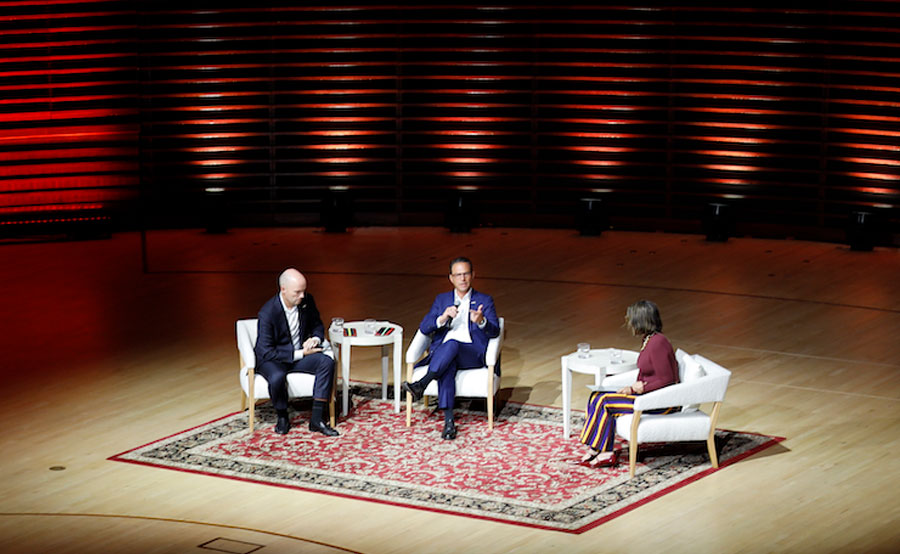
On September 9, the eve of the first anniversary of the murder of Charlie Kirk during an exchange of ideas at a Utah university, Philadelphia’s Kimmel Center hosted Utah Republican Governor Spencer Cox and Pennsylvania Democrat Governor Josh Shapiro for a discussion moderated by journalist Lulu García-Navarro. The event demonstrated that people with political disagreements can still engage in respectful and productive conversations.
Both governors spoke about free speech and political violence.
“More than one-third of Americans have lost a relationship because of political differences, a figure that is four times higher than it was just a decade ago,” Governor Cox said.
His recent book, Off Ramp, aims to serve as a guide for overcoming polarization by teaching people how to disagree constructively at the dinner table, on social media, and in American politics.
During the discussion with Shapiro, Cox revealed that it was the Pennsylvania governor who, one year earlier, moments before Cox delivered a speech following Kirk’s death, told him to “set aside his prepared remarks and speak from the heart.”
That speech offered comfort to a fractured nation searching for a way out of growing political violence.
Kirk often argued during his university appearances that “we must regain the ability to reach reasonable agreements where violence is not an option.”
“America was founded on the idea that our rights come from God, not from government,” states the First Liberty Institute (FLI), the largest legal organization in the United States dedicated exclusively to defending Americans’ religious freedom.
“That is precisely why religious liberty is the first freedom listed in the First Amendment.”
At the Kimmel Center, Shapiro noted that following the arson attack on his home a year earlier, both he and his family continue to receive threats.
“And often, this stems from attacks against me because of the way I practice my faith,” Shapiro said.
This is the reality 250 years after the founding of the United States and the adoption of the Constitution and the Bill of Rights, in which the First Amendment protects five fundamental freedoms: religion, speech, the press, peaceful assembly, and petitioning the government. America’s founding laws go beyond merely allowing people to disagree; they protect the right to express those disagreements freely.
The First Freedom, religious liberty, has made possible all other civil, political, economic, and social freedoms throughout the nation’s history.
But when freedom of expression is used to threaten or even take lives, “it becomes harder for people to feel they can share their ideas and speak freely,” Cox said a year ago. He connected this concern to Kirk’s philosophy: “When people stop talking, that’s when violence begins.”
Shapiro also referenced the 2024 assassination attempt against President Donald Trump and urged Americans to take a broader stance in condemning political violence.
This culture of violence affects young people as well. They are heavily exposed to social media platforms that have become a fast and easy vehicle for spreading hatred, racism, and threats across the political spectrum.
Choosing a Different Path
A year ago, Governor Cox addressed young people, telling them that their generation “has the opportunity to build a very different culture from the one we are experiencing right now… not by pretending differences do not matter, but by accepting them and having difficult conversations.”
“Social media is a cancer on our society right now, and I would encourage people to disconnect, turn off their devices, and get out into the real world,” Cox said in Philadelphia.
For Governor Shapiro, “We cannot resort to violence to settle our political differences. That is not who we are. We all must do our part to lower the temperature, condemn political violence, and work together to advance the values and freedoms that define our nation.
That is what we have shown is possible here in Pennsylvania, and elected leaders across the country, including the President of the United States, should follow our example.”
Shapiro added that in his daily activities, “I meet good and decent people who offer prayers for my family, even though they practice different faiths than mine, who invite me into their homes and share what is on their minds, what worries them and what excites them.” He also shared a wish with the audience: “I hope people teach politicians a lesson.”
Governor Cox’s initiative, Disagree Better, has promoted healthier political discourse by encouraging Republican and Democratic governors to appear together in public messages advocating respectful debate.

According to Cox, voters often focus on the most extreme voices in each party, making the country appear far more divided than it truly is. “But if I go out and say normal things… that doesn’t generate clicks.”
He added: “I firmly believe the way to save it [the country] is through one conversation and one relationship at a time,” while teaching people how to evaluate information critically.
According to a survey by the Knight Foundation, a co-organizer of the event, only 54 percent of Americans feel free to express their political opinions.
“If we can teach young people to do that better, to engage in fact-based critical thinking, we will heal our politics within a generation,” Cox said.
Maintaining mutual respect despite differences, Shapiro concluded, “is the work we must do.”