

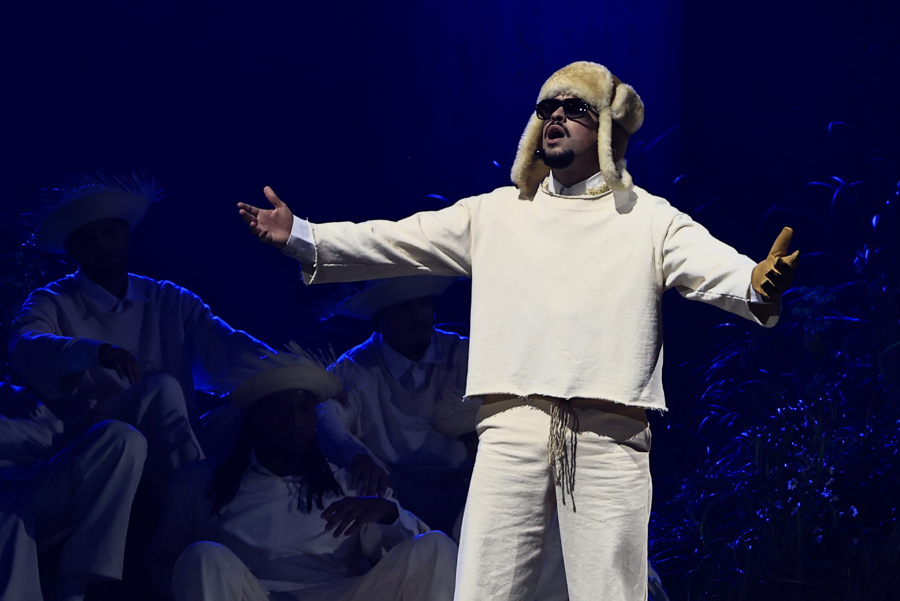
Last year, Bad Bunny turned music into resistance. Through his 30-show residency No Me Quiero Ir de Aquí (“I Don’t Want to Leave Here”) and his Grammy-winning album DeBÍ TiRAR MáS FOToS (“I should’ve taken more photos”), the first primarily Spanish-language Album of the Year, he placed Puerto Rico’s cultural legacy, colonial history, and present-day struggles on a global stage. From performances with local artists to lyrics and visuals confronting gentrification, displacement, and environmental harm, the project became a declaration of dignity, resilience, and belonging from an island fighting for its people and its future.
The upcoming Super Bowl halftime performance by Benito Antonio Martinez Ocasio, better known as Bad Bunny, is a defining cultural moment that transcends the social media frenzy around the big game and his 19.8 billion global Spotify streams in 2025. It’s also an opportunity for audiences across the United States and the world to learn, reflect, and stand in solidarity with Puerto Rico.
Through reggaeton and Latin Trap, infused with salsa, plena, and bomba, Bad Bunny’s artistry has helped unite Puerto Ricans in some of their most difficult moments. His culturally-grounded music and unapologetic political voice have sparked pride and collective belonging – especially amid escalating anti-Latino rhetoric and state-sanctioned ICE violence in the United States. His halftime show should be no different.
Yet even his selection for this coveted honor has been sucked into these xenophobic and racially charged attacks. The backlash has exposed widespread ignorance about Puerto Rico and underscored the urgent need for education about the island’s colonial history, its territorial status, and the systemic challenges shaping everyday life.
For a place repeatedly devastated by hurricanes and failed government responses, the reality of a warming world – and climate impacts on human health and self-determination – is central to this conversation. And it’s central to why Bad Bunny’s own lyrics continue to resonate so deeply with the island’s people, especially in the aftermath of Hurricane Maria and the disturbing sight of then-President Donald Trump throwing paper towels into a crowd after the devastating Category 4 storm in 2017.
“Otra ve’ va a pasar, Por ahí viene tormenta, ¿Quién nos va a salvar?” (from Bad Bunny’s “Una Velita” = “A Little Candle”) – “It’s going to happen again. The storm is coming – who will save us?”
While he may not label himself as a climate advocate, environmental issues are deeply embedded in the stories he tells and the social realities he addresses. Albert Laguna, Professor of Yale University’s new course Bad Bunny: Musical Aesthetics and Politics, describes his catalogue as a powerful educational tool for understanding Puerto Rico’s history and contemporary issues.
One example is the recurring image of “el sapo concho,” the endangered Puerto Rican crested toad, in Bad Bunny’s visuals. Once believed to be extinct until rediscovered in the 1970’s, the species symbolizes Puerto Rico’s duality – both the island’s fragility and resilience.
Salvador Gómez-Colón, Hurricane Maria survivor who distributed solar lamps to thousands of families and introduced a Congressional resolution to expand climate literacy after the storm, reinforces this idea that Bad Bunny often reveals climate impacts by showing how they intersect with infrastructure failure and inequality.
Striking just two weeks after Hurricane Irma, Hurricane Maria led to more than 3,000 deaths, 250,000 damaged homes, ravaged roads, polluted waterways, and a crippled healthcare system. Not all impacts were evenly felt in its aftermath – communities near petrochemical facilities, military bases, and Superfund sites faced higher rates of toxic exposures due to flooding; only 45% of rural areas had access to water; and adults 65 years or older accounted for more than 76% of deaths.
The collapse of the electric grid – which impacted 80% of the island’s power and pushed roughly 200,000 Puerto Ricans to migrate to continental United States – became a symbol of the storm’s destruction.
Bad Bunny later spotlighted this crisis through his song “El Apagón: Aquí Vive Gente(“The Blackout: People Live Here”), released alongside a 20-minute documentary that addressed the persistent outages. He did not shy away from criticizing LUMA energy’s multi-million dollar deal that privatized the grid amid widespread blackouts that threaten public health and quality of life to this day.
Climate change is now making hurricanes more frequent and more severe, including those in Puerto Rico. In a recent webinar hosted by EcoMadres – the initiative under the Moms Clean Air Force for which I am project manager and that works to empower Latinos to fight for clean air and climate change solutions – Puerto Rican meteorologist John Morales explained that fossil fuel emissions are heating the planet and accelerating the scale of extreme weather disasters. Today, 93% of Puerto Ricans are concerned about climate change, and the US EPA projects increasing storm intensity, sea level rise, among other climate impacts, across the Caribbean.
“El puente que tardaron en construir. El río creció’ lo va a romper” (“Una Velita” = “A Little Candle”) – “The bridge they didn’t build fast enough. The river grew; it’ll break it.”
Yet Maria’s impact cannot be explained by geographic susceptibility alone. Puerto Rico’s vulnerability had been shaped by the political and economic constraints of its territorial status, government corruption, weakened infrastructure, and a nearly 50% poverty rate long before the storm made landfall.The injustice was compounded by a failed federal response. A 2022 study by the US Commission on Civil Rights found that disaster aid for Puerto Rico was negligible compared to the federal support for Texas and Louisiana after Hurricane Harvey that same year, contributing directly to the island’s Rico’s higher death toll.
But when the institutions failed, communities came together. Puerto Rican Psychologist Dr. Carissa Caban-Aleman – who, like many others, supported recovery efforts from the diaspora – partnered with trusted local groups and caregivers to host trauma-informed healing workshops amid a surge in anxiety, depression, PTSD, and other cognitive issues. She notes that racism and structural inequality intensified psychological harm for already marginalized communities.
People-powered solutions – through mutual aid, community networks, and grassroots organizing – became central to recovery. Cultural leaders like Bad Bunny helped boost morale and collective pride when many felt abandoned and forced into survival mode. Out of the collective trauma, Dr. Caban-Aleman says, emerged a renewed sense of dignity and self-worth rooted in what communities were able to achieve together.
In 2018, Bad Bunny released what became an anthem of post-Maria recovery: “Estamos Bien” (“We’re Okay”). He performed the song on his The Tonight Show debut as images of hurricane devastation played behind him – centering Puerto Rico’s pain and strength on a national stage. In 2025, the final concert of his legendary 30-show residency in Puerto Rico fell on the anniversary of Hurricane Maria, transforming the concert into an emotional night of remembrance.
From his long history of politically charged performances to his latest album Debí Tirar Más Fotos, which explicitly references gentrification, displacement, and sovereignty, Bad Bunny has consistently used his platform to spotlight the island’s fight for self-determination while celebrating its beauty and strength. That’s what truly makes his Super Bowl halftime performance such a defining cultural moment that gives me – and millions of Latinos, fans, and climate advocates across the globe, hope.
Bad Bunny’s unapologetic cultural leadership has uplifted Puerto Rican voices globally. But visibility alone is not enough. For non-Puerto Ricans, especially for fellow Americans, this moment is an opportunity to listen and to learn.
Collective care and solidarity will help illuminate the path to a more just and safe future — especially with the looming threats of extreme weather — a message Bad Bunny conveys in is song “Una Velita” (“A Little Candle”):
“Recuerden que to’ somo’ de aquí, al pueblo el pueblo le toca salvar,”(From Una Velita = “A Little Candle”) – “Remember that we’re all from here, it’s the people who will save us”
* Por Danielle Berkowitz-Sklar, gerente de proyectos y eventos de Moms Clean Air Force y EcoMadres.