


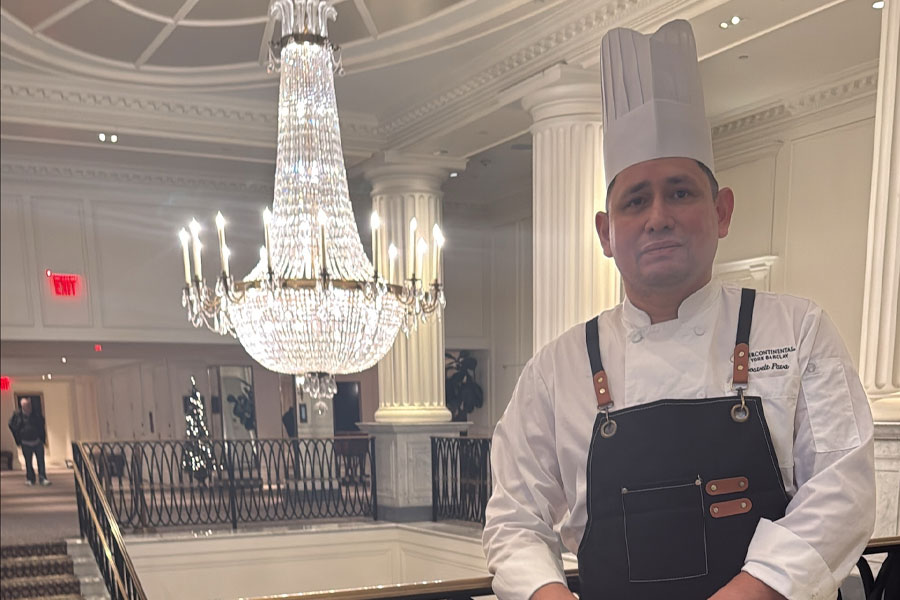
Roosevelt Alex Pace’s story captures more than the trajectory of a chef: it explains the city. New York is a network of kitchens where languages, memories, and techniques intersect. Roosevelt knows this because he has lived it from the bottom up and now leads from the top. His story documents the invisible force that sustains the industry: Latin hands that wash, chop, grill, emulsify, and ultimately create community.
As he looks toward the next service—respecting essence, exploring fusions, defending quality—his credo remains intact:
“When we set our minds to something, we achieve it.” And when the plate reaches the table, his goal is fulfilled: that someone leaves happy and grateful.
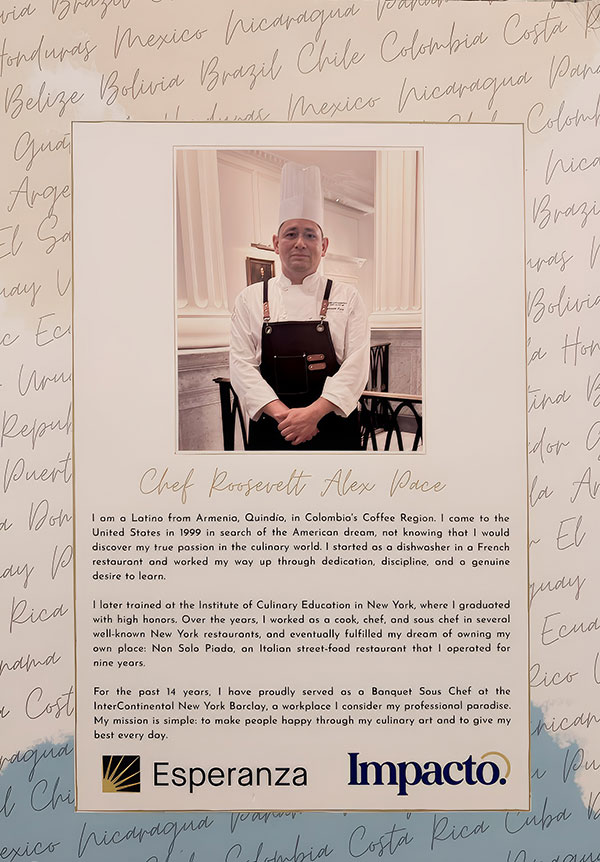
BORN IN ARMENIA, QUINDÍO, IN COLOMBIA’S COFFEE REGION
Roosevelt Alex Pace arrived in New York at 19 with a simple yet immense desire: to work, learn, and build a better future.
“I came at 19. My mom was already here in the U.S., and I came with the desire to work,” he recalls. With only a high school diploma and mandatory military service completed, he seized the opportunity to emigrate—never imagining that stepping into a kitchen would reveal his true calling.
DISHWASHING BUILDS CHARACTER
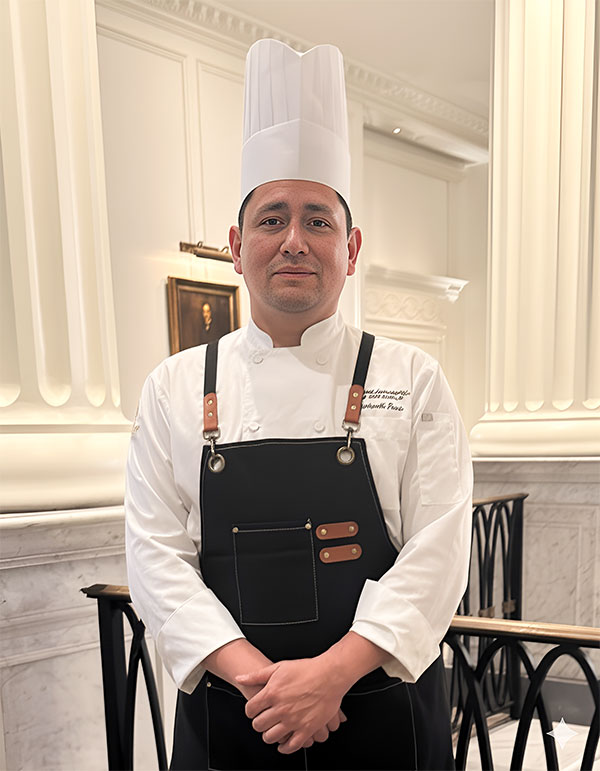
His first job was in a French restaurant.
“The first thing that came up was washing dishes… in a French restaurant in Brooklyn. I never imagined how hard it was to wash dishes, but that motivated me to move forward.”
Under the steam and relentless pace of service, he found the drive to keep learning.
“Anyone with the mindset to progress sees it as an opportunity. Many people, out of fear of language or discrimination, stay stuck. For me, it was the beginning of a culinary career.”
Roosevelt didn’t just work—he observed, took notes, and replicated.
“The motivation to get out of dishwashing made me disciplined and led me to write down the recipes the chef taught me,” he says. Without formal culinary training at first, his learning was intense and creative:
“My English was very basic… just by looking at the pictures, I interpreted the recipe and made it my way.”
The result: grateful diners and a firm decision.
“That motivated me to study and prepare myself even more.”
THE KITCHEN AS LABORATORY AND UNIVERSAL LANGUAGE
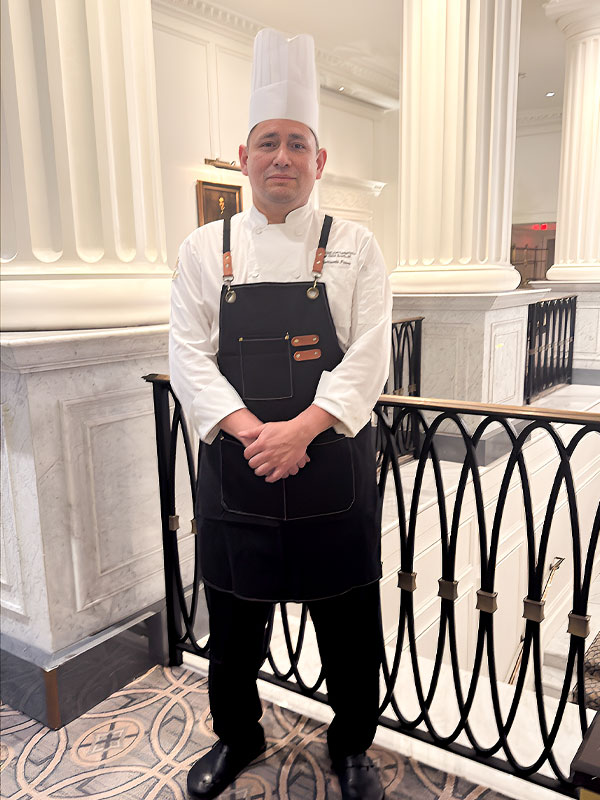
For him, cooking is trial, error, and discovery:
“The kitchen is like a lab: you have to test, experiment… sometimes it works, sometimes it doesn’t, until you create a dish ready to be served and accepted.”
His specialty isn’t a single technique but the ability to interpret recipes and cultures:
“My specialty is being able to interpret recipes—Mexican, Korean… I can create a dish based on that recipe.”
ITALY: FEW INGREDIENTS, PURE AUTHENTICITY
Life took him to Italy, where he embraced the essence of simplicity:
“I married an Italian woman and learned to cook Italian food very well.”
There, he discovered a timeless truth:
“They make a dish with a tomato, a basil leaf, good olive oil, salt, and pepper… and for them, that’s an appetizer. What makes it great? The freshness of their products.”
Italian culture also left a mark:
“Their family culture impressed me: their table is always set for ten.”
LATIN HANDS IN EVERY KITCHEN
From that first dishwashing station to leading teams, Roosevelt has seen a constant: Latin presence behind every kitchen door.
“You go to a Japanese restaurant, and if you step into the kitchen, you’ll find a Latino there. Many times, you see someone making sushi and think they’re Japanese… no, they’re Colombian, Panamanian, Nicaraguan, Mexican.”
And he adds:
“When we set our minds to something, we achieve it.”
NEW YORK: A CITY OF KITCHENS AND DIVERSITY
New York breathes gastronomy on every corner. The numbers back him up:
The city has tens of thousands of restaurants. Public listings show about 17,619 active in 2025, while broader estimates reach 25,000 or more OysterLink, GoSnappy, Restroworks, 2025. In 2019, the state recorded 23,650 establishments and a massive workforce: over 60% of restaurant workers were immigrants, and 44% were Hispanic [NY State Comptroller, 2020.
These figures confirm what insiders know: Latin hands sustain and elevate New York’s culinary scene.
Roosevelt calls many of these colleagues “invisible chefs”:
“People think there’s an Italian or French chef behind the kitchen… no, it’s a Latino running it.”
Diversity is a creative engine:
“In the kitchen, there’s diversity: Africans, Latinos, Jews… and it’s beautiful to share knowledge because you always learn something from everyone.”
THE RISE AND VALUE OF LATIN CUISINE
In the country’s most competitive market, Roosevelt celebrates the evolution of Latin flavors:
“Colombian and Latin food has evolved so much… today we can find almost all the ingredients and make dishes very similar to those in our countries.”
That progress shows in pricing and respect:
“People pay for a good Colombian, Mexican, or Central American dish.”
His logic is simple:
“A dish is expensive when it’s poorly prepared. But when it’s well made, well served, and well presented, people have no problem paying because they leave happy and satisfied.”
DISHES THAT BRING HIM HOME
Flavor memories never fade:
“The dish I miss the most… is sancocho, a good beef rib sancocho. It never disappoints.”
He also treasures Mexican cuisine:
“I love tacos and quesadillas. I worked at Dos Caminos as a chef—it was a beautiful experience.”
And Puerto Rico:
“You fall in love with everything you taste—the pernil, the arroz con gandules.”
COOKING WITH LOVE, SERVING WITH RESPECT
There’s an ethic that runs through every phase of his work:
“When food has flavor, it has care and love… you can tell that dish was treated with respect for the person who will eat it.”
His compass is the heart:
“If you cook with love, things will always turn out well.”
And he adds:
“If there’s one ingredient that can’t be missing, it’s passion.”
New York: Capital of Kitchens and Diversity
- How many restaurants? Estimates range from 17,619 active listings to 25,000 total OysterLink, GoSnappy, Restroworks, 2025.
- Economic weight: Before the pandemic, the sector had 23,650 establishments, 317,800 jobs, and $27 billion in taxable sales, contributing 15% of citywide taxable sales NY Comptroller, 2020.
- Who cooks in NYC? Over 60% of restaurant workers are immigrants, and 44% are Hispanic, confirming Roosevelt’s claim about Latin presence in every kitchen NY Comptroller, 2020.