

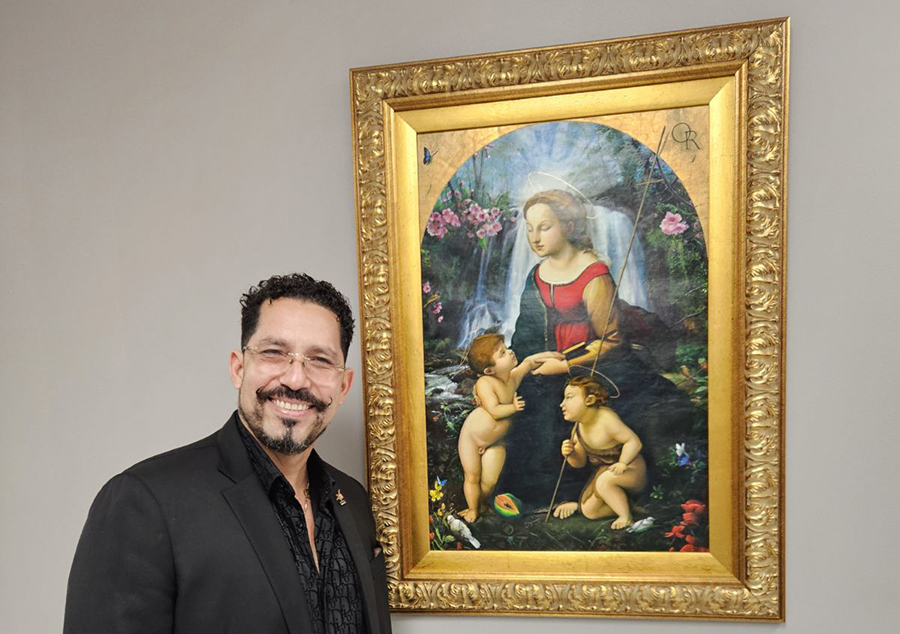
Since his arrival in the United States in 1993, Orlando Quevedo has divided his life between two cities that have been fundamental to his personal and professional development. Philadelphia, where he established his home and raised his family, provided him with stability and a profound sense of community. New York, meanwhile, offered the ideal stage to project his work through various exhibitions. This geographic duality proved decisive in the evolution of his artistic career—so much so that he was selected as the official artist of the 2023 National Cherry Blossom Festival.
Magical Realism: A style that balances the possible and the extraordinary
Orlando’s work is rooted in what he defines as magical realism, a term borrowed from Latin American literature. His visual language does not delve into the dreamlike or the excesses of surrealism; instead, it seeks a balance between the real and the magical, where both elements coexist without canceling each other out. It is a style that allows the painting to feel possible, tangible, yet infused with magic that makes it unforgettable.
For Orlando, magic is not rupture, it is subtlety: a gesture, an atmosphere, a detail that opens a door to the extraordinary without breaking the visual coherence of the real. This vision sets him apart from figures such as Miró, Dalí, or Chagall, whose dreamlike and absurd worlds are not his focus. In his style, the magical becomes a quiet complicity with the viewer.
Educator and Art scholar: History as the foundation of his work
Orlando, also an art historian, taught courses in Philadelphia, making one thing clear: “Everything I am, I owe to Philadelphia.” Art history nourishes his visual language and guides a creative process grounded in study, reflection, and respect for aesthetic tradition.
The exhibition at Galería Esperanza: A journey through 40 years of creation
The retrospective presented at the Esperanza Gallery on December 5 represents a singular milestone in his trajectory. For the artist, it feels almost miraculous to have received this opportunity during his lifetime, as in Cuba this type of retrospective exhibition is often held posthumously.
Produced by the program Cosas del Destino, the exhibition spans more than 40 years of work from his earliest pieces in Philadelphia to his consolidation as a recognized figure in New York. The show is designed so that the public can explore his story from multiple angles: chronological, thematic, technical, and even revisiting the same subject through different variations, mediums, or moments in his career.
“Idilio”: A work that summarizes a life
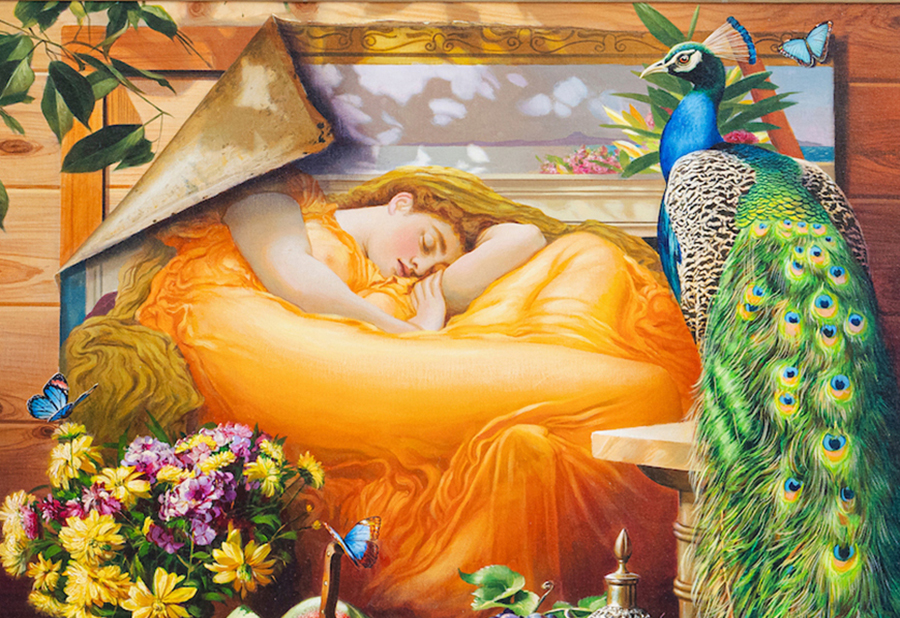
Among the most significant pieces in the exhibition is Idilio, a work the artist describes as a compendium of his personal and professional history. It brings together autobiographical elements, a panoramic view of his hometown in Cuba, direct references to art history, and the presence of various genres: the human figure, landscape, still life, animals, and flowers. It is, according to Quevedo, a painting that gathers “almost everything I am.”
Between art and cigars: An unexpected pairing
Another lesser-known facet of the artist is his connection to cigar culture. He presents this relationship as a “pairing” between two artisanal and sensory worlds. His ties to the cigar industry even led him to establish a factory in Nicaragua and launch his own brand—an extension of his creative identity into material culture and design.
Return to Philadelphia: Gratitude, memory, and responsibility
For Orlando, returning to Philadelphia with this retrospective means returning to the city that welcomed him echoing his birth city Holguín and a place that shaped him and gave him stability. The city marked essential stages of his life: raising his children, the loss of his parents, his first steps as a professor, and the solidification of his identity as an artist. Presenting his work at Esperanza is an act of gratitude and a gesture toward the community that has always supported him.
The artist insists that his role is not to over-explain his works. He prefers to let the painting speak for itself and allow each viewer to construct their own interpretation. For him, intervening in that process would mean limiting the public’s imagination.
Orlando represents a life devoted to art beginning with a humble and disciplined origin in Cuba and developing into a bicultural trajectory shaped between Philadelphia and New York. His vision of magical realism, balanced and profound, defines both his style and his creative philosophy. His retrospective at the Esperanza Gallery not only celebrates four decades of work but also pays tribute to the communities, cities, and experiences that shaped his journey. In every piece, Quevedo invites the viewer into a space where the real and the magical coexist in harmony, allowing the painting and not the word to have the final voice.
This exhibition also arrives at a particularly meaningful moment: Esperanza College celebrates its 25th anniversary this year, with lives touched and transformed by Orlando’s mentorship.
“In my magical realism, reality disguises itself as a dream: so possible it seems like magic, so magical it becomes impossible”. — Orlando.