

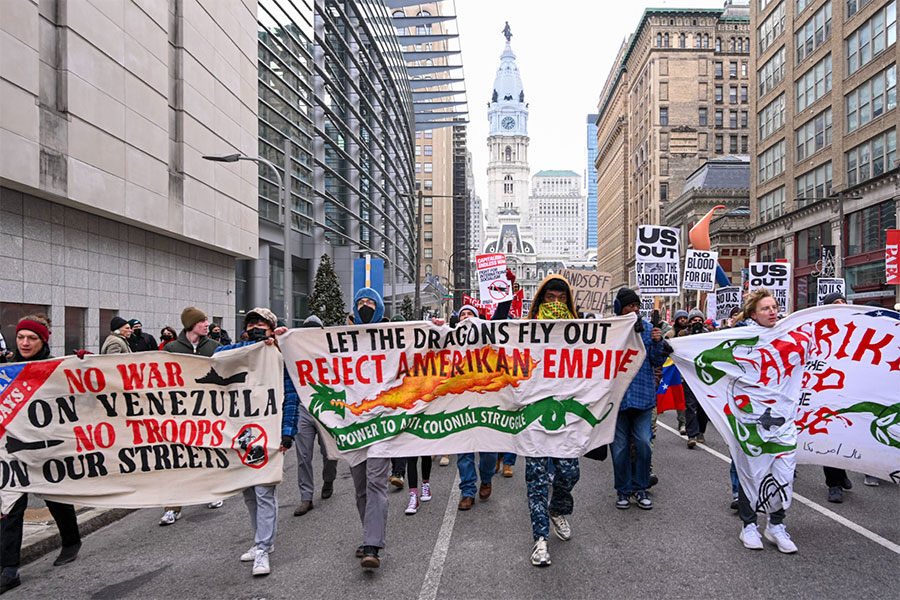
Philadelphia, PA_ January 20th, 2026, marked the one-year mark into President Donald Trump’s second term. The political map is clearer — and narrower.
While a loyal base continues to defend his positions, national polling shows that even his most ardent supporters are leaving the camp, and those that remain are now outnumbered by Americans who disapprove of his performance.
A new CNN/SSRS poll conducted Jan. 9–12, 2026, found Trump’s job approval at 39%, with 61% disapproving. (CNN). That gap is not an outlier. Reuters/Ipsos tracking from Jan. 12–13, 2026, shows 41% approval and 58% disapproval. (Reuters)
The divide remains intense, but the majority has shifted against him. In the Port Richmond area of Philadelphia, Doris Ramirez, a retired public-school teacher, said, “I didn’t vote for him because I was not impressed with his plans for our country, and his rallies were nothing more than circuses filled with hateful rhetoric.
Since January 20th of last year, my stress as a retired person has been continuously increasing due to food, medical, and general living costs. Medicare is being quietly cut back, and seniors can feel the economic pressure. Trump’s influence has also reshaped education in damaging ways. “Schools are no longer treated as places of learning — they’ve become political battlegrounds,” Ramirez said.
The last news that I heard was that the President was going to withhold federal funds from sanctuary cities and states that encompass these cities. Well, said Doris, “Philadelphia is a sanctuary city, and as a former teacher, I know firsthand that schools rely on Federal Title One Funds to accomplish their goals.
These cuts affect everything: morale, trust, and the ability of students to feel safe and supported. Recent national surveys conducted in January 2026 show Trump’s approval rating hovering just below 40 percent, with roughly six in ten Americans expressing disapproval. Across multiple polls, the pattern is consistent: strong backing among core Republicans, but declining support among independents and moderates. The data suggests a presidency losing a grip on its own base and seemingly ignoring the mass numbers of people to whom it lost its appeal.
Economic anxiety is central to the backlash. Voters report persistent frustration with rising living costs, housing insecurity, and a sense that national leadership is disconnected from everyday realities. While supporters credit Trump for decisiveness and a hardline stance on immigration, critics point to the lack of respect for the Constitution, American History, overwhelming cruelty, instability, governance by confrontation, and policies that have failed to ease pressure on working families. Across the river in the Camden area, David Mendez, a conservative Republican and third-generation immigrant, said he continues to support Trump’s border enforcement, but acknowledges growing fatigue even among conservatives. “I still agree with many of his positions,” Mendez said. “But people want stability. Constant conflict makes it harder for families and businesses to plan for the future. I also think that we need to respect the North Atlantic Treaty Organization (NATO) and all of our allies.”
I dove further and spoke to a long-time South Philadelphia undocumented resident. For undocumented workers, the political climate is felt far beyond opinion polls. He asked that his real name not be used for safety reasons and is identified here as Antonio. In our talk, Antonio said he doesn’t support Trump. “We are all human beings, and I am a native American just like the Navajo or Cherokee. My ancestors were of Mayan blood. We were here first, and the political borders crossed us. The heightened ICE enforcement and rhetoric have made his daily life more precarious. “We work because we have no choice,” Antonio said. “But every day we worry — driving to work, going to the store, even taking a child to the doctor. Antonio says, “We are invisible when it comes to rights,” he said, “but very visible when it comes to enforcement.”
One year into Trump’s second term, the numbers and the stories tell the same tale. His presidency is not helping anyone, not expanding its reach — it is hardening political lines. Some supporters remain intense, but opposition is broader and deeper in diverse communities. For Latino communities, the divide is not abstract — it is personal.