


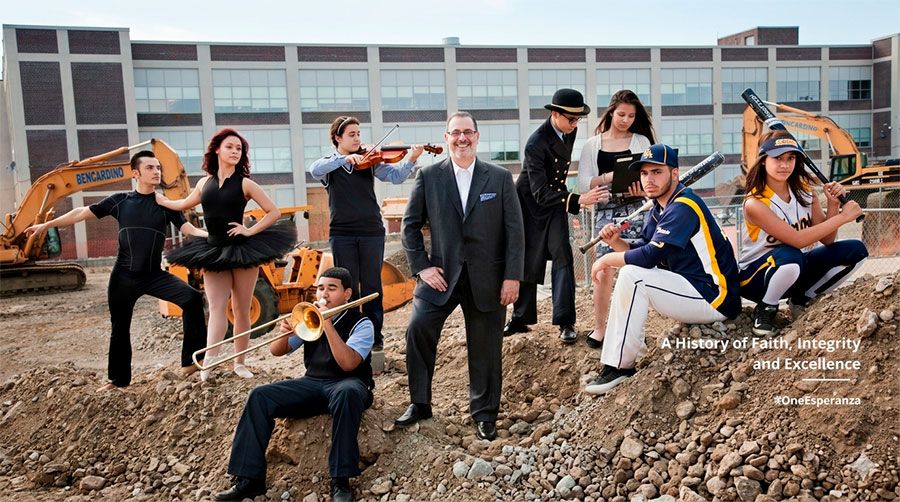
The organization Esperanza is commemorating its 40th anniversary by highlighting its comprehensive impact on the city’s Latino community, from its beginnings in the 1980s to its consolidation as a key institution in areas such as education, economic development, housing, and immigration. Its founder and CEO, Rev. Luis Cortés, shared a deep reflection on the organization’s origins, challenges, and achievements: “In 1983… I thought I was going to do this in New York, but I had the opportunity to come to Philadelphia to teach… and I realized that what I wanted to do in New York, I should do here,” Cortés recalled.
The reverend explained that, although he had a clear vision, he did not imagine the magnitude of the challenge: “I always thought we should create a faith-based organization that could address multiple needs of the people… an organization that would find synergy in how it responds to those needs… but I had no idea how difficult it would be to create the organization we have today, nor everything it would involve.”
From the beginning, Esperanza was conceived as a holistic organization, inspired by community models outside the United States: “In other contexts, leadership addresses all the needs of the neighborhood… it is not limited to just one area. That was the vision from the start,” he explained.
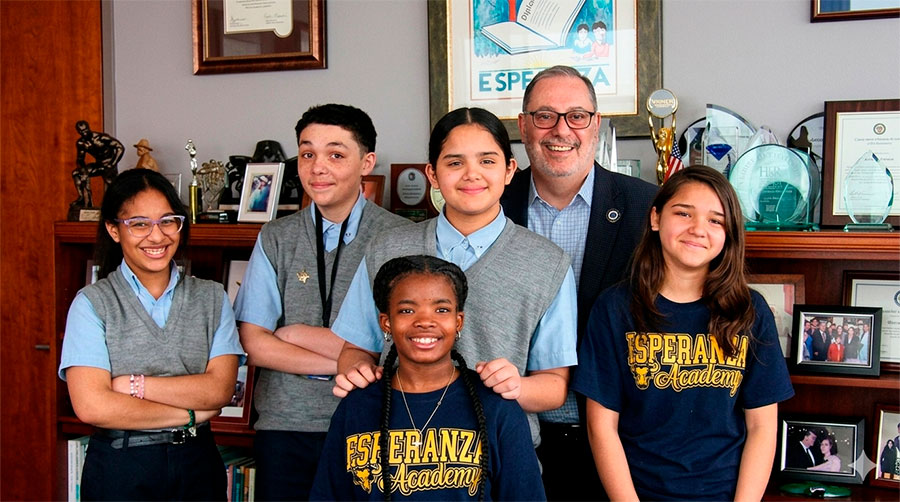
Community transformation and commitment to education
Cortés also recalled how the Latino community in Philadelphia has changed: “When I arrived, the Latino community had been displaced by processes of gentrification… many were moving into Hunting Park… an area with many vacant homes,” he explained.
It was in that context that Esperanza emerged in 1986, after religious leaders sought a more proactive organization. “We organized pastors in 1981 and 1982, and by 1986 Nueva Esperanza was born… later we simplified the name to Esperanza,” he said.
Education became a priority after deep inequalities became evident in the community: “Our top students could not read the Bible in English at a fifth-grade level… and we had dropout rates of 35 to 40 percent in high school,” he noted.
Faced with this reality, the organization became directly involved in creating schools and educational programs: “Our philosophy is to have first-class schools that take our young people to first-class colleges,” Cortés affirmed.
Additionally, Esperanza participated in community struggles for bilingual education, the construction of schools, and the inclusion of Latino teachers: “We were part of those struggles and then had the opportunity to do it ourselves… and we have been successful,” he added.
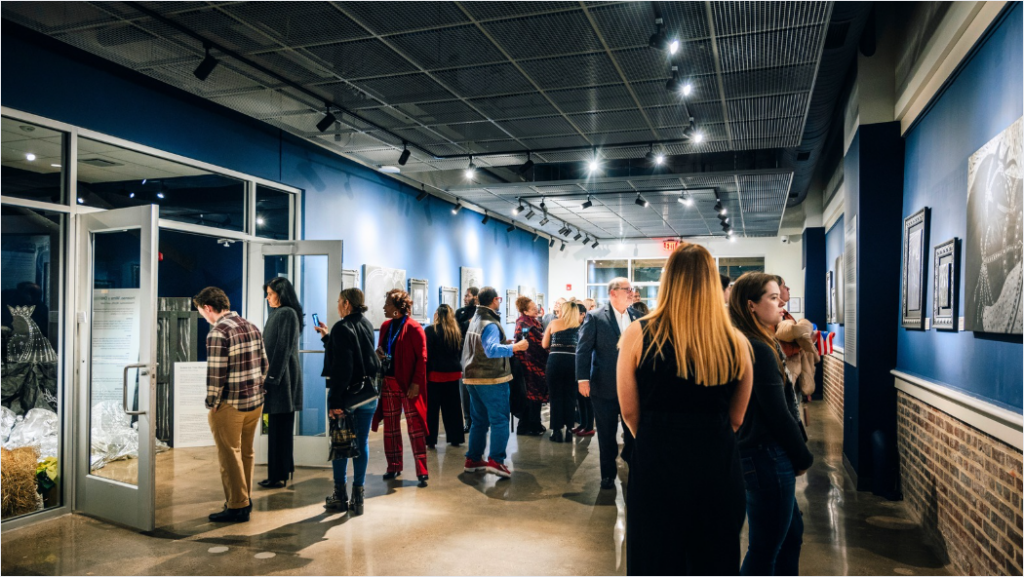
Economic development, housing, and community impact
In the economic sphere, Esperanza has created multiple initiatives to strengthen community stability: “We have educational programs from K-12, a college that supports students in completing their studies… and we also created a CareerLink that has been one of the most successful in the city for over a decade,” he explained.
He also emphasized the importance of partnerships: “The most important thing we do is create partnerships that bring resources into the neighborhood… we don’t necessarily control them, but we bring them because our community needs them,” he said.
These initiatives include partnerships with banks, childcare centers, educational institutions, and health services. He also highlighted the development of a technical school to expand job opportunities.

In terms of housing, Esperanza has led significant projects: “We have developed and are learning to rehabilitate individual homes for our families. We want to build enough affordable housing to keep Hunting Park a Latino neighborhood,” he stated.
The organization has also played a key role in immigration services: “Our immigration office is not downtown… we are in the neighborhood for the people of the neighborhood, and we help more than 100 families every year,” he explained.
Looking ahead, Cortés shared his personal and community goals. “My first goal is not to be here in ten years… I plan to retire in about five years,” he said. However, he emphasized the importance of preserving the neighborhood’s identity: “We want to stabilize Hunting Park, so it remains a Latino neighborhood… that it is not displaced by others with more resources.”
In his final message, he reiterated the value of unity: “If we work together as a community, we all win… our organizations are stronger today than they were 40 years ago, and I hope that in 40 years, our community will be able to say the same or even more about its progress.”
With four decades of history, Esperanza continues to establish itself as a fundamental pillar for the progress and well-being of Philadelphia’s Latino community.