


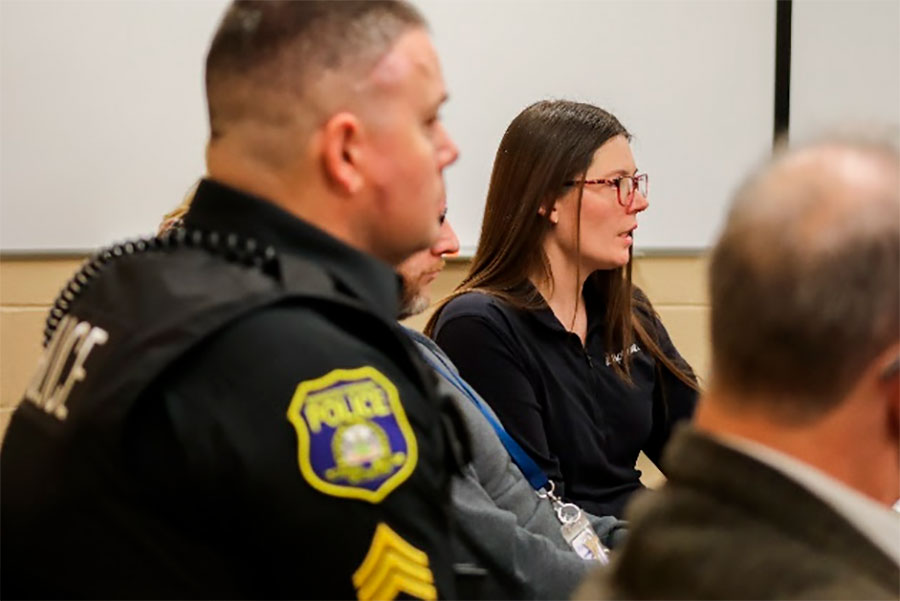
Thanks to PCCD’s Violence Intervention and Prevention (VIP) funding, Lancaster County’s Peer CoRe Program is expanding to five additional police departments.
The Shapiro-Davis 2025-26 budget increases funding for the VIP program by 10%, providing more than $62 million for grants to address gun violence and make Pennsylvania communities safer.
Lancaster, PA — Today, the Pennsylvania Commission on Crime and Delinquency (PCCD) joined the Pennsylvania Mental Health Consumer Association (PMHCA) and local law enforcement leaders to discuss how state VIP funding is helping to strengthen crisis response and community safety across Lancaster County.
“Lancaster’s Peer Co-Responder program is a great example of how we are transforming the way we respond to individuals in crisis,” said Kirsten Kenyon, Executive Director of PCCD. “By pairing law enforcement with behavioral health professionals to deliver the right support at the right time, this approach ensures people in crisis are met with compassion and care.It’s a powerful example of how PCCD’s VIP grant funding can be used to reduce violence, enhance community safety, and improve outcomes for individuals across the Commonwealth.”
In 2023, PCCD awarded over $380,000 in VIP grant funding to the PMHCA to launch a new police/peer recovery co-responder pilot program with the Elizabethtown Police Department. The program began pairing trained police officers with Certified Peer/Recovery Specialists— individuals with lived experience— to respond together to certain emergency calls with the goal is reducing conflict, de-escalating crises, and connecting people with the support they need.
“PMHCA is excited to partner with several Lancaster County police departments to launch a regionalized Peer Co-Responder program. This innovative initiative is designed to meet individuals where they are—providing immediate support and connecting them to community resources that can make a difference,”said Kathy Quick, PMHCA Executive Director. “By integrating trained peer professionals into a co-responder model, the program fosters empathy, builds trust, and strengthens community engagement. This approach benefits both law enforcement and the individuals they serve, creating meaningful connections while delivering cost-effective solutions that prioritize care and collaboration.”
In the latest round of state VIP grant funding, PMHCA received an additional award of almost $740,000 to expand the successful pilot program to five additional police departments in the Lancaster area, including West Lampeter Township, Pequea, Strasburg, East Hempfield, and Manheim Township police departments.
“As a police-based co-responder, I’m grateful for the opportunity to serve our community in meaningful ways and use my own lived experience to support others. Every day, I witness the impact of timely, compassionate, and trauma-informed support for individuals and families in crisis. With the guidance of Blueprints’ Division of Specialty Programs and the support of our law enforcement partners, I’m able to meet people where they are and connect them to resources that promote healing and stability,” said Leanna Ballester, CRS, CPS, Co-Response Team, Division of Specialty Programs, Blueprints for Addiction Recovery, Inc. “It is an honor to stand alongside our officers, PMHCA, the Specialty Programs Team, PCCD, and our community partners as we work together to strengthen trust, enhance safety, and create more compassionate outcomes for the people we serve. I remain grateful each day for the opportunity to support, uplift, and stand with our community through this vital and collaborative work.”
«The Blueprints Co-Responder Program represents a monumental step forward for community-focused policing in Manheim Township and Lancaster County,» said Lieutenant Michael Piacentino, Manheim Township Police Department. «Having Leanna not just on our team, but actively working out of our building, has truly transformed our approach. We are no longer simply responding to crises; we are connecting people with lasting solutions.»
“Working with a co-responder provides our officers an effective resource to connect with a resident or visitor in need, when that person needs it. Many times, people who struggle with drug and alcohol addictions and mental health diagnoses are very transient. They might be in our jurisdiction one day, another jurisdiction the next day, and a third jurisdiction on the third day. Each agency is spending time and resources many times dealing with the same person,” said Lieutenant Steven Heinly, West Lampeter Police Department. “By sharing the co-responder with neighboring jurisdictions, the co-responder stands a better chance staying connected and updated with the needs of someone who is struggling. This model has been a success for us and we look forward to expanding the availability of the co-responder model to other municipalities.”
Since 2023, the Shapiro-Davis Administration has awarded $85 million in VIP grants to more than 130 projects— each one focused on evidence-based strategies tailored to the local community. Those investments are seeing results— since 2022, homicides have declined by about 35 percent statewide. The newly enacted state budget increases funding for the VIP program by 10 percent, providing more than $62 million for grants to address gun violence and make Pennsylvania communities safer.
PCCD also supports Crisis Intervention Team (CIT) programs that equip law enforcement and other first responders with the skills to safely respond to individuals in crisis. Last October, PCCD announced the launch of the Pennsylvania CIT Training and Technical Assistance Center. The Center is designed to strengthen and expand CIT programs across Pennsylvania by providing training, best practices, and peer support to guide counties and local partners as they develop, grow, and enhance their crisis response efforts.
Since 2010, PCCD has invested nearly $3 million in the expansion, establishment, and assessment of CIT programs and trainings, and co-responder model programs across Pennsylvania. With PCCD funding, 40 counties have established CIT programs since 2010.