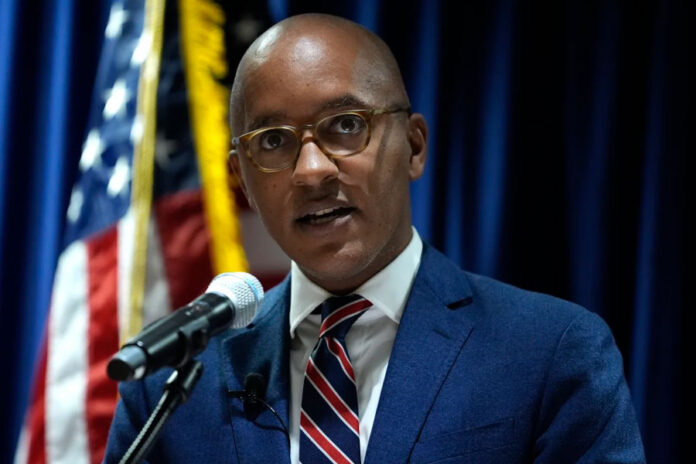
El Gobierno del presidente estadounidense, Joe Biden, presentó este jueves una demanda contra Apple, alegando que el gigante tecnológico ha creado un monopolio en el mercado de los teléfonos inteligentes con su modelo iPhone.
La demanda, interpuesta en un tribunal federal en Nueva Jersey, representa el primer gran esfuerzo antimonopolio contra Apple por parte de la Administración de Biden.
«Los consumidores no deberían tener que pagar precios más altos porque las empresas violan las leyes antimonopolio», afirmó el fiscal general, Merrick Garland, en un comunicado.
«Si esto no cambia, Apple seguirá fortaleciendo su monopolio en los teléfonos inteligentes», añadió.
En la demanda, interpuesta por el Departamento de Justicia y 16 fiscales generales de los estados, se acusa a Apple de haber restringido el acceso a la tecnología que usa para los iPhone de manera que aumentan los costos para los consumidores y se impide a potenciales rivales lanzar otros teléfonos inteligentes.
(Foto: EFE/MICHAEL REYNOLDS)
El Departamento de Justicia afirma que Apple ha usado su control sobre el iPhone para «participar en un tipo de conducta ilegal, de manera amplia y sostenida».
Entre otras cosas, la demanda alega que Apple impide el desarrollo exitoso de las llamadas «súper aplicaciones» que permitirían a los consumidores cambiar de manera más fácil de teléfono inteligente.
También se acusa a Apple de bloquear el desarrollo de aplicaciones de ‘streaming’ que permitirían a los usuarios disfrutar de vídeo de alta calidad sin tener que pagar por más espacio en la nube o ‘hardware’ para que el teléfono pueda soportarlo.
El caso se dirige específicamente contra la fortaleza digital que ha creado Apple no solo con iPhone, sino también con otros productos como iPad, Mac y Apple Watch para que los consumidores tengan que depender de esos dispositivos y no puedan combinarlos con otros productos de otras compañías.
(Foto: EFE/MICHAEL REYNOLDS)
Apple, con sede en Cupertino (California), negó las acusaciones y acusó al Gobierno de haberse extralimitado en sus acusaciones, según un comunicado recogido por medios locales.
«Esta demanda amenaza lo que somos y los principios que diferencian a los productos de Apple en mercados intensamente competitivos», se defendió Apple, quien aseguró que si la demanda prospera se sentará «un peligroso precedente», dando poder al Gobierno para intervenir en el diseño de tecnología.
Con esta demanda, Apple se une a la lista de gigantes tecnológicos contra los que ha emprendido una ofensiva el Gobierno de Biden.
El Departamento de Justicia ya demandó a Google por monopolizar los servicios de publicidad digital y la Comisión Federal de Comercio tiene un caso antimonopolio pendiente contra la matriz de Facebook, Meta, y otro contra Amazon.
Apple es una de las empresas más poderosas del mundo con unos ingresos anuales de casi 400.000 millones de dólares y, hasta hace poco, un valor de mercado de más de 3 billones de dólares.
Sen. Bob Casey, D-Pa., listens to a speaker during an event at AFSCME Council 13 offices, March 14, 2024, in Harrisburg, Pa. For Democrats trying to defend the White House and Senate majority, Casey is emerging as the tip of the spear in trying to reframe the election-year narrative around inflation, a key soft spot in 2024 for Democrats on the all-important voter issue of the economy. (Photo: AP/Marc Levy)
HARRISBURG, Pa. — Democratic Sen. Bob Casey of Pennsylvania leaned into the podium, almost past the microphone, to make his point to the union crowd about how mad corporate leaders are at him.
“But I got news for them,” Casey told Dauphin County Democrats and AFSCME members. “They should get used to it. Because I’m going to continue to prosecute the case on greedflation and shrinkflation.”
For Democrats trying to defend the White House and Senate majority, Casey is emerging as the tip of the spear in attacking “greedflation” — a blunt term for corporations that jack up prices and rip off shoppers to maximize profits — and trying to reframe the election-year narrative about the economy.
Fast-rising prices over the past four years have opened a key soft spot in 2024 for Democrats on an important voter concern, with polls showing that inflation is weighing down President Joe Biden in his bid for a second term against Donald Trump.
It is perhaps no coincidence that Casey is trying to help Biden by making the case against greedflation in the critical presidential swing state he represents, where a victory for Democrats is crucial to keeping the White House and Senate.
No Democrat has won the White House without Pennsylvania’s support since Harry S. Truman in 1948, and a Casey loss would likely guarantee Republican control of a Senate currently divided by the narrowest of margins.
Casey, running for a fourth term, argues that consumer prices are high primarily because of greedflation, a term coined to target corporate profiteering at shoppers’ expense under the cover of inflation. Casey also is attacking greedflation’s cousin, “shrinkflation”: a seemingly covert way for companies to raise prices by slightly reducing product size, like shortening candy bars or putting fewer potato chips in the bag.
Republican David McCormick, a candidate for U.S. Senate in Pennsylvania, speaks during an event at the Pennsylvania Manufacturers Association offices, March 15, 2024, in Harrisburg, Pa. McCormick wants to unseat Democratic Sen. Bob Casey, who is emerging as the tip of the spear in trying to reframe the election-year narrative around inflation, a key soft spot in 2024 for Democrats on the all-important voter issue of the economy. (Photo: AP/Marc Levy)
For Casey, the argument lines up neatly with the populist politics that have made him a favorite of labor unions, and he has taken on the job with gusto, seemingly spending more time attacking greedflation than his actual opponent in November, Republican David McCormick.
Inflation hit a four-decade high of 9.1% in 2022, more than enough to get the attention of consumers. And blaming greedflation for high prices is perhaps a potent argument both to direct the anger of the squeezed wage earner and deflect Republican accusations that spending under Biden — including his $1.9 trillion pandemic relief package — caused higher prices.
McCormick, a former hedge fund CEO, calls Casey’s contentions “nonsense” and blamed federal spending under Biden and rising energy prices.
“This greedflation-shrinkflation thing is trying to distract the conversation about what really happened,” McCormick said in an interview.
Economists generally don’t subscribe to either side’s black-and-white explanation.
Instead, they tend to list many forces that played a role in global inflation during and after the COVID-19 pandemic, including pandemic-fueled supply-chain shortages worldwide, a strong labor market pushing up wages and Russia’s attack on Ukraine creating energy and food bottlenecks.
Sen. Bob Casey, D-Pa., poses for a photo at a campaign event at AFSCME Council 13 offices, March 14, 2024, in Harrisburg, Pa. For Democrats trying to defend the White House and Senate majority, Casey is emerging as the tip of the spear in trying to reframe the election-year narrative around inflation, a key soft spot in 2024 for Democrats on the all-important voter issue of the economy. (Photo: AP/Marc Levy)
Prices in the U.S. remain about 20%, on average, above where they were before the pandemic.
But the U.S. government’s largely successful efforts to rein in inflation without nudging the economy into recession haven’t convinced people that credit is due, especially as rising food and housing prices defy overall slowing inflation rates.
The issue of the economy is No. 1 for many voters, and polls show the impact of inflation is weighing on how voters feel about Biden, despite improving views of the economy, said Christopher Borick, director of the Muhlenberg College Institute of Public Opinion in Allentown.
Borick said he has seen evidence that voters will buy the argument that companies jacked up prices to take advantage of inflation. But, even if they do, voters won’t necessarily give a pass to Biden and Democrats.
“They still are feeling the effects of inflation and their anger could be placed in multiple settings,” Borick said.
Casey has worked mightily to drag greedflation into the spotlight.
He has issued reports, written stern letters to trade associations, gone on national cable news shows and introduced legislation ordering the Federal Trade Commission to investigate price-gouging and shrinkflation as unfair trade practices.
“A lot of these companies said, ‘Oh, well, consumers can just decide not to buy a certain product,’” Casey said in an interview. “It’s like when you go to the grocery store, you got to get food every week. You got to get household items every week or every other week. You don’t have the choice to, you know, defer purchases for six months. It’s not like buying a new television set.”
He bent Biden’s ear about it during a Biden visit to Pennsylvania in January — and subsequently Biden blasted shrinkflation in a video released on Super Bowl Sunday and highlighted a social media post by the “Sesame Street” character Cookie Monster that said, “Me hate shrinkflation! Me cookies are getting smaller.”
In his State of the Union speech, Biden again railed against shrinkflation and promised to crack down on price gouging and “deceptive pricing.”
“Pass Bobby Casey’s bill and stop this,” Biden said. “I really mean it.”
Then, in likely the only mention ever of Snickers candy in a State of the Union address, Biden added: “You probably all saw that commercial on Snickers bars. And you get charged the same amount, and you got about, I don’t know, 10% fewer Snickers in it.”
Mars Inc., which makes Snickers, said it hasn’t reduced the size of Snickers bars.
Casey’s argument goes beyond political messaging and blame terminology.
It’s rooted in a report published last year by the Federal Reserve Bank of Kansas City. In it, Fed researchers say corporate profits contributed 100% of overall inflation in the first year of the recovery and 41% of inflation in 2021-22 — a dynamic similar to other recoveries in the last 70 years.
The Fed’s researchers described it as companies being “forward-looking” by raising prices in anticipation of higher costs.
In one common refrain, Casey asserts that inflation rose by 14% from July 2020 through July 2022, while corporate profits rose by 75% — five times faster. Using federal data, Casey projects that roughly $3,200 of the nearly $5,600 more spent by the average American family in 2021 is due to “corporate profit-taking.”
Some economists say companies can be less restrained by the usual competition in the midst of inflationary price hikes — and take advantage of temporary market power to pad profits.
The liberal economic advocacy group Groundwork Collaborative, for instance, compiled a list of times when corporate executives extolled their profits or price increases, and talked of issuing stock buybacks, increasing dividends or benefiting from high prices or high interest rates.
However, some researchers caution that the extent of profit-taking can be overstated.
Ahmed Rahman, an associate professor of economics at Lehigh University, said corporate profits have added to the inflationary winds, but he doesn’t see enough compelling evidence that greedflation is an important part of inflation, let alone the major driver.
Focusing on corporate profitability is “glib,” Rahman said. “It’s a little bit easy. It resonates during political cycles.”
Prices aren’t going back down, Rahman and other economists say, and it’s more useful for politicians to talk about the impact of upstream markets — like grain, oil and computer chips — when talking about the price of consumer products like potato chips or candy bars.
Besides, even if corporations raised prices more than costs justified, that’s their job, said Z. John Zhang, director of the Penn Wharton China Center at the University of Pennsylvania. Instead of blaming the companies, he said, people should blame the decisions that led to inflation.
“It’s politics and this is really a matter of politicians trying to shift blame for policy-induced inflation,” Zhang said. “And obviously if I were in Biden’s position, that probably is a button I’m going to push, too. It seems to be believable.”
El presidente estadounidense Joe Biden desciende del Air Force One el miércoles 20 de marzo de 2024, en el Aeropuerto Internacional Dallas-Fort Worth, en Dallas. (Foto: AP/Jacquelyn Martin)
El gobierno federal condonará los adeudos por préstamos federales para estudiantes a otros 78.000 estadounidenses a través de un programa que brinda ayuda a personal docente, enfermeras, bomberos y otros servidores públicos, informó el jueves el gobierno del presidente Joe Biden.
El Departamento de Educación está cancelando los adeudos de los prestatarios que hayan cumplido con 10 años de pagos al mismo tiempo que trabajaban en el servicio público, lo que los hace elegibles para recibir alivio bajo el programa de Condonación de Préstamos por Servicio Público.
“Estos trabajadores del servicio público han dedicado sus carreras a servir a sus comunidades, pero debido a fallas administrativas pasadas, nunca obtuvieron el alivio al que tenían derecho según la ley”, indicó el presidente en un comunicado.
El Congreso creó el programa en 2007, pero las reglas rígidas y errores de los administradores de préstamos estudiantiles causaron que muchos prestatarios no pudieran obtener la condonación que se les había prometido. El gobierno de Biden flexibilizó algunas de las reglas y otorgó condonación retroactivamente a muchos prestatarios por sus 10 años de pagos.
Mediante esas acciones, el gobierno de Biden ha cancelado deudas por préstamos a más de 871.000 trabajadores de servicios públicos. Anteriormente, alrededor de 7.000 prestatarios habían logrado la condonación de sus adeudos por préstamos.
La última ronda de condonación cancelará alrededor de 5.800 millones de dólares en préstamos federales para estudiantes.
A partir de la próxima semana, a quienes reciban la condonación les llegará un mensaje de correo electrónico de Biden felicitándolos por su alivio. También se enviará un email del presidente demócrata, que se postula para la reelección, a 380.000 prestatarios que se encuentran a dos años de la condonación bajo el programa.
JEANNETTE, Pa.— Investigators were searching Thursday for the cause of a fire that tore through a house in the Pittsburgh suburbs, killing a man and four children and spreading to another house before the flames were extinguished.
Firefighters arrived quickly but found the two-story house in Jeannette already engulfed. The man’s fiancée and two other children were rescued by a neighbor, police and firefighters.
Neighbor Jack Mull said he saw the flames when he stepped outside to have a cigarette early Wednesday, just after midnight. He screamed at his daughter to call 911 and raced to get a ladder. He told reporters he saw the children’s mother, Miranda John, standing on a rear roof with a small child.
“The mother, she just didn’t want to give up,” said Mull, adding she tried to go back inside. “It’s the worst thing you could ever imagine, knowing they were in there.”
Miranda John and the surviving children, ages 10 and 1, were hospitalized.
The Westmoreland County coroner identified the victims as Tyler J. King, 27; Kyson John, 7; Kinzleigh John, 6; Keagan John, 3; and 1-month-old Korbyn John. The coroner’s office said a ruling on the cause and manner of death was pending further investigation. Autopsies were performed.
“It’s a devastating loss for our families,” said Delena Lewis, Tyler King’s mother. “Not only mine, but his fiancée and the other two surviving children. They’re left without a father. How do you explain that to them?”
Jeannette Fire Chief Bill Frye said a nearby hydrant didn’t supply enough water to fight the raging blaze, and additional tanker trucks had to be called in.
“That’s when we were able to get sufficient water to bring the fire under control,” he said. “By the point we got water, the main house was already collapsing.”
The fire spread to the house next door, but everyone there evacuated without injury.
A prayer vigil was held outside City Hall later Wednesday.
Dos personas cargan un cajón para recoger el cuerpo de una persona en la calle este miércoles en Puerto Príncipe (Haití). EFE/ Johnson Sabin
Puerto Príncipe.- Las calles de Pétion-ville, en las colinas de Puerto Príncipe, volvieron este miércoles a sembrarse de cuerpos, en la que es la única comuna de la capital de Haití que aún no está completamente en poder de las bandas armadas.
Los al menos siete muertos aparecidos esta jornada en Pétion-ville se suman a los otros quince cadáveres con los que amaneció hace dos días esa misma zona, en circunstancias aún no esclarecidas.
En ambas jornadas las imágenes fueron similares: cuerpos tiroteados (en esta ocasión algunos en medio de llamas y otros ya carbonizados), camillas con fallecidos introducidas en ambulancias o trabajadores cargando ataúdes.
De acuerdo con las últimas informaciones colgadas por la Policía Nacional de Haití (PNH) en las redes sociales, en el curso de una operación en Pétion-ville el jefe de banda Mackandal fue herido de muerte.
También indicó que, después de disparar a una patrulla, tres miembros de pandillas fueron abatidos y dos vehículos Inmovilizados.
Por otra parte, un agente de la Policía fue asesinado por hombres armados en Delmas 72, comunicó el Sindicato Nacional de Policías Haitianos (Synapoha).
La violencia sigue muy presente en la zona metropolitana de Puerto Príncipe, pese a las patrullas de la Policía y el estado de emergencia y el toque de queda en el departamento del Oeste, donde está la capital.
En las últimos días, esa violencia se ha trasladado del centro de la ciudad a diferentes zonas de Pétion-ville, donde se registran enfrentamientos entre bandas o hay ataques de las pandillas en su intento por hacerse con el control de esas áreas, todo ello en medio de intensos tiroteos.
A la inseguridad ya existente, se suma que a principios de mes unos 3.000 presos, entre ellos miembros y cabecillas de bandas, lograron fugarse de las dos prisiones más importantes de la ciudad, tras ser asaltadas por los grupos armados.
Una ciudad paralizada en la que aumentan los desplazados
Todo ello repercute en el funcionamiento de la ciudad: prácticamente no hay actividad comercial, las escuelas están cerradas y es constante el ir y venir de personas que huyen de sus casas, de sus barrios, hacia zonas consideradas más seguras.
Según los últimos datos de la Organización Internacional para las Migraciones (OIM), la última escalada de la violencia en Puerto Príncipe, que comenzó a final de febrero pasado, ha llevado a que más de 15.000 personas se hayan convertido en desplazados.
En total, más de 86.000 haitianos viven en 84 puntos de desplazamiento, por lo que se han convertido en centros de refugiados en escuelas, iglesias y plazas públicas, en los que sus habitantes sobreviven en condiciones insalubres e inhumanas.
Además, de acuerdo con la OIM, en menos de una semana 17.000 personas abandonaron la capital en busca de un lugar más seguro y se fueron con familiares o amigos a otras provincias, con el peligro que conlleva viajar, puesto que la ciudad y las carreteras están rodeadas por las bandas.
Esta agencia de Naciones Unidas calcula que, desde principios de año, en el área metropolitana de Puerto Príncipe la población desplazada ha aumentado en un 15 % y unas 160.000 personas no pueden regresar a sus hogares.
También la Oficina de Coordinación de Asuntos Humanitarios de la ONU, la OCHA, considera que los tres primeros meses de este año han sido penosos para miles de haitianos.
Mientras tanto, continúan las evacuaciones de extranjeros y, este miércoles, Estados Unidos evacuó a una quincena de sus ciudadanos con un vuelo de helicóptero de Puerto Príncipe a República Dominicana.
El Departamento de Estado de EE. UU. detalló que espera evacuar de esta forma a unas 30 personas de nacionalidad estadounidense cada día.
Todo ello ocurre mientras se espera la implementación del consejo presidencial de transición, tras cuya constitución dejará el poder el primer ministro haitiano, Ariel Henry, y también el despliegue de la misión multinacional de apoyo a la seguridad que encabezará Kenia.
Two people walk near the body of a person on a street in Port-au-Prince, Haiti, on 20 March 2024. EFE/ Mentor David Lorens/ATTENTION EDITORS: EXPLICIT GRAPHIC CONTENT
The streets of Pétion-ville, in the hills of Port-au-Prince, were once again littered with bodies on Wednesday, being the only commune in the Haitian capital not yet completely under the control of armed gangs.
At least seven bodies were found on Wednesday in Pétion-ville following another 15 discovered two days ago in the same area under circumstances that have not yet been clarified.
On both days the scenes were similar: bodies with gunshot wounds (on this occasion some were on fire and others already charred), the deceased placed into ambulances, and workers carrying coffins.
According to the Haitian National Police (PNH) on social media, during an operation in Pétion-ville, gang leader Mackandal was fatally wounded.
It added that, after shooting at a patrol car, three gang members were killed and two vehicles immobilized.
On the other hand, a police officer was murdered by armed men in Delmas 72, reported the national police union (Synapoha).
Violence is still present in metropolitan Port-au-Prince, despite police patrols and the state of emergency and curfew in Ouest department, where the capital is located.
In recent days, this violence has moved from the city center to various areas of Pétion-ville, where there are attacks by and clashes between gangs in their attempt to gain control of those areas, amidst intense shootouts.
On top of the existing insecurity, at the beginning of the month some 3,000 prisoners, including gang leaders, escaped from the two most important prisons in the city when the institutions were attacked by armed groups.
The functioning of the city has been severely impacted. There is almost no commercial activity, schools are closed and people are still fleeing their homes towards areas they consider safer.
According to the latest data from the International Organization for Migration (IOM), the escalation of violence in Port-au-Prince, which began at the end of February, has led to more than 15,000 people becoming internally displaced.
More than 86,000 Haitians now live in 84 displacement points, which is why schools, churches and public squares have become refugee centers, where many people live in unsanitary conditions.
Furthermore, according to the IOM, in less than a week 17,000 people left the capital in search of safety in other provinces, with the danger that travel entails, since the city and the roads are surrounded by gangs.
This United Nations agency estimates that, since the beginning of the year, in metropolitan Port-au-Prince the displaced population has increased by 15 percent and some 160,000 people cannot return to their homes.
Meanwhile, the evacuations of foreigners continue. On Wednesday, the United States evacuated 15 of its citizens by helicopter to the Dominican Republic. The State Department said that it expects to evacuate about 30 US citizens each day in this way.
Haiti awaits the implementation of the transitional presidential council, after which Prime Minister Ariel Henry will step down, and also the deployment of the of the multinational security support mission that Kenya will lead.
El secretario general nacional de la Confede, Oscar Solorzano (d) participa en una reunión con líderes sindicales nacionales e internacionales, en San Cristobal de las Casas, estado de Chiapas (México). EFE/Carlos López
San Cristóbal de Las Casas (México).- Activistas denunciaron la creciente violencia en el sureño estado mexicano de Chiapas, donde aseguraron que hay múltiples violaciones a los derechos humanos.
“Chiapas vive en una crisis de derechos humanos, violentados y abandonados por parte de las autoridades. Estamos en medio de desapariciones, asesinatos, desplazamientos que no han sido atendidos por el Gobierno mexicano”, indicó Dora Lilia Roblero García, directora del Centro de Derechos Humanos -conocido como El Frayba-, durante la celebración del 35 aniversario de la organización en San Cristóbal de Las Casas, en Chiapas.
La activista denunció que la violación a los derechos humanos en Chiapas se agudizó desde 2022 y se generalizó en todo el estado, por lo que este aniversario los llama a la reflexión para “entrelazar conocimiento”.
«Las autoridades no han atendido ni han pensado dar solución o por lo menos investigar, lo cual nos preocupa mucho porque existe gente sufriendo, hay una situación de miedo y afectación psicológica”, dijo la defensora de derechos humanos.
El Frayba reunió para este evento a diversas organizaciones en las instalaciones del Centro Indígena de Capacitación Integral (Cedeci), y entre los invitados estuvo el obispo Raúl Vera López, presidente del Consejo Directivo de la organización.
También estuvo presente Blanca Martínez, directora del Centro de Derechos Humanos Fray Juan de Larios y una comisión de las organizaciones Las Abejas de Acteal, ejidatarios de San Jerónimo Bachajón, Organización Movimiento en Defensa de la Vida y el Territorio, el gobierno comunitario de Chilón y simpatizantes zapatistas.
Los activistas señalaron que durante estos 35 años de trabajo pocos han sido los cambios por parte de las autoridades, pues continúan dándose privaciones arbitrarias de la libertad, torturas sistemáticas, violencia estructural y hay múltiples casos por resolver.
“Parece que no somos seres humanos merecedores de una justicia digna porque somos pobres, porque somos indígenas, porque no somos ricos”, dijo en el evento Guadalupe Vázquez Luna, mujer tzotzil, activista y sobreviviente de la masacre de Acteal, perpetrada por paramilitares que dejaron sin vida a 45 personas en diciembre de 1997.
Activistas, ONG y comunidades han señalado en los últimos meses el clima de «guerra civil» que se vive en el estado por los conflictos armados, presencia de grupos del crimen organizado y carteles del narcotráfico, lo que ha desencadenado homicidios, desapariciones y desplazamientos forzados, en particular en comunidades indígenas y afines al Ejército Zapatista de Liberación Nacional (EZLN).
Ante este panorama violento institucional, la guerra entre los carteles de México y los procesos electorales que se avecinan en México este 2024, las organizaciones presentes en el evento aseguraron que buscarán nuevas estrategias para hacer valer los derechos Humanos de los pueblos originarios y campesinos en México. Señalaron los activistas.
HARRISBURG, Pa. — Pennsylvania’s House of Representatives on Wednesday approved Gov. Josh Shapiro’s plan to boost funding for public transportation systems still trying to recover pre-pandemic ridership numbers and facing a drop-off in funding when federal COVID-19 aid runs out.
The Democratic-controlled chamber voted 106-95, with all but one Democrat in favor, and all but five Republicans opposing it.
The bill would deliver an increase of about 20% in state aid to public transportation systems, proposed by the Democratic governor in his budget plan earlier this year. However, the bill faces long odds in the Republican-controlled Senate, with Republicans protesting the amount of the funding increase and objecting to procedures that House Democrats used to pass the bill.
Under the bill, the state would increase the share of state sales tax collections devoted to public transit agencies from 4.4% of receipts to 6.15%. That would translate to an estimated increase of $283 million in the 2024-25 fiscal year on top of the $1.3 billion going to transit agencies this year.
About two-thirds of the state aid goes to the Philadelphia-area Southeastern Pennsylvania Transportation Authority, or SEPTA, and another 20% goes to Pittsburgh Regional Transit. The rest goes to 29 public transportation systems around Pennsylvania.
The bill also excuses transit agencies from a 15% fund-matching requirement for five years.
Democrats defended the increase as an economic good and necessary to keep transit systems from cutting services or increasing fares.
“This is going to benefit all of us, and it’s going to keep Pennsylvania moving,» said Rep. Jennifer O’Mara, D-Delaware.
House Minority Leader Bryan Cutler, R-Lancaster, called the bill a “mass transit bailout.” The size of the subsidy increase is “eye-popping,» Cutler said, and he suggested that more funding won’t fix the things that are ailing public transit systems, including lagging ridership, rising fuel costs and high-profile incidents of crime.
“There are structural problems in mass transit systems that funding alone will not solve,” Cutler said.
Cutler’s criticisms echoed those in the past by Senate Republicans. In a statement Wednesday, Senate Majority Leader Joe Pittman, R-Indiana, said simply that Senate Republicans haven’t agreed to pass the bill.
Republicans also protested that the bill could be found unconstitutional by a court after the public transit provisions were inserted into a bill created for an entirely different purpose. Senate Republicans wrote the original bill to give landowners an income tax deduction for the use of natural gas, coal, oil or other natural deposits on their land.
Public transportation authorities across the U.S. have yet to fully recover their ridership after it dropped off during the pandemic and mass transit advocates say systems lack the revenue to avoid service cuts when federal COVID-19 relief aid runs out.
In addition, they say, operating costs have grown, with inflation that hit a four-decade high in 2022 and rising wages and fuel prices.
Pennsylvania State Capitol Complex. (Photo: Ilustrativa/Pexels)
HARRISBURG, Pa. — To offset the burden of student debt, employers in Pennsylvania could get a tax credit if they make contributions to their employees’ tuition savings account, under a bill that passed the Pennsylvania House of Representatives on Wednesday.
The legislation, which passed unanimously and now goes on to the state Senate, would allow employers to contribute up to $500 to an employee’s tuition savings account annually for a tax credit equal to 25% of the employer’s total contributions.
Tuition savings accounts, like the 529 plan, can be used for educational expenses — like tuition, room and board, books — at K-12 schools, college or career training programs and are meant to lower future borrowing.
Sponsors for the bill say with student debt totaling $1.77 trillion nationally, the legislation would help reduce the financial burden on students.
Pennsylvania ranks nearly last in just about every measure for college affordability. Tuition rates are high, students leave encumbered with more debt and the state gives less to higher education than others.
Employers that make contributions would have to do so equally to all employees who have tuition savings accounts.
The Department of Revenue estimates there are roughly 600,000 tuition savings accounts owned by Pennsylvania employees. The state would see an estimated $65.7 million cost annually, if each eligible account received the maximum contribution.
A fast-moving fire destroyed a clubhouse at a large senior community in a Philadelphia suburb but no injuries were reported. (Photo: AP)
NORTH WALES, Pa. A fast-moving fire destroyed a clubhouse at a large senior community in a Philadelphia suburb early Wednesday, but no injuries were reported.
The fire at the Village of Neshaminy Falls in North Wales was reported around 5:30 a.m. and was brought under control within two hours. The fire spewed thick black smoke throughout the community and sent flames shooting into the sky.
The clubhouse was a vital part of the community, which has hundreds of residents. It hosts numerous activities and was the site where residents cast ballots in elections.
The building was closed and apparently empty when the fire broke out. The cause of the blaze remains under investigation.