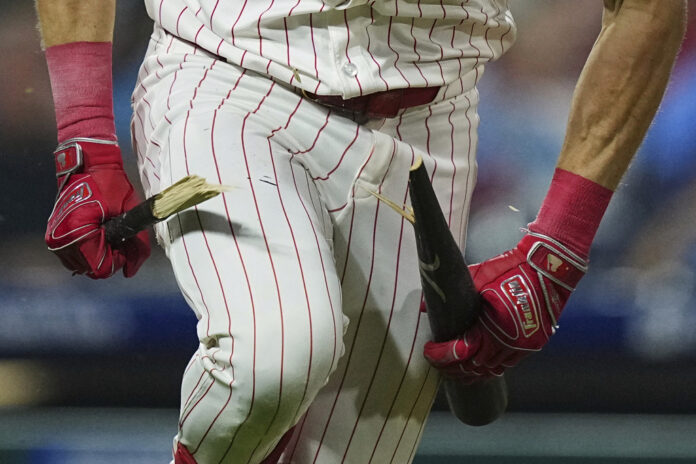
Max Kepler, de los Filis de Filadelfia, rompe su bate sobre su rodilla luego de conectar un sencillo productor en el juego ante los Mets de Nueva York, el miércoles 10 de septiembre de 2025 (AP Foto/Matt Rourke)
FILADELFIA (AP) — Max Kepler conectó un jonrón e impulsó cinco carreras, Bryce Harper desapareció también la pelota y los Filis de Filadelfia se acercaron a la revalidación del título de la División Este de la Liga Nacional al aplastar el miércoles 11-3 a los Mets de Nueva York.
El dominicano Cristopher Sánchez (13-5) permitió una carrera y cuatro hits en seis entradas y los Filis tomaron una ventaja de diez juegos sobre los propios Mets, que ocupan el segundo lugar, con 16 encuentros por jugar.
Filadelfia, que redujo su número mágico a siete juegos para asegurar el título de la división, intentará una barrida en la serie de cuatro duelos este jueves por la noche.
El dominicano Juan Soto conectó un jonrón y sumó tres hits por los tambaleantes Mets (76-70), quienes perdieron su quinto juego consecutivo. Se mantuvieron dos juegos por delante de San Francisco en la pugna por el último comodín de la Liga Nacional.
Kepler se fue de 4-3 e igualó su total de carreras impulsadas de todo el mes de julio en una sola noche. Fue la mayor cantidad de remolcadas que ha tenido en un juego desde 2016.
Harper descargó su 25º jonrón contra el relevista Ryne Stanek. Brandon Marsh, quien también totalizó tres hits, impulsó dos carreras y anotó dos más.
Por los Mets, el puertorriqueño Francisco Lindor de 3-0. Los dominicanos Ronny Mauricio de 1-0, Soto de 5-3 con dos anotadas y una producida, Starling Marte de 4-2 con una remolcada, José Siri de 2-0. Los venezolanos Francisco Álvarez de 3-0, Luisangel Acuña de 2-0.
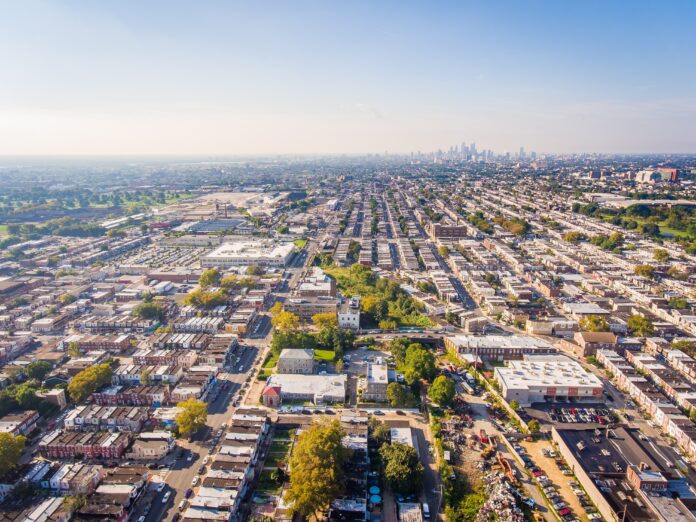
Vista aérea de Hunting Park, uno de los vecindarios beneficiados con los nuevos fondos para mejorar la salud a través de la vivienda. (Foto: Suministrada)
El Departamento de Salud Pública de Filadelfia (PDPH), a través de su División de Prevención de Enfermedades Crónicas y Lesiones (CDIP), en colaboración con Nueva Esperanza Inc. (Esperanza), lanzó una nueva oportunidad de financiamiento destinada a mejorar el bienestar de los residentes de Hunting Park y promover la equidad en salud en el norte de Filadelfia.
La iniciativa, titulada “Health Justice for Hunting Park: Healthier Homes”, pondrá a disposición un total de 50,000 dólares para organizaciones sin fines de lucro —501(c)3 o con patrocinio fiscal— con sede en los vecindarios de Hunting Park, Feltonville y Juniata (códigos postales 19122, 19124, 19133 al sur de Lehigh Ave. y 19140).
Los proyectos seleccionados podrán contar con presupuestos que oscilen entre 5,000 y 15,000 dólares y se desarrollarán entre enero y diciembre de 2026.
Entre los criterios de selección, los proyectos deberán abordar desafíos de salud relacionados con la vivienda, como la exposición al plomo, la calidad del aire interior, la eficiencia energética, la seguridad en el hogar o la estabilidad habitacional, y demostrar acciones que generen un impacto duradero en la comunidad. Además, se dará prioridad a iniciativas lideradas por residentes afroamericanos y latinos de Hunting Park, que participen activamente en el Health Justice for Hunting Park Collaborative.
Las organizaciones interesadas deberán completar el formulario de interés inicial antes del 29 de septiembre de 2025 en el sitio web JotForm.
Las propuestas seleccionadas serán invitadas a entrevistas de seguimiento y, eventualmente, a presentar solicitudes completas. Las decisiones de financiamiento se anunciarán en diciembre de este año.
Como parte del proceso, Esperanza y PDPH realizarán una sesión informativa el 18 de septiembre de 2025, de 12:00 a 1:00 p.m., en la sede de Esperanza (4261 N 5th St, Filadelfia) y de manera virtual vía Zoom. El registro está disponible aquí.
Con esta iniciativa, ambas instituciones buscan responder a los retos y aprovechar las fortalezas de Hunting Park, reafirmando su compromiso con garantizar viviendas seguras, saludables y estables para todos los residentes.
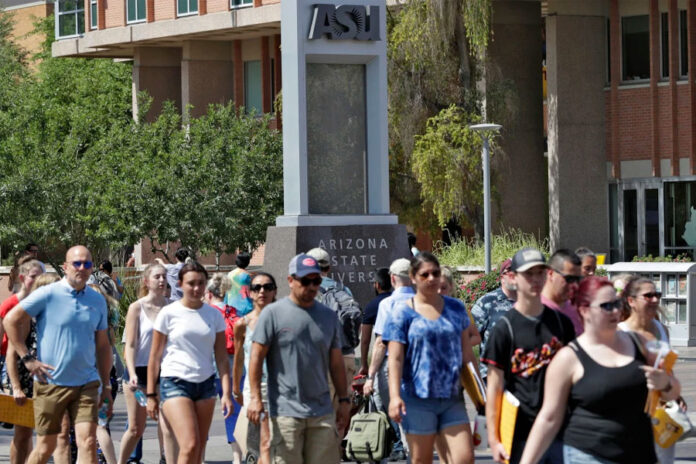
Peatones cruzan una calle en el campus de la Universidad Estatal de Arizona, el 25 de julio de 2018, en Tempe, Arizona. (Foto: AP/Matt York/Archivo)
El gobierno del presidente Donald Trump puso fin a varios programas de subvenciones que estaban reservados para universidades que tienen un gran número de estudiantes de minorías, argumentando que incurren en una discriminación ilegal al vincular los fondos federales a cierto número de alumnos de minorías raciales.
En un cambio que trastoca precedentes de varias décadas, el Departamento de Educación informó el miércoles que ahora cree que es inconstitucional otorgar subvenciones federales utilizando requisitos de elegibilidad basándose en niveles de inscripción racial o étnica. La agencia anunció la retención de un total de 350 millones de dólares en subvenciones presupuestadas para este año y pidió al Congreso que «reimagine» los programas para los próximos años.
Más de 250 millones de ese monto estaban asignados para el programa gubernamental de Instituciones al Servicio de los Hispanos, el cual ofrece subvenciones a colegios y universidades en donde al menos una cuarta parte de los estudiantes de licenciatura son hispanos. El Congreso creó el programa en 1998 después de encontrar que la tasa de estudiantes latinos que asistían y se graduaban de la universidad eran mucho más bajas que las de estudiantes blancos.
Varios otros programas más pequeños también sufrieron recortes, incluidos 22 millones de dólares para escuelas donde al menos el 40% de los estudiantes son de raza negra, junto con programas reservados para escuelas con ciertos niveles de inscripción de estudiantes asiático-estadounidenses, de las islas del Pacífico o indígenas estadounidenses. Tradicionalmente, los programas han recibido apoyo bipartidista en el Congreso y fueron creados para abordar añejas disparidades raciales en la educación.
En los recortes no se incluyeron fondos federales para los Colegios y Universidades Históricamente Negros (HBCU), que están abiertos a cualquier estudiante, independientemente de su raza.
“La diversidad no es meramente la presencia de un color de piel”, dijo la Secretaria de Educación, Linda McMahon, en un comunicado dado a conocer el miércoles. «Estereotipar a una persona basándose en características inmutables menoscaba el panorama completo de la vida y las contribuciones de esa persona, incluyendo su carácter, resiliencia y mérito.»
McMahon agregó que su objetivo es el de trabajar con el Congreso para reutilizar los fondos para instituciones que sirven a estudiantes “con poca preparación o recursos”, sin que haya un nivel mínimo de inscripción racial o étnica. No detalló los planes para la reutilización de los 350 millones de dólares.
Las subvenciones del gobierno para Instituciones al Servicio de los Hispanos están siendo impugnadas como parte de una demanda federal presentada por el estado de Tennessee y el grupo contrario a la acción afirmativa Students for Fair Admissions. Tennessee argumenta que todas sus universidades públicas brindan servicio a estudiantes hispanos, pero ninguna cumple con el «arbitrario umbral étnico» para ser elegible a las subvenciones.
El Departamento de Justicia se negó a defender las subvenciones en la demanda, y en junio emitió un memorando en el que destacó que el requisito de inscripción del 25% es una violación a la Constitución.
En documentos judiciales, una asociación nacional de Instituciones al Servicio de los Hispanos dijo que las subvenciones son legales y ayudan a poner a sus miembros en igualdad de condiciones.
Más de 500 colegios y universidades están designados como Instituciones al Servicio de los Hispanos, lo que los hace elegibles a las subvenciones. La lista incluye campus emblemáticos como la Universidad de Texas en Austin y la Universidad de Arizona, junto con muchos colegios comunitarios e instituciones más pequeñas.
Los nuevos recortes provocaron el rechazo de legisladores demócratas.
La senadora Patty Murray dijo que Trump está «prioriza la política sobre los estudiantes que simplemente buscan salir adelante.» Llamó la atención sobre el actual proyecto de ley de financiación del gobierno, una medida provisional que fue aprobada en marzo y le otorga al gobierno mayor flexibilidad para redirigir los fondos federales.
«Este es un nuevo e importante recordatorio de por qué el Congreso necesita aprobar iniciativas de financiación, como la que el Senado marcó este verano, que aseguran que el Congreso —y no Donald Trump o Linda McMahon— sea el que decida cómo se gastan los limitados dólares de los contribuyentes,» subrayó Murray en un comunicado.
El Departamento de Educación dijo que de cualquier forma liberará alrededor de 132 millones de dólares para programas de subvenciones similares que están considerados como obligatorios, lo que significa que sus niveles están determinados por leyes existentes. Aun así, la agencia señaló que «continúa sopesando los problemas legales subyacentes asociados con el mecanismo de financiación obligatoria en estos programas».
El expresidente Joe Biden dio prioridad a las universidades hispanas, y el año pasado firmó un decreto que prometía una nueva junta asesora presidencial y un aumento en la financiación. Trump revocó la orden en su primer día de regreso en el cargo, en enero pasado.
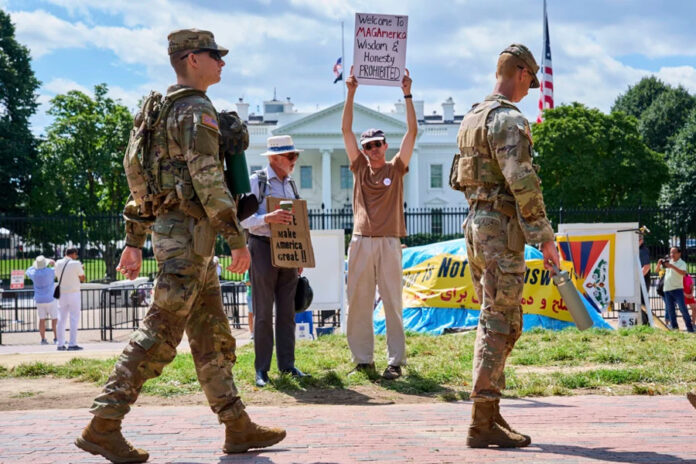
Miembros de la Guardia Nacional patrullan Lafayette Park cerca de la Casa Blanca, el viernes 29 de agosto de 2025, en Washington, mientras que el manifestante Will Roosien, de Grand Rapids, Michigan, que pretende inspirar a otras personas de su generación para que protesten, sostiene un cartel sobre el movimiento MAGA. (Foto: AP/Jacquelyn Martin)
El presidente de Estados Unidos, Donald Trump, ha retratado su intervención federal en Washington D.C. como enfocada en combatir el crimen. Sin embargo, los datos de la operación federal, analizados por The Associated Press, muestran que más del 40% de los arrestos realizados durante el mes que ha durado la operación estuvieron relacionados con la inmigración.
Los hallazgos destacan que, en la capital de la nación, el gobierno siguió impulsando su agenda de línea dura contra la inmigración.
El gobierno de Trump afirma que la toma de control federal en D.C. ha sido un éxito, ya que ha producido más de 2.300 arrestos, entre ellos, más de una docena de sospechosos de homicidio, 20 presuntos miembros de pandillas y cientos de personas acusadas de delitos relacionados con drogas y armas. Más de 220 armas ilegales han sido retiradas de las calles, incluyendo las vinculadas al caso de un adolescente que hizo una publicación preocupante en redes sociales sobre una escuela, dijeron funcionarios.
Sin embargo, la prominencia de los arrestos de inmigración —más de 940 personas— ha alimentado las críticas de que el verdadero propósito de la operación podría haber sido aumentar las deportaciones.
“La toma de control federal ha sido una cobertura para llevar a cabo la aplicación de la ley de inmigración federal”, dijo Austin Rose, un abogado gerente en el Amica Center for Immigrant Rights, un grupo activista. “Quedó bastante claro desde el principio que esta fue una gran campaña de aplicación de la ley de inmigración”.
Para los críticos, el esfuerzo parece menos un impulso único contra el crimen en la capital que un modelo para la intervención federal y para destacar los índices de crímenes violentos en otras ciudades gobernadas por alcaldes demócratas, una conocida jugada política que Trump utilizó durante la campaña presidencial de 2020.
Las autoridades de Chicago, que durante mucho tiempo ha sido un objetivo de la retórica policial del gobierno federal, ya se preparan para la previsible llegada de agentes de inmigración y, posiblemente, de tropas de la Guardia Nacional. El propio Trump avivó la especulación el fin de semana, cuando publicó en redes sociales una imagen parodia de la película “Apocalypse Now” con helicópteros sobrevolando Chicago y el pie de foto: “Me encanta el olor de las deportaciones por la mañana”.
No es claro cuántas personas enfrentaron cargos no relacionados con inmigración
El gobierno ha argumentado repetidamente que las deportaciones son inseparables de la reducción del crimen, a menudo presentando a las personas arrestadas por las autoridades migratorias como los “peores de los peores”. Aun así, sigue sin estar claro cuántos de los detenidos en Washington tenían otros cargos pendientes.
En un comunicado, la portavoz de la Casa Blanca, Abigail Jackson, dijo que muchas de esas personas tenían arrestos previos, condenas u órdenes de arresto pendientes por delitos como agresión, posesión de drogas y abuso sexual infantil, sin especificar una cifra.
“La policía hace un trabajo sobresaliente al retirar estas amenazas de las comunidades de D.C.; el objetivo de esta operación ha sido detener los crímenes violentos cometidos por cualquier persona, independientemente de su estatus migratorio”, afirmó Jackson en un correo electrónico.
Informes internos de las fuerzas de seguridad obtenidos por la AP proporcionan una imagen parcial. En 10 días muestreados durante la intervención, alrededor del 22% de los arrestados por violaciones de las leyes migratorias tenían antecedentes penales, como conducir en estado de intoxicación, posesión de drogas, hurto y robo. Esa muestra constituye un tercio de todo el periodo. Por el momento, no se dispone de las cifras de otros días.
La operación de Trump en D.C. se lanzó por una “emergencia de criminalidad”.
La orden de emergencia de Trump está por expirar
El 11 de agosto, Trump invocó la Sección 740 de la Ley de Autonomía del Distrito de Columbia en una orden ejecutiva para declarar una “emergencia de criminalidad” con el objetivo de que su gobierno pudiera tomar el control de la fuerza policial de la ciudad. Está previsto que esa orden expire la noche del miércoles. El mandatario firmó una directiva para que el secretario de Defensa, Pete Hegseth, activara la Guardia Nacional, que permanece en la ciudad junto con otros agentes federales.
Si bien los agentes de inmigración han formado parte de la operación desde el principio, Trump ha puesto énfasis en que quiere reducir las tasas de criminalidad de la ciudad, que, según las cifras, disminuyeron durante la intervención federal, pero ya iban a la baja antes de eso. El Congreso dejó que la orden de emergencia expirara el miércoles, pero se espera que las tropas de la Guardia Nacional permanezcan desplegadas en la ciudad.
Pocos días después de que el presidente declarara una emergencia de criminalidad, la secretaria de Justicia Pam Bondi ordenó a las autoridades de la ciudad que revocaran las “políticas de santuario” del distrito, debido a que el gobierno centrarse en la aplicación de la ley de inmigración en la operación. Las políticas de santuario generalmente limitan la cooperación de las policías locales con los agentes federales de inmigración.
Después de una demanda presentada por funcionarios de D.C., el gobierno acordó dejar a la jefa de policía de la ciudad a cargo del departamento, pero Bondi, en un nuevo memorando, ordenó a la policía que cooperara con la aplicación de la ley de inmigración federal independientemente de cualquier ley de la ciudad.
En la orden que Bondi emitió el mes pasado sobre “restaurar la seguridad y protección” en la capital de la nación, escribió que los peligros que plantea la comisión de crímenes violentos en la ciudad se ven “multiplicados por las políticas de ciudad santuario del Distrito”. Añadió que la “proliferación de extranjeros ilegales en nuestro país durante el gobierno anterior, incluso en la capital de nuestra nación, presenta riesgos extremos para la seguridad pública y la seguridad nacional de nuestro país”.
En general, los estudios académicos revisados por pares no han encontrado un vínculo entre la inmigración y los crímenes violentos, aunque las conclusiones varían según los datos examinados.
Los inmigrantes sintieron las medidas a través de la intervención federal
El Servicio de Inmigración y Control de Aduanas (ICE, por sus siglas en inglés) realizó arrestos relacionados con la inmigración en el área de Washington antes del inicio de la operación. Pero la presencia de la agencia ha sido mucho más visible desde su lanzamiento el 11 de agosto. Activistas de toda la ciudad han respondido, generalmente, publicando en redes sociales las ubicaciones donde se ha visto al ICE y compartiendo videos de agentes arrestando a personas.
Los inmigrantes preocupados por los puntos de control o los arrestos han compartido intensamente información a través de aplicaciones de mensajería sobre las calles a evitar. Los activistas también han intervenido para entregar alimentos a los inmigrantes temerosos de salir de sus hogares porque corren el riesgo de encontrarse con los agentes federales desplegados en la ciudad.
“Ha creado un miedo inimaginable y ha obligado a las personas a alterar completamente sus rutinas, a no ir a trabajar”, dijo Rose, del grupo activista.
En publicaciones en redes sociales, el Departamento de Seguridad Nacional (DHS, por sus siglas en inglés) ha destacado el número de personas a las que ha arrestado por violaciones de inmigración como parte de la operación del gobierno de Trump contra los crímenes violentos en D.C. En una de esas publicaciones, afirmó que el personal del ICE y de la Oficina de Aduanas y Protección Fronteriza (CBP, por sus siglas en inglés) estaba siendo desplegado para “ayudar a limpiar las calles de la capital de nuestra nación”.
“El DHS apoyará el restablecimiento del orden y la seguridad pública en D.C., lo que incluye sacar a los narcotraficantes, miembros de pandillas y extranjeros criminales de las calles de la ciudad”, dijo el departamento.
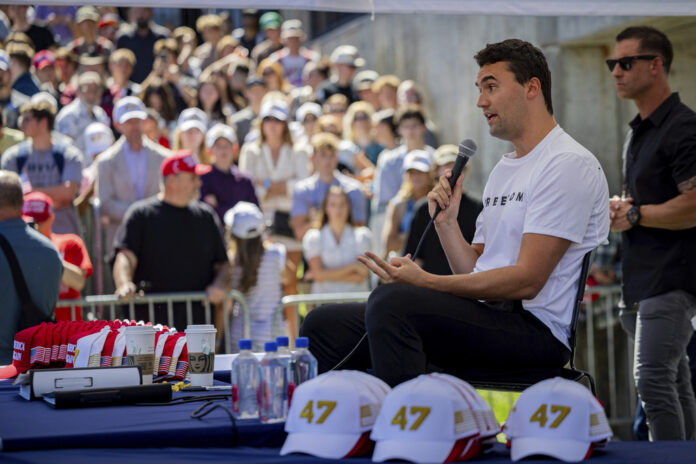
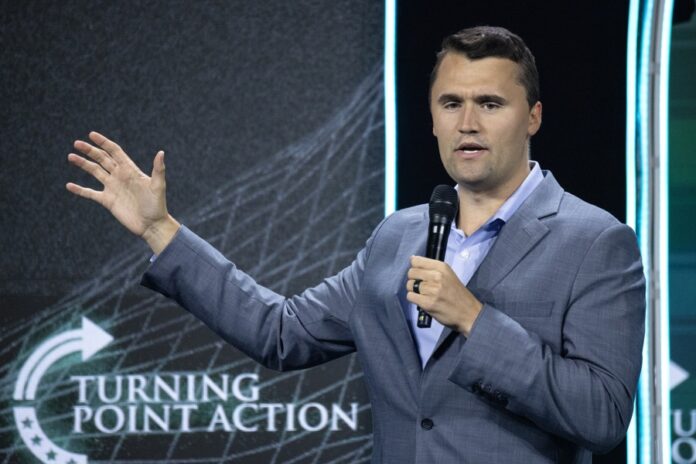
Charlie Kirk, director general y cofundador de la organización juvenil conservadora Turning Point USA, habla antes de recibir un disparo durante un evento público en a la Universidad del Valle de Utah, en Orem, Utah, el miércoles 10 de septiembre de 2025. (Tess Crowley/The Deseret News vía AP)
Charlie Kirk, un activista conservador y aliado cercano del presidente Donald Trump, falleció el miércoles tras recibir un disparo en un evento universitario en Utah, en un incidente que el gobernador del estado calificó de “asesinato político”.
Una “persona de interés” estaba detenida el miércoles por la noche, señaló el gobernador, Spencer Cox, aunque por el momento no se han anunciado los cargos en su contra.
“Este es un día oscuro para nuestro estado”, añadió Cox, que calificó lo ocurrido como un “asesinato político”.
“Estamos buscando activamente a cualquier persona que tenga información relacionada con el tiroteo”, dijo.
Las autoridades de Utah dijeron que el tirador vestía ropa oscura y disparó desde el tejado de un edificio del campus ubicado a cierta distancia.
La muerte fue anunciada en redes sociales por Trump, quien recordó a Kirk, de 31 años y cofundador y director general de la organización juvenil Turning Point USA, como “Grande, e incluso legendario”.
“Nadie entendía ni conocía mejor el corazón de la juventud en los Estados Unidos de América mejor que Charlie”, escribió Trump en su cuenta de Truth Social.
El sospechoso del tiroteo no ha sido arrestado, dijo el alcalde de Orem, Utah, David Young. Una persona que fue detenida por las fuerzas de seguridad en la universidad donde se celebraba el acto no era el autor del ataque, según una persona familiarizada con la investigación que no estaba autorizada a hablar en público.
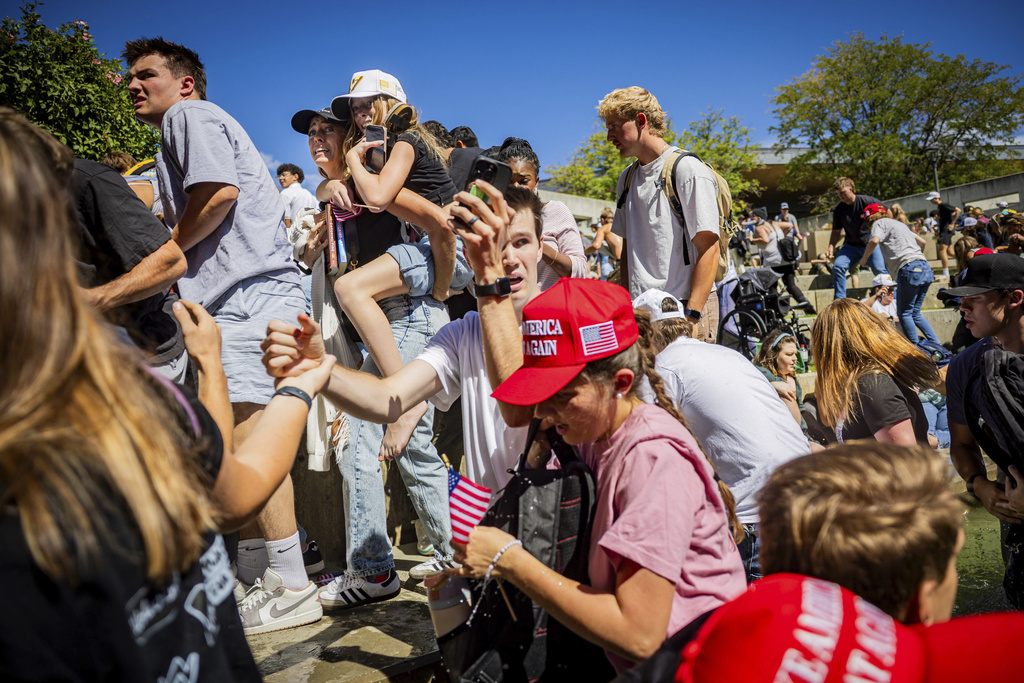
Videos publicados en redes sociales desde la Universidad del Valle de Utah muestran a Kirk hablando con un micrófono mientras está sentado bajo una carpa blanca con los lemas “El regreso estadounidense” y “Demuestra que me equivoco”. Se escucha un solo disparo y se puede ver a Kirk levantando la mano derecha mientras le brota una gran cantidad de sangre del lado izquierdo del cuello. Se oyen los gritos de los espectadores atónitos antes de que la gente eche a correr. The Associated Press pudo confirmar que los videos fueron tomados en el patio del Centro Sorensen, en el campus de la Universidad del Valle de Utah.
Kirk intervenía en un debate organizado por su organización política sin fines de lucro. Inmediatamente antes del tiroteo, respondió a preguntas de un asistente sobre tiroteos masivos y violencia armada.
“¿Sabes cuántos estadounidenses transgénero han sido tiradores masivos en los últimos 10 años?”, preguntó un miembro de la audiencia. Kirk le respondió: “Demasiados”.
El participante continuó: “¿Sabes cuántos tiradores masivos ha habido en Estados Unidos en los últimos 10 años?”
“¿Contando o sin contar con la violencia de pandillas?”, preguntó Kirk.
Luego se escuchó un único disparo.
La Universidad del Valle de Utah dijo que el campus fue evacuado de forma inmediata y seguía cerrado. Las clases quedaron canceladas hasta nuevo aviso. A quienes aún estaban en el recinto se les pidió que permanecieran allí hasta que la policía pudiera escoltarlos de manera segura fuera del campus. Agentes armados caminaron por el vecindario que rodea el campus, tocando puertas y pidiendo información sobre el tirador.
Se ha visto a agentes mirando una foto en sus celulares y mostrándola a la gente para ver si reconocen a una persona de interés.
El evento, anunciado como la primera parada de la “Gira de regreso estadounidense» de Kirk, había generado una reacción polarizada en el campus. Una petición online que pedía a los administradores de la universidad que prohibieran la aparición de Kirk recibió casi 1.000 firmas. La semana pasada, el centro emitió un comunicado citando los derechos contemplados en la Primera Enmienda constitucional y afirmando su “compromiso con la libertad de expresión, la investigación intelectual y el diálogo constructivo”.
La semana pasada, Kirk publicó en X imágenes de recortes de noticias que mostraban que su visita a universidades de Utah estaba generando controversia, acompañadas del texto “¿Qué está pasando en Utah?”.
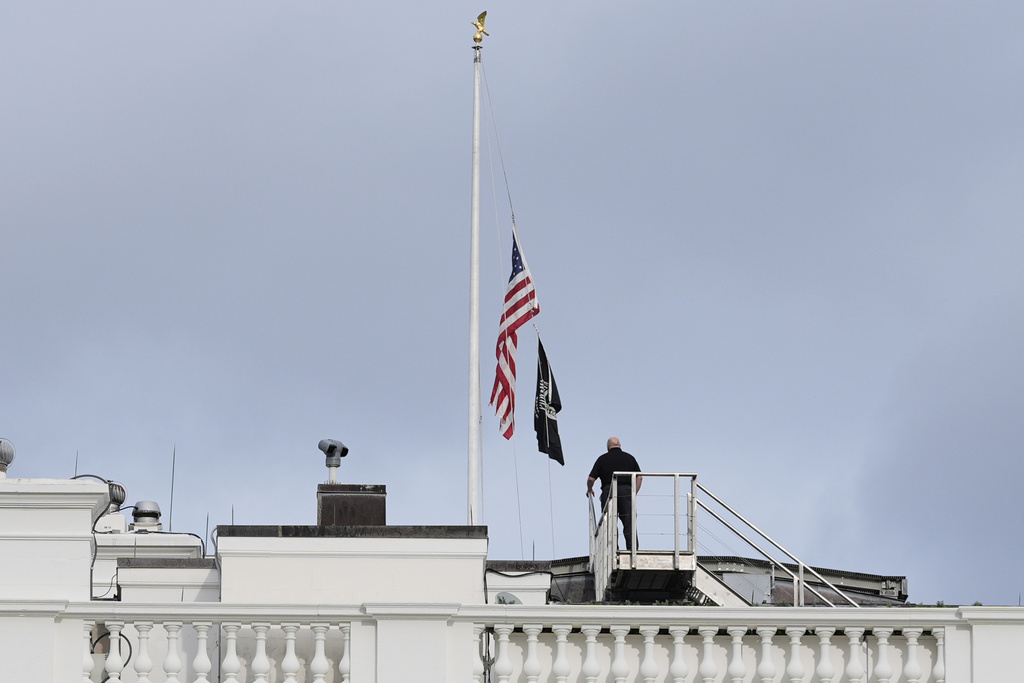
La bandera estadounidense en la Casa Blanca, en Washington, baja a media asta tras la muerte de Charlie Kirk, director general y cofundador de Turning Point USA, tras recibir un disparo en un acto en Orem, Utah, el 10 de septiembre de 2025. (AP Foto/Alex Brandon)
El tiroteo provocó una rápida condena bipartidista, con funcionarios demócratas uniéndose a Trump —quien ordenó que las banderas ondearan a media asta y emitió una proclamación presidencial— y aliados republicanos de Kirk para denunciar la violencia.
“El ataque a Charlie Kirk es repugnante, vil y censurable”, escribió en X el gobernador demócrata de California, Gavin Newsom, quien en marzo pasado recibió a Kirk en su podcast.
“El asesinato de Charlie Kirk me rompe el corazón. Mis más profundas condolencias a su esposa, sus dos hijos pequeños y amigos”, dijo Gabrielle Giffords, la excongresista demócrata herida en un tiroteo en 2011 en su distrito de Arizona.
Aunque no se ha revelado el posible motivo, las circunstancias del tiroteo alimentaron el temor a que formase parte de un repunte de la violencia política que ha atravesado el espectro político. Los ataques incluyen el asesinato de una legisladora estatal de Minnesota y su esposo en su casa en junio, el lanzamiento de bombas incendiarias en un desfile en Colorado para exigir que Hamás libere a los rehenes, y un incendio provocado en la casa del gobernador de Pensilvania, quien es judío, en abril. El más conocido de estos actos fue el tiroteo a Trump durante un mitin de campaña el año pasado.
El excongresista de Utah, Jason Chaffetz, un republicano que estaba en el evento, dijo en una entrevista en Fox News Channel que escuchó un disparo y vio a Kirk retroceder.
“Parecía que fue un disparo cercano”, dijo Chaffetz, quien parecía conmocionado mientras hablaba.
Señaló que había poca presencia policial en el acto y que Kirk tenía algo de seguridad, pero no suficiente.
“Utah es uno de los lugares más seguros del planeta”, dijo. “Y por eso simplemente no tenemos este tipo de cosas”.
Turning Point se fundó en los suburbios de Chicago en 2012 por Kirk, que entonces tenía 18 años, y William Montgomery, un activista del tea party, para hacer campaña en los campus universitarios en favor de los impuestos bajos y las limitaciones al gobierno. No tuvo un éxito inmediato.
Pero el entusiasmo de Kirk por confrontar a los liberales en el ámbito académico llegó finalmente a un conjunto influyente de financiadores conservadores.
A pesar de las dudas iniciales, Turning Point respaldó con entusiasmo a Trump cuando se aseguró la nominación republicana en 2016. Kirk fue asistente personal de Donald Trump Jr., el hijo mayor del presidente, durante la campaña electoral a la Casa Blanca.
Pronto, Kirk llegó a ser una presencia habitual en la televisión por cable, donde se adentró en las guerras culturales y elogió al entonces presidente. Trump y su hijo fueron igual de efusivos y a menudo participaban en las conferencias de Turning Point.
Asistentes reaccionan luego de que Charlie Kirk, director general y cofundador de la organización juvenil Turning Point USA, fuese baleado en la Universidad Utah Valley el 10 de septiembre de 2025, en Orem, Utah. (Tess Crowley/The Deseret News vía AP)
Richer y Sherman informaron desde Washington. Los periodistas de The Associated Press Nicholas Riccardi en Denver y Michael Biesecker, Brian Slodysko, Lindsay Whitehurst, Michelle L. Price y Eric Tucker en Washington contribuyeron a este despacho.
Esta historia fue traducida del inglés por un editor de AP con la ayuda de una herramienta de inteligencia artificial generativa.
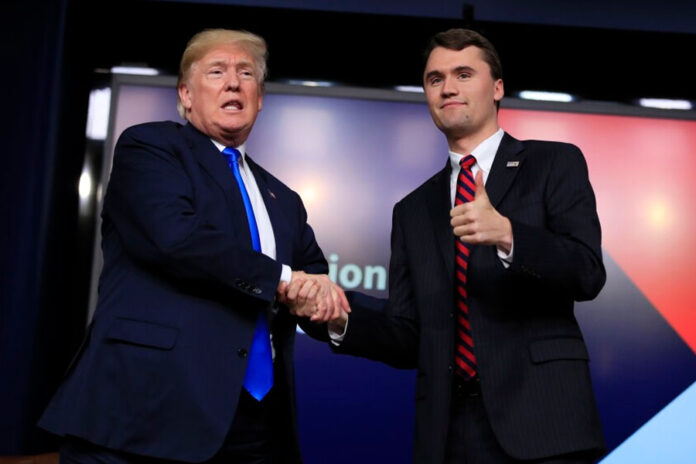
President Donald Trump shakes hands with moderator Charlie Kirk, during a Generation Next White House forum at the Eisenhower Executive Office Building on the White House complex in Washington, Thursday, March 22, 2018. (Photo: AP/Manuel Balce Ceneta/File)
Kirk died doing what made him a potent political force — rallying the right on a college campus, this time Utah Valley University. The event was kicking off a planned series of Kirk college appearances from Colorado to Virginia dubbed “The American Comeback Tour.”
His shooting was one of an escalating number of attacks on political figures, from the assassination of a Democratic state lawmaker and her husband in Minnesota to last summer’s shooting of Trump, that have roiled the nation.
Trump announced Kirk’s death on his social media site, Truth Social.
Kirk personified the pugnacious, populist conservatism that has taken over the Republican Party in the age of Trump. He launched his organization, Turning Point USA, in 2012, targeting younger people and venturing onto liberal-leaning college campuses where many GOP activists were nervous to tread.
At the center of the right-of-center universe
A backer of Trump during the president’s initial 2016 run, Kirk took Turning Point from one of a constellation of well-funded conservative groups to the center of the right-of-center universe.
Turning Point’s political wing helped run get-out-the-vote for Trump’s 2024 campaign, trying to energize disaffected conservatives who rarely vote. Trump won Arizona, Turning Point’s home state, by five percentage points after narrowly losing it in 2020. The group is known for its events that often feature strobe lighting and pyrotechnics. It claims more than 250,000 student members.
Trump on Wednesday praised Kirk, who started as an unofficial adviser during Trump’s 2016 campaign and more recently became a confidant. “He was a very, very good friend of mine and he was a tremendous person,” Trump told the New York Post.
Kirk showed off an apocalyptic style in his popular podcast, radio show and on the campaign trail. During an appearance with Trump in Georgia last fall, he said that Democrats “stand for everything God hates.” Kirk called the Trump vs. Kamala Harris choice “a spiritual battle.”
“This is a Christian state. I’d like to see it stay that way,” Kirk told the 10,000 or so Georgians, who at one point joined Kirk in a deafening chant of “Christ is King! Christ is King!”
Influencing a new generation of conservatives
Kirk also remained a regular presence on college campuses. Last year, for the social media program “Surrounded,” he faced off against 20 liberal college students to defend his viewpoints, including that abortion is murder and should be illegal.
Admirers stressed that, for all of Kirk’s confrontational rhetoric, he relished debate and the free exchange of ideas. “His entire project was built on reaching across the divide and using speech, not violence, to address and resolve the issues!” William Wolfe, executive director of the Center for Baptist Leadership, posted on X.
His style has been hugely influential for a new generation of conservatives. Republican Rep. Anna Paulina Luna of Florida spoke on the Capitol steps after the shooting Wednesday, reflecting on Kirk’s influence on her political journey.
“I was supposed to go to medical school. Charlie Kirk called me the day before I was supposed to leave, and recruited me to go be the national Hispanic outreach director for the organization,” said Luna. “I was with him at many of them, debating those kids, and that conversation needs to happen. You can’t squelch that.”
Kirk was married to podcaster Erika Frantzve. They have two young children.
Zeal for challenging liberals
Turning Point was founded in suburban Chicago in 2012 by a then 18-year-old Kirk and William Montgomery, a tea party activist, to proselytize on college campuses for low taxes and limited government. It was not an immediate success.
But Kirk’s zeal for confronting liberals in academia eventually won over an influential set of conservative financiers.
Despite early misgivings, Turning Point enthusiastically backed Trump after he clinched the GOP nomination in 2016. Kirk served as a personal aide to Donald Trump Jr., the former president’s eldest son, during the general election campaign.
Soon, Kirk was a regular presence on cable TV, where he leaned into the culture wars and heaped praise on the then-president. Trump and his son were equally effusive and often spoke at Turning Point conferences.
Kirk announced he was organizing buses to travel to Washington to back Trump on Jan. 6, 2021, and later invoked the Fifth Amendment rather than answering questions from the Jan. 6 subcommittee. Also in 2021, as he stepped up criticism of the Black Lives Matter movement on college campuses, Kirk called George Floyd, the Black man whose 2020 murder at the hands of Minneapolis police sparked protests that roiled Trump’s last full year in office, a “scumbag.”
“Just don’t totally mess up this state,» Kirk said at the event in Mankato, Minnesota. «It was built by wonderful Scandinavians, and it seems as if it’s being destroyed now, rather intentionally.”
As money poured in, Kirk bought a $4.75 million Spanish-style estate on a gated Arizona country club. Turning Point steered millions of dollars to contractors owned by Kirk and his associates, and some Republicans were skeptical when it announced it would spearhead an attempt to turn out infrequent voters during Trump’s 2024 campaign.
But as younger voters shifted right in 2024 and Trump ran up a five-point margin of victory in Arizona, Kirk and his allies claimed vindication of his view of a sharp-elbowed, culture-war-oriented conservatism.
He also referenced the Seven Mountain Mandate, which specifies seven areas where Christians are to lead — politics, religion, media, business, family, education and the arts, and entertainment.
Kirk argued for a new conservatism that advocated for freedom of speech, challenging Big Tech and the media, and centering working-class Americans beyond the nation’s capital.
“We have to ask ourselves a question as a conservative movement: Are we going to revert back to the party of the status quo ruling class?” he said in his speech opening the Conservative Political Action Conference in 2020.
“Or are we going to learn from what I call the MAGA doctrine? The MAGA doctrine, which is a doctrine of American renewal, revival, one that America is the greatest country in the history of the world.”
El candidato demócrata a la alcaldía de Nueva York Zohran Mamdani habla en el estrado durante la Marcha sobre Wall Street el jueves 28 de agosto del 2025. (AP Foto/Heather Khalifa)
El candidato a la alcaldía de la ciudad de Nueva York, Zohran Mamdani, quien ganó la nominación demócrata con una plataforma para hacer la ciudad más asequible, pidió al organismo rector del fútbol mundial que haga más barato para los neoyorquinos asistir a la Copa del Mundo.
En una petición publicada el miércoles, Mamdani exigió que la FIFA revierta su plan de fijar los precios de las entradas para el torneo del próximo año en función de la demanda, y comparó la práctica con «explotación de precios».
El socialista demócrata, que apodó su campaña «Game Over Greed» (Juego por sobre la Codicia), también pidió que el 15% de las entradas se reserve a precios reducidos para los residentes.
«Como un fanático de toda la vida del fútbol — perdón, quiero decir del soccer, no podría estar más emocionado», dijo Mamdani en un video en redes sociales que acompaña la petición, afectando un acento británico falso mientras hacía malabares con un balón de fútbol en sus zapatos de vestir. «Pero, ¿algún neoyorquino de clase trabajadora realmente podrá ver alguno de los partidos?»
El torneo se jugará en 16 ciudades de América del Norte. Ocho partidos, incluida la final, se llevarán a cabo en el MetLife Stadium en Nueva Jersey, cerca a la ciudad de Nueva York.
«Muchos de nuestros vecinos no podrán permitirse estar allí», añadió Mamdani, acusando a la FIFA de «excluir a la gente trabajadora del juego que aman».
Un portavoz de la FIFA no respondió a una solicitud de comentarios enviada por correo electrónico.
En los últimos días, el plan de la FIFA para adoptar un modelo de «precios variables» para la venta de entradas —similar al utilizado por aerolíneas o hoteles— ha generado controversia entre algunos aficionados.
Los boletos más asequibles serán de 60 dólares para los partidos de la fase de grupos y alcanzaran los 6.730 dólares para la final, dijeron los funcionarios la semana pasada, pero podrían fluctuar bajo el modelo de precios basado en la demanda. Mamdani también pidió al organismo rector que implemente un límite en los precios de reventa de entradas, algo que ha acordado hacer en México, pero no en Estados Unidos o Canadá, dijo.
Mamdani, quien logró la victoria en las elecciones primarias basándose en promesas como congelar el alquiler para los neoyorquinos y hacer que los autobuses sean gratuitos, situó la lucha por la Copa del Mundo como parte de su batalla más amplia contra el aumento de los costos para las personas trabajadoras.
“El papa Juan Pablo II dijo: ‘De todas las cosas sin importancia, el fútbol es la más importante’, dijo Mamdani en una conferencia de prensa el miércoles. ”Esto es parte integral de una crisis de asequibilidad más grande en esta ciudad. Una vez más, serán las personas trabajadoras las que quedarán atrás».
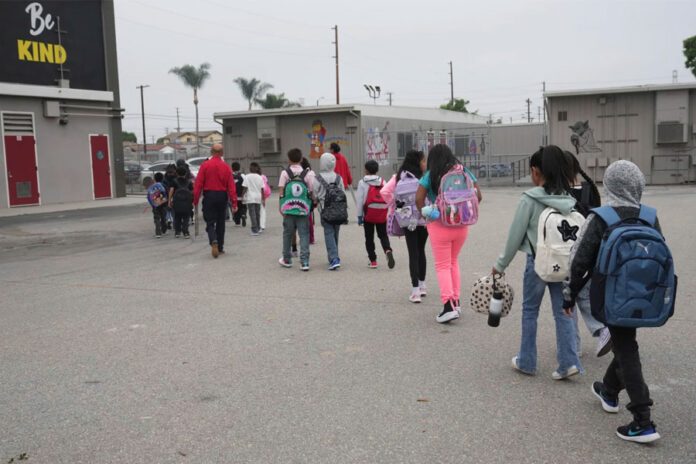
Teachers walk with students on the first day of school Thursday, Aug. 14, 2025, in Los Angeles. (Photo: AP/Marcio Jose Sanchez)
Labor unions representing millions of educators and school employees are suing President Donald Trump’s administration over its immigration crackdown, saying arrests near school campuses are terrorizing children and their teachers, leading some students to drop out.
At the start of Trump’s second term, his Republican administration said it would allow immigration arrests at schools — long considered off limits. That violated the law, argues the lawsuit from the two largest U.S. teacher unions, the National Education Association and the American Federation of Teachers, which represent more than 4 million school employees nationwide.
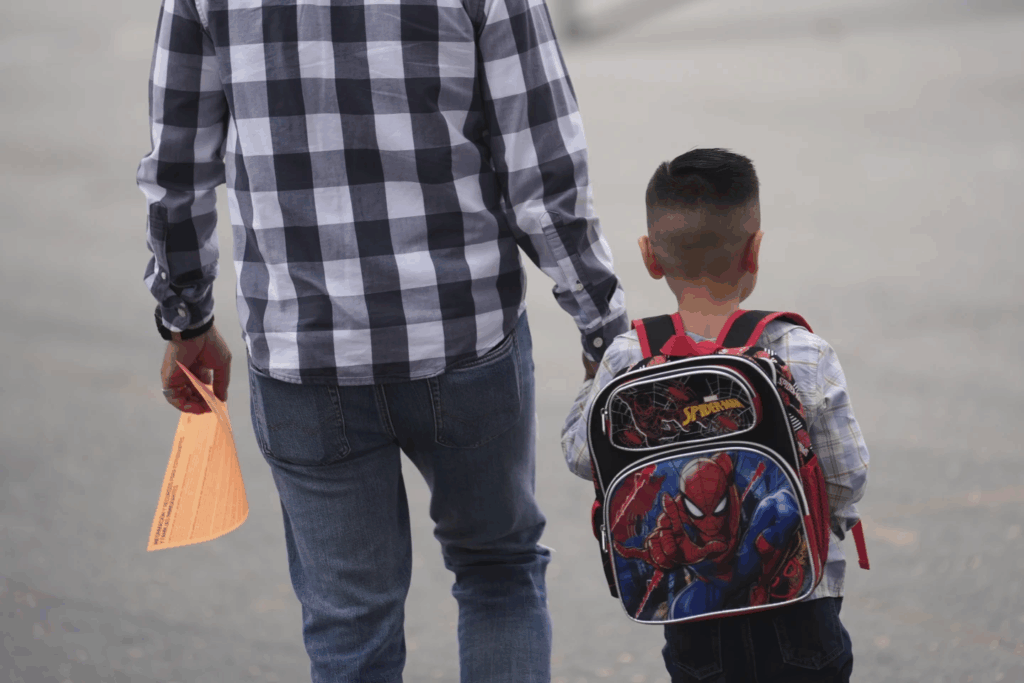
Also joining the lawsuit are educators from an Oregon preschool where masked agents broke a car window and dragged a student’s father from his car shortly after the child had been dropped off. The arrival of police prompted the school to go into a lockdown, with teachers playing music so students couldn’t hear the commotion outside.
Teacher Lauren Fong, who teaches the child whose father was arrested that day, said she was troubled by the decision to confront the father in the school parking lot, which is private property.
“Why a school? Why not someplace else, any place else?» Fong said in an interview. “It was in the parking lot, where it could be witnessed by so many young children.”
The educators are joining a lawsuit filed in April by an Oregon farmworker union and a group of churches, challenging the Trump administration’s decision to open houses of worship to immigration enforcement as well. The amended lawsuit was filed Tuesday in federal court in Eugene, Oregon.
Department of Homeland Security Assistant Secretary Tricia McLaughlin said immigration officers use discretion when making arrests at schools or churches.
“Officers would need secondary supervisor approval before any action can be taken in locations such as a church or a school,” McLaughlin said. “We expect these to be extremely rare.”
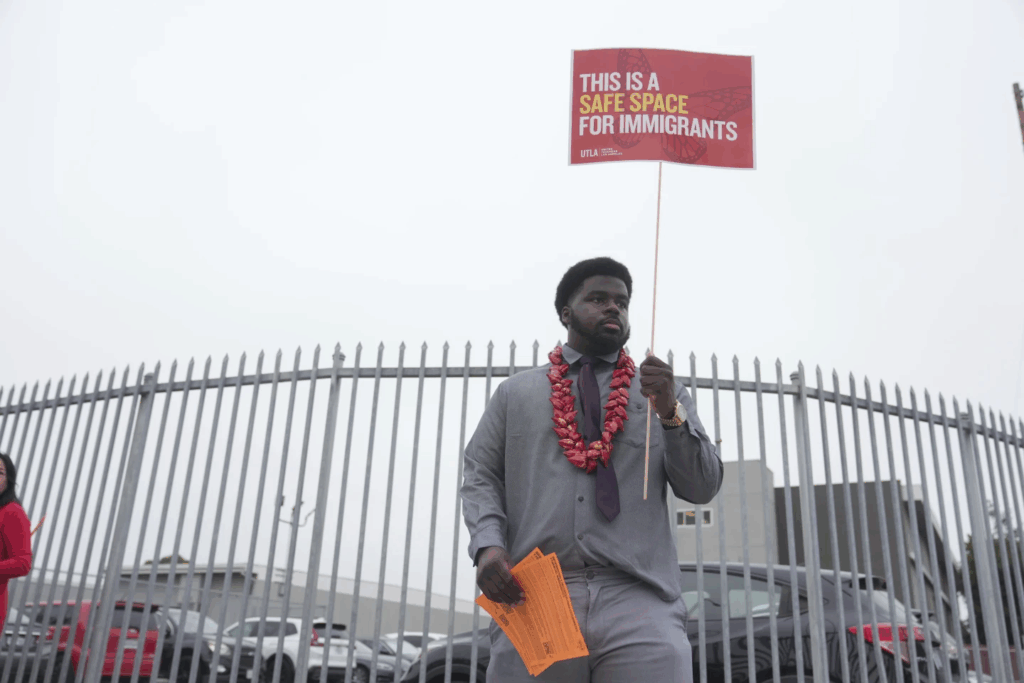
eacher Naim Muhammad holds a sign supporting immigrants on the first day of school Thursday, Aug. 14, 2025, in Los Angeles. (Photo: AP/Marcio Jose Sanchez)
A policy reversal opened the door to arrests at schools
For nearly three decades, immigration agents were instructed to steer clear of “sensitive locations” like schools, hospitals and places of worship, except under extraordinary circumstances. Homeland Security, according to a 2021 memo, could “accomplish (its) enforcement mission without denying or limiting individuals’ access to needed medical care, children access to their schools, the displaced access to food and shelter, people of faith access to their places of worship.»
A day after Trump took office, the department rescinded the memo and instead urged agents to use “common sense” when operating near schools and churches. In a statement, officials outlined their reasoning behind the move: «Criminals will no longer be able to hide in America’s schools and churches to avoid arrest.”
The lawsuit describes several instances of masked agents from Immigration and Customs Enforcement making arrests in and around school and church grounds. In Los Angeles, masked border patrol officers descended on a car parked next to a high school and ordered a 15-year-old boy with disabilities out at gunpoint while searching for a man with gang ties. They handcuffed him and only released him when they discovered they had the wrong person.
Students and family members are escorted into school on the first day of school Thursday, Aug. 14, 2025, in Los Angeles. (Photo: AP/Marcio Jose Sanchez)
School attendance dropped in some districts
In the months following Trump’s inauguration, some school districts reported lower attendance as immigrant families kept their children home or, in some cases, left the country. In California’s Central Valley, immigration raids in January and February coincided with a 22% spike in student absences compared with the previous two school years, according to a study from Stanford University economist Thomas Dee and Big Local News.
The lawsuit includes testimonials from unnamed teachers who report seeing increased anxiety and decreased participation and attendance from students who are either immigrants or the children of immigrants.
High school teachers in Pennsylvania and Virginia said some students stopped showing up in the spring, fearful they would be arrested on campus. A speech pathologist at a California elementary school said immigrant parents were reluctant to sign up their children for special education services because it would mean giving more information to the school. A Texas high school teacher for students learning English said enrollment in her classes has dropped precipitously.
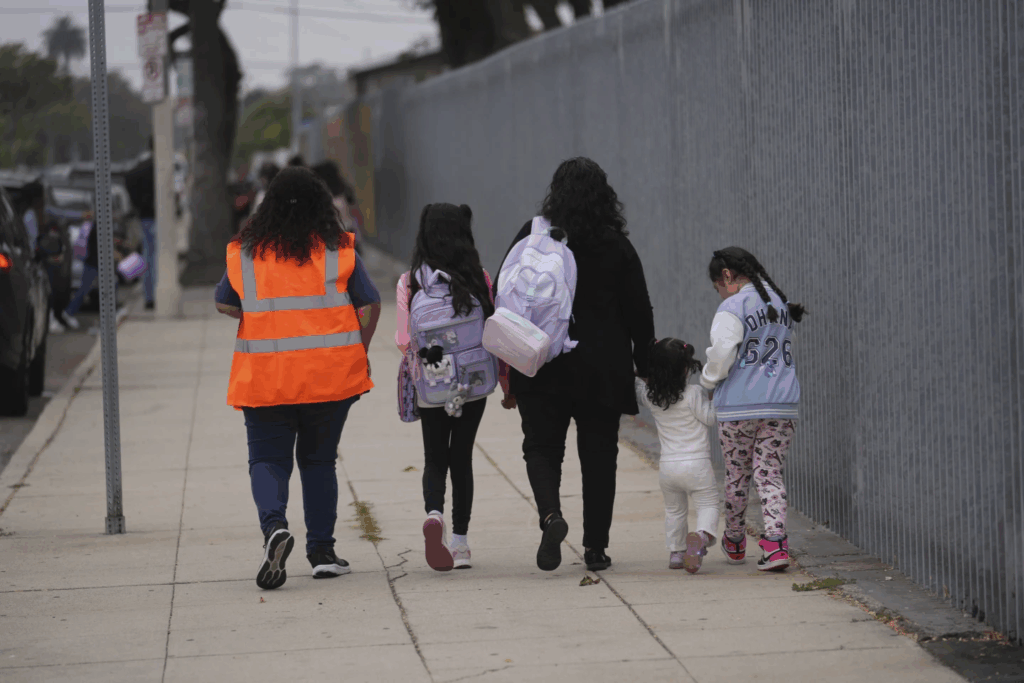
A parent and student arrive on the first day of school Thursday, Aug. 14, 2025, in Los Angeles. (Photo: AP/Marcio Jose Sanchez)
“America’s classrooms must be safe and welcoming places of learning and discovery,” said Randi Weingarten, president of the AFT.
Becky Pringle, president of the National Education Association, said the Trump administration is creating fear and chaos and «our students, schools, and communities are paying the price.”
Leaders in the heavily immigrant churches that sued also described increased anxiety and a drop in Mass attendance.
Lawyers argue Trump’s decision to open up churches to immigration enforcement violates the First Amendment rights of parishioners because it makes them too fearful to attend church. Rescinding the sensitive-locations memo, the lawsuit says, violates the Administrative Procedure Act, which bars agencies from implementing policies that are “arbitrary, capricious, an abuse of discretion, or otherwise not in accordance with the law.”
Comentarista y activista conservador Charlie Kirk. (Foto: EFE/Cristóbal Herrera-Ulashkevich/Archivo)
Agentes del FBI y de la Agencia de Alcohol, Tabaco, Armas de Fuego y Explosivos (ATF, por sus siglas en inglés) se encuentran desplegados en el campus de la Universidad Utah Valley donde el comentarista político Charlie Kirk recibió un disparo en el cuello, según informó en X este miércoles la fiscal general, Pam Bondi.
«Estamos monitoreando de cerca los informes sobre el trágico tiroteo que involucró a Charlie Kirk en la Universidad Utah Valley. Nuestros pensamientos están con Charlie, sus seres queridos y todos los afectados», escribió el director del FBI, Kash Patel.
Kirk recibió un único disparo cuando participaba como ponente invitado en un acto de la universidad.
«La policía está investigando el caso y el sospechoso se encuentra detenido», avanzó la universidad en una alerta.
Sin embargo, las autoridades todavía no lo han identificado.
El suceso ocurrió frente a unas dos mil personas presentes, según el excongresita Jason Chaffetz, que estaba en el evento.
Trump pidió una oración por su aliado político, tras conocer la noticia. «Todos debemos orar por Charlie Kirk, quien recibió un disparo. Un gran hombre de pies a cabeza. ¡Que Dios lo bendiga!», escribió el mandatario republicano en su plataforma Truth Social.
También el vicepresidente JD Vance pidió oraciones para Kirk, a quien definió como «un hombre verdaderamente bueno y un padre joven».
«Estoy siguiendo de cerca la situación en la Universidad del Valle de Utah. Les pido que se unan a mí en oración por Charlie Kirk y los estudiantes allí reunidos», indicó por su parte el senador estadounidense por Utah, Mike Lee.
Nacido en octubre de 1993 en Illinois y padre de dos hijos, Kirk es un activista, escritor y comentarista conocido principalmente por haber fundado Turning Point, una organización estudiantil que promueve los valores conservadores.
Kirk prestó su apoyo públicamente a Trump en varios de sus mítines de campaña el año pasado y estuvo presente en la ceremonia de investidura del presidente.
Antonieta Cádiz, directora ejecutiva adjunta de Climate Power En Acción.
En todo Estados Unidos, las comunidades se están recuperando de las consecuencias de una administración que parece más centrada en las posturas políticas que en el bien común. Desde las fábricas de vehículos eléctricos en Georgia hasta los equipos de respuesta a incendios forestales en Washington, las medidas federales de inmigración están debilitando a las mismas comunidades a las que se supone deben servir.
La semana pasada, cientos de trabajadores fueron detenidos en una redada de ICE en la planta de baterías para vehículos eléctricos de Hyundai en Elabell, Georgia. Esta instalación representa la mayor inversión industrial en la historia de Georgia. Sin embargo, bajo esta administración, la planta se convirtió en un objetivo. Los trabajadores, muchos de ellos ciudadanos surcoreanos, fueron detenidos en redadas que generan temor e incertidumbre en las empresas que intentan invertir en Estados Unidos.
Los empleos en el sector manufacturero ya están en declive, con un informe nacional que muestra la pérdida de 78.000 empleos durante el último año. Gran parte de este impacto ha afectado al sector de las energías limpias, que ha visto más de 64.000 empleos perdidos o estancados desde que Trump asumió el cargo. Mientras tanto, las facturas de electricidad han aumentado un 10 por ciento desde que Trump asumió el cargo. En lugar de impulsar industrias que podrían estabilizar a las comunidades y fortalecer las economías locales, las políticas de Trump están generando caos, aumentando los costos para los estadounidenses comunes y corrientes, y enviando un mensaje claro a las empresas: la política es lo primero.
La indiferencia hacia las necesidades de la comunidad no se limita a la industria manufacturera. En el estado de Washington, dos bomberos contratados para combatir un incendio forestal de 9.000 acres fueron detenidos por agentes de la Patrulla Fronteriza debido a discrepancias en su estatus migratorio. Los trabajadores de respuesta a emergencias, que arriesgaban sus vidas para proteger vidas y propiedades, fueron retirados de la línea de fuego, sus equipos retrasados y los contratistas federales retirados del lugar. Estos arrestos ocurren en un momento en que los incendios forestales se están volviendo más largos, frecuentes y devastadores debido al cambio climático. Cada minuto cuenta, y las comunidades no pueden permitirse perder personal capacitado en medio de un desastre provocado por el clima. Sin embargo, las políticas de esta administración priorizan la deportación sobre la seguridad pública, poniendo en riesgo vidas y el medio ambiente.
Estos incidentes forman parte de un patrón más amplio. Las redadas masivas de deportación transmiten un mensaje escalofriante: independientemente de las contribuciones positivas que realicen los inmigrantes, ya sea en fábricas, respuesta a emergencias o servicios esenciales, se les considera desechables. El costo humano y económico de estas políticas recae directamente sobre las familias y comunidades estadounidenses.
Esta misma semana, la Corte Suprema de EE.UU. dictaminó que los agentes de ICE pueden considerar la raza, el idioma y la ubicación al detener a personas, lo que en la práctica da luz verde a la discriminación racial. La decisión anula las protecciones vigentes en Los Ángeles y sienta un peligroso precedente nacional, al permitir que los agentes federales persigan a personas simplemente por parecer latinas o hablar español. En combinación con las redadas masivas, este fallo amenaza aún más a nuestras comunidades y nuestra capacidad para responder a sus necesidades esenciales.
Comunidades de todo el país dependen de industrias estables y servicios de emergencia. Dependen de que las personas acudan a trabajar, a combatir incendios y a mantener la electricidad. Las políticas que priorizan la deportación sobre el bienestar de los residentes son una amenaza directa para la prosperidad y la seguridad pública de Estados Unidos. Si la administración Trump realmente se preocupara por las familias de clase trabajadora y las comunidades locales, alentaría la inversión, garantizaría empleos y protegería los servicios de emergencia, no los sabotearía en nombre del teatro político.
Antonieta Cádizes la directora ejecutiva de Climate Power En Acción. Anteriormente, trabajó como corresponsal nacion.