

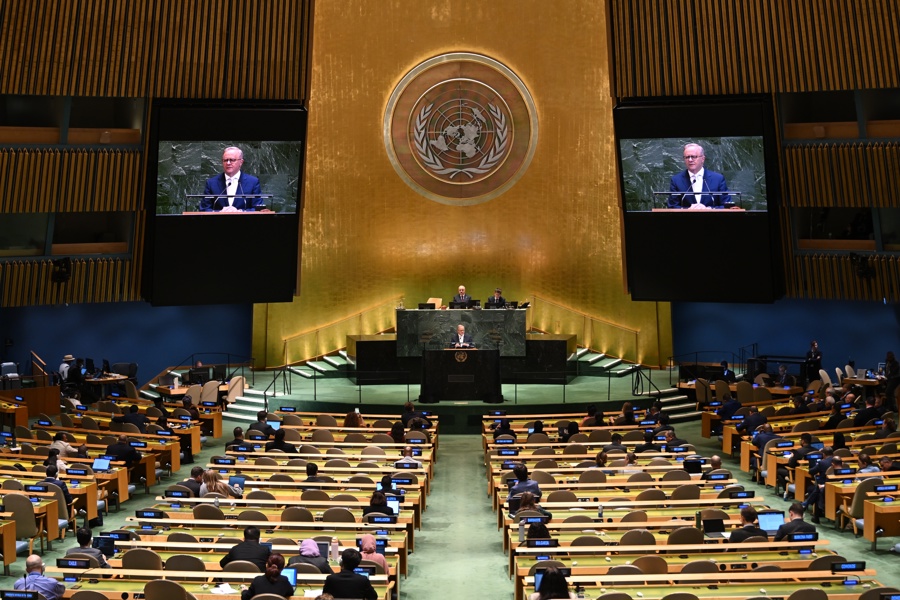
As the United Nations 80th General Assembly session moved forward Wednesday, starkly different views emerged between leaders defending the system and its critics, who debated global crises from Haiti and Iran to Ukraine and Gaza.
Spain’s King Felipe VI opened the day with a firm defense of multilateralism and the U.N. as an institution “indispensable, irreplaceable,” calling on the international community not to remain silent about Gaza and urging the Israeli government to halt what he described as a “massacre.” EFE reported his words in Spanish.
Independent English accounts confirm he condemned violence in Gaza and defended the U.N.’s central role.
President Volodymyr Zelenskiy of Ukraine addressed the assembly with a sense of frustration toward international institutions. He asserted that global law and cooperation are increasingly subordinated to force. “Weapons decide who survives,” Zelenskiy said, according to Reuters coverage of his speech.
Other leaders joined in expressing their views. Argentina’s Javier Milei criticized the U.N., calling it “a government of bureaucrats” in a speech that echoed the rhetoric of his ally, U.S. President Donald Trump.
Iran’s President Masud Pezeshkian branded Israeli attacks in June as “a betrayal of diplomacy,” denied that Iran seeks to build nuclear weapons, and accused Britain, France, and Germany of serving U.S. interests by reactivating sanctions over alleged breaches of the 2015 nuclear deal.
Meanwhile, leaders supporting the U.N. and global democracy—such as Spain’s Pedro Sánchez, Brazil’s Luiz Inácio Lula da Silva, Chile’s Gabriel Boric, and Colombia’s Gustavo Petro—called for strengthening global democratic norms in a parallel forum.
The Dominican Republic’s President Luis Abinader appealed for action in Haiti, urging the U.N. Security Council to transform the Kenya-led Multinational Security Support mission into a force capable of imposing order amid escalating gang violence.
Kenyan President William Ruto spoke of operating “in a volatile environment and under enormous limitations,” asking under-what conditions the U.N. family could act with unity.
Also speaking was Guyana’s Irfaan Ali, who, amid a border dispute with Venezuela over Esequibo, invoked the primacy of “international law” against what he called “repeated attacks and aggression” by Nicolás Maduro’s government.
Paraguay’s Santiago Peña decried a global “crisis of democracy,” citing “systematic violations of human rights” and “persecution of political leaders” in Venezuela.
Though he acknowledged Israel’s “legitimate right to defend itself,” Peña made an urgent plea to address the humanitarian crisis in Gaza.