


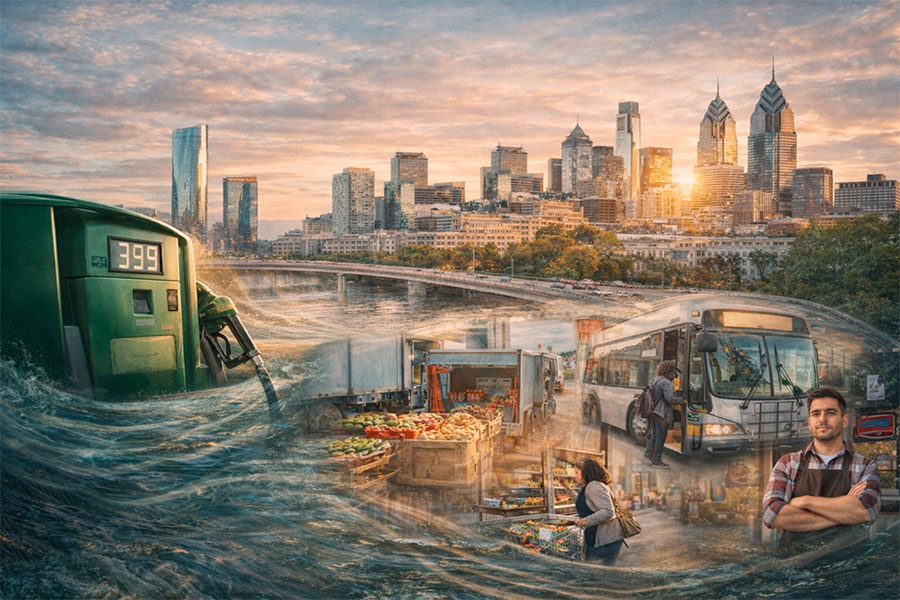
Rising gasoline prices are quietly making food, transportation, and essential services more expensive for working-class families across Philadelphia. When a rock hits water, the first splash is small, but the ripples spread outward across the surface until they reach the shore. Economic shocks often move in the same way. Gasoline prices may begin at the pump, but the consequences spread through the economy—touching grocery stores, workplaces, small businesses, and household budgets. For many working-class communities in Philadelphia, those ripples are already shaping everyday life.
Food prices begin the first ripple
Fuel powers nearly every step of the food supply chain. Trucks transport crops from farms to warehouses and then to grocery stores. Agricultural equipment, irrigation systems, and fertilizer production also depend heavily on energy. When gasoline prices rise, the ripple reaches food production and distribution. The cost of producing and transporting food increases, pushing prices higher for consumers. Research published in the journal Energy Economics found that increases in gasoline prices significantly raise retail food prices, confirming a direct connection between fuel costs and grocery inflation.
The Center for American Progress has also found that energy costs can account for up to 50 percent of variable food production costs, meaning spikes in fuel prices can quickly influence grocery prices. For families already managing tight budgets, the ripple often appears gradually. Grocery bills increase month after month, forcing many households to stretch their income further, buy cheaper food, or cut back on healthier items.
Mobility and job access shrink
Transportation connects workers to job opportunities. In cities like Philadelphia, many workers commute across neighborhoods—or even across state lines—to reach their workplaces.
Lizandra Perez, a Social Services Worker at Catholic Charities of Philadelphia, said rising fuel costs have directly impacted her ability to maintain financial stability. She commutes approximately 30 minutes each way using her personal vehicle and noted that traffic delays increase fuel consumption. “I am forced to allocate more of my income toward transportation,” she said. “I am currently living paycheck to paycheck.” Service workers, including cleaners, construction workers, home health aides, and delivery drivers, often travel long distances or work multiple jobs in different locations. For many of them, driving is not optional, it is essential. Research from the Urban Institute shows that higher gasoline costs can make it harder for low-income households to access jobs, education, and essential services, particularly in regions where workers depend on personal vehicles. For some workers, higher fuel costs mean working longer hours to maintain the same income level.
Small businesses feel the pressure
Another ripple reaches small businesses, particularly those built around transportation and service work.
Paul Tisdale, owner of ROSES Opti-Clean, said fuel is critical to his operations. “I tend to spend about $210 on gas a week, and that was before the hike,” he explained. Rising costs have forced him to increase service prices and reduce service areas, resulting in fewer clients. As a newer business, he emphasized the difficulty of adapting without sufficient capital, noting that the impact has been abrupt and challenging to absorb. Dwaine R. Lewis, Chief Executive Officer of GPS Transportation,Inc, said fuel volatility is increasing operational pressure across the industry. As more funds are allocated to gas, companies are forced to raise service rates. He noted that since everything began, tracking fuel prices has become essential to determining travel capacity and operational planning. He emphasized that unpredictable pricing creates structural challenges, making it difficult to forecast budgets, maintain consistent pricing, and compete with larger companies that have more resources.
The burden on low-income households
Fuel expenses make up a significant portion of household spending. According to the U.S. Department of Energy, American households spend more than $2,000 each year on transportation fuel. For lower-income families, however, the burden is significantly heavier. Research shows some households spend up to 30 percent of their income on transportation expenses alone. Dushan Chacon Flores, who lives and works in Poconos, described how rising prices have disrupted his financial balance. “A few months ago, a full tank was $20 to $30. Now it’s close to $40 to $50,” he said. The increase has forced him to reconsider commuting options, including biking to work, as rising fuel costs begin to compete directly with other essential bills—demonstrating how the impact extends beyond the pump and ripples through everyday financial decisions.
Uneven impact across Philadelphia neighborhoods
These economic pressures do not affect every community equally. In Philadelphia, many historically disadvantaged neighborhoods—home to Latino, Black, immigrant, and other working-class families—already face higher financial vulnerability. Communities that have experienced decades of economic inequality and underinvestment often operate with smaller financial margins. Philadelphia has long been a city where economic opportunity is unevenly distributed across neighborhoods.
Decades of housing segregation, industrial decline, and unequal investment have left many communities with fewer resources to absorb financial shocks. When fuel prices rise, these inequalities amplify the ripple effect. Research from the Brookings Institution shows that rising gasoline prices disproportionately affect lower- and middle-income households. Analysis from the International Monetary Fund also shows that fuel price increases spread through supply chains, raising the cost of goods and services across entire economies.
A ripple beyond the gas pump
Many people assume gasoline prices only affect drivers. Fuel prices quietly increase the cost of food, transportation, services, and running small businesses.
Across Philadelphia, those ripples move through grocery stores, job sites, small businesses, and household budgets. They reach communities that were already navigating tight financial margins long before fuel prices began to rise. Like the rock that disappears beneath the water’s surface, the original cause may fade from view. But the ripples continue to move outward—quietly reshaping the city’s economic reality.