

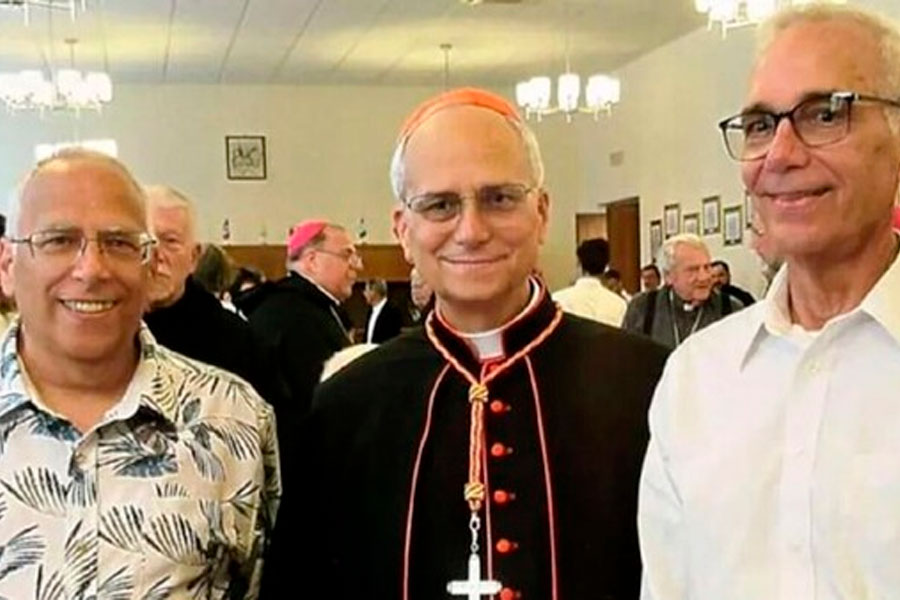
The new pope is the youngest of three children from a multicultural marriage. Robert Francis Prevost was born on September 14, 1955, in Chicago, Illinois. His father, Louis Marius Prevost, was a member of the U.S. Navy and served in World War II. His grandparents were immigrants—his grandmother was French, and his grandfather was Italian.
His mother’s maiden name was Mildred Agnes Martínez. Legal documents from the 19th century and civil records confirm that her father, Joseph Norval Martínez, was the son of Jacques Martínez, originally from Santo Domingo, and Marie Rosa Ramos, both residents of New Orleans.
His mother, Louise Baquiex (or Baquié), was a Louisiana Creole of French, African, and Spanish descent. Both are described as black or mulatto in various census documents.
However, there are discrepancies regarding the birthplace of Joseph, Pope Leo XIV’s grandfather. On his daughter’s birth certificate, his place of birth is listed as “the Dominican Republic”; however, in the 1900 census, it appears as “Haiti.” His occupation was listed as “cigar maker,” and his race was classified as “African.” In the 1910 and 1920 censuses, he is listed as “born in Santo Domingo” and described as “white.”
He has two brothers: Louis Martin, a military veteran currently living in Florida and affiliated with the MAGA movement, and John Joseph, a retired Catholic school principal who has stated that the new pope will defend Christian values and stand up for the most vulnerable, including immigrants and refugees.
One of Pope Leo XIV’s notable traits is his connection to Latin America. Prevost maintains a close relationship with Peru, a country whose citizenship he adopted after living there for decades and where he carried out most of his pastoral career.
In various interviews, his brothers have shared that their younger brother left for an Augustinian school right after high school. He then went on to attend a university near Philadelphia, Pennsylvania, so they only saw him during vacations from an early age.
His calling was evident from childhood, according to Louis Martin: “I used to play with guns, knives, bows, and arrows, while he would play at being a priest. I’d tell him, ‘That’s boring! Let’s play something else, Rob.’ ‘No… Can I give you the Communion?’ he’d reply.”
His brother John Joseph told NBC Chicago that their parents only got to see him officiate as a priest. “They visited him in the missions in Peru. And they were very impressed with what he was doing there,” he said. Their parents died long before he became a bishop (2015) and a cardinal (2023). Two years later, in a conclave marked by broad consensus, he would become pope, with a long life ahead.
The cardinals swore to keep secret what happened inside the Sistine Chapel, so they cannot reveal any information. However, many—across the ideological spectrum—have expressed enthusiasm over his election. Among them, Ecuadorian Luis Cabrera told the press in his country that the next day, the pope had lunch with the cardinals, and he had the chance to exchange a few words with him. He said they spoke about his family. “He told us his mother was not born in Ecuador (as rumored), but in the Dominican Republic,” he clarified, as reported also by Diario Libre.
There have also been rumors that he has relatives with Cuban ancestry; what is certain is that he has Creole and, presumably, Afro-Latin heritage.
The presence of surnames like Martínez, Ramos, and Girard in the records, as well as given names like Joseph, Adele, Rita, and Aline, points to a Hispanic-Caribbean cultural and linguistic heritage, most likely Dominican, that endured across generations in a Creole, Afro-descendant community in the southern United States.
Although the Dominican Republic gained independence in 1844, it was common in 19th-century U.S. official documents to use the term “Hayti” to refer generally to the entire island of Hispaniola.
This explains why Joseph’s birthplace appears that way in the 1900 census, even though other sources, like his daughter’s birth certificate, clearly state he was from the Dominican Republic.
While the oldest brother denies that their family identifies as Afro-descendant, Black, Latino, and Afro-Latino communities claim this pope as their own—and that, perhaps, is part of the Holy Spirit’s plan.