

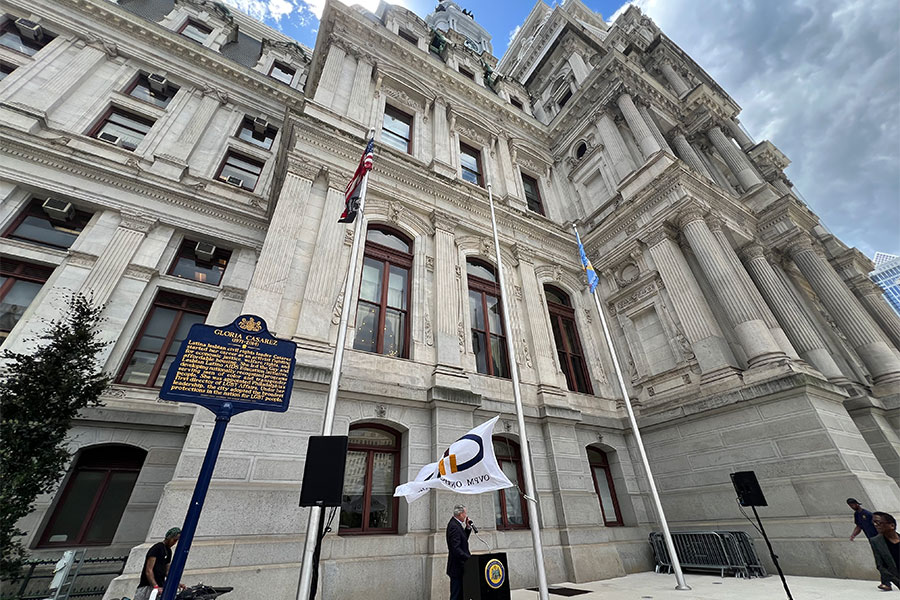
On Thursday afternoon, May 28, 2026, Philadelphia raised the flag of the Organization of World Heritage Cities on the north apron of City Hall, marking the culmination of a citywide, month-long celebration of the city’s distinction as the first World Heritage City in the United States. As a city that helped give rise to American democracy — and in this semiquincentennial year, as the nation prepares to mark 250 years since its founding — that legacy feels especially alive.
«Today, we are raising the flag of the Organization of World Heritage Cities with its logo representing the unity and protection of human heritage, with which Philadelphia is proud to be the first city in the United States to be designated as a World Heritage city and affiliated,» said Zabeth Teelucksingh, president of the Global Philadelphia Association. Our organization organizes these events in partnership with the City of Philadelphia and a coalition of cultural and business organizations.
The city earned the distinction in November 2015, when it was inducted into the Organization of World Heritage Cities — a relationship, says Zabeth Teelucksingh, that Global Philadelphia manages through public and private partnerships, placing Philadelphia among more than 330 World Heritage Cities worldwide».
Teelucksingh said Global Philadelphia manages that relationship through public and private partnerships that connect the city to international networks and opportunities.
“This work is fundamental because it connects everyone to Philadelphia and allows everyone to feel connected to the city,” Teelucksingh said. “On one hand, Philadelphia is very parochial, and on the other hand, it is extremely international. Global Philadelphia’s role is positioning that, day in and day out.”
The designation recognizes cities that have made profound contributions to humanity and are home to officially designated UNESCO World Heritage Sites. Philadelphia qualifies chiefly through Independence Hall, a UNESCO World Heritage Site since 1979. It was there that the Declaration of Independence and the U.S. Constitution were debated, adopted, and signed.
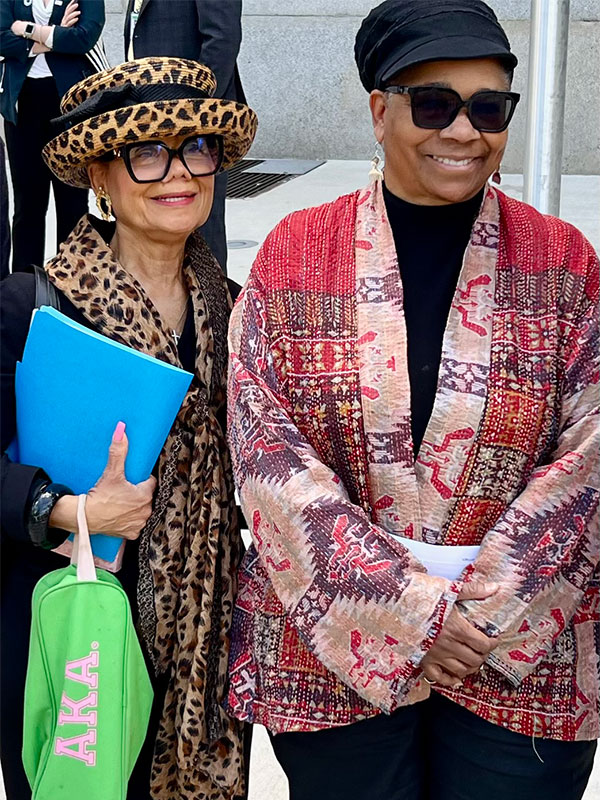
For Philadelphia, the World Heritage City designation carries both symbolic and practical value. It creates opportunities for cultural exchange, heritage preservation, education, community partnerships, international recognition, tourism, and trade.
As the flag rose above the crowd and snapped in the afternoon wind against the gray granite of City Hall, speakers and partners reflected on Philadelphia’s role as both a birthplace of American democracy and a city shaped by global communities.
Among those attending the flag-raising and speaking program were the Rev. Dr. Lorina Marshall-Blake of the Independence Blue Cross Foundation; former Philadelphia Mayor Michael Nutter; Josh Fishbein, chief commercial officer of the Philadelphia World Trade Center; Deacia Borgia of Visit Philadelphia, and Sheila Alexander-Reid, executive director of PHL Diversity.
Alexander-Reid, whose work is rooted in fostering inclusion and creating intentional cultural change amid rising hatred, offered one of the afternoon’s most powerful reflections.
“If you’re not native to this land, then either you came on a boat or under the boat,” she said.
Her words underscored one of the central messages of the celebration: Philadelphia’s heritage is not only colonial or historic. It is also immigrant, multicultural, and deeply connected to the many communities that continue to shape the city today.
That message resonated with Marta Lopez, a longtime Colombian immigrant and Hunting Park resident who attended the event and said she was moved by Global Philadelphia’s mission.
“I have always felt welcomed in the United States, even though I experienced bullying in my childhood back in the 1960s and ’70s,” Marta said. “But now, in this current political climate, I am scared. I cry for the people who have been detained. Efforts like the one we are seeing today — and the people here — are helping turn the tide toward peaceful acceptance.”
For Marta, the flag-raising was more than a ceremonial gesture; it was a reminder that public institutions can still make immigrants feel seen, protected, and included.
Marta, who preferred not to give her full name, said she felt encouraged by the way the organization was embracing people from many backgrounds and lifting up Philadelphia’s identity as an international and welcoming city.
“We are a partner of the Global Philadelphia Association, and we are here to support,” said Josh Fishbein. “Personally, having lived here my whole life, I think Philadelphia gets lost in the shuffle, as we all know, with New York and Washington, D.C. So all the events throughout the month, including this culmination, are important not only for the city’s wonderful history, but also for the wonderful things happening now in Philadelphia and throughout the region.”
“I know Zabeth, and I think this is a great organization,” he said, noting that he has also been involved with the World Affairs Council, another Philadelphia organization focused on international engagement.
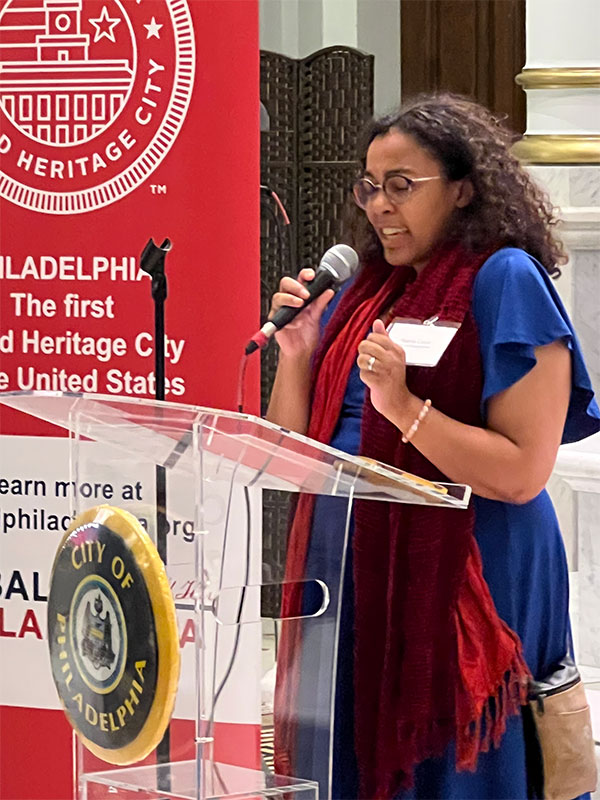
After the flag-raising, the gathering moved indoors to the historic Masonic Temple. Guests were escorted into a marble hall lined with golden chairs facing the podium. Behind it stood a large bronze statue of Benjamin Franklin — a fitting presence, given Franklin’s legacy as a traveler, diplomat, and international figure.
The setting served as a reminder that Philadelphia’s global identity is not new. It has roots in the nation’s founding, in diplomacy, and in the ongoing contributions of immigrants and communities from around the world.
Organizers emphasized that the World Heritage City designation was never meant to be only an honorific title. It was a first step in a broader effort to raise Philadelphia’s international profile and deepen recognition of the city’s cultural and historic heritage.
Since 2010, the Global Philadelphia Association and its partners have worked with local and international organizations to build programs that promote Philadelphia’s global connections. These efforts include advancing the United Nations Sustainable Development Goals, supporting heritage education in local schools, and creating opportunities for collaboration across cultural, educational, civic, and business sectors.
What began as World Heritage Week has now grown into a month-long observance. World Heritage Month runs from May 1 through May 31 and reflects the city’s expanding global ties and vibrant multicultural neighborhoods. The City of Philadelphia has also formally proclaimed World Heritage Day on the fourth Thursday of May.
“Philadelphia is a truly special place and was designated America’s first World Heritage City in 2015,” said Deacia Borgia of Visit Philadelphia, the city’s marketing and tourism office and a Global Philadelphia partner. “Every year, May is set aside to honor global communities and Philly’s contributions. We invite you to be part of the future.”
As Alexander-Reid reminded the crowd, the future must include all of Philadelphia’s communities.
“I want the Latino community to know,” she said, “we are all immigrants.”