


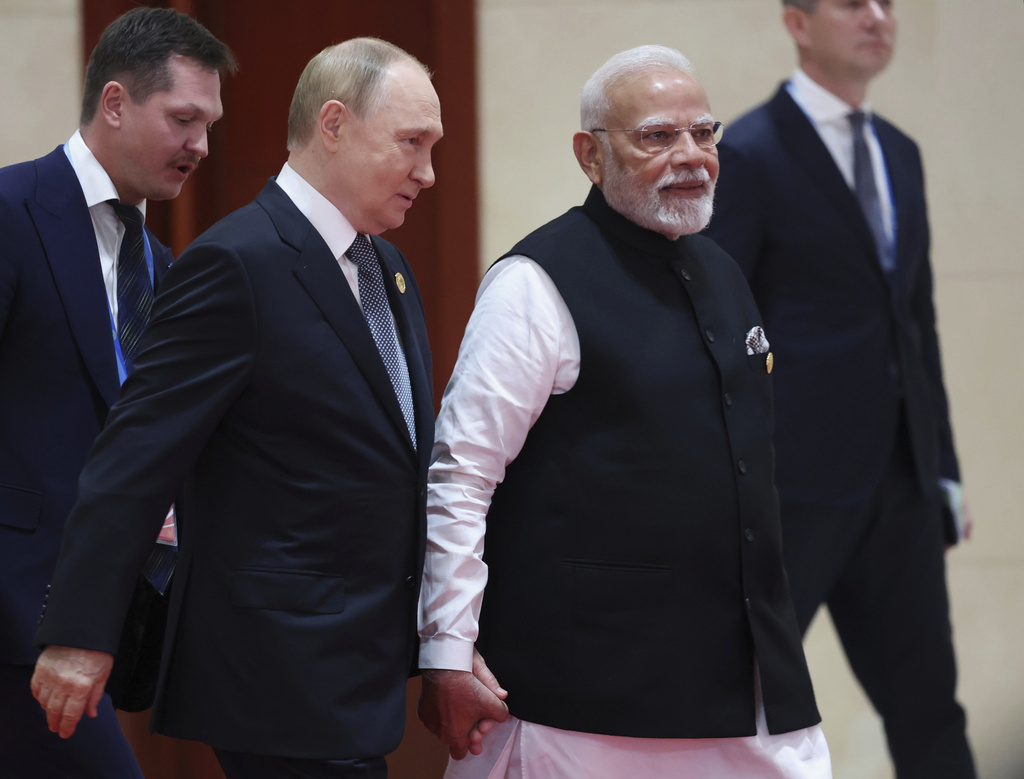
In recent months, we have witnessed geopolitical movements that, although subtle in some cases and openly visible in others, are drawing a new map of global alliances and rivalries. Leaders of traditionally distrustful powers such as China, Russia, and India are meeting in increasingly friendly ways, sharing diplomatic, economic, and even military spaces. It seems we are witnessing the beginnings of a reconfiguration of the world order, while the United States watches warily from the sidelines.
The recent presence of North Korea’s leader at China’s military parade was a highly symbolic act, suggesting that Beijing, in addition to strengthening its regional influence, is openly flaunting its alliances—even with regimes that have been isolated for decades. These kinds of rapprochements do not bode well for the United States, which has historically favored containment and isolation of Pyongyang, and now sees its rival strategically opening the doors wide.
The scene contrasts with Donald Trump’s insistence on organizing a grand military parade that coincided with his recent birthday. Was that the kind of demonstration he desired? Probably yes: a show of strength and unity that, in the American case, fails to materialize amid internal divisions and unclear priorities.
Meanwhile, signals from the American continent also deserve attention. Secretary of State Marco Rubio recently visited Mexico and declared that our southern neighbor is now “our best ally.” Is this a sincere recognition or a preventive move to stop Mexico from deepening its ties with China. This country has quietly expanded its economic and technological presence in the region. The question is not trivial, as whoever controls supply chains, infrastructure, and technology in Latin America will hold a significant geopolitical advantage in the future.
Speaking of encirclements and tensions, the growing diplomatic and military pressure around Venezuela cannot be overlooked. Is the United States surrounding Caracas due to its alliances with Iran and Russia? Joint military maneuvers in the Caribbean, prolonged sanctions, and intermittent negotiations in exchange for energy concessions show that U.S. policy toward Venezuela oscillates between pressure and pragmatism, without a clear strategy or defined goals in sight.
On another front, questions arise: Is China gaining the upper hand over the United States in the field of artificial intelligence? China’s advances in this field, along with its massive data integration capabilities and centralized state strategy, contrast with regulatory debates and corporate tensions in the U.S. tech ecosystem. If the next global dominance is defined by the ability to master AI, the clock is ticking—and the U.S. may be falling behind.
The underlying question is: How much will the isolation of the United States unite the rest of the world? The narrative of blocs, which seemed to have faded after the Cold War, is reemerging with new protagonists, new rules, and above all, at a dizzying pace. On this chessboard, the United States risks becoming trapped in a policy of multiple containment: containing China in Asia, Russia in Europe, Iran in the Middle East, and Venezuela in its own neighborhood. But containment without bridges and without clear cooperation strategies hardly produces long-term stability.
The world is repositioning itself, and we’ll have to wait and see whether the United States will adapt to this new scenario—or continue betting on the idea of undisputed leadership, which may already belong permanently to the past.