


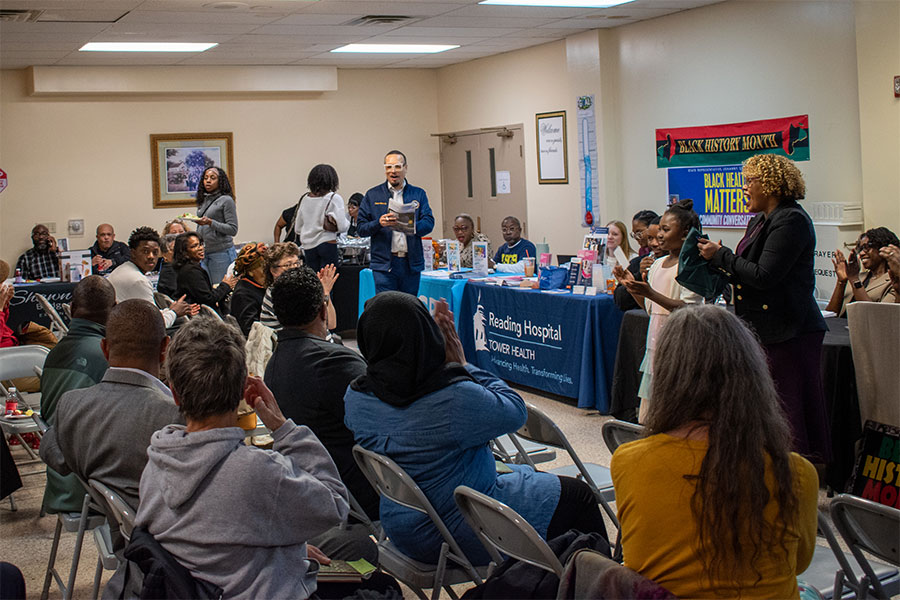
“Black lives matter, but what about Black health?” asked Alexander Civil, executive director of Bring the Change. Civil used these words to introduce Representative Johanny Cepeda-Freytiz’s (D-Berks) community discussion on health equity.
The discussion, which took place at Zion Baptist Church on Feb. 19, connected Reading community members and leaders in honor of Black History Month.
The event highlighted how health inequities in Black and immigrant communities are shaped not only by medicine, but by factors such as language-barriers, housing, education, and immigration policy.
Speakers at the event included Philadelphia State representative Andre Carroll (D) alongside Wynton Butler, director of social services for the Reading School District. Representative Cepeda-Freytiz also spoke at the event to an intimate audience of approximately 50 Reading residents.
Civil’s question struck to the heart of health disparities within Pennsylvania. According to the PA Department of Health’s State Health and Improvement Plan (SHIP), Black Pennsylvanians experience almost twice the rate of infant mortality. In Philadelphia, black homeownership continues to decline while, according to the CDC, life expectancy is as much as four years less for Black Americans across the United States.
These issues are felt particularly strongly in Reading. According to U.S. Census Bureau estimates, roughly 70% of Reading residents identify as Latino, while about 24% are white. The same data shows that only 11.4% of residents have attained a bachelor’s degree or higher. Long-term housing instability compounds these challenges: the Reading Eagle reports that homeownership in the city has declined steadily since the 1970s.

But positive change is possible
“I’ve learned that about 93% of cases could have been prevented,” Cepeda-Freytiz said in reference to Black infant mortality. “To me that’s an alarming number […] I know I’ve had my own share of struggles when it comes to maternal health.”
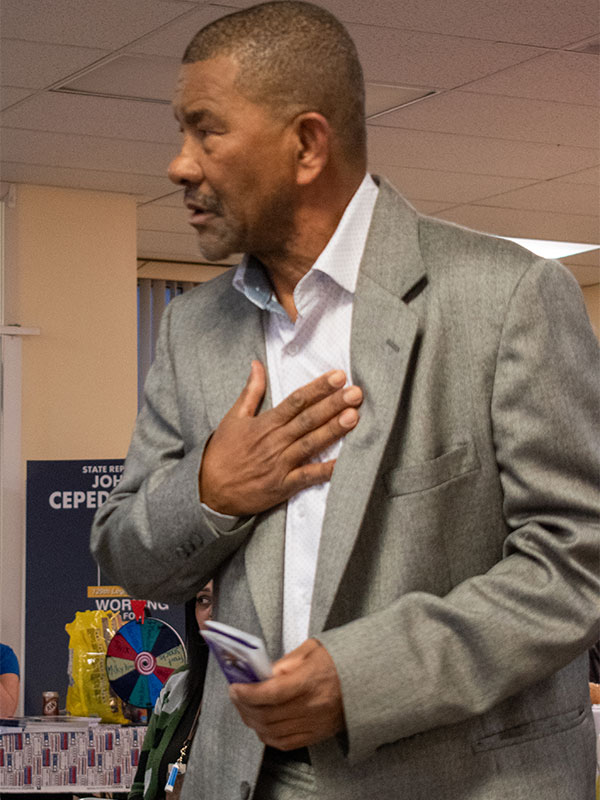
The politics were personal for many of the panelists
Civil is from Haiti. He described how discussion of mental health is often taboo in his community: “To us, depression doesn’t exist.” Several of the panelists agreed that feelings of shame can often keep black men from seeking out mental health services.
These may not be new issues, but they do exist in a new context: The discussion widened as panelists connected health inequity to immigration enforcement and political violence nationwide.
“We have to be creative,” representative Carroll said. “What we are experiencing are issues we’ve never seen before. We’ve never seen American citizens in broad daylight turn on each other and literally commit murder.”
Wynton Butler, who is also president of Reading NAACP, spoke about the fears of students in light of current immigration enforcement: “The fear is not that they would get picked up, the fear is ‘my parents will get picked up, and I’ll come home to an empty house.” According to the American Psychological Association, this kind of fear regarding immigration actions can contribute to anxiety, PTSD, and depression.
Anxieties about ICE are hard for Reading to ignore. The Trump administration recently finalized the purchase of a warehouse in Berks County for $87.4 million. Plans to turn the warehouse into an immigration detention center have brought national politics directly to Representative Cepeda-Freytiz’s backyard.
The Berks County representative is not shy in her criticism of Donald Trump or the federal government’s immigration policies. She recently signed on as a co-sponsor for State House Resolution 402, which urges Congress to withhold funding from ICE and DHS unless meaningful reforms are implemented. “It’s not an immigration thing, it’s a civil rights issue,” said Cepeda-Freytiz.
Combating civil rights violations and addressing health disparities is no simple task. In an interview after the event, Cepeda-Freytiz focused on people-first politics as a way to fight for positive change: “I’m very grass-roots, and it starts by listening to people, and listening to their experiences […] it’s important that the pressure comes from the people.”
Pressure certainly came from the people on the night of the event. One community member made his frustration clear. “No todo el mundo habla inglés,” he said. The event occurred without a translator in a city that has the highest percentage of Latinos in Pennsylvania. In so doing, the event itself demonstrated exactly the kind of barrier-to-access that it was designed to address.
“I feel really bad,” Cepeda-Freyitz said later, reflecting on the incident. “These were conversations we did have about getting headsets and an interpreter because we understand the makeup of our community.”
The representative from Berks is familiar with the community because she is from the community. Cepeda-Freyitz is a member of the PA Legislative Black Caucus and the Legislative Latino Caucus. In a recent interview with Impacto, she described how her transition into politics came as a result of her experience as a small business owner at the heart of Reading’s Latino community.
“I’ll never forget where I am from,” Cepeda-Freyitz said.
The absence of a translator at an event centered on equity underscored one of the night’s clearest lessons: access matters. As speakers and attendees alike acknowledged, addressing health disparities requires more than policy conversations; it requires meeting people where they are, in the languages they speak, and with the resources they need. This is true for all American communities, black, white, or otherwise.
As Cepeda-Freytiz emphasized, progress depends on listening to lived experiences and translating them into action. The night’s conversations, planned or unplanned, served as a reminder that health equity is not only a policy issue but a measure of whose voices are heard.