


On the morning of Saturday, May 30, at Awbury Arboretum in Germantown, families of missing loved ones gathered for a culmination of the Missing Persons Month event organized by Northwest Victim Services, with support from the Philly Goat Project and members of the Philadelphia Police Department. They came to honor those whose whereabouts remain unknown, to support one another, and to raise awareness about the pain families carry when a loved one disappears.

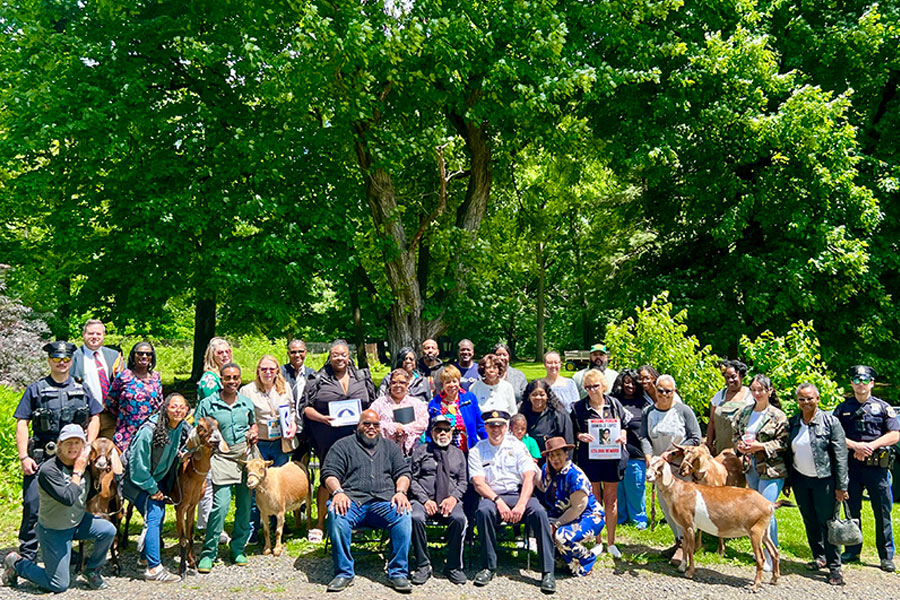
A few goats, from the Philly Goat Project, trailed the group down Awbury’s shaded paths. They passed the garden and walked through a path, where ribbons hung from branches and painted rocks lined the trail like markers left for the lost. The air smelled of cut grass and Springtime. Children played, as families walked slowly, some holding photographs, others carrying the weight of desperation as they recited names, they had said again and again, hoping someone, somewhere, would have seen them.
The gathering was led by Melany Nelson, executive director of Northwest Victim Services, who wanted families to have a place to sit together among the goats, gardens, trees, and open sky at 6336 Ardleigh Street. The Reverend Dr. John L. Payne offered prayers and words of encouragement that settled over the mourners like a steady hand on their shoulders.
Northwest Victim Services was founded in 1981 as Philadelphia’s first community-based victim services program. Since then, the group has spent more than four decades walking Philadelphians through grief, trauma, violence, and uncertainty. On Saturday, that work took the form of presence: standing beside families still waiting for answers.
Awbury itself carried a deeper emotional weight. Nelson remembered Kada Scott, and so did many gathered there. The arboretum where families prayed and walked is near the same area police searched last fall for Scott, a 23-year-old Mount Airy woman who disappeared Oct. 4 after leaving her overnight shift at an assisted-living facility in Chestnut Hill. After two weeks of searching, her remains were found behind the abandoned Ada H.H. Lewis Middle School near the arboretum. The Medical Examiner’s Office ruled that she died of a gunshot wound to the head.
Scott’s case ended in the way families of the missing fear most — with an answer, but also with a grave. For other families, there is still no answer.
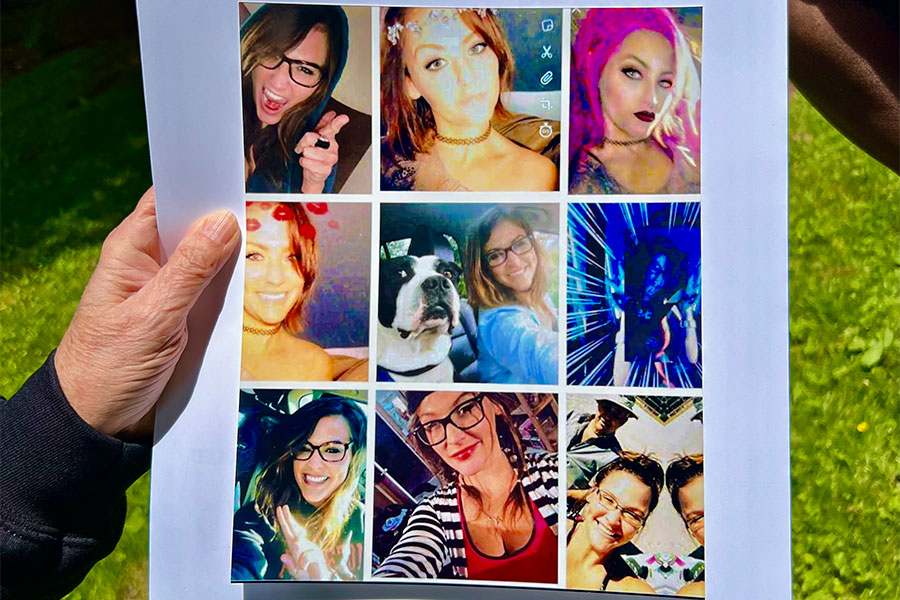
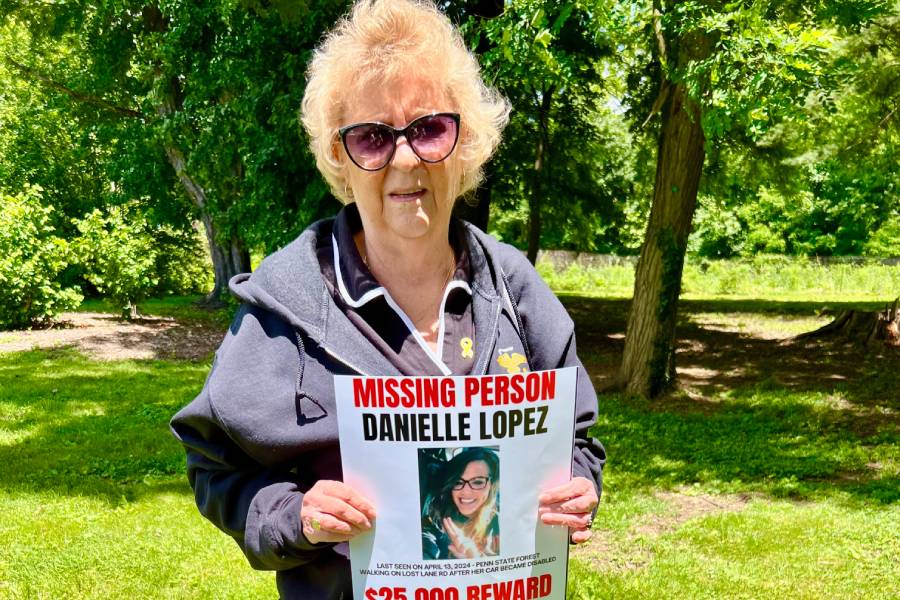
Among those who attended was Sue Quackenbush, whose daughter Danielle Lopez, 37, has been missing since April 2024. Lopez was last seen in the Pine Barrens of New Jersey when her car became disabled. Sue, her mom, has offered a $25,000 reward for information.
“I have no idea how to do this, and I’m just figuring it out as I go along”. There is no process, no information, just uncertainty and loss,” Quackenbush said. “It’s just hard.” She was lost in a million acres of forest. “I was able to reach out to companies for billboards, and some have been donated to me.”
Captain John Craig, Commanding Officer of Northwest Detectives, who attended the gathering, said missing persons cases are handled first by district detectives. If a case grows cold, it may be referred to the Special Victims Unit. He said many missing persons reports involve young people who return home within days, but a smaller number remain open and continue to haunt families and investigators.
Deputy Commissioner Pedro Rosario, who works in the Kensington Area of Philadelphia, is in the opposite part of the city. He shared some eye-opening information. “In my district, 217 people were reported missing in 2024, all but two found,” Rosario said. “Of 321 reports in 2025, four remain open; and of 174 so far this year, two are active.” New technology and social media are getting more people to pay attention to missing people.
Citywide, about 3,600 people are reported missing each year in Philadelphia — roughly ten people a day — and most are found within hours or days, Rosario said. Many are juveniles, and across his district, about 95 percent of cases close.
But for the families whose cases remain open, statistics offer little comfort.
Deputy Commissioner Pedro Rosario, The Philadelphia Police Department does not formally close missing persons cases or place a time limit on them. Some remain active for years or even decades. Some Philadelphia missing-person and unidentified-remains cases have remained open for generations, including the case once known as the “Boy in the Box,” publicly identified in 2022 as Joseph Augustus Zarelli.
The city has also begun holding an annual Missing Persons Day, where relatives can meet with detectives and representatives from the Medical Examiner’s Office to enter new information, update old cases, and make sure their loved ones are not forgotten in a file.
The reasons people disappear are often tied to vulnerability. In Kensington, where addiction, homelessness, mental illness, and family separation frequently overlap, relatives sometimes search for loved ones by trading sightings in Facebook groups and community networks. For families, the search can become its own form of daily survival — calling hospitals, checking shelters, scanning social media, walking blocks, asking strangers, and holding on to small pieces of information that may or may not lead anywhere.
Homelessness and missing persons cases often share the same root causes: untreated mental illness, substance use, family conflict, abuse, poverty, and youth who have run away or aged out of unstable systems. National research has found that homeless youth are especially vulnerable, with many having left home, foster care, or other unsafe situations before adulthood.
The crisis is not equal across communities. Nationally, Indigenous women and girls, Black people, and Latino children are disproportionately represented among the missing. Black people make up a far larger share of missing persons than their share of the U.S. population, and Latino children account for a significant number of missing children’s cases. For families in these communities, the fear is not only that a loved one will vanish, but that their case may not receive the same urgency, coverage, or public attention.
Rosario also offered practical safety advice. He urged people not to broadcast their daily routines, home addresses, locations, or travel patterns on social media. He warned against checking in everywhere, accepting rides from strangers, or sharing too much personal information online.
“Keep your eyes up,” he said, encouraging people to remain aware of their surroundings.
Still, the morning at Awbury was not only about danger. It was about tenderness. The goats moved gently through the group. Families tied ribbons. People hugged. Some stood in silence. Others said the names of the missing aloud, letting the trees, the soil, and the people around them hold what has been too heavy to carry alone.
As the morning turned toward afternoon, the group began to disband, each family returning to the daily life that continues even when answers do not. They had prayed together, walked together, tied ribbons, and remembered. For a few hours, the space held them gently.
I watched Sue Quackenbush leave through the gate, carrying the unbearable weight of not knowing whether her daughter Danielle was still somewhere, trying to find her way home.