


A $3.5 billion investment by drug manufacturer Eli Lilly and Company will bring a major pharmaceutical manufacturing facility to the Lehigh Valley, marking one of the largest economic development projects in the region’s history and positioning it within the rapidly expanding market for next-generation weight-loss drugs.
The facility, which is expected to produce the experimental obesity drug retatrutide and create about 850 permanent jobs, signals a broader push to compete in the booming GLP-1 drug sector while strengthening the region’s post-industrial economy.
It is projected to be the largest single economic development project in the region’s history.
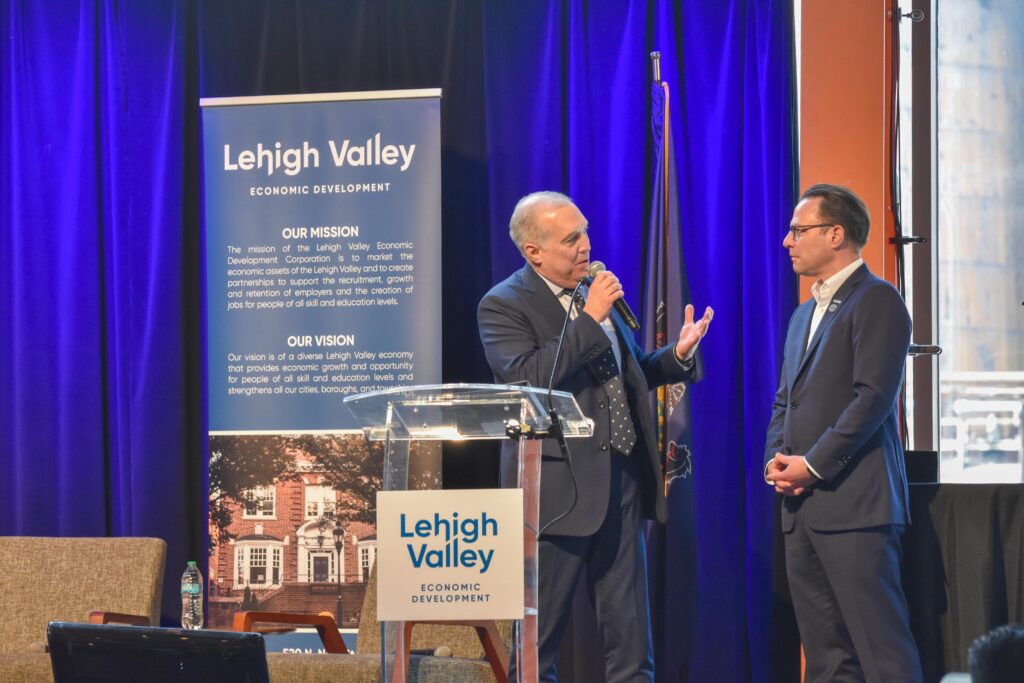
Governor Shapiro celebrated the deal on Tuesday at the annual meeting of the Lehigh Valley Economic Development Corporation (LVEDC). The project is a cornerstone of Shapiro’s strategy to attract advanced manufacturing to Pennsylvania, and is being described as a victory lap for The Governor and his administration.
“Pennsylvania is winning again,” Shapiro told attendees.
The address comes at a politically consequential moment. Shapiro is campaigning for his second term while negotiating a 53.2 million dollar state budget that faces unified opposition from Pennsylvania Republicans. The proposal relies on a projected $4.6 billion withdrawal from the Commonwealth’s “rainy day fund,” with much of the money going to economic revitalization and infrastructure development – spending that officials consider necessary to secure projects like the Eli Lilly facility.
Harrisburg Democrats have already pointed to the Eli Lilly deal as validation for Shapiro’s approach. Rep. Matt Bradford (D-Montgomory), the House Majority Leader, has already cited the Eli Lilly project as a proof of concept for Shapiro’s willingness to deploy public resources to compete for high-value industries.
Local officials, for their part, emphasized the immediate symbolic and long-term economic significance. Don Cunningham, president and CEO of the LVEDC, described the project as the culmination of decades of work to reinvent the Lehigh Valley after the collapse of its once-dominant steel industry.
“When the steel mills went quiet, we went to work,” Cunningham said.
Those same steel mills, now defunct, loomed over the Steel Stacks campus where the event took place. The contrast underscored both the progress made and the stakes of the transition.
“I still dream new dreams for the Lehigh Valley,” Cunningham said.
Shapiro’s plans extend beyond the Lehigh Valley. In February, Johnson & Johnson announced a $1 billion investment project in Montgomery County, and a nuclear-science firm TerraPower Isotopes announced that they are building a new manufacturing facility in Philadelphia’s Bellwether District.
Securing these investments costs money. The state committed tens of millions of dollars in incentives to secure the project for the Lehigh Valley, including roughly $50 million in tax credits for Eli Lilly and Company, and an additional $50 million in grants. With the facility not expected to open until 2031, the economic payoff remains years away.