


ALEIDA GARCIA
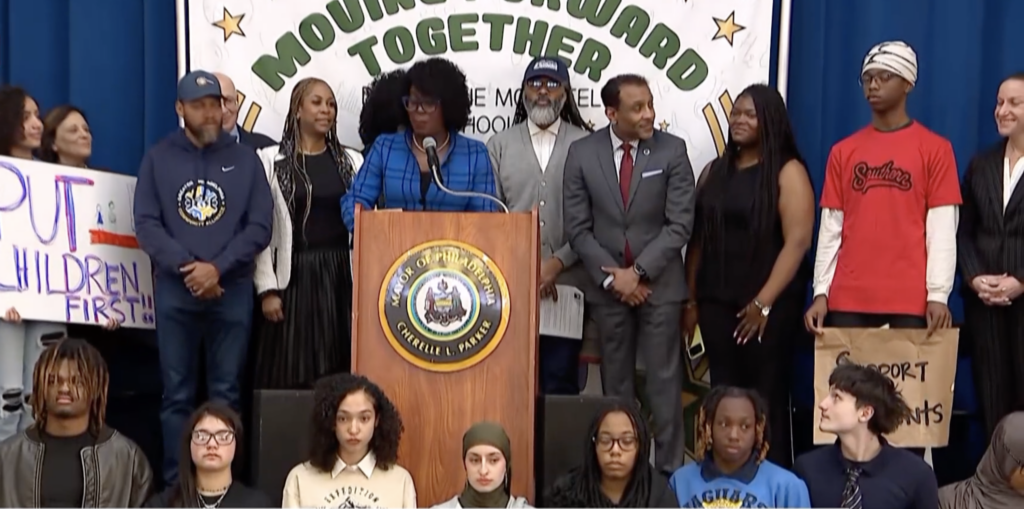
The sounds of the rain fell against the brick facade of the Delaplaine McDaniel School at 1801 South 22nd Street, but inside, something was shifting. Standing beside Superintendent Dr. Tony Watlington, Mayor Cherelle Parker stepped to the microphone Monday and did what community advocates, parents, and educators had been begging City Hall to do: she put money on the table to rescue 18 schools from the School District of Philadelphia’s Facilities Plan.
A Crisis in the classrooms
Mayor Parker explained that the school district’s financial distress stems from decades of chronic underfunding by the state. and the expiration of federal COVID-19 relief funds. Superintendent Watlington’s $225 million cut plan has been an attempt to triage the situation. At the Central Office, approximately 130 vacant positions would be eliminated, saving $30 million. At the school level, 220 building-substitute positions would be cut, and roughly 340 employees would be reassigned to fill vacancies rather than face layoffs. Even so, a deficit will remain.
Mayor Parker’s proposal is a $1-per-ride tax on rideshare services like Uber and Lyft originating within city limits. This proposal aligns with taxes such as cigarette and soda taxes. Originally floated as a 20-cent fee in her March 12 budget address, Parker raised it to $1 per ride after the district revealed the full extent of its cash crisis. The tax would generate an estimated $192 million over five years, beginning six months earlier than planned, protecting critical school-based positions threatened by a $300 million structural deficit. “While I am mayor, we will do everything we can so students don’t have to suffer.” — Mayor Cherelle Parker.
One driver, two kids, one question
Roberto, a father of two from Juanita Park who drives for both Lyft and Uber, heard about the mayor’s announcement. His response was layered. “I support keeping the schools open. That’s my priority,” he said. “My kids go to our neighborhood school, and I want them to stay there. I understand the district needs money.” But Roberto paused, his voice carrying the particular weight of a man doing math in real time. “I already pay real estate taxes. I already pay the soda tax every time I buy a drink. And now this. Other parents with kids in these same schools — they don’t have a new tax on their work. Why should the burden fall on drivers?”
Mayor Parker addressed this tension directly at the announcement, making clear that rideshare companies — not drivers — can elect to absorb the tax but are not legally required to do so. Roberto had heard that, too. “Maybe the company pays it. But we all know how these companies work,” he said with a quiet smile. “Maybe the rider should pay for it, then the city could spread the burden around more.” Make it fair.”
Roberto did find comfort in other parts of the plan — particularly the Philadelphia Parking Authority pilot, which will use $3 million annually to help low-income residents clear tickets and recover impounded vehicles. “That helps people like me. You lose your car, you lose your income.” But his eyes came back to the same place they always did: the school down the street. “Keep that school open. That’s all I’m asking.” Roberto’s concern is far from singular. In January, Watlington unveiled a $2.8 billion Facilities Master Plan proposing 20 closures. After fierce community resistance — 47 public listening sessions, 35 data-verification sessions with principals, and over 13,000 survey responses — the number was revised to 18 in February. Twelve properties would be repurposed for district use; the rest would be conveyed to the city for workforce housing. The 18 targeted schools are exempt from the budget cuts, but for families in those communities, that promise offers cold comfort.
The ongoing costs.
Parker’s five-year revenue plan also draws on shifting 1% more of Real Property Tax to the district, projected to contribute $119 million over five years, alongside a push for philanthropic investment. “Our kids are worth it, and they deserve it,” said Mayor Cherelle Parker. The proposal enters three months of City Council hearings beginning March 24. The rideshare tax would not take effect until July 1, 2027, and Harrisburg’s authorization remains uncertain in a divided legislature. Philadelphia’s history with targeted taxes is instructive. The $2-per-pack cigarette tax launched in October 2014 raised roughly $50 million in its first nine months specifically for the school district — a genuine help, but projected to decline as smokers quit or crossed city lines. The sweetened beverage tax, in place since January 2017, has generated over $481 million in total, funding pre-K and parks — vital programs, but not direct operational relief for schools facing this deficit. Creative taxes help but are only part of the solution. For Roberto, maths remains unresolved. He wants the school to stay. He wants the tax to be fair. He wants his children to walk to class in September and find their teachers still there.