


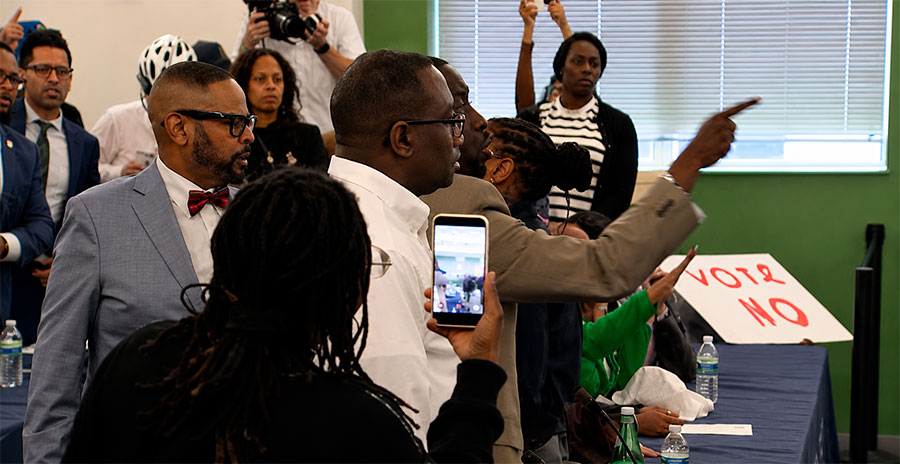
The Philadelphia School closure question has not been resolved, or so say parents, teachers, students, and City Council members. Since the tumultuous meeting on April 30, 2026, when the Philadelphia School Board voted 6-to-3 to approve the district’s “Accelerating Opportunity” facilities plan — a $3 billion, ten-year blueprint to close 17 schools, merge six others, and modernize 169 buildings across the city — City Council has been working diligently to stop the closings. The original plan has been revised three times since its introduction in January 2026, scaled back from an original proposal of 20 closures. The district plans to contribute $1.1 billion through capital borrowing, but the remaining $1.9 billion depends on state funding and philanthropic partnerships that have not yet been secured.
The news was not well received. At the school board vote on that evening, recess was called twice; the auditorium at district headquarters felt less like a public forum and more like a standoff. Police and school security officers lined the walls. Eleven City Council members pressed as close to the board as they were allowed, voices raised. And then, the board members got up and left the room. They did not come back. Instead, they dialed in on Zoom, and the meeting was shown on a large screen in the auditorium. The board voted from a locked room, on a laptop, behind a closed door. Councilmember Quetcy Lozada was unimpressed by the board’s actions. She commented, “Despite the noise that was happening, it was their responsibility to stay present and feel what people are feeling.” Lozada, who represents the 7th District and is known among her constituents for staying and listening long after others have gone home, did not hide her disappointment.

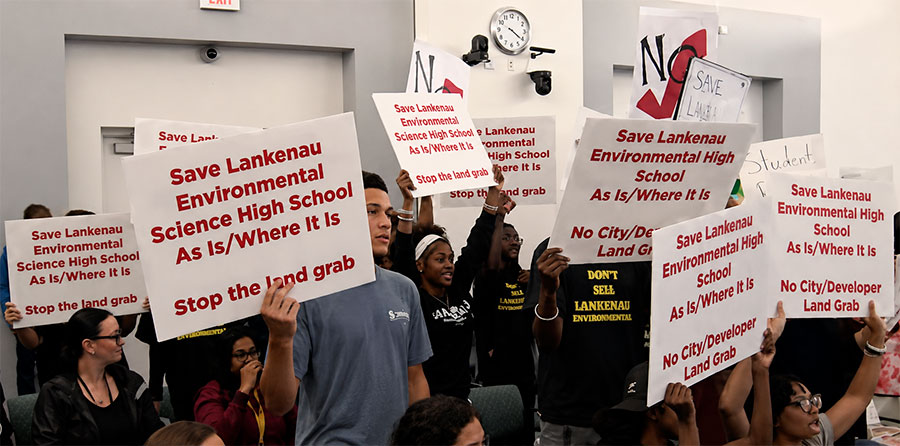
City Council members have stood in chambers while crowds yelled over issues that stir people to their core — school funding, housing, and public safety. But what happened on April 30th was different. These were not constituents venting frustration at their elected representatives. These elected representatives were yelling at the school board, expressing their frustration and vowing to fight back. They were hemmed in by police and school security officers, pressing as close to the board as they were permitted, shaken not by the noise of the crowd but by the board’s silence — its refusal to remain present, to keep negotiating, to hear the case being made in real time by eleven Council members who had vowed, publicly and on the record, to stop the closing of 17 schools. The board’s financial assessment had been heard. Its answer to the community’s concerns had not.
Councilmember Isaiah Thomas, Councilmember at-large, among the most vocal opponents of the plan, was direct in his response to the vote. “Anyone who voted in favor”, he said, “should resign”. “I can assure you,” he added, “that I would not vote to confirm their return to the school board”. Council President Kenyatta Johnson supported the council members’ position. Others echoed the threat, making clear that board reappointments, which require Council confirmation, would not be automatic. Councilmember Curtis Jones Jr. moved quickly; he introduced legislation calling for an independent audit of the district’s nearly $5 billion annual budget. Councilmember Jamie Gauthier was visibly disappointed in the school board’s unwillingness to try other avenues and work with the Mayor and City Council. “How are we going to increase people’s rides by a dollar and still close the schools in their faces?” she asked.
The vote also placed Mayor Cherelle Parker’s proposed $1-per-trip rideshare tax in immediate jeopardy. The tax, designed to raise an estimated $50 million annually for school funding, had been quietly tethered to goodwill between the board and Council. That goodwill evaporated on April 30. Arthur Steinberg, president of the Philadelphia Federation of Teachers, said, “The board’s decision echoes the 2013 closures ordered by the state-appointed School Reform Commission — a decision whose consequences the district spent years trying to repair. “The events that followed those actions spurred a mass exodus of students and staff out of this district, and a downward spiral of achievement and learning,” Steinberg said. Andrew Salz, a teacher at Paul Robeson High, offered a heartfelt challenge to those who claimed to understand the community’s pain: “Whenever anyone says they know the hard feelings, show me the child you comforted”, he said. Casey Gleason, a parent, was unsparing: “You tied our hands and shoved this down our throats.” Celia Flores Rivera, a teacher at Lankenau, did not raise her voice. “They are going to lose good teachers, they are going to lose good students, they are going to lose a lot of support.” Then she paused, looked directly into the camera, and said: “I hope they are happy with this plan.” When the board left, Makkah Peterson, a student at Lankenau High School — a model student at an award-winning school, a school slated for closure — was among those still there.
When the community is not heard, the decision may be legal… but it will not be legitimate.