


Taller Puertorriqueño, located at 2600 North 5th Street, is the cultural heart of el Barrio—founded by local artists in the 1970s and still the neighborhood’s vital gathering place. Its attractive, modern building houses an exhibit space, a bookstore, offices, and a large auditorium designed for workshops, symposia, and community meetings.
I pulled into the spacious parking lot behind Taller as the sun was setting, then stepped through the wide glass doors, which reflected the evening’s colors—brilliant yellows, warm oranges, and deep reds—and into the main hall.

Community representatives from the Philadelphia Police and Fire Departments stood ready to greet arrivals—a presence that was visible, yet relaxed. To my left, the auditorium was already full. The overflow crowd had spilled into the main hall, where people were seated before a large screen to watch Mayor Cherelle Parker’s live presentation on the City’s proposed Fiscal Year 2027 budget, which is scheduled for a vote in September 2026.
Inside the auditorium, rows of city offices and community organizations lined the space, distributing information about programs available across Philadelphia. For this predominantly Puerto Rican neighborhood in the heart of North Philadelphia, many said it was an evening unlike any they had seen before.
Wilfredo Pedraza, a father from the neighborhood, summed up why he came:
“I don’t know what is in the budget, but I want to know how our taxes are being spent—and I appreciate this effort,” he said. His words captured the voice of a community that has often been talked about, rather than spoken with.
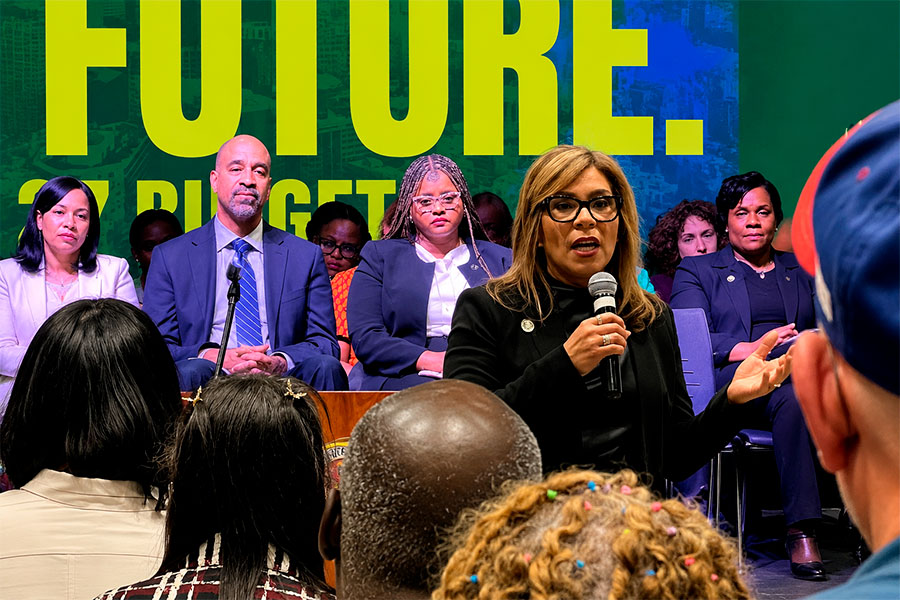
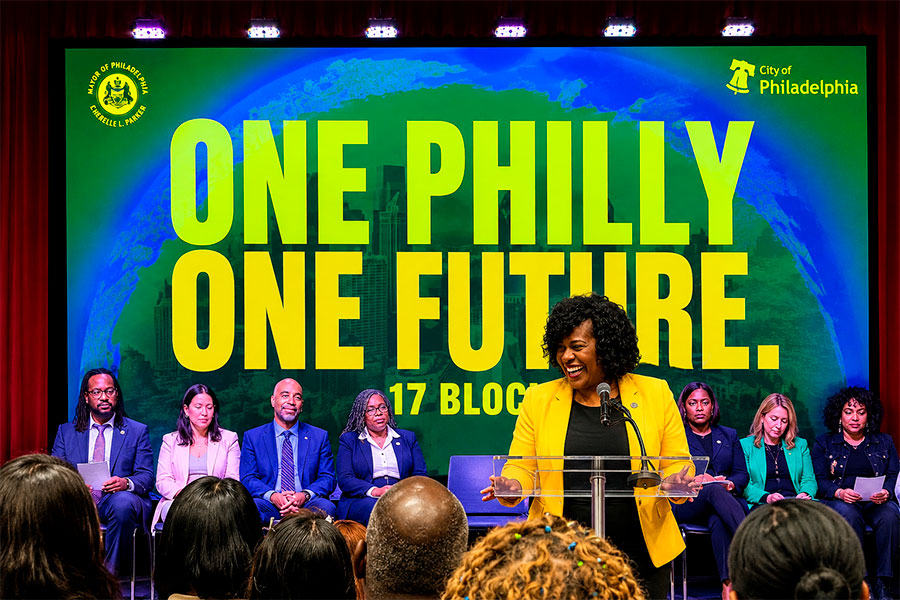
City Councilmember Quetcy Lozada was seated at the front of the room, while commissioners and department heads stood on stage beneath a large, colorful neon sign in shades of blue, yellow, and green that read, “One Philly, One Future.” Their presence signaled something equally important—that leadership was willing to meet residents where they are.
Mayor Parker entered wearing a bright yellow suit—the kind of bold, intentional color she is known for, reflecting the energy she brings into every room. She did not head straight to the podium. Instead, she moved slowly through the auditorium, row by row, pausing to shake hands, lean in, and exchange a few words—making a point to see, and to be seen.
The mayor often dresses in vibrant colors that mirror her positive, engaging approach, and that connection with people was undeniable in that room. Longtime community activists said they could not recall another mayor ever doing anything quite like it.
Dr. Reverend RobertoLuis Lugo put it simply: “No, it’s new. This mayor is doing new things.”
Community board member Miguel Concepción emphasized the urgency behind civic participation:
“Residents need to come to these meetings because we have to listen—and speak up about our concerns,” he said. “We have to anchor our communities where they are. We’re being pushed out to the Northeast, following lower rents—but that breaks the cohesion of the community.”
Housing dominated much of the conversation. Nayda Cintrón, a longtime community leader, gave the issue a human dimension:
“There should be more affordable housing for families working two or three jobs just to survive,” she said. “Maybe the husband works in construction, and the wife works at WAWA. How can these families afford new construction that costs $258,000 to $600,000?”
Jennifer Rodriguez of the Hispanic Chamber of Commerce was seated in an aisle seat. “Businesses in Philadelphia are very concerned about the changes to the BIRT tax,” she said. “We also have questions about how the Sugar Tax funds are being spent, and the proposed ride-share tax worries us — many of our businesses depend on Uber and Lyft to bring customers through the door.”
Handouts summarized the budget’s priorities around economic opportunity, education, and housing, though the presentation took roughly 45 minutes to move into specifics. Mayor Parker spoke candidly about her childhood and the lived realities that shaped her agenda. One of the programs she has committed to is beautifying the City. She cited a University of Pennsylvania study showing a direct link between greened vacant lots and reduced crime — a cornerstone of her push to fund the Clean and Green Initiative.
As I was leaving, I met Alfred Gaddy, who grew up around the corner from Taller, near 8th and Huntingdon. He has witnessed the neighborhood’s evolution for more than sixty years. I asked what he thought of the evening.
He looked down at his worn hands, then back at me, and said:
“I don’t believe in politics. I believe in progress.”