


At a moment of tension between the governments of Madrid and Mexico over the historical controversy surrounding Hernán Cortés—and in response to the “tribute” and statements made by the president of the Community of Madrid, Isabel Díaz Ayuso, who was even forced to cut short her troubled visit to the country—the Mexican president, Claudia Sheinbaum, presented an edict issued by King Charles I in 1548, referring to atrocities attributed to the conquistador.
In this context, the wounds of the past—ones many still resist acknowledging—found a different and deeply symbolic expression in Philadelphia: art.
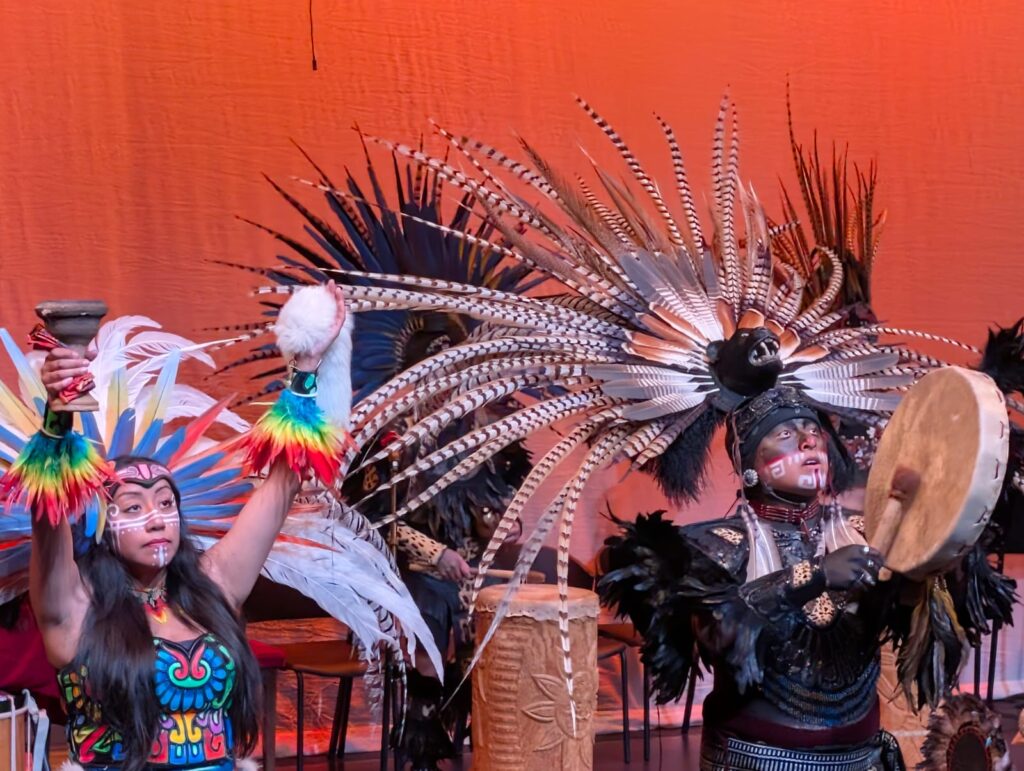
Priscilla Herreid, artistic director of the Pifarro ensemble, connected online with Francisco Javier Hernández Carbajal, known as Brujo de la Mancha, co-founder and executive director of Ollin Yoliztli Calmecac, an organization dedicated to preserving Mexico’s pre-Hispanic culture. As a result of this collaboration, during the performance of Águila e Imperio at Teatro Esperanza on May 8, Brujo coordinated nine dancers who performed Aztec chants and dances in a presentation that was both evocative and successful.
The four appearances by Ollin Yoliztli Calmecac included songs in Nahuatl—the most widely spoken Indigenous language in Mexico—accompanied by drums, flutes, rattles, and whistles, all integrated with dance. The repertoire featured pieces such as “Fuego,” “Xipe Tótec,” “Tonantzin,” and “Mayahuel,” evoking the worldview and spirituality of pre-Hispanic Mexico.
Soprano Estelí Gómez, born in California to a Nicaraguan mother and Mexican father, reflected on the fusion of pre-Hispanic traditions with the music performed by Pifarro:
“I felt a great emotion and Latino pride seeing the power of women in every generation as musicians and dancers.”
Meanwhile, Uruguayan-American soprano Nell Snaidas, who first encountered Aztec dance as a young performer at a festival, shared her enthusiasm:
“It was a very special experience to see the dancers in their ceremonial attire and hear their music. It felt like a journey through time, combining the music of the 16th and 17th centuries that we specialize in.”
She added:
“Watching their dance and hearing their music, with seeds tied around their ankles acting as an additional percussion, I felt surrounded by a sound that seemed to exist across multiple centuries at once.”
Snaidas also emphasized how the experience led her to reflect on the connection between Indigenous dance rhythms and the evolution of the music performed by the Pifarro ensemble, highlighting the influence of these elements on musical structures.
Following the performance, a question-and-answer session was held, moderated by Daniel de Jesús, music director of Artistas Músicos Latinoamericanos, based at Esperanza. Participants included Priscilla Herreid, Gaspar Hernández, Brujo de la Mancha, and Laura Moratín.
Ollin Yoliztli Calmecac, a nonprofit organization founded in 2003, is dedicated to researching, preserving, and promoting Mexicáyotl—a Nahuatl term referring to the essence of what is Mexican before the arrival of Spanish conquistadors in 1519. Its name means “School of the blood that moves within the heart.”