


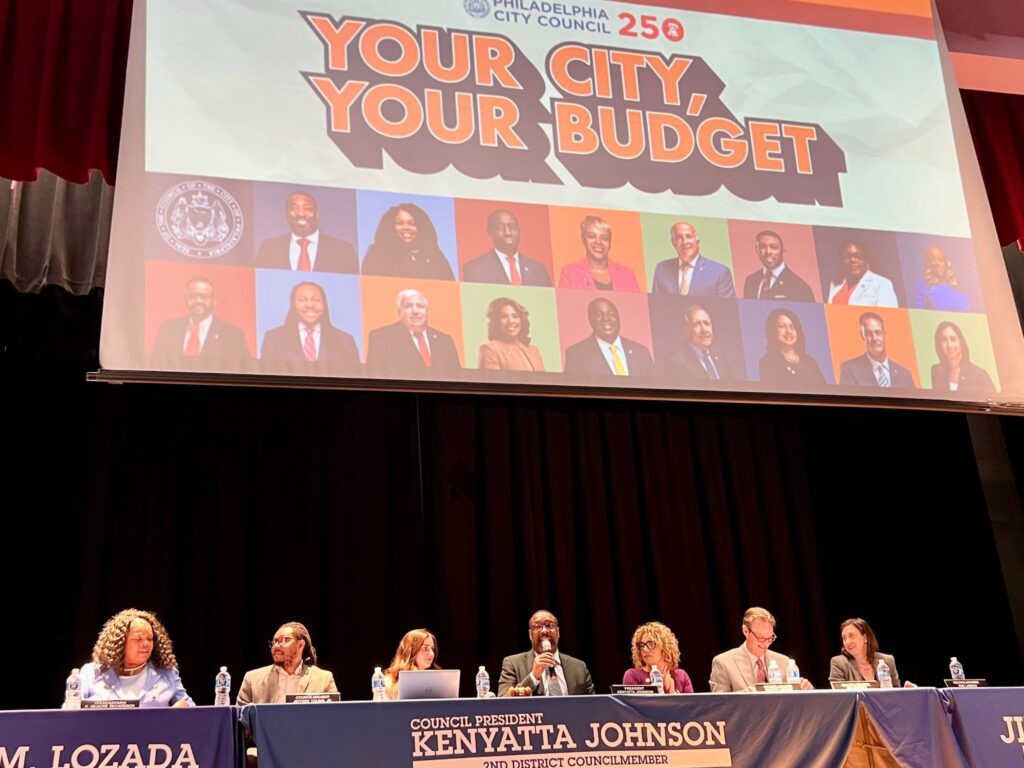
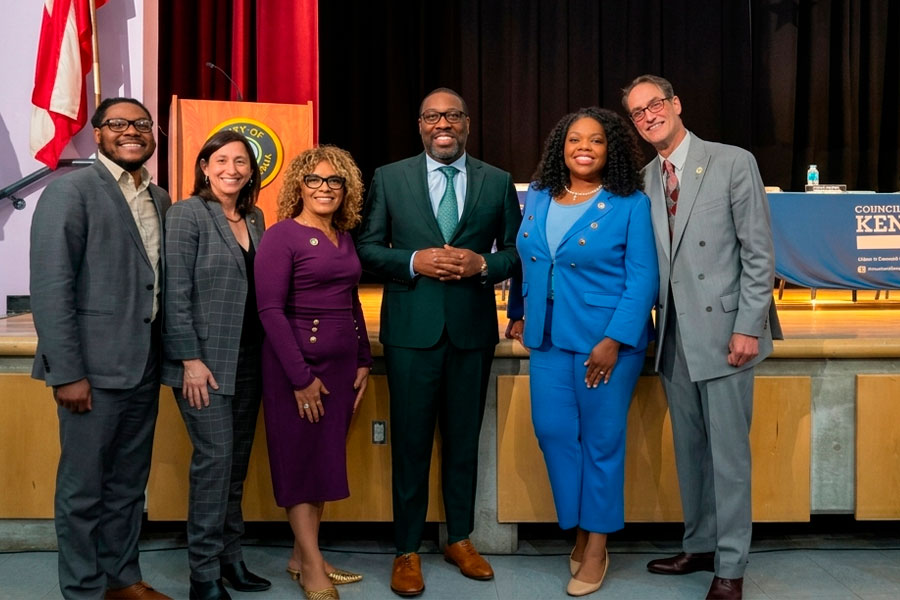
PHILADELPHIA, PA_ On April 21, the front door of Julia de Burgos Elementary School was propped open when constituents arrived Tuesday evening, and the large vestibule just inside felt warm and inviting, like a neighborhood coming home. Representatives from Philly 311, the Philadelphia Parking Authority, the office of Councilmember Quetcy Lozada, and Congreso de Latinos Unidos, and more lined the walls with flyers, giveaways, and welcoming smiles. People trickled into the meeting room, a large theatre at the school, feet away from the entrance. At 6:00, Philadelphia City Council President Kenyatta Johnson and Councilmember Lozada called the room to order. The theater was energized — residents, community organizers, business owners, and stakeholders settling in to hear in their own neighborhood, exactly how the city plans to spend $6.7 billion of their money.
The town hall — one in a series organized by City Council to bring the proposed Fiscal Year 2027 budget directly to Philadelphia neighborhoods — landed in a community that has earned the right to ask hard questions. The North Philadelphia corridor and Kensington, home to one of the city’s largest Puerto Rican populations, have faced decades of concentrated poverty, chronic disinvestment, a devastating opioid crisis, and a housing market that routinely fails the people who need it most. The school where residents gathered that evening is named after Julia de Burgos, the beloved Puerto Rican poet, and sits less than a block from el Bloque de Oro — North 5th Street’s storied commercial corridor. This neighborhood carries both a deep cultural legacy and a long list of unmet needs. City Council, recognizing that many residents cannot leave work or family in the middle of the day to go to City Hall, is bringing the budget to the people, walking them through the numbers in a projected PowerPoint, defining key terms, and then opening the microphone for questions and comments. Lozada framed the evening in straightforward terms. “Today, the goal is to inform community residents of the proposed budget for fiscal year 2027,” she said. “It is an opportunity for residents to hear and learn about the proposal and to share their concerns and priorities for their neighborhoods. Overall, the priorities for the districts have remained consistent with what we have seen and heard residents prioritize: funds for public safety, for affordable housing, and for our schools.”

Additional town halls are scheduled for April 28, April 30, and May 5 at locations across Philadelphia. The numbers, laid out step by step on the screen at the front of the room, told a story of a city balancing urgent priorities against finite resources. Of Philadelphia’s $6.7 billion operating budget, 52 percent goes to public safety. Economic opportunity accounts for 23 percent. Housing receives 15 percent — including $22 million in FY27 to add 1,000 shelter beds, fund proactive rental inspections, and support new housing investments. The city’s opioid response carries a $211 million commitment over five years, directing resources toward the Kensington Wellness Support network, Riverside Wellness Village, and Wellness Court. An additional $25 million is budgeted for grassroots public safety initiatives. The city’s clean and green efforts account for 4 percent of the total, with new sanitation trucks and investments in illegal dumping enforcement.
For Gloria Cartagena Hart, those housing numbers are not abstractions. A resident of Kensington and a community organizer with the Kensington Corridor Trust — where she works the stretch of Kensington Avenue from Allegheny to Tioga — Hart has spent years fighting for the kind of stability that the budget promises but does not always deliver. Housing, drugs, and crime, she said, remain the defining concerns of the neighborhood. She knows that not from data, but from memory. Her family experienced homelessness. For months, she, her husband, and their children lived without a permanent home before they were able to reorganize their lives.
“I felt so alone back then,” Hart said. “Everyone deserves decent housing.”
After the presentation, people lined up on either side of that school theater — and carried their stories to the microphone — that turned a budget presentation into something that felt like democracy working the way it is supposed to. Some forgot to give their names and went straight to the issue. When Gloria reached the microphone, she stood with the composure of someone who has done this before — who has learned that the window is narrow and the stakes are high. She plainly reminded the councilmembers: homelessness can happen to anyone, and we need to prioritize housing in our neighborhood. It had happened to her family. She was determined to make sure it did not happen again — to her, or to as many people as she could reach.
Not everyone in the room came with a crisis. Dan Haney, a committeeman from the 42nd Ward, came with a question. “I like that there is a consensus on how the taxes will be spent,” he said. “I believe that services should not be cut and that the city has to look at places where they can trim waste, as we do with our budgets at home.”
Todd Parker, Director of Communications and Strategic Partnerships for American Paradigm Schools — a Philadelphia charter network, arrived early. He was there, he said, to understand where charter schools fit into the city’s plan. “I am here to listen and be informed about the progress of schools in Philadelphia.”
The lines on either side of the room stayed long until the end. The budget, the City Council had promised, would reflect what they heard. Gloria Cartagena Hart already knows her answer. She gave it at the microphone, in a school named after a poet who wrote about struggle and survival, a block from the golden street where her community has always found a way to endure.
“I felt so alone back then,” she said. “Everyone deserves decent housing. And now I am a community organizer helping people get just that — a decent home.”