


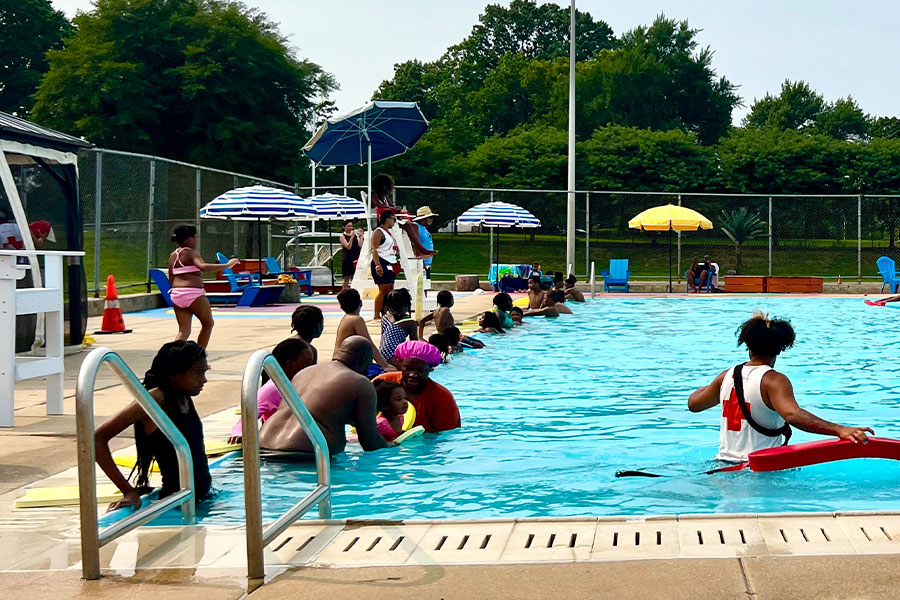
Trinity used to circle the edge of the pool at Hunting Park, close enough to feel the spray but never willing to go in. This summer, she is right in the water, taking swimm lessons.
Her mother, Ronnicia Davis, watched from the deck nearby. “Everything is so expensive right now, but the children need to go out and enjoy themselves and get some exercise,” she said. “This is where we are every day. This pool is clean, safe, and the staff and leadership are wonderful.” It was the staff, she said, who helped Trinity through her fear and coaxed her from the pool’s edge into the lessons.

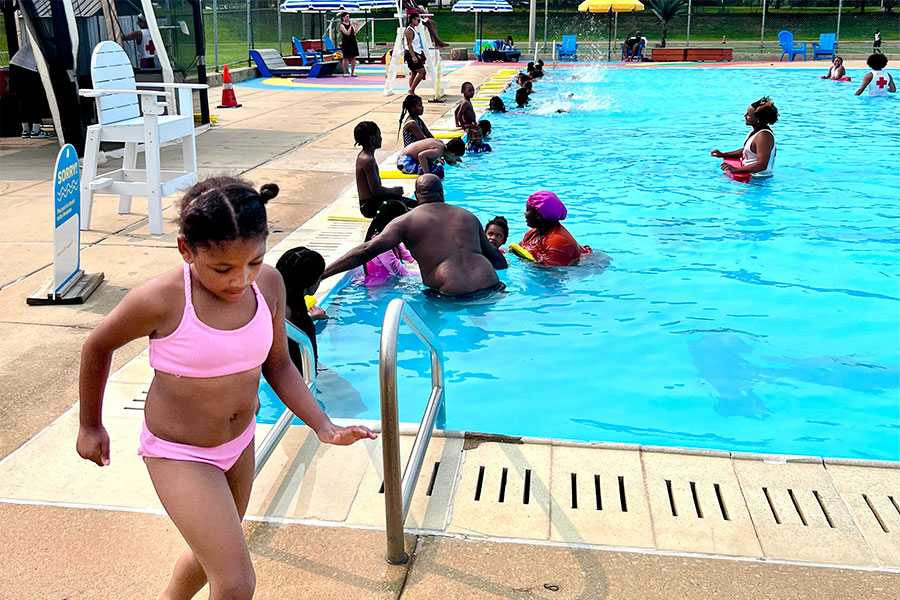
The pool, the second-largest in Philadelphia, is a cool blue oasis in the heart of Hunting Park Recreation Center, ringed by the time-tested trees and greenery of the 88-acre park, which is part of the city’s Parks & Recreation Department. It is open Monday through Friday, 11: a. m. to 7:00 p. m., and when temperatures climb above 90 degrees, the schedule opens to public swim all day.
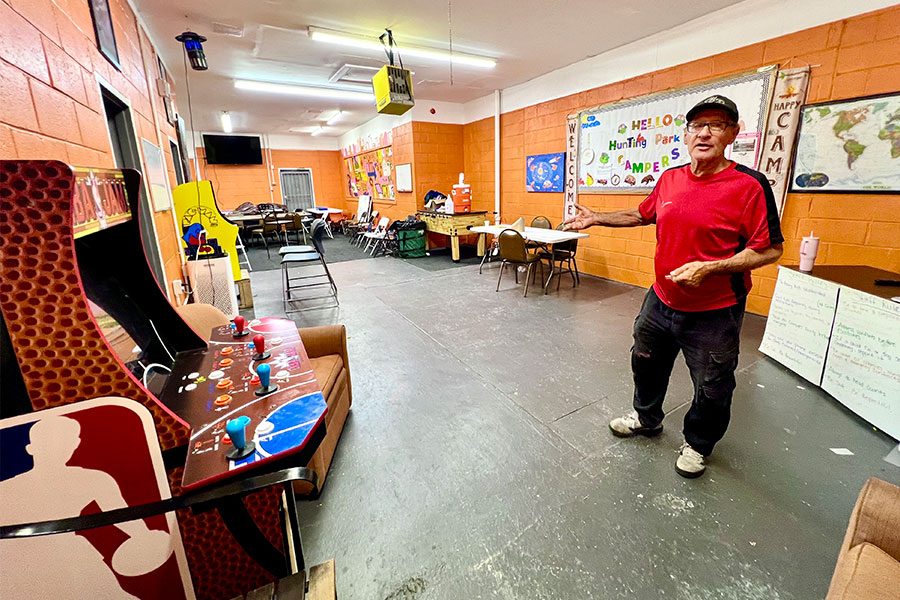
Greg Stepp, supervisor and Recreation Leader III, runs the programs at the recreation center and the pool, and helps run recreation-center baseball leagues across the city. John Molinari, president of the center’s Advisory Council, describes him as a welcoming, hardworking leader. Both men are at the pool every day, alongside Ms. Barbara, who runs the summer camp program with her staff and the pool maintenance attendants who keep the water and the pool house safe and clean. Outside of the pool area, an assigned police officer keeps watch, especially on hot days. This is one of the reasons parents call this pool a safe space.
The care of the Rec Center’s stewards shows in the details. The dedicated team took an old, stone-faced, abandoned concession building and refurbished it themselves — design and labor alike- into an air-conditioned workshop where summer campers build their projects. The building still lacks running water because the aging main is the city’s responsibility to repair, so for now the campers make do with the bathrooms in the main building.
In the mornings, the pool is reserved for summer campers, including guest campers from other recreation centers without a pool of their own. Boys and girls swim at separate times because the number of swimmers exceeds the pool’s 250-person capacity. Later in the day come adult and family swims, and swim lessons taught by the pool’s 11 lifeguards. During the recent heat wave, the pool became a center of rest for the neighborhood. “The problem was getting enough lifeguards,” Molinari said. “Greg was able to keep the number of lifeguards steady by implementing effective policies.”
The park has known harder days. Once part of the colonial estate of James Logan, William Penn’s secretary, the land became a public park on April 24, 1855, when Charles Henry Fisher and a group of citizens purchased the 88-acre tract and gifted it to the city by deed. For decades, it was a clean, safe place with a carousel and a wading pool. Then, as local industries departed in the 1960s, poverty and redlining took hold, and by the mid-1980s, the neighborhood and the park were plagued by crime, prostitution, and drug corners. During those times, it was difficult and dangerous to use the park. Today, reinvestment through the Fairmount Park Conservancy, Rebuild, and neighborhood organizations is restoring the park to the beautiful, safe space it once was, which is why, on any hot weekday, Trinity is back in the water. “I love to come here,” she chimed in, “and I ask my mom to bring me every day.”