


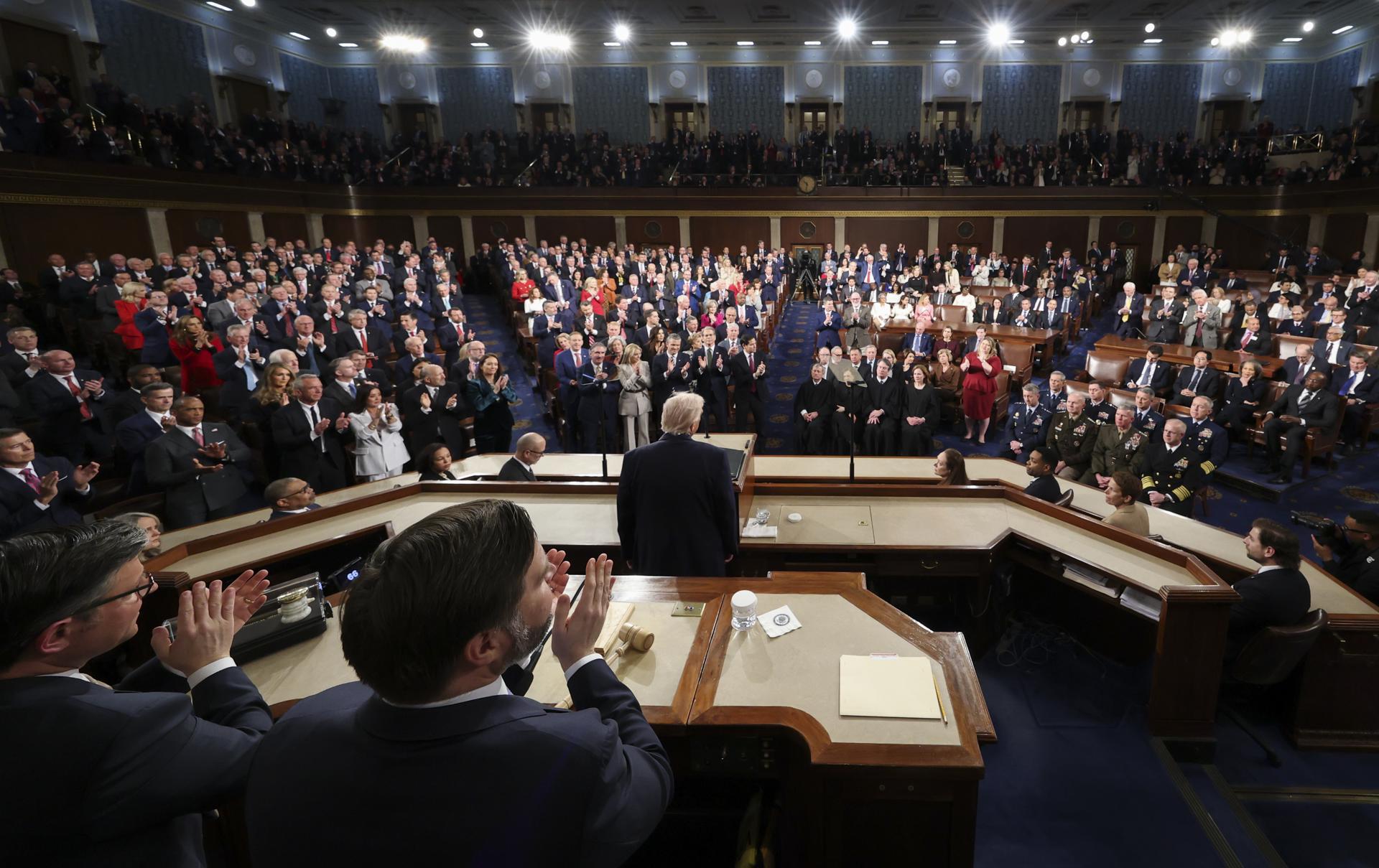
On the night of February 24, 2026, President Donald Trump stood before a joint session of Congress and spoke for one hour and 48 minutes — the longest State of the Union address ever delivered. Behind him, with bated breath, stood the American flag — its red, white, and blue still in its honored place in the chamber, a silent witness. Those colors asked nothing. They only watched and listened.
By the time Trump finished speaking, fact-checkers at ABC News, CNN, NPR, PBS, and FactCheck.org had flagged dozens of inaccurate or misleading statements. What many observers noticed, though, was not just what Trump said — but what he carefully avoided saying.
Throughout the speech, Trump used a familiar tactic: inviting heroes to the House chamber — veterans, a crime victim’s mother, Olympic athletes — and honoring them on camera. On the surface, it was emotional, but it also served another purpose. Each guest seemed to represent one of the most difficult issues facing the country, and by celebrating them personally, Trump could signal that he cared about those issues without ever having to explain his administration’s policies around them in any real detail.
Trump opened with news on the economy, saying it was «roaring like never before» and claiming he had inherited a «stagnant economy» from President Biden. Neither claim holds up well. According to FactCheck.org, the U.S. economy actually grew 2.5% or more every year under Biden. Under Trump’s first year back in office, growth slowed to 2.2% — lower than any year of the Biden presidency.
Job creation also slowed sharply. According to the Bureau of Labor Statistics, just 181,000 jobs were added in all of 2025 — compared to more than 1.4 million in Biden’s final year. The unemployment rate rose from 4.0% when Trump took office to 4.3% by January 2026. After-tax income, adjusted for inflation, grew only 0.9% in 2025 — down from 2.2% the year before.
Trump also claimed gas prices were as low as $1.85 per gallon in Iowa. GasBuddy, which tracks gas prices nationwide, found only four stations in Idaho selling gas at that price. The national average that day was $2.57 per gallon in Iowa and $2.95 nationwide — lower than when Trump took office, but nowhere near $1.85.
One of Trump’s boldest announcements of the night was that illegal immigration was now near zero. In fact, border crossings have fallen dramatically under his administration — from over 1.5 million encounters in 2024 to just under 28,000 in 2025, according to Customs and Border Protection, but Trump did not stop there. He used the story of Iryna Zarutska, a 23-year-old Ukrainian woman who was stabbed on a train in Charlotte, North Carolina, in August 2025, to claim she was killed by an undocumented immigrant released through open borders. According to NPR’s fact-check, local media reporting shows the accused attacker, DeCarlos Brown Jr., was born and raised in Charlotte and had spent time in and out of North Carolina jails. There is no evidence that he was an immigrant. Using the grief of real victims to support a false claim is troubling.
What Trump did not mention were the deaths that have occurred on the other side of his immigration crackdown. Since the beginning of 2025, multiple people — including U.S. citizens and legal residents — have died in ICE custody or during deportation operations, according to reporting by The Guardian and ACLU monitoring data. Among them, American-born children have been separated from their parents and, in at least one documented case, a U.S. citizen toddler was deported along with her mother. Justice stood in silence as those stories went unspoken.
Perhaps the most calculated move of the evening was Trump’s use of the guests seated in the chamber. Veterans were honored — yet Trump offered no plan for fixing the VA’s long-standing care backlogs. An Olympic athlete was celebrated — even as Trump’s foreign policy tensions with international allies have raised questions about America’s global standing. Supreme Court justices who attended the address sat stone-faced at the podium-level bench as Trump called their recent decision striking down key parts of his tariff agenda «unfortunate and disgraceful» — and then vowed to push ahead anyway.
And then there is Lady Justice — the ancient statue who stands blindfolded, holding her scales in perfect balance, sword at her side. She is blindfolded so that she cannot be swayed by who stands before her: rich or poor, powerful or forgotten. But if, just for a moment, she dared to peek — what would she see? She might see a president calling a Supreme Court decision disgraceful from the same podium where presidents have traditionally pledged to uphold the law. She might see detention centers where American citizens have been held by mistake, their rights stripped without a hearing. She might see the scales of her own balance tipped — not by evidence, but by executive orders signed before sunrise.
Democratic members of Congress who largely sat in silence or walked out argued the speech felt less like an honest accounting of the nation and more like a campaign rally. PBS News reported that a majority of Americans, in a poll taken just before the address, said the country was worse off than a year ago. Trump’s speech gave little acknowledgment of that sentiment.
Trump told the audience he had ended eight wars in his first ten months back in office. Fact-checkers at NBC News and FactCheck.org both noted that there is no consensus on how many wars Trump has actually ended. He claimed credit for a peace deal between the Democratic Republic of Congo and Rwanda — a deal that has since seen major violations, with Trump’s own senior adviser acknowledging ongoing violence. He also claimed credit for brokering a ceasefire between India and Pakistan. India has publicly denied that the U.S. played a role.
Donald Trump delivered an emotional speech that was, in many ways, factually unreliable. The record-breaking length did not translate into depth or clarity — but rather into accusations and insults, as Trump called Democratic members of Congress «crazy.» Hard topics were either glossed over or handled through the presence of a symbolic guest rather than through actual policy explanation. Tariffs, deportation deaths, the Supreme Court’s rebuke, and the rising cost of living — all were mentioned only in passing or not at all.
Nor did Trump shy away from the extraordinary. Recently, the president has openly flirted with the idea of serving a third term — a move that would require overturning the 22nd Amendment to the U.S. Constitution, which has limited presidents to two terms since 1951. The Constitution is not a campaign promise. It is the supreme law of the land — the very document that the flag in that chamber was sewn to represent.
For communities most affected by this administration’s policies — immigrant families, veterans, working-class Americans watching their grocery bills climb — the speech offered few answers. As a State of the Union, it was more of a state of mind: a portrait of a president who wants the country to feel that everything is fine, even when many of its own citizens are telling pollsters otherwise.
In the end, the American flag stood where it always stands — patient and unmoved. It, like the Constitution, has outlasted every president who has ever spoken beneath it. It does not cheer. It does not boo. It simply holds its colors and asks, in its quiet way, whether the words spoken in that chamber are worthy of the nation it represents. On the night of February 24, 2026, that was a question worth asking.