


In December 1959, I was a student at Palomar Community College in San Marcos, California. Thanks to the generosity of the college staff, I was able to travel back home to Las Animas, Colorado for Christmas.
Shortly after a scheduled stop at the Trailways San Diego bus station, the bus stopped again on the side of the road and two middle-aged border patrol men boarded the bus. Sitting on an aisle seat near the back of the bus, I saw them clearly. One of them spoke Spanish. “Sus documentos, por favor.” The other requested proof of American citizenship in English.
When they came to me, I presented my Palomar Community College student card that I had at the ready. “That is not proof of citizenship,” the border agent proclaimed, and then moved on to the Mexican man behind me. The Mexican man behind me had legal proof of United States residency. I knew they would soon return down the aisle. It was now dark outside, and I began to panic. What to do?
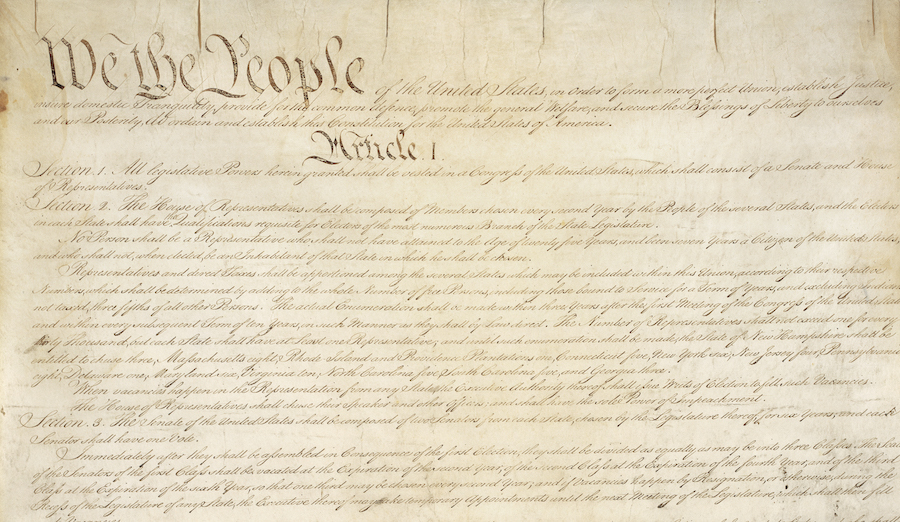
Then, somehow out of nowhere, I recalled that I knew the preamble to our constitution. A high school civics teacher had made my class memorize it. I found the words so beautiful in substance and meaning, because it captured who we were as a nation, “We the people…” that I often used to recite it along with the Ten Commandments as if it were a beautiful prayer. It was and is.
As I heard the border patrol returning down the aisle, I began to recite the preamble in a firm, confident voice so loudly that everyone on the bus could hear it. “We the people of the United States, in order to form a more perfect union, establish justice, ensure domestic tranquility, provide for the common defense, promote the general welfare, and secure the blessings of liberty to ourselves and our posterity, do ordain and establish this constitution for the United States of America.”
The border patrol officer loomed next to my seat as I finished. I turned to him and said, “Only an American citizen would know the Preamble to our Constitution, do you?” He scoffed and turned away. The officers exited the bus with a couple of men they had taken into custody. And so I was spared.
The white woman sitting next to me quietly said that I shouldn’t have asked the man if he knew the preamble. In retrospect, I was lucky the border patrol didn’t react in anger at my presentation of the preamble and pull me off the bus as well.
And now, so many decades later, how naïve my younger self seems, believing that the promises of the Constitution would necessarily be promises kept, or the ideals cherished by Federal officers who are supposedly sworn to defend the Constitution and enforce the law. My personal incident on that bus in 1959 still serves to remind me, that to be American is not defined by the color of our skin, by the language that we speak, our ancestry, or even our place of birth but our devotion and commitment to the vision of the Founding Fathers (and mothers) who championed a nation ever striving for greater justice and freedom and equality, a nation embracing diversity and respect for human dignity.
It is ironic, but not surprising, how the current administration violates daily the rights of not only illegal immigrants, but legal immigrants, and law-abiding citizens. And so it is now incumbent upon all of us, citizens and sojourners, refugees and tourists, to remember the Constitution, to proclaim the Constitution firmly, confidently, and loudly. Eventually, we will be heard.