


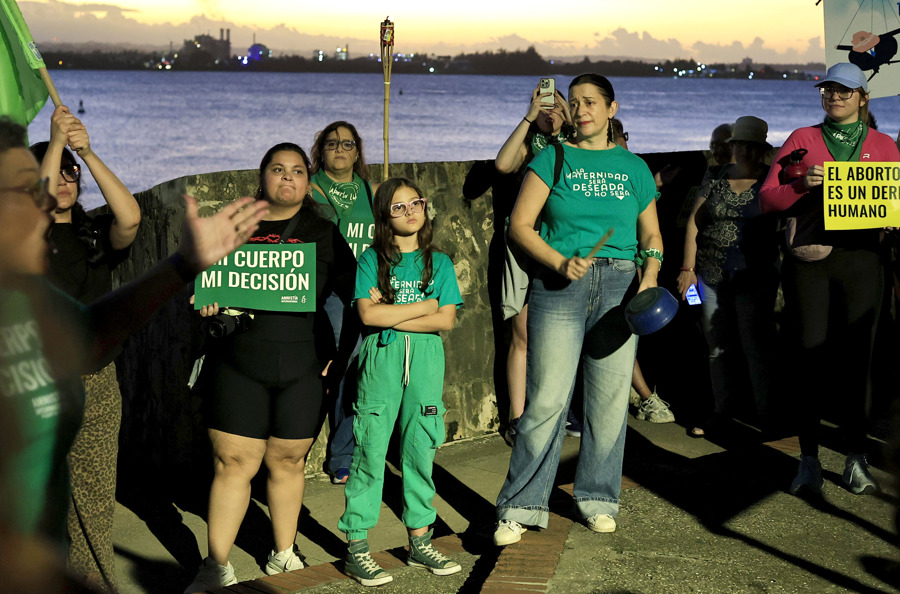
San Juan.— Feminist groups in Puerto Rico are mobilizing against a new law recognizing the unborn as a natural person, warning it could threaten abortion rights despite privacy protections.
The legislation was enacted this week by Governor Jenniffer González and has led to strong reactions from activists, legal experts, and medical professionals.
Alondra del Mar Hernández, an Afro-feminist lawyer and member of Aborto Libre Puerto Rico, said the law could become “a tool of manipulation” against women, particularly by men.
“This is going to be used as a mechanism of control,” Hernández told EFE, adding that the measure signals a move toward the “criminalization” of people who can become pregnant.
The law amends Puerto Rico’s Civil Code to clarify that a human being in gestation, including at any stage of pregnancy within the womb, is recognized as a natural person.
According to Hernández, this could allow the unborn to become beneficiaries of labor and property rights, including inheritance and donations.
Since the United States Supreme Court overturned Roe v. Wade in Jun. 2022, multiple bills seeking to restrict abortion have been introduced in Puerto Rico, though none had previously succeeded.
Legal experts stress that while abortion is no longer a federal constitutional right, it remains protected in Puerto Rico under the island’s constitutional right to privacy.
Parallels with restrictive US states
Patricia Otón, also a lawyer and member of Aborto Libre Puerto Rico, criticized the bill’s rapid approval without public hearings, saying it affects “multiple areas of law” without proper analysis.
“This kind of legislation already exists in several US states, particularly in the South, where abortion laws are most restrictive,” Otón said.
She cited Georgia’s LIFE Act, which grants legal personhood to the unborn, as well as similar statutes in Ohio and Texas.
Senator María de Lourdes Santiago of the Puerto Rican Independence Party (PIP) warned that the law is intended to “add another step on the path toward making women’s right to decide illegal.”
Before the law was signed, more than 320 doctors and healthcare professionals urged Governor González to reject the bill, warning it posed “a risk to the lives of women and pregnant people” by delaying urgent medical decisions.
Limited access and poor maternal care
Although abortion remains legal in Puerto Rico, Hernández noted that access is limited due to high costs and a shortage of clinics; only four exist, all located in the metropolitan area.
Mayra Díaz, director of the anti-racist organization Colectivo Ilé, said conditions for pregnancy and childbirth on the island are “terrible,” citing a lack of delivery rooms across many of Puerto Rico’s 78 municipalities, including Vieques.
“There is widespread obstetric violence,” Díaz said, referring to physical and psychological abuse during childbirth, a phenomenon recognized by the World Health Organization (WHO) since 2014.
Díaz criticized lawmakers for prioritizing punitive measures instead of policies that genuinely protect life. “Of all the things that could be legislated to defend life, they choose to continue criminalizing people who can become pregnant,” she said.