


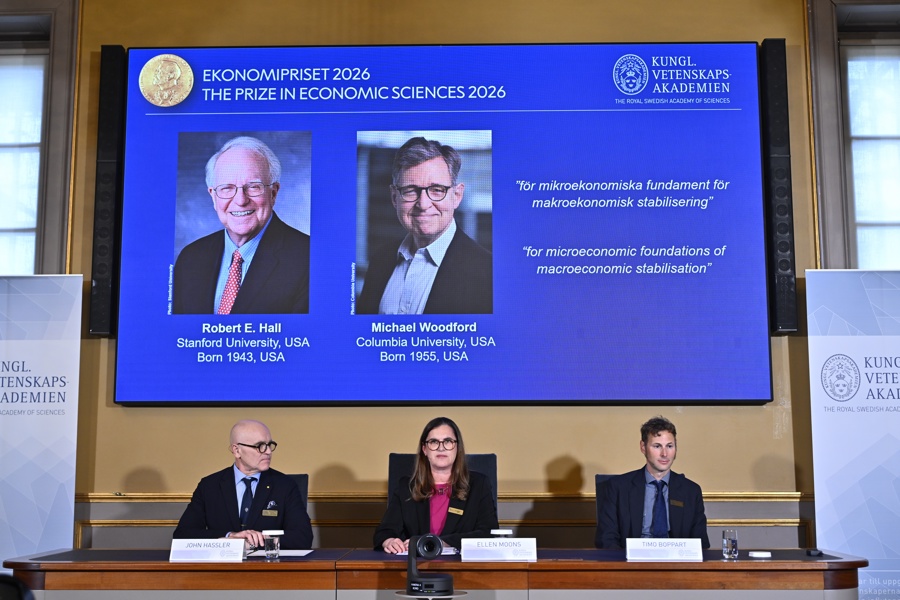
The 2026 Nobel Prize in Economics has been awarded to American economists Robert E. Hall and Michael Woodford for research to stabilize economies and manage financial crises, the Royal Swedish Academy of Sciences said Monday.
The economists were honored “for microeconomic foundations of macroeconomic stabilization,” according to the academy.
“This year’s Laureates (…) have developed new macroeconomic models that have significantly improved our ability to implement effective stabilization policy,” the statement said.
“On the basis of these models, well-timed fiscal and monetary policy measures can reduce the economy’s peaks and troughs.”
The models help explain how fiscal and monetary policies can reduce economic fluctuations, including recessions and periods of rapid expansion.
Their work laid the foundations for the New Keynesian paradigm, which builds economic models from the bottom up, using the decisions of individuals and businesses to explain broader economic trends.
Traditional Keynesian models relied largely on statistical and historical relationships between macroeconomic variables such as inflation, output and consumption.
New Keynesian models instead draw on microeconomic principles, marking a shift in how economists understand and design stabilization policies.
Hall’s research, published in a 1978 paper, argued that changes in consumption cannot be reliably predicted because they depend on new information that is itself unpredictable. His findings became a cornerstone of modern research into consumer behavior.
Woodford’s model has helped economists understand how policymakers can respond to shocks that disrupt the balance between supply and demand.
Such shocks can include raw-material shortages, technological advances that lower production costs, or changes in household spending driven by expectations about the future.
The models developed through their research allow economists to assess how stabilization policies influence economic cycles. Central banks and finance ministries worldwide now use them to guide policy decisions.
The academy said the research has helped governments respond more effectively to major economic disruptions, including the coronavirus pandemic and recent energy crises, limiting their long-term effects on economic growth and inflation.
Unlike the economic turmoil of the 1970s, these crises have not produced similarly lasting consequences, the academy said, adding that economies were not plunged into a catastrophic economic depression.
Recessions and episodes of high inflation have not disappeared, but they are less prolonged, it underlined.
