


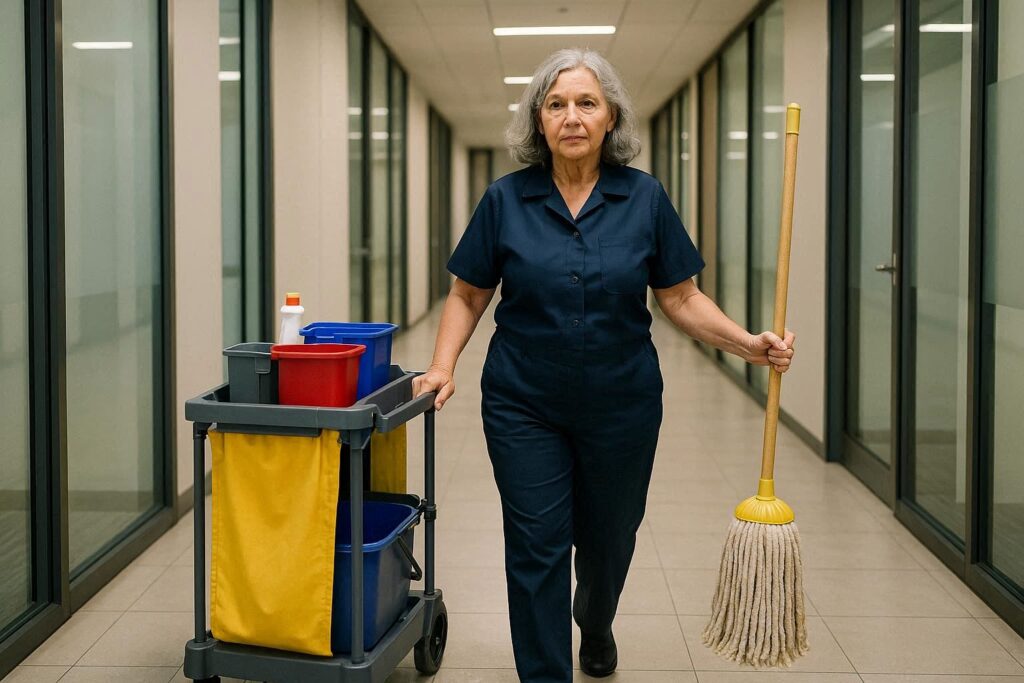
At 6 am, before the city wakes, Carmen Melendez is already on her feet. At 68, she moves through newly lit office corridors with a mop and supply cart, the hum of fluorescent lights overhead, the faint smell of industrial cleaner trailing behind her. She has been doing this kind of work for years — and she is not ready to stop. Not because she wants to, but because she cannot afford to.
Carmen began collecting Social Security benefits last year at the age of 67. Under federal law, she is permitted to work and receive benefits simultaneously, and for now, that combination keeps her afloat. Her benefit amount lands just above the limit for most public assistance programs — too much to qualify for help, not enough to feel secure. The rising cost of Medicare premiums, the co-pays that seem to grow each year, and the predictions about future benefit cuts have settled into her daily life like a low, persistent weight.
“If I stop working,” she says quietly, “I don’t know how I will keep going. My check covers the basics — barely — and with the constant rise in basic costs like rent, food, and utilities, I feel insecure about tomorrow. I’m afraid of what happens when my body says enough.”
Carmen’s story is not unusual. It is, in fact, a portrait of a crisis that is reshaping the economic landscape of the United States — one aging body, one underfunded benefit check, one vanishing safety net at a time. America is aging faster than its workforce can keep up. A convergence of falling birth rates, tightening immigration policies, and a surging population of retiring Baby Boomers is putting enormous pressure on Social Security and Medicare. This is not a crisis on the horizon. It is unfolding now.

The numbers don’t lie
According to U.S. Census Bureau projections, by 2030, all Baby Boomers will be 65 or older — meaning one in five Americans will be of retirement age. The population of Americans 85 and older, those who draw most heavily on public resources, is projected to triple to nearly 19 million. Meanwhile, the working-age population that funds these programs through payroll taxes is shrinking proportionally. The old-age dependency ratio — retired adults per 100 working-age adults — is projected to nearly double between 2020 and 2060.
Demographer Dowell Myers of the University of Southern California has warned that this imbalance will trigger not only fiscal crises in Social Security and Medicare, but serious workforce shortages as mass retirements deplete the labor pool. According to the Bureau of Labor Statistics, the retirement wave will significantly slow labor force growth over the next decade and beyond.
Social Security: Decades of accounting trouble
When Social Security was established in 1935, the retirement age was set at 65, at a time when average life expectancy for men was well below that. The program was designed, in part, on the assumption that a large share of contributors would never collect. That math has since inverted dramatically as Americans live longer.
For Carmen, the numbers are not an abstraction. A 21 percent cut to a check that already leaves little room would mean choices between medication and meals, between heat and rent. The retirement age has already been raised to 67 for those born after 1957, and proposals to push it to 68 or 70 continue to surface in Congress. For Latino and Black workers in physically demanding jobs — who already face shorter average life expectancies due to systemic health disparities — each incremental increase effectively prices them out of a benefit they spent decades paying into. For a woman whose work is written in her hands and her back, the idea of working another two years beyond 67 is not a policy debate. It is a physical reckoning.
The two-front demographic crisis
For generations, the U.S. had a reliable buffer: relatively high birth rates and steady immigration of young workers who paid into the system and raised the next generation of taxpayers. Both are now in decline. The fertility rate has fallen steadily since 2007. Net legal immigration has dropped nearly 58 percent from its peak, and current federal enforcement policies have accelerated that trend through increased deportations and narrowed legal pathways.
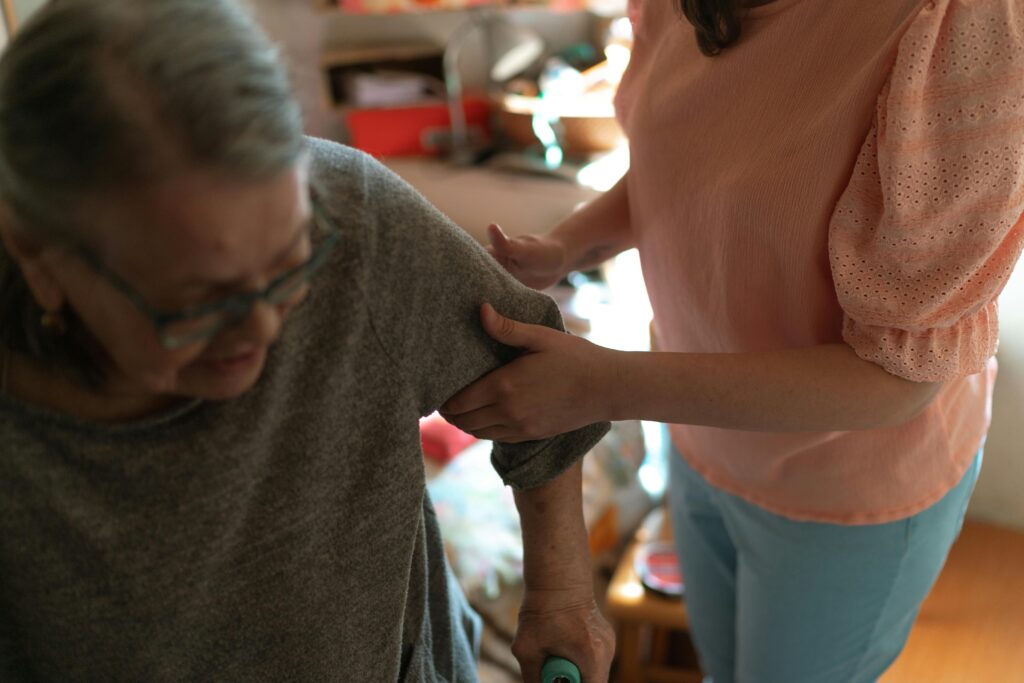
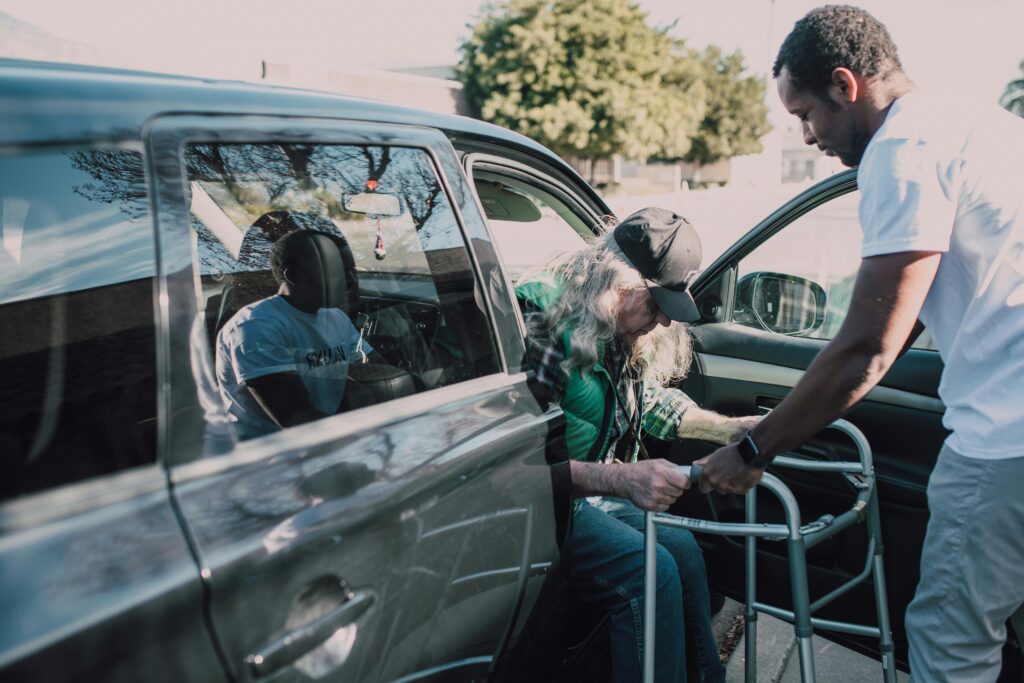
The consequences ripple across the entire economy. Fewer immigrants means fewer workers, less payroll tax revenue, a weaker housing market, and a shrinking pool of elder care workers to staff the facilities where millions of Boomers will need care. As the Census Bureau has noted, higher immigration levels directly increase the working-age share of the population — and under low-immigration scenarios, the dependency burden worsens substantially. The workers most likely to fill those caregiving roles, to clean the offices, staff the wards, and pay into the system, are precisely the workers now being pushed out.
Who in Washington is acting?
Some lawmakers are paying attention. Senator Bernie Sanders and Representatives Pramila Jayapal and Alexandria Ocasio-Cortez have advocated lifting the payroll tax cap so that high earners pay payroll taxes on income above the current ~$168,000 threshold. Moderate Republicans have backed targeted immigration reform for labor-shortage sectors, including agriculture, construction, healthcare, and elder care.
Others have proposed raising the retirement age further, cutting benefits, or moving toward partial privatization — solutions that would fall hardest on lower-income workers. The gap between these camps remains wide. The Population Reference Bureau projects that Social Security and Medicare expenditures will rise from 9.1 percent of GDP today to 11.5 percent by 2035. Without structural reform, that gap will be bridged by benefit cuts or debt.
A path forward
There is no single fix. But a combination of expanded legal immigration pathways, investment in family-support policies to stabilize birth rates, and retirement age policies that account for the physical toll of working-class labor would make the challenge manageable. For Philadelphia’s Latino community — young, largely immigrant, and deeply embedded in the caregiving and labor economy — these are not abstract policy debates. These workers fill the elder care facilities, staff the hospital wards, and pay the payroll taxes, keeping the system alive.
And then there is Carmen. Still mopping floors in the dark, still stretching her check to cover what Medicare does not, still arriving early so that the rest of us can walk into clean offices at sunrise. She is not waiting for Washington to figure it out. She is doing what she has always done: showing up, working hard, and hoping the system holds long enough to catch her when she finally has to let go.