


Every morning, Alicia Reyes walks her daughter past red-brick rowhouses to Overbrook Elementary — past the corner store, past the neighbor who waves from his stoop. Inside, teachers greet students by name. It is a school that knows its children. Reyes is not sure how much longer it will be there. Her school is on a list. So are nineteen others — elementary, middle, and high schools spread from Northwest Philadelphia to West and North — all flagged under the School District of Philadelphia’s long-term facilities plan. Officials say the proposal is about fiscal stewardship: consolidating underused buildings, reducing maintenance costs, and redirecting savings into modernized facilities and stronger programs. Plans are available here. Fewer buildings, they argue, means smarter dollars. For families, many of them low-income and Latino in neighborhoods already stretched thin, it sounds like something they have heard before.
District enrollment has dropped roughly 12 percent since 2014–15, falling to about 117,956 students in traditional and alternative schools this year. Buildings designed for full classrooms now absorb the echoes of half-empty hallways. The math, district officials say, no longer works. But the slide is not uniform. Hispanic and Latino enrollment has climbed steadily across the city, reshaping schools in Kensington, Hunting Park, and Fairhill. Spanish is now the most commonly reported non-English home language in the district. In communities where the student population is rising — not shrinking — a school closure is not a response to demographic reality. It is a collision with it. «It’s a question of priorities,» said Coretta Avery of Mount Airy, whose children graduated from Philadelphia public schools. «And every time there’s a question of priorities, it’s the same communities that lose.»
Whatever math the district applies to its buildings, it is doing so amid deepening federal instability. The federal government withheld nearly $7 billion in education funding expected to flow to states and districts — money tied to English learner programs, teacher development, and academic enrichment. Federal agencies later released some funds under legal pressure. Still, the disruption exposed a structural vulnerability: Philadelphia’s schools depend on grants that may not come from a federal government whose priorities lie elsewhere.
Meanwhile, nearly a third of the city’s public-school students attend charter or cyber charter schools, each of which draws per-pupil funding away from the district’s budget. The result is a city with too many partially empty buildings — some run by the district, some by charter operators — and a funding formula that punishes the district for empty seats regardless of why they exist.
The schools named in the district’s plan include Robert Morris, Samuel Pennypacker, John Welsh, Overbrook Elementary, and Fitler Academics Plus at the elementary level; Stetson, Warren G. Harding, and Russell Conwell among middle schools; and Lankenau, Paul Robeson, Motivation, Parkway Northwest, Parkway West, and Penn Treaty at the high school level.
Research on consolidation is sobering. Larger class sizes — the near-inevitable result of absorbing displaced students without equivalent staff increases — consistently correlate with weaker outcomes, especially for children navigating poverty, language barriers, or housing instability. For those students, disruption is not a minor inconvenience. It is an obstacle with lasting academic consequences. Philadelphia has been here before. When Germantown High School closed in 2013, the district assured families that students would land in stronger environments and the neighborhood would recover. «In the past, we were told that our children would benefit from consolidation,» said Melanie Rivera of Germantown, whose son was displaced in his final year. «He had difficulty adjusting. And the neighborhood never fully came back.»
At public hearings this spring, that history surfaced again and again. The Philadelphia Federation of Teachers has been explicit: investment, not closure, is what struggling schools require. Consolidation without adequate staffing is not reform — it is displacement dressed in the language of efficiency.
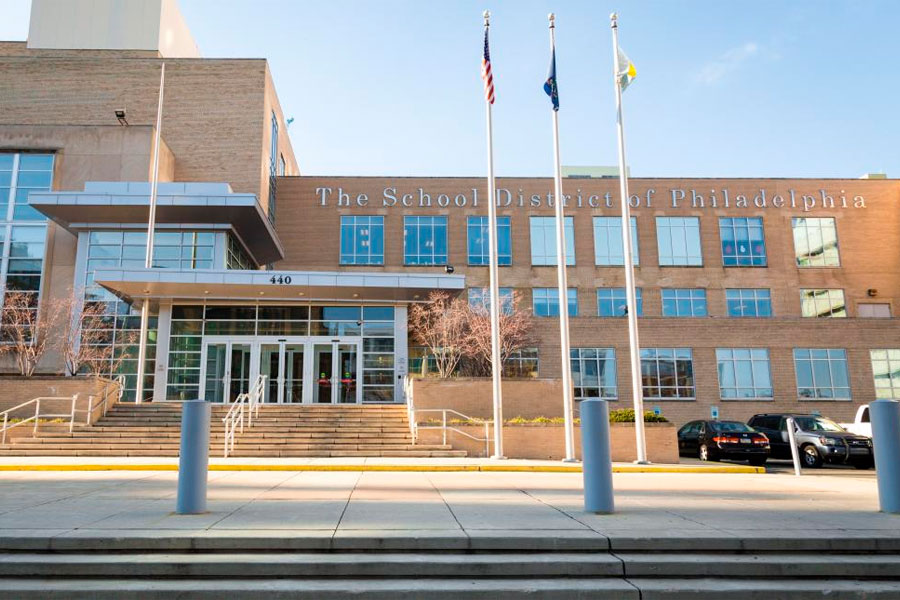
At 440 North Broad Street — the district’s administrative tower — officials will eventually decide which schools survive. The district headquarters is deliberately institutional, the architecture of systems rather than communities, but the schools are not just buildings; they are the sound of a hallway packed with children who know where they belong, the artwork on walls painted by former students. They are, and the cold January mornings when parents wait at the door because dropping off their child is one of the things the day still gets right. «We aren’t asking for miracles,» one parent told a packed hearing room. «Just for someone to say our children matter — and then show it.» The district says it is listening. The families say they have heard that before. What happens next — in budget negotiations and closed-door planning sessions far from the neighborhoods they will shape — will answer a question Philadelphia has been failing to answer for decades: Is public education in this city something its leaders are building, or something they are slowly winding down?